🚨New paper released today:
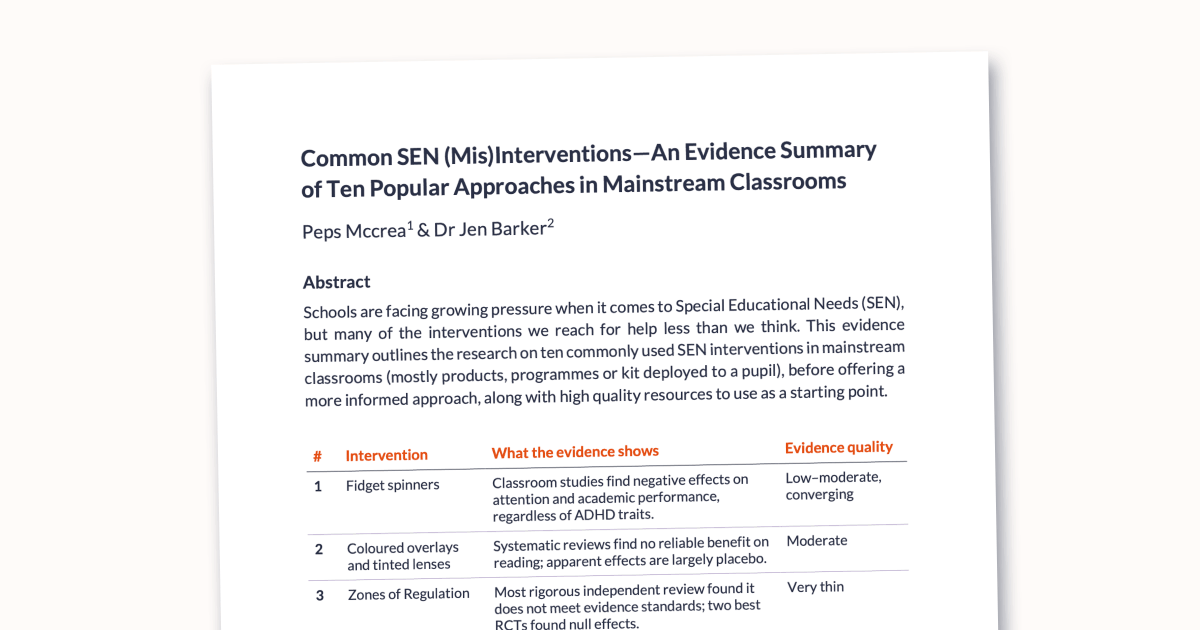
10 Common SEN Mis(Interventions)—An Evidence Summary
https://t.co/8lQNH00Co4
Supporting students with Special Educational Needs (SEN) is a vital and growing challenge for schools. But it’s not straightforward. Learning is complex, marketing claims are confident, and the evidence is often hard to access. As a result, we can sometimes end up adopting approaches which are less effective than we initially think.
For some, this may well be uncomfortable reading. As a profession, many of us have put time, effort and belief into these things, and lots will have seen students who looked like they were getting something from it. However, it’s essential that we temper our intuition with evidence, because ultimately: our most vulnerable students deserve it.
This new paper co-authored with @Barker_J is an attempt to raise the visibility of the best available evidence around several commonly used SEN interventions. For each, we provide an overview of what the research says, offer a more informed approach, and provide a suite of rigorous links to help you get started.
We hope it will serve as a useful resource and over time: push us to be even more 'evidence demanding' as a profession.
As ever, let me know what you think. If you have pushes or suggestions for how this paper could be better, hit reply and give it to me straight.
👊
NEW ARTICLE:
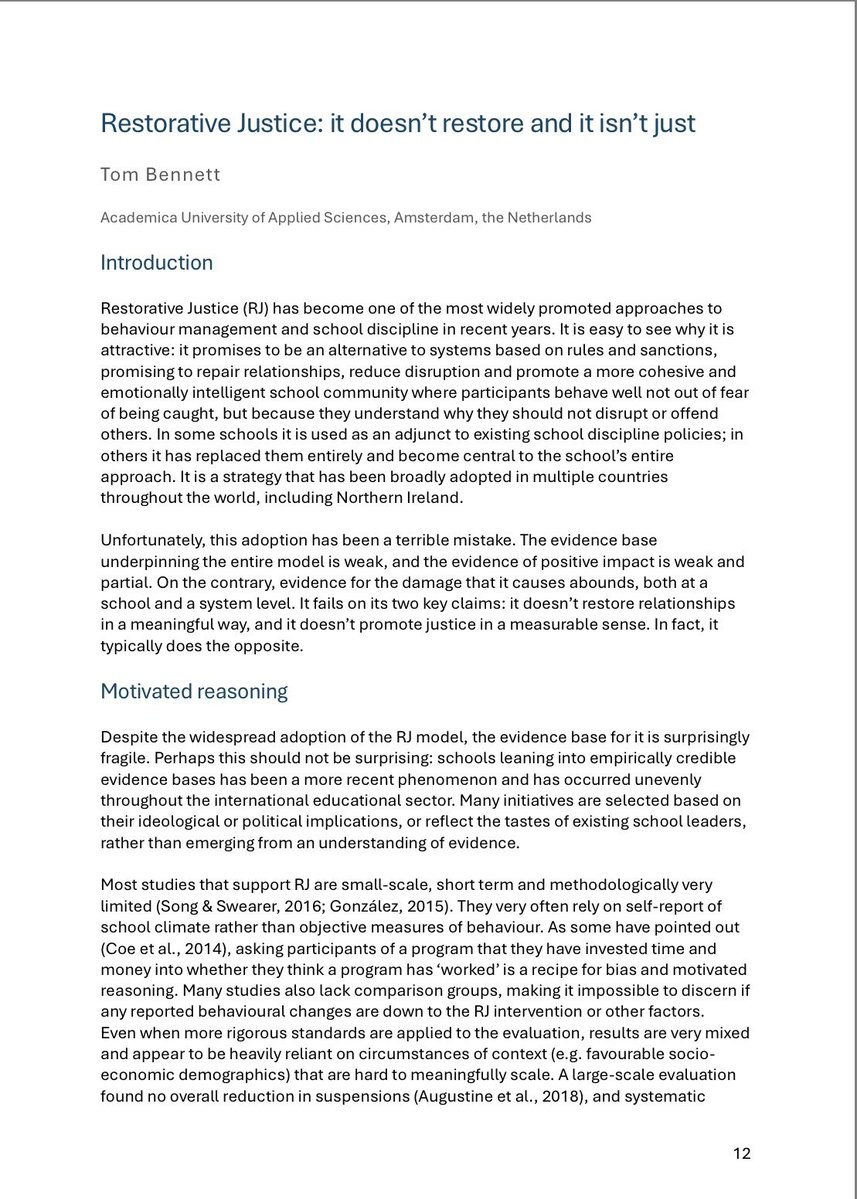
Restorative justice- it doesn’t restore and it isn’t just. Apart from that, I like it.
My article in @Education_NI latest quarterly. Link below.
The curriculum is not a mirror. It’s a selection.
If we replaced An Inspector Calls, the case for doing so shouldn’t be representational optics but literary and curricular merit. Still, it’s striking how many plausible alternatives exist. What stops us is expedience.
https://t.co/gZLqGuuQnN
When things go a little sideways during my lessons, it’s usually not my students’ working memory getting overloaded. It’s mine.
Too many decisions. Too much to manage in the moment. It’s like a tidal wave you can feel building in your brain. But…
Offloading in advance, “proceduralizing” as much of a lesson as possible, and maintaining consistent routines has made a huge difference for my cognitive load—and by proxy has improved student outcomes.
Here’s how I optimize my own cognitive load. 📖🧠👇
Does teacher centred teaching reduce inequality?
Yes according to this study. Explicit instruction is associated with higher mathematics attainment for low SES pupils, while student centred instruction shows no such equity effect.
Takeaways: if the goal is to reduce inequality in mathematics outcomes, structured, explicit, teacher led approaches may provide a stronger academic return for pupils from less advantaged backgrounds.
Both approaches were equally distributed across SES groups. The difference lay in outcomes.
Student centred teaching is not automatically more equitable. In some contexts, it may simply advantage those who already possess background knowledge.
https://t.co/5ea8PWFkuI
All children deserve good teaching. Some need it more than most. If support replaces thinking, it isn’t support.
Our aim must be independence.
Link below 👇
Classrooms should never be places of political indoctrination, even when it’s a cause you really, really believe in. Perhaps especially then, because you’ll be more likely to be blinded to the need not to proselytise.
Always consider: would I be happy with someone with the *opposite* political perspective doing the same to a group of children? To your own children ?
The usual response to this is the ‘everything is political; you can’t be truly non political’ but that bland truth misses the obvious point: there is an ocean of difference between nothing and everything. We should always try to minimise our biases. I taught RS, and political philosophy, and my students used to say they couldn’t tell my faith or politics. That’s what I was aiming for.
Professional scepticism is the disciplined habit of slowing down unscrupulous optimism before it does damage.
Before rolling out the next shiny policy, ask:
- What problem are we solving?
- What would show this is wrong?
- What will we stop doing if it fails?
Good schools don’t implement ideas before they are tested.
Link below ⬇️
Growth Mindset update: In 19 countries, mindsets showed no association with achievement; in five countries, students with fixed mindsets actually outperformed those with growth mindsets.
https://t.co/Ruca6f8M4C
We have a webinar for teachers in Aus & NZ on 2 Dec.
You'll take part in some live Comparative Judgement of real students' writing, & see if you agree with the AI!
We will also share details of our national assessment projects which DECIMATE workload!
https://t.co/niqvey0Rjr
The science of learning isn't about prescriptions, it's about probabilities. And this is where knowing the boundary conditions of any principle matters so much. Knowing when not to use it can be as important as knowing when to.
This is my problem with every lesson starting with retrieval practice "because science".
A principle applied everywhere becomes dogma; a principle applied within its limits increases the probability of it being effective, because it honours the conditions that make it work in the first place.
Retrieval practice is a key driver of learning but there are a lot of contexts where retrieval might be counterproductive: introducing new concepts or when prior knowledge is insufficient to make retrieval attempts meaningful rather than random guessing.
The boundary conditions matter precisely because they reveal the mechanisms underlying the effect. Retrieval practice works through the effortful reconstruction of knowledge from memory, which strengthens retrieval pathways. But if there's nothing meaningful to retrieve, or if the retrieval demands exceed working memory capacity, the mechanism breaks down. The practice becomes ritual rather than science.
Interleaving benefits discrimination between similar concepts, but becomes less valuable when categories are already easily distinguishable. Spacing enhances retention through forgetting and relearning, but may hinder initial acquisition when foundational knowledge is still forming.
Senior leaders saying "use retrieval practice when learners have established some initial knowledge of the material, when the cognitive demand matches their capacity, and when errors can be corrected through feedback" is less compelling than "start every lesson with retrieval practice." The nuanced version requires professional judgment; the simplified version offers algorithmic certainty.
This is where we need to move away from "what does the research say" but "under what conditions does this research apply/not apply to my context and how can I apply it?"
New Zealand's government is pushing for knowledge-rich curriculum & teaching methods grounded in cognitive science.
It's still a work in progress, but things look promising.
More in my latest Substack post:
https://t.co/ht2B224eb1
Explicit Direct Instruction in Sports. A long-ish🧵:
One of the consistent findings of CogPsych is that while discovery learning can be effective for experts, direct instruction benefits novices.
Youth coaches often overlook this & assume...