Two economists just published a mathematical proof that AI will destroy the economy.
Not might. Not could. Will — if nothing changes.
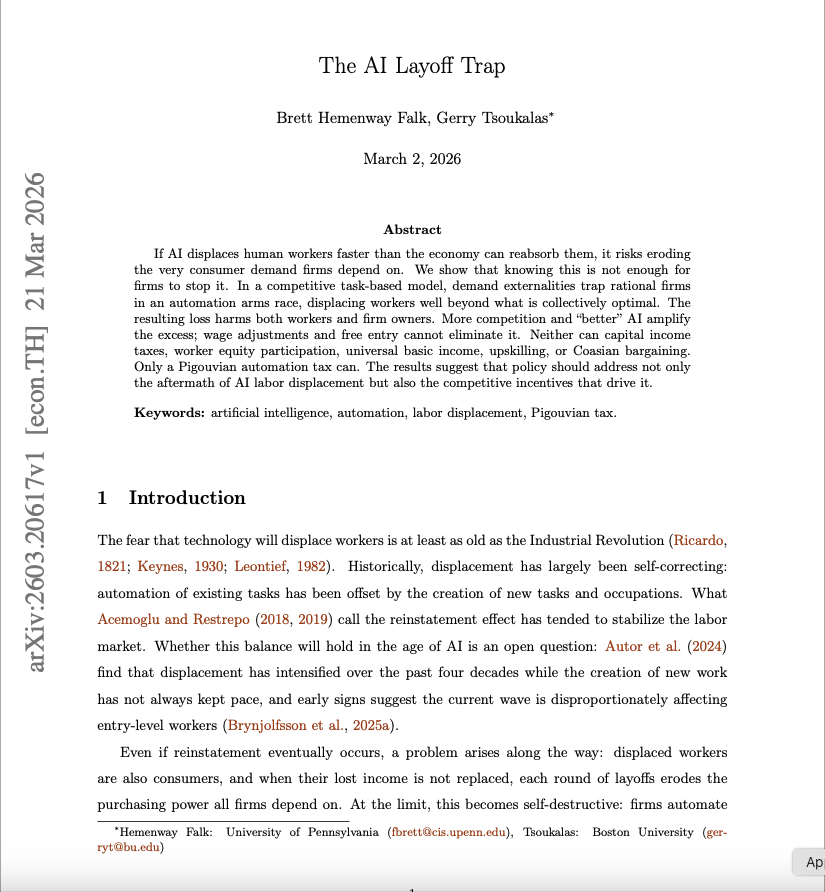
The paper is called "The AI Layoff Trap." Published March 2, 2026. Wharton School, University of Pennsylvania. Boston University. Peer reviewed. Mathematically modeled.
The conclusion is one sentence.
"At the limit, firms automate their way to boundless productivity and zero demand."
An economy that produces everything. And sells it to nobody.
Here is how you get there.
A company fires 500 workers and replaces them with AI. A competitor fires 700 to keep up. Another fires 1,000. Every company is behaving rationally. Every company is following the incentives correctly. And every company is building a trap for itself.
Because the workers who were fired were also customers.
When they lose their jobs faster than the economy can absorb them, they stop spending. Consumer demand falls. Companies respond by cutting costs — which means automating more workers — which means less spending — which means more falling demand — which means more automation.
The loop has no natural exit.
The researchers tested every proposed solution. Universal basic income. Capital income taxes. Worker equity participation. Upskilling programs. Corporate coordination agreements.
Every single one failed in the model.
The only intervention that worked: a Pigouvian automation tax — a per-task levy charged every time a company replaces a human with AI, forcing them to price in the demand they are destroying before they pull the trigger.
No government has implemented this. No major economy is seriously discussing it.
Meanwhile the numbers are already tracking the curve. 100,000 tech workers laid off in 2025. 92,000 more in the first months of 2026. Jack Dorsey fired half of Block's workforce and said publicly: "Within the next year, the majority of companies will reach the same conclusion."
Nobody is doing anything wrong. Companies are following their incentives perfectly. That is exactly the problem.
Rational behavior. At scale. Simultaneously. With no mechanism to stop it.
Two economists built the math. The math leads to one place.
Source: Falk & Tsoukalas · Wharton School + Boston University ·
Thank you to jockey @jose93_ortiz & trainer @reredevaux for throwing out today’s ceremonial first pitches!
This past Saturday, Golden Tempo was victorious at the 152nd running of the @KentuckyDerby, becoming the first-ever female-trained horse to win the race 🏇🙌
Nvidia just figured out how to put an AI data center on the side of your house. And pay you to host it.
Each XFRA node packs 16 Blackwell RTX Pro 6000 GPUs, 4 AMD EPYC CPUs, and 3TB of RAM in a Dell PowerEdge rack mounted next to the AC condenser. The homeowner pays nothing for the hardware. They get discounted electricity and internet in exchange for letting Span tap unused capacity on their electrical panel.
This sounds insane until you look at the actual constraint blocking AI infrastructure.
Hyperscalers are not GPU-limited. Nvidia ships them on schedule. They are not capital-limited. They are sitting on hundreds of billions in capex. What they cannot get is grid interconnection. A 100MW data center requires a substation upgrade that takes 4 to 7 years in most US markets. US grid operators have over 2,600 gigawatts stuck in their interconnection queues per Lawrence Berkeley Lab. The wait, not the silicon, is the bottleneck.
Span solved this by going behind the meter.
A new Pulte home has 200A service. That's 48kW of capacity. The home uses 1 to 3kW most hours. The headroom never gets touched. Span's smart panel measures real-time consumption and dynamically routes whatever the home isn't using to the XFRA node. No substation upgrade. No queue. Just slack capacity sitting on the residential side of the meter, already cleared.
Span claims it can deploy 8,000 nodes for one fifth the cost of a comparable 100MW centralized facility, six times faster.
PulteGroup is the wedge. They delivered 29,000 homes in 2025. The XFRA unit goes in during construction next to the smart meter. No retrofit. Pulte gets a feature on the spec sheet and revenue share on the compute that flows through the wall.
The grid was the bottleneck. Pulte just became the workaround.
For the first time in 152 years — HISTORY IS MADE!!!
Trainer Cherie DeVaux watches Golden Tempo and Jose Ortiz get up at the wire to win the Kentucky Derby at odds of 23-1.
🎥: Reaction footage owned by America’s Best Racing.
@reredevaux | @jose93_ortiz | @PhippsStableFan
Warren Buffett, in his first sit-down since stepping down as Berkshire CEO, gave the cleanest indictment of legalized gambling in a decade. He called it a tax cut for the wealthy. The math proves him exactly right.
Americans wagered $165 billion at legal sportsbooks in 2025. They lost $16 billion of that. FanDuel pulled $6 billion of the losses. DraftKings pulled $5.3 billion. Every state with legal mobile sports betting collected a tax on the bettor side. New York alone took in over $1.2 billion in 2025 sports betting tax revenue.
Layer the lottery on top. State lotteries generate over $90 billion a year. The bottom half of income earners account for roughly 70% of total spend. The average lottery player makes $38,000. A household earning $20,000 spends three times more on tickets than one earning $30,000. The implicit tax rate, meaning whatever the state keeps after prizes, runs 30 to 50% depending on the game. No other revenue source in America has that base and that rate.
The structural design is the engine. A single straight sports bet carries a hold of 4 to 5%. A four-leg parlay carries a hold above 30%. FanDuel and DraftKings spent five years rebuilding their apps to make parlays the default product. FanDuel's blended hold rate hit 11.4% in 2025, up from roughly 7% in 2022. The product got worse for the customer and the customer wagered more anyway.
Now look at the substitution. Nine US states have no state income tax. Seven of those nine run state lotteries. Seven of those nine have legalized sports betting. The states most committed to never taxing wealth are the same states running the largest extraction machines on people who cannot afford to lose. Read it as policy.
Here is what Buffett is actually pointing at. The state needs revenue. It can raise income tax on the top decile, or it can run a lottery plus a sports betting tax. The second option raises the money from the people who can least afford it. The first option becomes politically optional. New York's $1.2 billion in 2025 sports betting tax is $1.2 billion the state did not have to ask of someone earning $5 million.
DraftKings and FanDuel sell a privatized collection mechanism for a regressive tax that the state never has to defend at the ballot box again. Voters approve legalization once. Collection runs forever. The state takes a cut. The wealthy get a quieter top bracket. The bettor's cut shrinks every quarter as the parlay menu gets pushed harder.
The function of a government, Buffett said, is not to play its people for suckers.
Thirty-nine state governments now do.
🚨A 25 YEAR OLD BUILT THE FASTEST GROWING SOFTWARE COMPANY IN HISTORY.. WITH ZERO MARKETING SPEND.. AND SPACEX JUST OFFERED $60 BILLION TO BUY IT..
His name is Michael Truell.. He started coding at 11.. Interned at Google at 18.. Dropped out of MIT to start a company that built AI tools for mechanical engineering..
That company failed..
So he pivoted.. And built Cursor.. An AI-powered code editor that writes software for you..
Here's how fast it grew..
$100 million in annual revenue in 12 months.. Fastest in SaaS history.. Broke every record ever set by Slack, Zoom, and Wiz..
$500 million by month 21..
$1 billion by November 2025..
$2 billion by February 2026..
Projected to hit $6 billion by end of year..
Zero marketing spend.. Not a single dollar.. Pure word of mouth from developers who couldn't stop talking about it..
Over 1 billion lines of code accepted per day.. Used by 70% of Fortune 1000 companies.. Every single one of Nvidia's 40,000 engineers uses it.. Coinbase hit 100% adoption among their developers..
And he did this with a team of four MIT co-founders.. One of them was a three-time International Math Olympiad competitor from Pakistan.. Another was a college squash captain with zero startup experience who built the entire product strategy..
They spent zero on sales.. Zero on ads.. Zero on growth hacking.. The product sold itself..
But here's where the story takes a turn nobody expected..
Even at $50 billion valuation.. Even generating billions in revenue.. They hit a wall..
Not a market wall.. A physics wall..
They couldn't get enough GPUs to train their next AI model.. The physical chips didn't exist in sufficient quantities for them to buy.. Money couldn't solve the problem..
Enter Elon Musk..
On April 21.. SpaceX announced a deal to potentially acquire Cursor for $60 billion.. The largest acquisition option in tech history..
The structure is insane..
SpaceX gives Cursor immediate access to Colossus.. xAI's supercomputer equivalent to one million Nvidia H100 GPUs.. For nine months of joint development..
At the end.. SpaceX can buy the company for $60 billion..
If they don't buy it.. They owe Cursor a $10 billion breakup fee.. The largest breakup fee in corporate history..
Think about what that means for Cursor..
Either they get acquired for $60 billion.. Or they walk away with $10 billion in cash and nine months of free training on the most powerful supercomputer on earth..
There is no losing scenario..
And here's why Musk wants it..
SpaceX is preparing for an IPO at $1.75 trillion.. The biggest IPO ever.. But aerospace alone can't justify that number..
By merging xAI into SpaceX.. And now acquiring Cursor.. Musk transforms SpaceX from a rocket company into an AI empire that owns the compute, the models, and the developer tools..
Cursor is the missing piece.. The application layer that puts xAI's models into the daily workflow of every Fortune 500 engineering team..
Oh and one more thing..
In 2022.. FTX's trading firm Alameda Research made a seed investment in Cursor.. During the FTX bankruptcy.. Liquidators sold that stake for $200,000..
That stake is now worth approximately $3 billion..
Sam Bankman-Fried called it the worst liquidation decision in venture capital history.. From a prison cell..
A failed mechanical engineering startup.. Pivoted by four kids from MIT.. Zero marketing.. Zero sales team.. Built the fastest growing software company in history..
And now SpaceX is writing a $60 billion check for it..
This is the most insane founder story in Silicon Valley history.. And most people haven't even heard of Michael Truell.
🇩🇪 A Czech millionaire hit 414 km/h (257 mph) in his Bugatti Chiron on the Autobahn and walked away without charges.
German prosecutors investigated, then dropped the case, ruling the early morning run on a near-empty stretch posed no proven danger to others.
If you want to legally do the same, start looking at apartments in Germany, the only place on Earth where this is allowed on public roads.
Congratulations to Hall of Fame driver David Miller for eclipsing another milestone in 2026, this time for 15,000 wins. #harnessracing
Presented by @WinbakFarm
Amazon just got caught running a secret price manipulation operation with Levi's, Home Depot, Walmart, and many more.
Every time you "comparison shopped" online, you were looking at prices that were already rigged.
Here's what happened:
Amazon would monitor prices on Walmart, Target, Best Buy, Home Depot, and Chewy in real time. The second a competitor listed a product cheaper than Amazon, they'd contact the brand directly and tell them to "fix it."
And the exact emails are now PUBLIC.
Amazon sent Levi's links to two Walmart listings with the subject line "styles of concern." They basically said the prices on Walmart are too low and we have a problem.
The next day, Levi's responded: "I talked to Walmart and they have partnered with us to take Easy Khaki Classic fit back up to ladder SPP price, $29.99 immediately."
Levi's literally called Walmart and told them to raise the price. Because Amazon told Levi's to make the call.
Walmart complied. Then Amazon matched the HIGHER price.
Both retailers ended up charging more. The customer paid extra. Nobody competed.
Same playbook with Hanes:
Amazon sent them links showing Target and Walmart prices were lower. Hanes confirmed they "reached out to Target and Walmart to have the prices increased."
Target increased the prices. Walmart increased the prices. Amazon kept their margins.
But it gets even worse...
Amazon told Allergan (the company that makes eye drops) that their product was "suppressed" on Amazon because it was cheaper on another site.
Allergan responded: "Walmart got their price back up to $16.99." Amazon then unsuppressed the listing.
They did this with pet treats on Chewy. Furniture on Home Depot. Products across dozens of categories spanning YEARS.
The mechanism is simple but terrifying:
If you're a brand and you sell cheaper on Walmart than on Amazon, Amazon suppresses your product, removes you from the Buy Box, buries you in search results, and effectively makes you invisible to 300 million customers.
Brands can't afford that. So they call Walmart and Target and say "raise your prices or we'll lose our Amazon listings."
Walmart and Target comply because they need the brand's products.
Amazon captures 40 cents of every dollar spent online in America. That gives them the leverage to set prices across THE ENTIRE internet. Not just their own platform.
So turns out, you were never comparison shopping.
You were looking at a coordinated price floor set by Amazon through backroom phone calls between brands and their competitors.
"Amazon is working to make your life more unaffordable."
3 separate antitrust trials are now scheduled for 2027. The FTC has its own case. 18 states plus the DOJ are piling on.
This is literally happening during the WORST affordability crisis in a generation. Groceries up 25% since 2020. Housing unaffordable. Wages flat.
And the largest ecommerce company on Earth has been secretly coordinating with brands to make sure you can't find a cheaper price ANYWHERE.
"Competition" in retail is just a fantasy.
The hate in the comments is hilarious. He was patient with most inane “golly gee” questions. I don’t know how he sits through it and doesn’t get distracted from chase of the prize. Sure he has privilege! All golfers in top echelon would have similar perks available to them (jet, access to course etc). Only problem I had with presser was shitting on the lead up tourneys. Think it. Don’t say it. 😏
Ahora sí hablemos en serio de la foto. Este es un trino para interesados en fotografía, astrofotografía y el que quiera ¿Por qué esta foto es increíble? Algún conspiranóico, dándoselas de suspicaz, preguntó que por qué esta foto tomada por el comandante del Artemis II se veía más opaca que la foto tomada por la tripulación del Apolo 17 en 1972. Bueno. Acá viene lo emocionante. Esta fotografía hubiera sido imposible tomarla con una cámara análoga; y no cualquier cámara digital puede tomarla. El archivo original de esta foto está disponible para su descarga en la página de la NASA. En las propiedades del archivo se puede ver con qué cámara fue tomada y los ajustes de exposición que se usaron. Hasta el serial de la cámara. Esto, primero que todo, garantiza que la foto que estamos viendo no fue creada digitalmente, ni con IA, sino capturada por una cámara real por un humano. Sé que no es suficiente argumento para los conspiranóicos, pero ni modos. Esa que está ahí es la Tierra. Ahora sí lo interesante. ¿Por qué se ve como más opaca que la del 72? porque resulta que en la cara de la tierra que vemos en esa foto, está de noche; si hacen zoom pueden ver el brillo de la iluminación nocturna. Pero ¿cómo, si es de noche, puede verse como si fuera de día? Porque la foto se hizo con un altísimo ISO de 51200! El ISO es la sensibilidad del sensor a la luz. Con la mayoría de cámaras digitales, con ISOs de más de 6400, el ruido es tanto que la foto se ve prácticamente ilegible. Pero la cámara que tiene el comandante Reid Wiseman es una NIKON D5, que no es una cámara muy nueva; tiene 10 años de haber sido lanzada. Pero su sensor es reconocido por garantizar una calidad decente de imagen con ISOs altos. Y eso, para los que siempre preguntan cómo se hace una buena foto del cielo, es fundamental ¿Por qué? Pues para poder tomar fotos de los astros sin tener que bajar mucho la velocidad de exposición. Porque si bajas mucho la exposición apra que entre más luz, queda capturado el movimiento de los astros y de la rotación de la Tierra, cuando estás en la Tierra. Así que un iSO tan alto hizo posible que Wiserman pudiera disparar a una velocidad de 1/4 de segundo. Que es baja, pero no tanto. Es digamos, el límite para la astrofotografía. Por eso esta foto tiene ruido, porque de todas formas es un ISO altísimo.
Pero lo que más me emociona a mí, es que la tomó con un lente 14 -24mm F2.8. Es decir, en terminos coloquiales, que esta foto no tiene zoom. Para que lo dimensionen: cuando uno quiere tomar una foto de la Luna desde la Tierra que salga así de "cerca" tiene que usar un lente de unos 400mm de distancia focal. Wiserman usó un ¡gran angular de 22mm! Es decir que él estaba viendo la Tierra asi de grande frente a sus ojos. Porque la foto no fue recortada en edición y eso lo sabemos porque en las propiedades del archivo siempre aparece cuando una foto fue editada. El archivo está limpio, tiene la resolución original de la cámara. La tierra era inmensa frente a su mirada. Hermoso.
Pero para mí lo más mágico de esta foto, incluso más que las auroras boreales, es que se ve como la luz de sol, que está del otro lado de la tierra, ilumina nuestra atmosfera. Y eso es magia pura, porque esa atmosfera tiene una composición milimétricamente perfecta para permitir que la vida, tal y como la conocemos, sea posible. Esta foto, es un regalo precioso para la humanidad.
Les dejo al link para que descarguen la foto en alta resolución y el pantallazo de las propuedades del archivo.
Christina Koch was a firefighter at the South Pole at -111°F before she ever applied to be an astronaut. That was maybe the fourth most interesting line on her resume. She grew up in North Carolina, got three degrees from NC State, and her first real job was building deep-space instruments at NASA.
Then she left for Antarctica. Spent three and a half years bouncing between the Arctic and Antarctic as a research scientist, including a full winter at the South Pole base. That means going months without sunlight or fresh food, with a crew of about 50 people and no way out until flights resume. While she was down there, she also joined the glacier search-and-rescue team.
After coming back, she went to Johns Hopkins and built instruments for two NASA missions (one of them is still orbiting Jupiter right now). She figured out how to start a tiny vacuum pump that NASA designed for a future Mars rover. Johns Hopkins nominated it for their Invention of the Year in 2009. Then she went back to the field. More time in Antarctica and a stretch up in Greenland. A government research station in northern Alaska, near the top of the world. Then she ran another one in American Samoa, near the equator.
In 2013, NASA selected her from 6,300 applicants. Eight people got in. Her first space mission was supposed to be a normal rotation on the International Space Station, but NASA extended it. She ended up staying 328 straight days and orbiting Earth 5,248 times, covering about 139 million miles (roughly 291 round trips to the Moon). Up there, she ran over 210 experiments, including tests of cancer drugs in zero gravity and 3D printers that can build structures close to human tissue. Six spacewalks, 42 hours floating outside the station. She learned Russian for the training. She flies supersonic jets.
Right now, Koch is on Artemis II, heading for a flyby behind the far side of the Moon. The crew launched on April 1 and is on track to travel about 252,000 miles from Earth, which would break the all-time human distance record of 248,655 miles set by Apollo 13 in 1970. That record has stood for 56 years, and it was set during a disaster that nearly killed the crew. Fred Haise, one of the Apollo 13 astronauts, is 92 now. He told Koch: "I heard you're going to break our record."
Nobody had left Earth's neighborhood since December 1972. Koch and her three crewmates are the first in 53 years, and they are coming home at about 25,000 mph. That is faster than any crewed spacecraft has ever come back through the atmosphere.