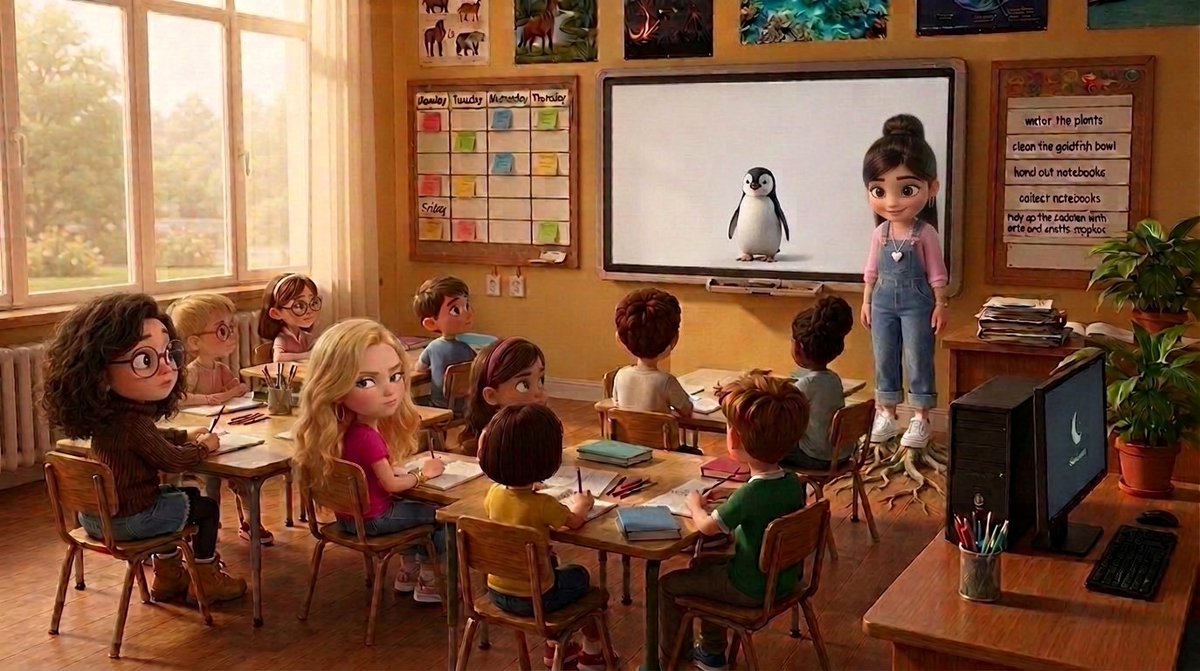
It's wild that this entire cinematic short was made in one hour. Solo.
No crew, no studio, no budget.
Here's the exact stack: Neolemon + Kling 3.0 + Suno 👇
Our pro users love Story Scene Pro, and I get it.
Upload your characters, your background, your dog. Name them. Then write the scene like you'd tell it to a friend and tag them in.
Same kids, same farmhouse, every page.
Live now in Neolemon.
A kid drew this fairy.
5 minutes later: a polished storybook character. Same crown, same wings, still recognizably hers.
Then the same character becomes story scenes, coloring pages, and worksheets:
For my first post, I’m sharing a letter @NVIDIA signed on why open models matter.
AI will transform every industry, power every company, and be built by every country.
Open models strengthen safety and cybersecurity, accelerate innovation and diffusion, and enable sovereignty.
The world needs both frontier closed models and frontier open models.
https://t.co/AUKzoQ5Ikb
We have one rule for the canvas: if it needs a tutorial, we built it wrong.
That rule has killed more features than any roadmap meeting. Layer controls, failed it. Manual shadow angles, failed it. A prompt field for scene composition, failed it hardest.
What survives is in this clip. Character, shadow, speech bubble, layout, all in one pass, none of it explained to me first.
The rule is annoying to live with. You spend weeks making something invisible rather than a week making something demoable. But every tutorial you write is a confession that the product did not carry its own weight.
Full video walkthrough here: https://t.co/KPWAlaH335
We cover the exact BSR history for each keyword, then builds all three niches in Neolemon: nativity characters kept consistent across scenes with Multi-Character Pro, a watercolor reindeer edited scene by scene in Editor Pro, and Santa pages finished with text in Canvas.
There's also a step-by-step guide linked in the video description if you'd rather read than watch.
Three Q4 children's book niches that could make you your first $10k month on KDP. A year of Amazon BSR data backs every one of them.
We just published the full breakdown on the Neolemon channel:
"The First Christmas" books sit around 35,000 BSR in August. Last December the top one hit BSR 106, an estimated $2,400 a day.
A quiet snowman story about gratitude climbs from 90,000 BSR to about 5,000 every November, roughly $5k a month for a simple watercolor book.
"The Night Before Christmas" is the big one. The lead title reached BSR 55 last December, an estimated $3,500 a day from one children's book.
The pattern across all three: simple stories, simple illustrations, published early enough to collect reviews before the seasonal spike.
In the video Danny also builds each niche start to finish with Neolemon, from a nativity scene with three consistent characters to a watercolor reindeer to Santa pages with text added in Canvas.
Full walkthrough is on YouTube, link in the first comment. Which niche would you pick?
It’s kind of unreal how fast a character idea turns into a fresh storyline.
Neolemon lets you craft characters that stay true to themselves, keep their style and vibe locked in, and place them anywhere you want.
Build your own line of storybooks and entire worlds with polished, pro-level illustrations—then grow it scene by scene, chapter by chapter, front cover to final page, until it feels like a universe that could only be yours.
Here's an example.
A character showed up in my head at daybreak.
By breakfast, he was standing in front of me.
The idea: The Golden Orchard Squire
He has a wooden buckler, a borrowed sword, and no idea how dangerous the road ahead is. Perfect hero material.
We just ran a free live masterclass on illustrating a children's book with AI. The full recording is now on YouTube. Highlights below.
One thing building Neolemon has taught me: nobody actually wants AI images. They want to finish the book they've been carrying in their head for years.
So that's what we taught. My co-founder Diana and I walked through the exact five-step process our users follow to go from plain story text to a finished picture book: break down the story, create each character once, build variations with editors, compose your scenes page by page, assemble the book.
The moment I was proudest of: we opened the session holding a printed children's book one of our users made with Neolemon and published on Amazon. She had the story for years. Now she reads it to her kids as a real book.
The full 37-minute masterclass is free on YouTube, no signup, every prompt included. Link in the first comment.
If you know a parent, teacher, or writer sitting on a story, send them this.
Then I used the Neolemon character references with the cut-by-cut prompts to generate the video shots.
After that, I chose the best clips and edited everything together into a fast comedy fight sequence.
The trick was keeping the visuals epic while making the actual threat completely ridiculous 😂
This started as a serious vampire anime fight scene…
Then I gave the hunter garlic bread instead of a weapon 🧛🥖
Here’s how I made the sequence with AI tools, character references, and cinematic video prompts
Once the characters were locked, I went back to ChatGPT to create the video prompt structure.
I broke the fight into short cinematic cuts like:
“vampire landing on the cathedral roof beneath the full moon”
“hunter lifting the basket cloth”
“garlic crumbs bounce upward in slow motion”
“the vampire runs away in full panic”
This morning I went from idea to finished character in the time it took to make coffee.
The Fox Court Messenger.
He carries royal secrets, sealed letters, and a dagger no one is supposed to notice. He knows exactly who's lying.
A few years ago, the gap between a character you could imagine and a character you could actually see was months of work. Or a budget most creators didn't have.
This morning? One cup of coffee.
Moodboard. Character turnaround. Final stance. First cinematic frame.
Before I'd finished breakfast.
Here's what shifted:
The spark was always the rare thing. A character specific enough that you already know how he'd lose an argument. That part hasn't gotten easier.
What collapsed was everything else. The production cost. The technical barriers. The months of iteration just to get him out of your head and onto a page.
That's the shift worth watching.
The barrier to cartoon storytelling just disappeared. The only thing that matters now is whether you have a character worth building a world around.
That was the full workflow:
Neolemon for the character references
Neolemon for the location reference
Video generation using those image references
Suno for the music prompt
Give it a try and lets see what you come up with
I created a short animation story using this workflow:
Story idea → Neolemon character creation → Neolemon location creation → Seedance → Suno
The story:
The Tiny Soldier and the Sleeping Giant
A tiny soldier wants to recover a tiny glowing crown resting on the nose of a giant asleep in a peaceful green meadow. To reach it, he has to climb across the giant’s body without waking him.
The final scene gives the short animation a warm ending.
Scene 4 — The Gentle Catch
Cut 1: Long cinematic tracking shot of the tiny soldier spinning through the air above the green meadow as the tiny glowing crown tumbles beside him, with the giant’s enormous shadow stretching across the grass below, SFX: wind rush, cape flapping, crown chiming. Cut 2: Low-angle slow-motion shot as the giant’s huge hand rises from the meadow and gently catches the tiny soldier before he hits the ground, the tiny crown landing softly in the giant’s palm beside him, SFX: heavy hand moving through grass, soft landing impact, magical ring. Cut 3: Extreme wide final shot of the giant carefully placing the tiny soldier and tiny crown onto a small grassy hill, then lying back down peacefully as the soldier raises the crown in victory, sunrise light spreading across the meadow, SFX: warm breeze, birds returning, soft giant exhale. [no music]
For the music, I created this Suno prompt:
Whimsical cinematic fantasy adventure score for a short animated scene in a peaceful green meadow at sunrise. Soft magical orchestral music with playful tension, gentle strings, warm brass, light percussion, sparkling bells, woodwinds, and subtle choir textures. Start calm and curious as the tiny soldier begins his climb, build into mischievous suspense as the giant starts waking, swell into a fast comedic action moment for the sneeze, then resolve into a warm heroic fairytale ending. No vocals.