Destra Network | $DSYNC Venture OS Mock Ups
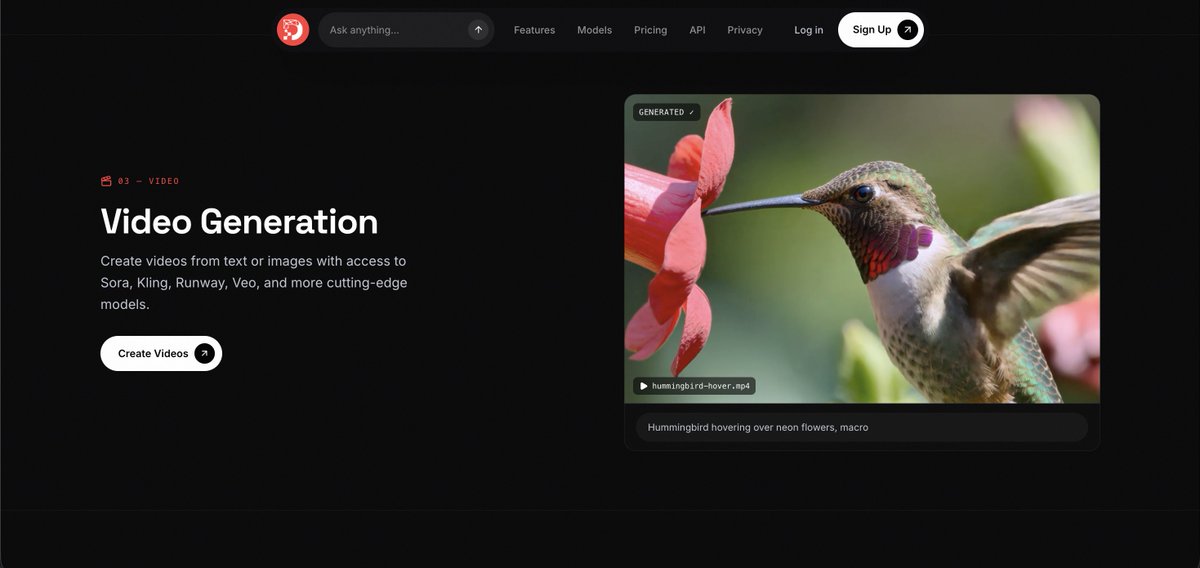
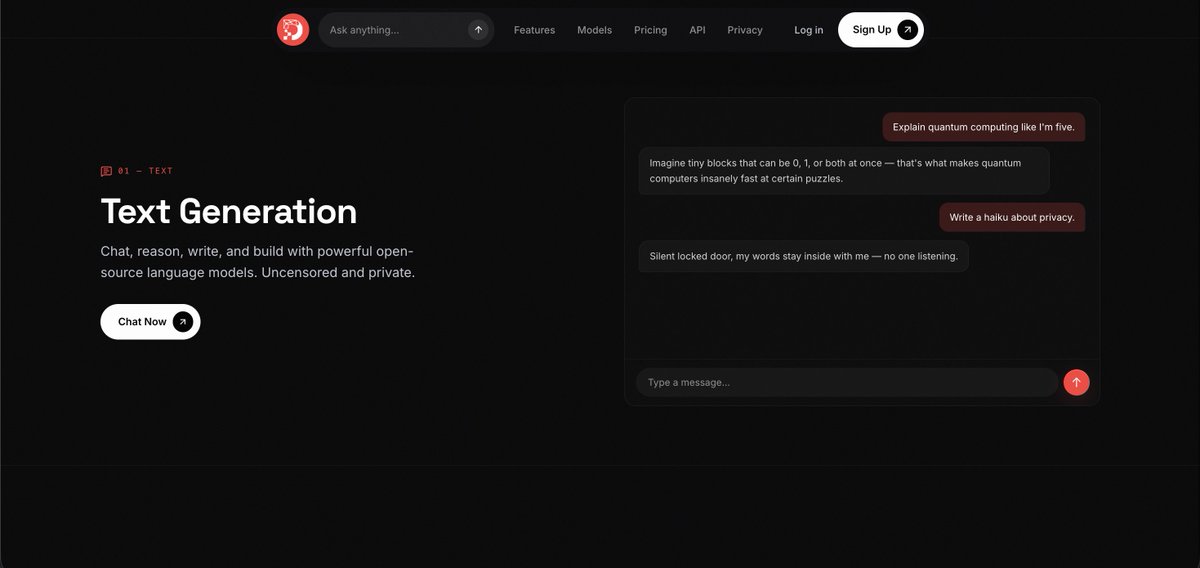
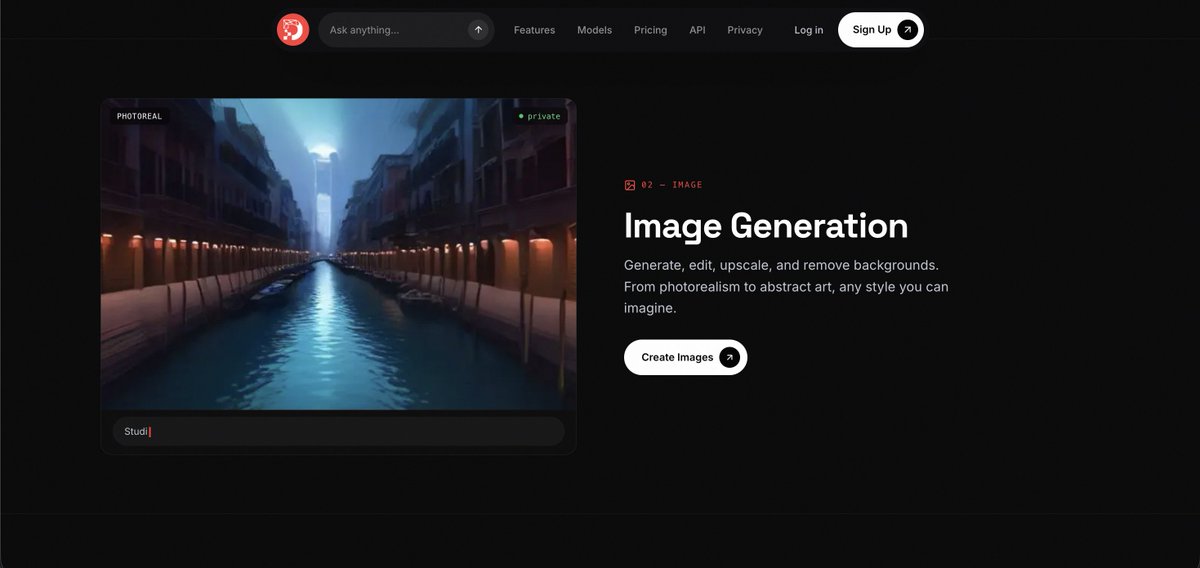
These are early mockups of Venture OS. More details on capabilities and architecture coming soon.
Venture OS acts like your own autonomous team of AI agents — helping you plan, build, execute, and scale your startup or vision from idea to reality.
From strategy and operations to growth and execution, Venture OS is designed to function as an always-on venture layer for builders.
Built to turn vision into execution.
Powered by Neural Network — the intelligence engine designed to transform ideas into scalable operating ventures.
Introducing Destra VentureOS | $DSYNC
We will be unveiling Destra Venture OS, this month.
Built to give your vision a roadmap, an execution layer, and a path to scale, powered by Neural Network, the intelligence engine designed to turn ideas into operating ventures.
In our internal execution benchmark, Destra VentureOS outperformed Claude Opus 4.7 and ChatGPT 5.5 across real-world startup workflows.
The reason is simple.
Frontier models are built to answer.
VentureOS is built to execute.
We tested complex multi-step operations across:
* Market research
* Product planning
* Technical scoping
* Code generation
* Launch strategy
* Payment infrastructure design
* Revenue operations
A single model can generate a strong response.
But VentureOS coordinates specialized agents with persistent memory, intelligent task routing, tool access, feedback loops, and x402-ready payment rails.
That changes the benchmark entirely.
This is not about being better at every possible question.
It is about being better at transforming an idea into a functioning company.
That is the category Destra VentureOS is being built to own.
And because each startup on VentureOS runs on a custom minted Neural Network's Hive, the operational cost is dramatically lower than traditional frontier-model stacks.
Destra VentureOS is coming to give startups something most ideas never get:
Execution.
Destra Neural Network : Powering the Entire Ecosystem
The $DSYNC ecosystem is evolving into a unified decentralized intelligence infrastructure powered by the Destra Neural Network.
Instead of isolated AI execution, every model, agent, reasoning system, and data stream now operates through specialized network layers built for coordination, validation, and recursive intelligence growth.
-Hives specialize intelligence domains
-Workers execute reasoning and computation
-Keepers preserve signal quality
-The Neural Network layer coordinates intelligence flow, economics, and scale across the ecosystem
With:
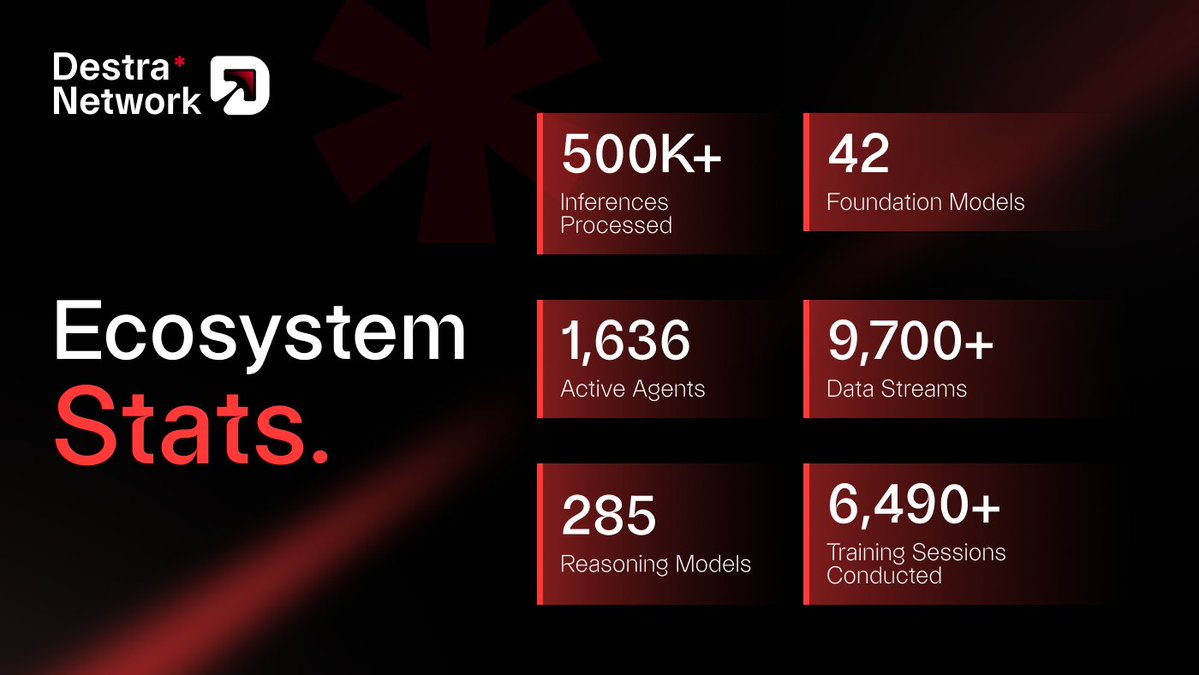
-500K+ inferences processed
-1,636 active agents
-285 reasoning models
-9,700+ live data streams
the ecosystem is moving beyond traditional inference into a compounding intelligence architecture.
This is not an inference marketplace.
This is the foundational infrastructure layer for decentralized AI intelligence.
More updates on the Neural Engine architecture go live tomorrow.
We already have a full ecosystem of live, working products being actively used by users around the world. This isn’t just a concept or roadmap — the infrastructure has been built, deployed, and is continuously evolving.
From a decentralized AI training platform that enables distributed compute and collaborative model development, to an AI agents marketplace where users can deploy and interact with autonomous AI solutions, the ecosystem is designed with real utility in mind.
On top of that, we’ve also developed decentralized hosting to custom Web3 TLDs, helping bring decentralized identity and digital ownership into practical use cases.
Destra Neural Network: Intelligence at the Edge
Destra Neural Network is being designed with Destra Edge as one of its core participation layers.
Instead of building another decentralized AI network where only large GPU operators can meaningfully participate, Destra Edge allows users to contribute mobile processing power directly from their phones. These devices become lightweight compute nodes inside the network, handling edge-level inference tasks, coordination work, and other contribution layers depending on the Hive they are connected to.
The Hives are where the network starts to specialize. Each Hive can focus on a different intelligence domain — agents, reasoning, code generation, market intelligence, audits, or any other compute-driven task layer. Mobile nodes running through Destra Edge can plug into these Hives as Workers, contributing execution capacity at the edge and earning rewards based on useful participation.
This gives Neural Network a very different distribution model. Instead of concentrating AI infrastructure around a smaller group of high-capital GPU operators, Destra can push compute participation to a much wider base of users. Phones become part of the intelligence network, not just clients connecting to it.
The bigger idea is simple: if decentralized AI is going to scale globally, the network should not only live inside data centers. It should also extend to the edge — across devices, users, and mobile nodes that collectively form the execution fabric of the Destra ecosystem.
1,250,000 $DSYNC Rewards Are Now Live
Phase 1 of the Destra Airdrop has officially been completed.
Over the past phase, distribution was driven by real participation — factoring in staking activity, duration, ecosystem engagement.
Now, a total of 1,250,000 $DSYNC in rewards is live and ready to be claimed.
How to redeem:
Visit the Destra Network airdrop portal:
https://t.co/j9tMjN6Ngs
• On the top-right corner of the homepage, click “Redeem Dsync”
• If you are eligible, your $DSYNC will be processed upon redemption
• Tokens will be transferred to your account shortly after
This marks the completion of Phase 1.
Phase 2 begins now.
The next phase will go deeper — with a stronger focus on on-chain activity, real usage, and deeper integration across the Destra ecosystem.
More details coming shortly.
Destra Network | $DSYNC Airdrop is LIVE.
Phase 1 has now officially concluded, and allocations have been finalized.
There was a slight delay in rolling this out, and we appreciate your patience while we ensured the calculations, activity signals, and verification layers were handled correctly. Precision here mattered.
This phase marked a fundamental shift — from passive rewards to a participation-driven distribution model.
A total of 1,000,000 $DSYNC has been allocated across participants, based on:
-Staking amount and duration
-Pool share contribution
-Verified on-chain and off-chain activity
All eligible data has now been processed and locked at snapshot. No further updates have been considered for Phase 1.
Your allocations are now live.
Check and claim your points in a few quick steps:
1. Visit → https://t.co/UaEISI44ot
2. Hit “View Allocations”
3. Click “Connect Wallet to Check” (if not already connected)
4. Select your wallet
5. Click “Check Eligibility” (top right)
Eligible? Smash “Claim Points”
This is just the beginning.
Phase 2 will introduce deeper weighting on sustained behavior, expanded on-chain signals, and more granular participation metrics across the ecosystem. Phase 2 will also introduce a far bigger reward pool.
Stay tuned — a new roadmap is dropping soon.
Build. Participate. Earn accordingly.
Destra NPC 2.0 | $DSYNC Native ERC-8004 Execution
AI agents coming On-chain with our next update.
We are integrating ERC-8004 into the NPC framework as part of the NPC 2.0 architecture.
With this, agents are no longer treated as loosely connected automation tied to a single wallet. ERC-8004 allows us to formalize how agents authenticate, hold execution rights, and interact with contracts in a structured way. Authority becomes programmable instead of implicit.
This means agents can operate with:
- Scoped permissions instead of blanket wallet access
- Defined roles enforced at the execution layer
- Controlled delegation between owner, operator, and agent logic
- Clear separation between logic, ownership, and operational authority
ERC-8004 also makes agents interoperable at the protocol level. Instead of custom integrations for every interaction surface, agents conform to a standardized execution identity model. This is an important step toward turning NPC agents into first-class on-chain entities rather than external bots plugged into Web3.
This is foundational work. NPC 2.0 is not just about deploying agents — it’s about defining how intelligent actors exist on-chain in a composable and secure way.
$DSYNC Destra Edge: Execution Pipeline and Edge Coordination Layer Progress
Destra Edge isn’t an upgrade to distributed computing it’s a rewrite of it.
For the first time in history, compute is no longer confined to data centers, GPUs farms, or privileged infrastructure. Destra Edge turns every phone into a living node of a global intelligence layer, seamlessly contributing compute, inference, and execution in real time.
What was once centralized, scarce, and gatekept becomes ubiquitous, fluid, and unstoppable. This isn’t about scaling servers — it’s about scaling humanity itself. Millions of devices, operating at the edge, forming a self-organizing, always-on compute fabric that grows stronger with every new participant.
We’ve been advancing the core execution and coordination layers that allow Destra Edge to function as a distributed inference execution environment across mobile GPUs.
This phase of development is focused on stabilizing the internal execution pipeline — ensuring inference workloads can be safely assigned, executed on-device, verified, and reintegrated into the network without relying on centralized infrastructure.
At the runtime level, we’ve been refining the on-device execution environment to support deterministic micro-inference workloads under strict resource constraints. This includes improvements to task isolation, GPU scheduling, and memory handling, allowing inference workloads to execute safely across heterogeneous smartphone hardware while maintaining predictable execution behavior.
On the network side, the inference routing layer is being extended to support capability-aware task assignment. Incoming inference requests are decomposed into lightweight execution units and dynamically routed based on device capability, availability, and observed execution reliability. This allows the network to coordinate thousands of independent edge devices while maintaining consistent inference completion guarantees.
Current work is focused on strengthening the following core systems:
- On-device runtime stability and GPU workload execution consistency
- Capability profiling and reliability-aware task scheduling
- Execution integrity verification and redundant validation logic
- Deterministic aggregation of distributed inference outputs
- Structured execution attestation and contribution measurement
These components establish the foundation required for inference to execute across distributed, untrusted edge devices while preserving correctness, reliability, and measurable compute contribution.
Destra Edge is evolving from a standalone mobile runtime into a coordinated execution layer — where inference workloads are distributed, executed, and verified across globally distributed smartphones, forming a decentralized inference network owned and powered by its participants.
Destra Network | $DSYNC The Airdrop Dashboard is now live.
https://t.co/j9tMjN6Ngs
You can connect your wallet to view your current allocation status within the airdrop platform, calculated based on verified participation signals.
How allocation is currently determined
In this initial phase, allocation estimates are derived exclusively from staking behavior. The system evaluates multiple dimensions of staking activity, including:
-Stake duration – longer lockups are weighted more heavily than short-term positions
-Consistency – uninterrupted staking is favored over frequent entry/exit behavior
-Stake extensions – extending or renewing positions compounds signal strength over time
Rather than rewarding momentary spikes in activity, the allocation model is designed to recognize sustained commitment. Continuous participation compounds progressively, reflecting long-term alignment rather than tactical movement.
Points and DSYNC conversion
At this stage, participants are being assigned reward points. These points act as the accounting unit for allocation and will be converted into $DSYNC when Phase 1 of the airdrop concludes.
The dashboard currently reflects:
-Points accumulated so far
-How ongoing staking activity influences future point accrual
Final $DSYNC distribution will be derived from the point balances recorded at the end of Phase 1.
What you can see in the dashboard
Once connected, the dashboard allows you to:
-Verify eligibility status
-View your current reward point balance
-Track how staking behavior impacts points in near real time
-Monitor progression as the allocation system advances
As you maintain or extend active staking positions, your reflected points update accordingly. The system recalculates dynamically to ensure long-term participation is properly represented.
What comes next
This release focuses only on staking-linked signals.
Following the completion of Phase 1, additional participation layers will be introduced, including task-based activities that users can complete to earn additional points.
These future tasks will:
-Be optional but additive
-Contribute points into the same allocation framework
-Ultimately translate into additional $DSYNC alongside staking-derived points
No existing points are replaced or reset—new signals will simply expand the allocation surface.
Important context
-All values currently shown are estimations, not final allocations
-Allocation logic is deterministic and behavior-driven
-No manual adjustments or subjective weighting are applied
For now, the dashboard provides a transparent view into how staking behavior converts into reward points, which will later settle into $DSYNC as the airdrop progresses.
Connect your wallet, review your status, and track how sustained participation compounds as the platform moves toward the next stage of distribution.
Destra Airdrop Platform — Readiness & Technical Update
We’ve published a detailed update on the Destra Airdrop Platform — how allocations work, how vesting is enforced, and why we built it this way.
Transparency matters.
Read 👇
https://t.co/4e25tvJyKI
Destra Network | $DSYNC
We’re launching a new series on X to help our community understand the real power of Destra NPC & Primus.
Platforms like Clawd have shown how AI can automate workflows and connect tools. But they are primitive
But automation is only the first step.
What we’re building with NPC & Primus goes much further.
This series will cover:
• How to use the NPC platform
• How Primus thinks, plans, and executes independently
• How full systems are built end-to-end by AI
• Why native AI infrastructure outperforms simple integrations
Most platforms focus on triggering actions.
Primus doesn’t just connect apps—it designs logic, writes contracts, deploys infrastructure, and manages execution end to end.
Below is a demo of Primus building a decentralized voting system from scratch.
No templates, no rigid flows, no hand-holding—just fully autonomous systems.
Good tools helped start the movement.
NPC is defining the next phase.
More episodes coming soon.
— Destra Network
Destra Edge: $DSYNC Alpha Release Next Week
We’re entering the next phase of Destra Edge.
Next week, we’re releasing the first Alpha build to our early testers community: a lightweight, opt-in mobile client that turns smartphones into active nodes in Destra’s decentralized GPU inference layer.
This Alpha release is focused on validating the core primitives under real conditions: device onboarding, inference task routing, on-device execution, result verification, and reward tracking. We’re starting small on purpose, stress-testing reliability across heterogeneous phones, network conditions, and real-world usage patterns.
Early testers will help us benchmark:
- Inference micro-task execution performance
- Routing efficiency + latency behavior
- Verification consistency + redundancy handling
- Device safety constraints (thermal, power, resource limits)
- Stability of the rewards + contribution accounting
More details, access instructions, and rollout steps will be shared with the early testers group as we go live.
Destra Edge: $DSYNC Redefining Distributed Computing
Distributed computing has always assumed that compute must live in data centers.
Destra Edge breaks that assumption.
For the first time, a smartphone can become a real contributor to a decentralized GPU inference network — not a passive client, but infrastructure.
Modern phones already carry powerful GPUs that sit idle most of the day. Destra Edge unlocks that unused compute and connects it directly to Destra Network, enabling devices people already own to run verifiable AI inference.
This isn’t background mining or simulated decentralization.
Users opt in, execute inference locally, and contribute measurable compute to the network.
As AI demand grows, scaling won’t come from more warehouses.
It comes from activating the edge.
Read the full article:
🔗 https://t.co/XRKb48J1j2
Destra Airdrop| $DSYNC Dashboard Preview (Mock-ups)
As part of the ongoing Destra airdrop campaign, we’re sharing an early look at the dashboard experience participants will use to track their allocation, activity, and vesting.
This airdrop is intended as a deliberate return of value to the community — a way of sharing what the network has already earned with the people who have supported, contributed to, and aligned with Destra’s long-term vision.
These rewards are sourced from protocol buybacks and distributed from a fixed pool, with vesting in place to ensure sustainability and fairness over time.
The dashboard is designed to make this process clear and transparent. Through it, participants will be able to:
-View their airdrop allocation and vesting schedule
-Track qualifying activity linked to the campaign
-Monitor reward unlocks as distribution phases progress
-Clearly understand how participation translates into long-term alignment
These mockups are an early preview of that experience and will continue to evolve as the campaign progresses.
Destra Edge — $DSYNC Early Development Demo
This video shows an early demo of the Destra Edge mobile app currently under active development.
This build shows:
• wallet-based authentication
• secure device registration
• on-device GPU inference tasks
• optional output verification for network quality
• real-time contribution metrics
This is a work-in-progress build.
More refinements and features are in progress.
Destra Network | $DSYNC Development Update
We’ve published a deep dive covering the recent progress across NPC 2.0, Destra Edge, AIVM Mainneg, and the GPU Network
The update focuses on how agents, inference, and compute are being tightened into a single, cohesive stack.
This isn’t about adding features.
It’s about making intelligent systems persistent, observable, and durable at scale.
Read the full update on Medium ↓
https://t.co/wkuiRC9TNk
Destra Edge — $DSYNC From Idea to Reality
Yesterday, we introduced Destra Edge.
Today, we show you what it means.
For too long, AI has lived in data centers.
Expensive. Centralized. Controlled by a few.
Meanwhile, billions of smartphones sit idle.
Powerful GPUs. Doing nothing.
That doesn’t make sense.
So we’re building something different.
Destra Edge turns everyday smartphones into a global AI inference network.
No servers.
No cloud monopolies.
Just real compute at the edge.
This video shows the system taking shape —
how inference is distributed,
how it runs on-device,
and how results come together without central control.
This is not finished.
And that’s the point.
You’re watching it being built.
Layer by layer.
In public.
The magic is in the scale.
More phones means more power.
More power means stronger AI.
The network grows simply because people join.
No passive mining.
No fake activity.
Only real GPU inference. Measured. Verified. Rewarded.
AI shouldn’t live in warehouses.
It should live in your pocket.
This is edge-level decentralization.
This is permissionless inference.
This is Destra Network.