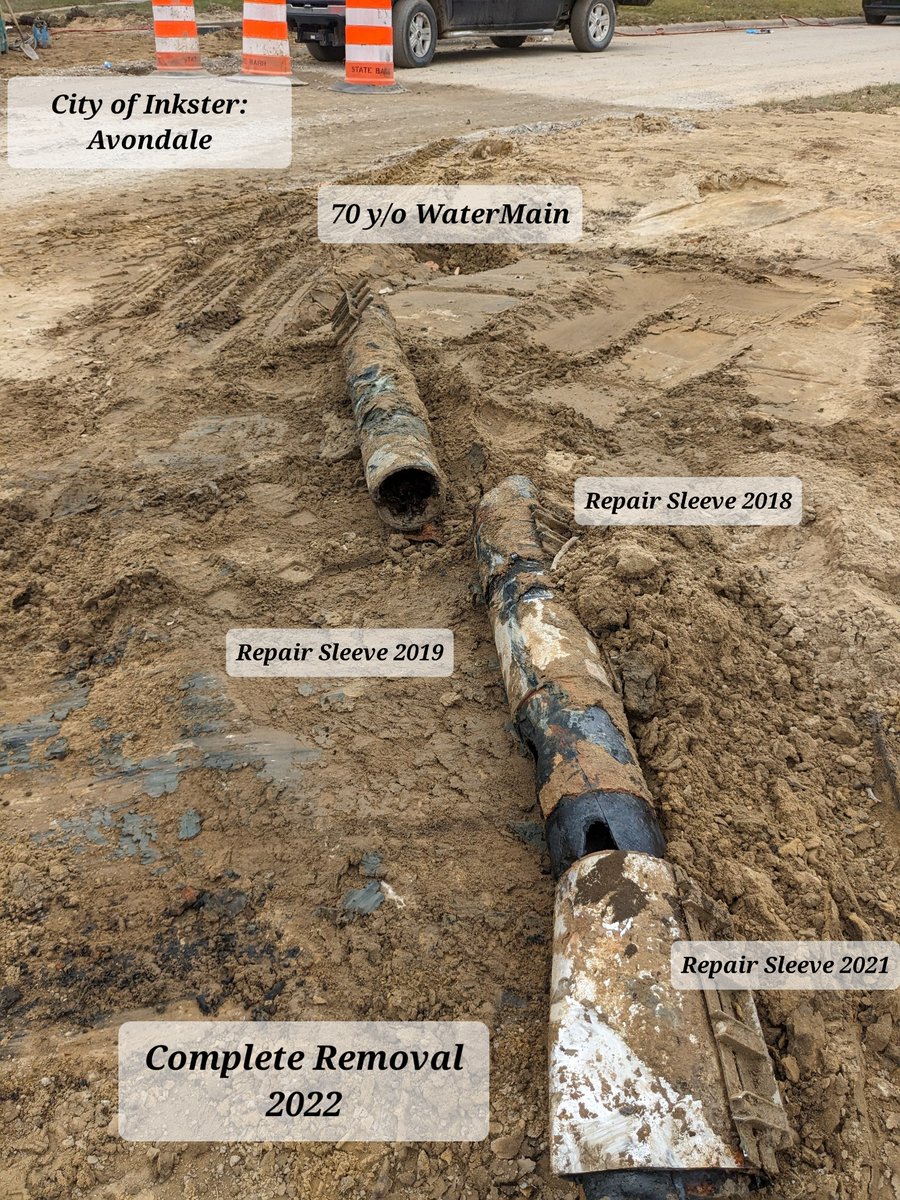
The life of American municipal water systems; for context, each repair sleeve is about $10k-$15k to perform including labor. This is a 30ft section of Water-Main.
Detroit’s Lee Plaza has windows again! 🤝
This historic piece of architecture sat hollowed out for years. It towered ominously over the west side neighborhood. And now it’s receive new windows, the facade has been largely repaired, and more to come!
📸 @jordangarlandmi
My favorite f*cking podcast did the most respectable summary of Detroit & Michigan construction-infrastructure-culture drama of my undergrad-to-date & inspiration for my having become an engineering inspector. Absolute chefs ���
https://t.co/8I9PYYddQu
Did you know Central Park used to be a thriving Black community called Seneca Village? It was founded in 1825 by free Black people. They build 50 homes, a school, and 3 churches. White people removed Black people from the land, declaring their property eminent domain.
Ford, the company that killed sedans (and Escape), outsourced the Mach-e, Maverick & Bronco Sport to Mexico, fleeced taxpayers for battery plants, says Michigan is headed in the wrong direction? Ford has held the wheel for the last 100 years. https://t.co/19dHuvyjbf
I think one reason people become fascinated by the Rust Belt is that its architectural splendor is magnified by the population collapse in its urban neighborhoods.
It’s not just the contrast between the grandiosity of the historic churches, office towers and schools against the squalor of their surroundings; the depopulation itself seems to enhance them by increasing their visibility. Houses in these neighborhoods were wood-frame and lightly built while the churches and schools were stone and brick, with congregations and institutions to maintain them even as they went into decline (for example, St Albertus is supported by a Polish civic association even though its congregation long ago suburbanized).
As homes were abandoned and then demolished, institutional and commercial buildings became visible from each other across the weedy half-empty blocks and down the oversized boulevards, creating an odd cityscape dominated by isolated monuments.
These four churches are a great example of what I mean. You can see each one from the one closest to it because there are few buildings left in these neighborhoods to block the view. To give you a sense of what it's like on the ground, the two easternmost are today in a census tract with a pop density of just 1k ppl/mi^2. That's the density of an exurban large-lot subdivision. In 1950, when Detroit's population peaked, their two census tracts had ~30k ppl/mi^2 and 20k ppl/mi^2 respectively. The churches stand in neighborhoods that are 95-98% less dense than they were when the pews were full, and as such they dominate them in a way parish churches elsewhere would not.
One of the greatest collections of ecclesiastical architecture in the country is along this 1.1 mile stretch of Canfield St on Detroit’s east side. St. Josaphat (1901), Sweetest Heart of Mary (1893), St. Albertus (1885), and St. Elizabeth (1892). All built by immigrant Catholic factory workers in neighborhoods that have since seen dramatic decline.
I have the utmost respect for Senator Kaine and Senator Warner but we do not need “coaching” on redistricting coming from a cuck chair in the corner. How about you all stay focused on the fascist in the White House and let us handle redistricting in Virginia. 10-1
Hard to explain to people how the "Rust Belt" was basically just New England #2 and for a brief period the most "modern" and "developed" part of the country
This map highlights it quite well
The Great Lakes had an insane grip on the imagination of New Englanders
ICE agents in Minnesota staged a car breakdown to lure Jesus Flores out of his house so they could arrest and detain him. Our government is weaponizing our shared humanity in order to hunt people down.
@DE_Gifford@Boenau It applies to everything in terms of the puritanical justice system in practice which is what we have in the outcome of that but most other examples. Loss of licensure if you kill someone potentially as a doctor, engineer. Retraining with absences of neglect or malintent.
This reminds me of an early @DistillSocial video where they caught @BetsyDeVos saying a factory floor at a John Deere plant or a cow pasture is just as good as a classroom for high schoolers.
Meanwhile, @DrOz wants to push the retirement age back to never.
Google’s single data center in Council Bluffs, Iowa consumed 1 billion gallons of fresh water in 2024. One facility. One year. Enough to supply every home in Iowa for five days.
The reason they need fresh water is pure chemistry. Evaporative cooling towers work by running water over hot surfaces and letting it evaporate. 80% of the water a data center pulls in literally vanishes into the atmosphere as steam. You can’t recycle steam.
The remaining 20% becomes concentrated mineral waste. Calcium, magnesium, silica. Every cycle through the cooling loop makes the water more corrosive. After enough passes, it starts clogging pumps and eating through heat exchangers. Multi-million dollar equipment destroyed by limescale.
Recycled wastewater carries even more of these minerals from the start. You could treat it, but less than 1% of U.S. water is recycled. Most cities don’t even have separate pipes to deliver reclaimed water to industrial customers. A data center wanting to use recycled water would essentially need to build its own treatment plant on site. Meanwhile, municipal potable water costs almost nothing.
So they just drink from the tap. Across all its data centers, Google used 8.1 billion gallons in 2024, nearly double what it used three years earlier. The company claims its water stewardship projects “replenished” 4.5 billion gallons. Those projects aren’t even in the same watersheds where they’re pulling the water. Same playbook as carbon offsets. Consume locally, offset globally, call it sustainable.
The trajectory is the real story. U.S. data center water consumption could quadruple by 2028. That’s 68 billion gallons for cooling alone, before the 211 billion gallons consumed indirectly through electricity generation. Two-thirds of new data centers since 2022 are being built in regions already facing water scarcity.
Nobody’s asking why they use fresh water. They’re asking what happens to the towns sharing a water main with a facility that drinks like 50,000 people showed up overnight.