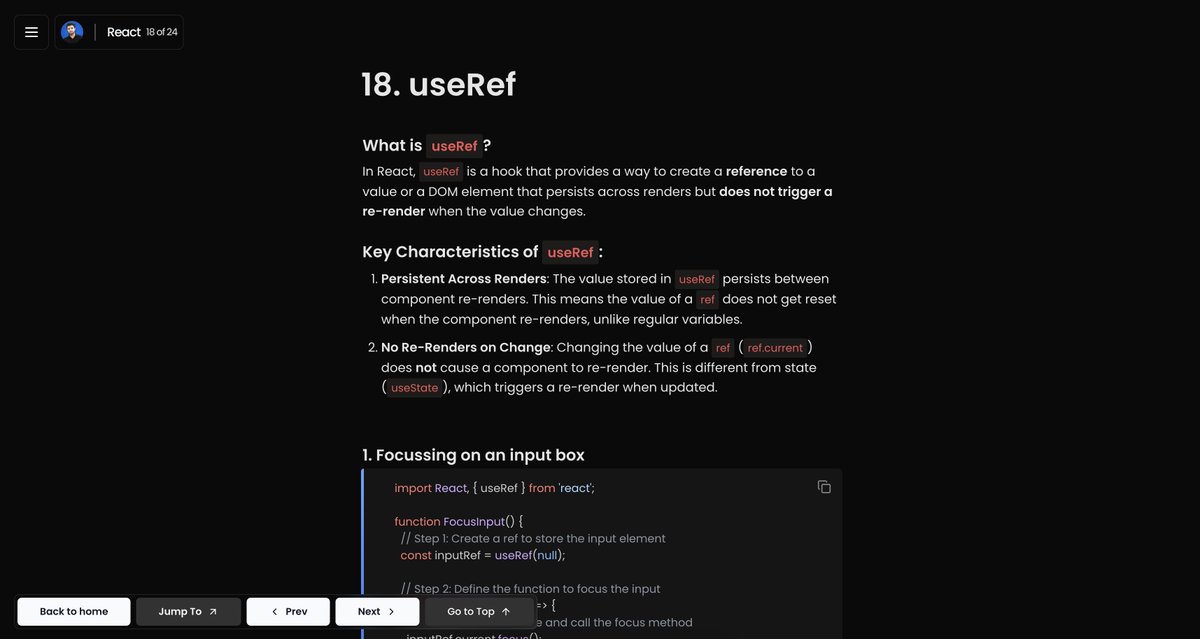
Just completed Week 18 of the 100xDevs Bootcamp by @kirat_tw 🚀
Today’s learnings:
• Bootstrapping React projects using Vite ⚡
• Why Vite is faster with blazing fast HMR
• Creating React apps using npm create vite@latest
• Understanding React Components and reusable UI building blocks
#ReactJS #WebDevelopment #JavaScript #100xDevs
Just completed Week 18 of the 100xDevs Bootcamp by @kirat_tw 🚀
Today’s learnings:
• Bootstrapping React projects using Vite ⚡
• Why Vite is faster with blazing fast HMR
• Creating React apps using npm create vite@latest
• Understanding React Components and reusable UI building blocks
#ReactJS #WebDevelopment #JavaScript #100xDevs
Just learnt how centralized exchanges like Binance/Backpack work under the hood 🚀
@kirat_tw
Key learnings today from the exchange architecture deep dive:
• Built understanding of SPOT exchanges & orderbooks
• Users place bids (buy) and asks (sell) just like real-world brokers
• Trade executes when bid & ask prices overlap
• Orderbooks are stored in-memory for ultra low latency
• Databases are used for persistence, not real-time matching
• Designed schemas for users, balances, trades & markets
• Learnt how backend communicates with matching engine
• Understood why concurrency & speed matter in exchanges
Just attended Week 17 of the 100xDevs Bootcamp by @kirat_tw 🚀
Today’s focus:
• Explored how SWE-bench works
• Understood benchmark creation for evaluating LLMs
• Started cloning SWE-bench concepts
• Building our own benchmark
• Goal: Can LLMs solve easy coding tasks effectively?
• Went through SWE-bench dataset structure & inspected ~85% of the fields
Super interesting dive into AI evaluation systems, datasets, and benchmarking ⚡📊
Just learnt how centralized exchanges like Binance/Backpack work under the hood 🚀
@kirat_tw
Key learnings today from the exchange architecture deep dive:
• Built understanding of SPOT exchanges & orderbooks
• Users place bids (buy) and asks (sell) just like real-world brokers
• Trade executes when bid & ask prices overlap
• Orderbooks are stored in-memory for ultra low latency
• Databases are used for persistence, not real-time matching
• Designed schemas for users, balances, trades & markets
• Learnt how backend communicates with matching engine
• Understood why concurrency & speed matter in exchanges
Just attended Week 17 of the 100xDevs Bootcamp by @kirat_tw 🚀
Today’s focus:
• Explored how SWE-bench works
• Understood benchmark creation for evaluating LLMs
• Started cloning SWE-bench concepts
• Building our own benchmark
• Goal: Can LLMs solve easy coding tasks effectively?
• Went through SWE-bench dataset structure & inspected ~85% of the fields
Super interesting dive into AI evaluation systems, datasets, and benchmarking ⚡📊
Week 16 of Harkirat’s 100x Bootcamp ✅
@kirat_tw
📌 Key Learnings
-> TypeScript adds type safety on top of JavaScript
-> Code doesn’t run directly — it compiles to JavaScript
-> Understanding basic types: number, string, boolean, etc.
-> How to type:Function arguments
Return values
-> Type inference reduces the need for explicit types
-> Using interfaces to define object structures
💡 Max Product Subarray in JS
Track both max & min at each step
🔁 Swap when current < 0
📈 Update maxSoFar & minSoFar
🏆 Keep global result
#JavaScript#Coding#LeetCode
Solved Count Inversions
Split array into smaller parts (like merge sort)
Sort left and right parts
While merging, compare elements
If left element is bigger than right → it's an inversion
Count how many elements are left in the left part
Add that to total count
Keep merging until array is sorted
💡 Missing & Repeating Number
Given an array of size n with numbers from 1 to n:
👉 One number is missing
👉 One number repeats
🔍 Approach:
Create a frequency array of size n+1
Count occurrences of each element
Traverse 1 → n:
• freq[i] == 0 → missing
• freq[i] == 2 → repeating
Return [repeating, missing]
Merging two sorted arrays in-place 👇
• Start from the end to avoid overwriting values
• Use 3 pointers:
i = last valid in nums1 (m-1)
j = last in nums2 (n-1)
k = last position in nums1 (m+n-1)
• Compare nums1[i] & nums2[j]
• Place the larger at nums1[k]
• Move pointers accordingly
• Stop when nums2 is fully merged
Merging intervals efficiently
• Sort intervals by start time
• Initialize result with first interval
• Traverse remaining intervals
• If overlap (current start ≤ last end) → merge
• Else → add as new interval
• Keep updating end with max value
Solved the 3Sum problem 💡
=> Sort the array
=> Fix one number (loop through array)
=> Use two pointers: left (next index) and right (end)
=> Check sum of three numbers
=> If sum = 0 → store the triplet
=> If sum < 0 → move left pointer forward
=> If sum > 0 → move right pointer backward
=> Skip duplicates to avoid repeating results
#coding #javascript #leetcode
🚀 Solving Majority Element (> n/3)
Approach 👇
• Use a hashmap to count frequency of each element
• Loop through array → store counts
• Traverse map → check elements > ⌊n/3⌋
• Push valid elements to result
#JavaScript#DSA#Coding
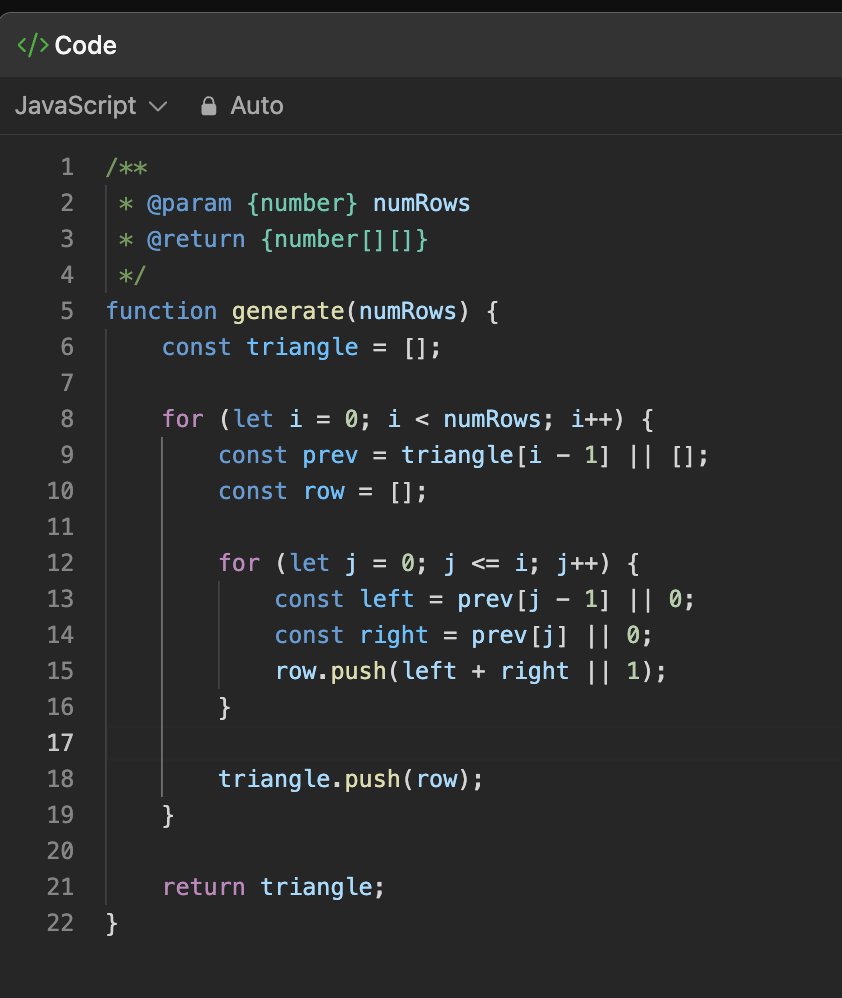
Solved Pascal's Triangle Problem
Approach:-
Start with an empty array to store all rows
Each row has i + 1 elements
Use previous row to calculate current values
Edge elements are always 1
Inner elements = sum of two values above (left + right)
Use 0 fallback when indices don’t exist
Push each row into the result
Return the full triangle





![DevChawla04's tweet photo. 💡 Missing & Repeating Number
Given an array of size n with numbers from 1 to n:
👉 One number is missing
👉 One number repeats
🔍 Approach:
Create a frequency array of size n+1
Count occurrences of each element
Traverse 1 → n:
• freq[i] == 0 → missing
• freq[i] == 2 → repeating
Return [repeating, missing]](https://pbs.twimg.com/media/HG5nKCIaUAAyUZN.jpg)
![DevChawla04's tweet photo. Merging two sorted arrays in-place 👇
• Start from the end to avoid overwriting values
• Use 3 pointers:
i = last valid in nums1 (m-1)
j = last in nums2 (n-1)
k = last position in nums1 (m+n-1)
• Compare nums1[i] & nums2[j]
• Place the larger at nums1[k]
• Move pointers accordingly
• Stop when nums2 is fully merged](https://pbs.twimg.com/media/HGwlpFwasAER2_Z.jpg)