September 6, 2026.
I’m still learning Linux, networking, DNS, servers and everything that comes with managing infrastructure.
One day, I’ll look back at this post from the other side.
And when I finally land that DevOps role?
I’m barbing my hair and making that mala. 😂
🐧 When I started learning the Linux logging system, I had this mindset that Linux centralizes all logs in one specific storage location.
But later, I learned that logs are stored differently depending on the service, application, and logging mechanism involved.
For example:
📂 /var/log/ — traditional log files.
⚙️ journalctl — to query logs collected by systemd-journald.
Understanding this made me realize that troubleshooting Linux isn’t just about checking logs; it’s about knowing where to look and how to interpret what you find. 🔍
Recruiters for DevOps roles scan for one thing before they read a single word of your resume.
They look for evidence.
That usually means there is a GitHub link.
And not just any GitHub but one with repositories that actually show you've worked with DevOps tools.
A README that explains what the project does and why!
You do not need real production experience. You need proof that you can operate in that environment.
𝗛𝗧𝗧𝗣, 𝗛𝗧𝗧𝗣 𝟮, 𝗛𝗧𝗧𝗣 𝟯: 𝗗𝗼 𝘆𝗼𝘂 𝗸𝗻𝗼𝘄 𝘁𝗵𝗲 𝗱𝗶𝗳𝗳𝗲𝗿𝗲𝗻𝗰𝗲𝘀?
HTTP now powers complex modern applications, but it started as a simple protocol for retrieving documents.
𝗛𝗧𝗧𝗣/𝟬.𝟵 only supported a single GET request with no headers or status codes; just raw HTML from the server. It was simple and fast, but lacked structure and scalability.
𝗛𝗧𝗧𝗣/𝟭.𝟬 introduced headers, status codes, and content types, making the web more structured and extensible, but required a new TCP connection for every request, which didn’t scale well.
𝗛𝗧𝗧𝗣/𝟭.𝟭 added persistent connections, caching, and chunked transfer, making web interactions more efficient, but still suffered from head-of-line blocking and connection overhead at scale.
𝗛𝗧𝗧𝗣𝗦 is HTTP layered over TLS, providing encryption, integrity, and authentication, securing communication over the internet, but adds handshake overhead and operational complexity.
𝗛𝗧𝗧𝗣/𝟮 introduced multiplexing, binary framing, and header compression, allowing multiple requests over a single connection, improving performance, but still relies on TCP and suffers from transport-level blocking.
𝗛𝗧𝗧𝗣/𝟯 runs over QUIC (UDP) with built-in TLS 1.3, enabling independent streams, faster handshakes, and reduced latency, but introduces more complexity in infrastructure and network handling.
From per-request connections → to multiplexing over TCP → to QUIC and independent streams. That’s the evolution of HTTP.
📌 If you want to learn more, dive deeper here: https://t.co/HsKI9atEuR
What else would you add?
China has killed the entire vector database industry.
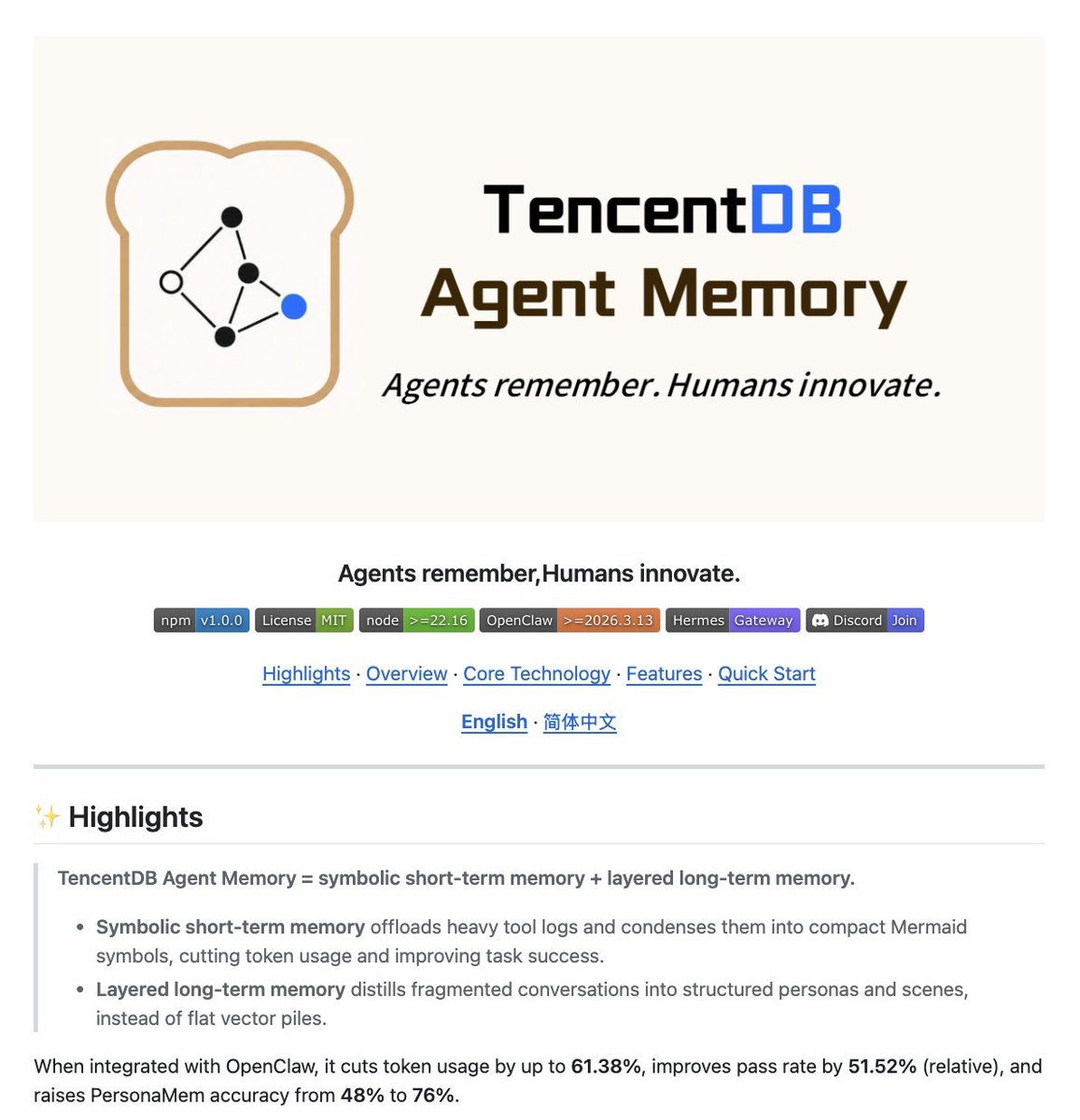
They open-sourced TencentDB Agent Memory. It gives any AI agent long-term memory that runs 100% locally.
No Pinecone. No cloud APIs. No repeating yourself every session.
- 61% fewer tokens
- PersonaMem accuracy: 48% → 76%
- Zero external API dependencies
- Runs on plain SQLite
Most memory systems compress your history into an opaque vector pile. when recall goes wrong, you're guessing. this one doesn't compress, it builds a semantic pyramid.
L0 Conversation → L1 Atom → L2 Scenario → L3 Persona.
Short-term state gets encoded as a Mermaid graph in your agent's context. verbose tool logs get offloaded to disk. when the agent needs proof, it drills back via node_id to the exact raw log.
no lossy compression. every layer is readable markdown you can just open and inspect.
5.1k stars. 100% Open Source.
Today, I learned how to analyze system logs using journalctl in Linux.
A crucial skill for Linux System Administrators when troubleshooting service failures, investigating system errors, and understanding what’s happening behind the scenes.
One command at a time.
@lloydtheophilus This is one of the biggest lessons I’m picking up as I transition into DevOps. It’s easy to focus on getting a system working, but building it so the next engineer can understand, maintain, and improve it is a different level of engineering.
@lloydtheophilus Boss, I can relate. It is close to also inheriting a codebase poorly documented with no mindset of who will be handling this code in the future
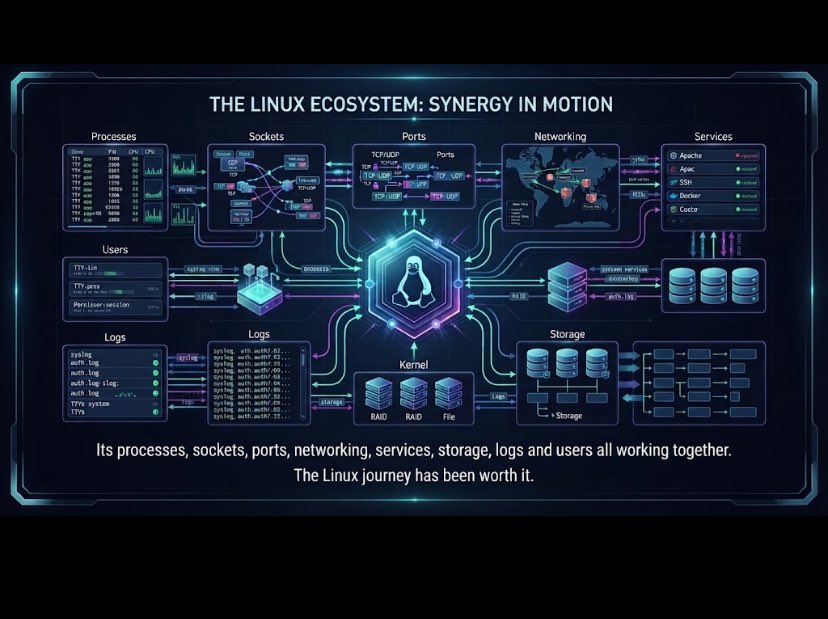
Months ago, commands like ss, systemctl, ip, dig and ps were just things I was learning.
Now I’m starting to see the bigger picture.
A production application isn’t just “code running somewhere.”
There are people who leave a mark on the world, and then there are people who change it entirely. Steve changed the world and so many lives in the process. He certainly changed my life forever. His spirit lives on in everything he created and everyone he inspired.
I’m about 98% through the Linux foundation I’ve been building for DevOps.
The remaining pieces:
→ Logs
→ SSH
After that, I don’t want to keep collecting Linux commands.
The more I learn Linux, the more I realize DevOps isn’t just about knowing Docker, Kubernetes, AWS or CI/CD.
Those tools sit on top of fundamentals:
Processes
Sockets
Ports
IP addresses
DNS
Routing
Services
Logs
SSH
And now I know why it matters