Meet Nosa, our new AI helper in the Nosana Discord 🦾
Ask about deploying a model, running a GPU node, or an error you're stuck on.
💡Nosa draws on our docs and thousands of solved support cases, with sources you can check.
Now LIVE in beta👇 https://t.co/uL259tp5s8
Claude Managed Agents just got a serious upgrade.
• Per-agent effort levels
• Seeded sessions with events
• Webhooks for environments & memory stores
• Live event streaming for sub-agents
This is the kind of release that's easy to overlook—but it's exactly what production AI teams need.
The gap between "AI demo" and "AI system" keeps getting smaller.
https://t.co/caxKbiLHm6
We've just added several new features to Claude Managed Agents.
You can now configure effort levels per agent, seed sessions with events, add up to 500 skills per session, use webhooks for environments + memory stores, and stream events for sub-agents.
Everyone's chasing the next 100x coin.
The smarter trade?
Find the sectors where capital is quietly accumulating before the headlines.
Right now, I'm watching:
• AI infrastructure
• Real-world assets (RWAs)
• On-chain derivatives
• DePIN
• Oracle networks
The biggest winners of this cycle probably won't be the loudest coins.
They'll be the protocols generating real revenue while everyone else is chasing hype.
Still paying hyperscaler prices for AI inference?
Here's what an H100 GPU typically costs today:
☁️ AWS: ~$6.88/hr
⚡ Lambda: ~$3.29/hr
🚀 RunPod: ~$1.99–2.99/hr
🔥 Nosana: ~$1.36/hr
Your AI project outgrew your laptop.
That doesn't mean you need to overcomplicate your infrastructure.
Run GPU workloads on demand - from LLM inference to custom Docker containers - and get back to building.
Start here: https://t.co/UBLeP9Cq2S
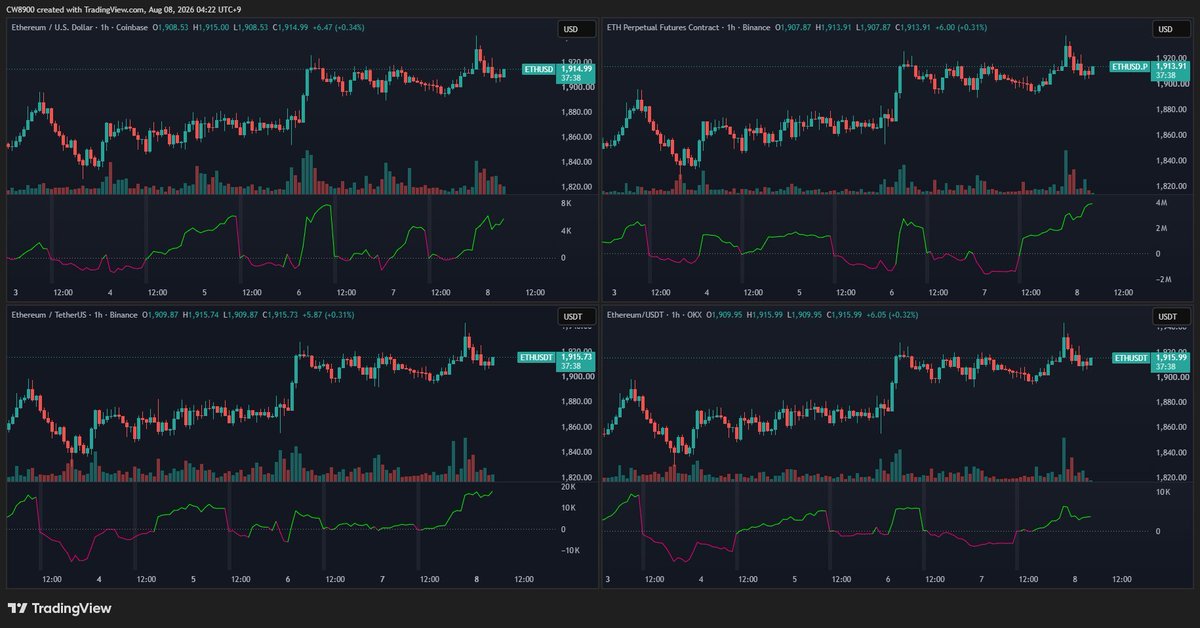
Ethereum demand is becoming hard to ignore.
Net ethereum:native buying has now increased for four consecutive days across nearly every major exchange.
🇺🇸 U.S. spot demand remains strong.
🟡 Binance users are accumulating.
🔵 OKX is seeing the same trend.
When buying pressure is this broad, it's no longer just an ETF story.
It's a market-wide rotation into Ethereum.
The question isn't whether demand is increasing.
It's whether supply can keep up.
Crypto feels alive again, but not convinced.
BTC is back around $65K and heading for its first green week in three, while macro is still driving most of the tape.
The setup is pretty simple:
bitcoin:native holds → alts get room to breathe.
BTC breaks resistance → rotation gets interesting.
Macro turns ugly → everyone remembers crypto is still a risk asset.
Right now, this feels less like euphoria and more like the market quietly rebuilding confidence.
And those are usually the weeks worth paying attention to!
The most underrated benchmark in AI isn't MMLU.
It's whether developers keep using the model after week one.
DeepSeek-V4-Flash becoming the default on Ollama Cloud makes sense.
⚡ 120+ tokens/sec
🔒 Zero data retention
💻 Long uninterrupted coding sessions
Those aren't flashy features - they're the things that determine whether a model becomes part of someone's daily workflow.
The AI race is quietly shifting from "Which model is smartest?" to "Which model disappears into your workflow?"
The best model isn't always the one with the highest benchmark.
It's the one you never have a reason to switch away from.
https://t.co/kGwIShbd8R
Everyone talks about agentic engineering.
Very few people actually practice it.
Karpathy's point at Sequoia Ascent 2026 wasn't that agents need better prompts - it was that production AI requires an engineering discipline: specs, evals, security, observability, and repeatable deployment.
Until now, the tooling lagged behind.
Building a real agent usually meant bouncing between your editor, terminal, browser, cloud console, deployment scripts, and a separate eval framework. Great for demos. Painful for production.
Google's new Agents CLI is one of the first attempts to solve that end-to-end.
From a few natural language prompts, it can:
• scaffold an ADK agent
• build a RAG pipeline
• generate evaluation suites
• measure hallucinations & citation accuracy
• deploy to Google Cloud
• enable observability with Cloud Trace
• register the agent across Gemini Enterprise
The biggest takeaway isn't that AI writes more code.
It's that evals become part of the default workflow.
If your agent can't prove it's retrieving the right context, citing sources correctly, and refusing to hallucinate when information is missing, it isn't production-ready.
We're moving from vibe coding → software engineering for AI agents.
That transition may end up being more important than the next model release.
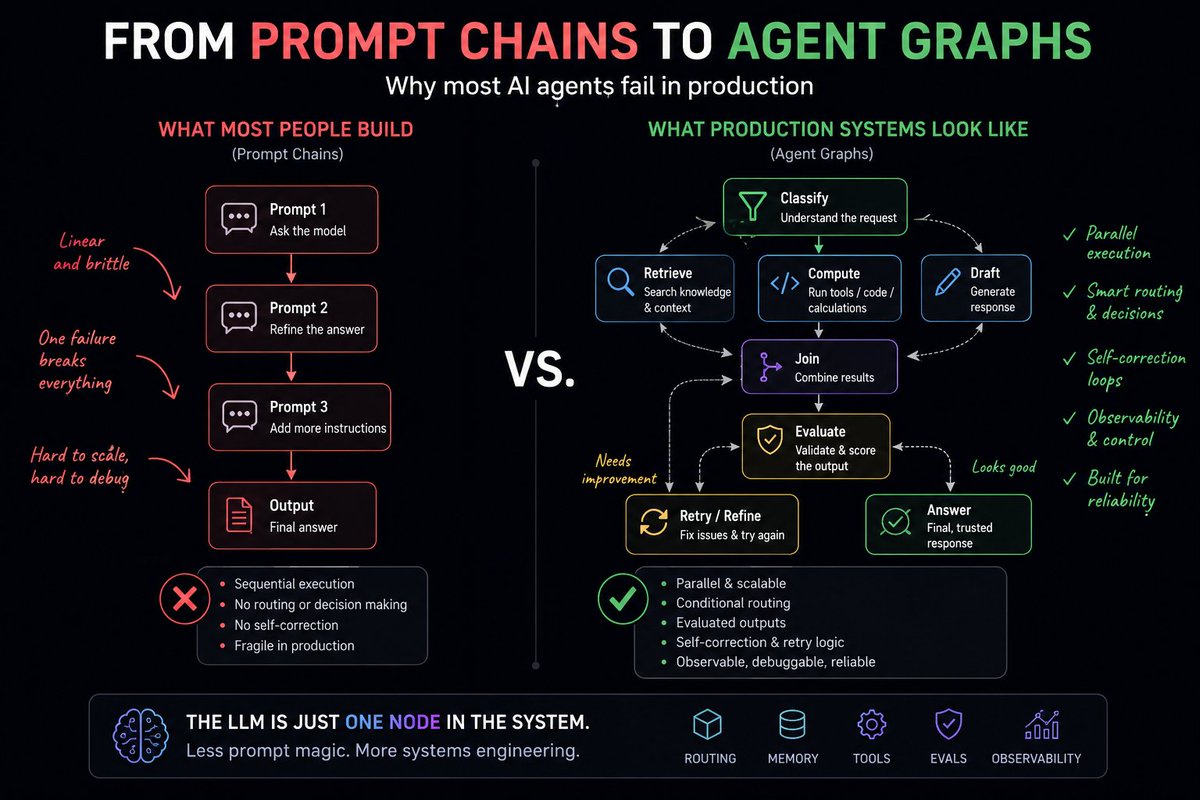
One diagram explains why so many AI agents fail in production.
Most people build:
Prompt → Prompt → Prompt → Output
Production systems look more like: Classify → Route → Parallel Tasks → Join → Evaluate → Retry → Answer
Less prompt magic is a key
📈 The charts are moving again.
Time for a fresh TA. After weeks of consolidation, bitcoin:native is testing a key area that could decide the next major move.
Here's what I'm watching:• Higher lows continue to hold
• Liquidity is building around recent highs
• Volume is returning after a quiet stretch
• A confirmed breakout could trigger momentum, while rejection likely sends BTC back into range
The next few daily candles matter more than the last few weeks.
What's your BTC outlook for the rest of August? 👀
We've spent years scaling context windows.The next frontier is memory.
This paper argues that memory isn't just retrieval - it's a continuous write → manage → read loop that lets AI agents learn from experience instead of starting from scratch every session.
It covers everything from retrieval-augmented memory and hierarchical memory to self-improving and policy-learned memory, along with the engineering challenges behind long-term agent behavior.
The biggest takeaway: Context helps an LLM answer.
Memory helps an agent evolve
Paper: Memory for Autonomous LLM Agents: Mechanisms, Evaluation, and Emerging Frontiers (arXiv:2603.07670)
coding agents are becoming a commodity very fast. the real competition now is who can understand a messy repo, make safe changes and not create 12 new bugs while fixing one 😅
Most people still use AI like a search engine.
The real unlock is treating it like a research partner.
Upload the docs.
Feed it whitepapers, specs, APIs, research papers, meeting notes, or your codebase.
Instead of asking an LLM to guess from its training data, you give it the exact context it needs.
The quality of the output isn't just about the model anymore.
It's about the context you provide.
Source: Karpathy
llama.cpp is one of the best repos for understanding what efficient LLM inference actually looks like below the API layer.
A few areas worth exploring:
• GGUF internals — how model weights, metadata, and quantization formats are packaged
• Quantization trade-offs — compare Q4_K_M, Q5_K_M, and Q8_0 across memory, latency, and output quality
• GPU layer offloading — tune --n-gpu-layers to find the right CPU/GPU split for your hardware
• KV-cache behavior — test how context length, batch size, and cache type affect throughput
• Backend performance — compare CUDA, Metal, Vulkan, SYCL, and CPU execution paths
• Server mode — run the OpenAI-compatible endpoint and benchmark it under concurrent requests
• Speculative decoding — experiment with draft models to reduce generation latency
Don’t just run a model. Profile it, change one variable at a time, and measure tokens/sec, time-to-first-token, RAM/VRAM usage, and quality degradation.
https://t.co/m8iMNO1bmC
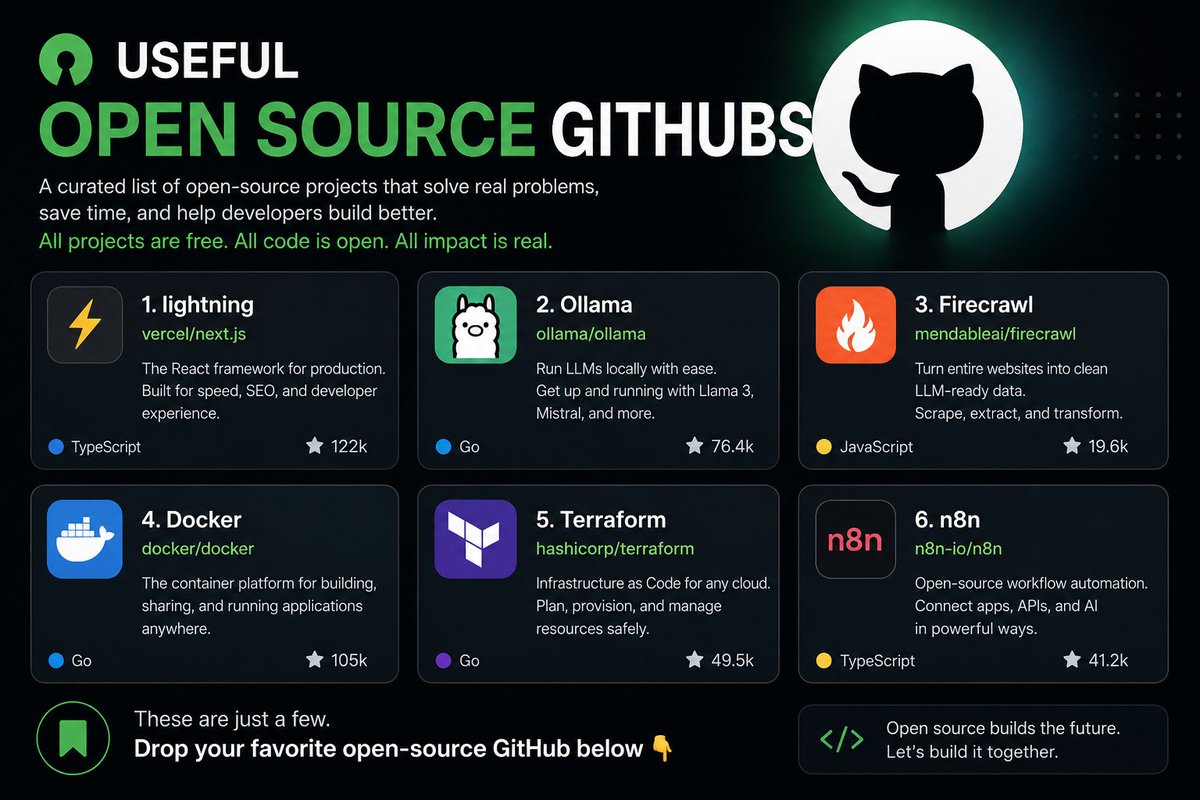
6 useful open-source GitHub projects worth bookmarking:
Next.js — production-ready React framework
https://t.co/bT8hSki6ro
Ollama — run LLMs locally
https://t.co/fgQWrnP9MI
Firecrawl — turn websites into LLM-ready data
https://t.co/aN2PmjhUzk
Docker — build and run applications in containers
https://t.co/oqwYegZWvx
Terraform — manage infrastructure as code
https://t.co/oatvwMxZ8H
n8n — open-source workflow and AI automation
https://t.co/bchfF86FCD
Open source is where some of the most useful developer tools are being built.
Which repositories should I document next?
Altcoins with real catalysts this week 👀
algorand:native — gaining momentum around the x402 ecosystem
sei-network:native — SIP-5 launch after its post-quantum upgrade
solana:3iQL8BFS2vE7mww4ehAqQHAsbmRNCrPxizWAT2Zfyr9y — still the dominant AI agent layer on Base, with Robinhood exposure
base:0x940181a94a35a4569e4529a3cdfb74e38fd98631 — 4 of the top 10 DeFi pools by volume
qubic-network:native — now available through Alchemy with zero purchase fees
casper-network:native — futures trading now live on Kraken
ethereum:0xd7efb00d12c2c13131fd319336fdf952525da2af — staked supply climbs to 10.5B
$PI — Mainnet preparing for Protocol v26
The best setups usually start before the wider market notices the catalyst.
Which one looks most underpriced right now?
You can use a non-custodial wallet and still have zero privacy.
Your keys may be protected, but your real name, phone number, address, old accounts, and public wallet connections can still expose you.
So I spent 12 hours deleting myself from the internet with Claude:
47 data broker listings removed.
12 dead accounts deleted.
3 unwanted search results buried.
Here is the exact step-by-step process:
Step 1: Map your digital footprint
Search your:
→ Full name
→ Email addresses
→ Phone number
→ Old usernames
→ Wallet-linked usernames
Take screenshots of every result.
Prompt:
“Categorize these results into data brokers, social media, dead accounts, public records, articles, and potential security risks. Rank them by deletion priority.”
Step 2: Remove data broker listings
Check sites like:
✦ Spokeo
✦ BeenVerified
✦ Whitepages
✦ MyLife
✦ PeopleFinder
These listings can connect your name, phone number, address, relatives, and previous locations.
That becomes much more dangerous when your public identity is connected to crypto.
Prompt:
“Write a GDPR or CCPA data deletion request for [data broker]. My information is: [details]. Include the relevant legal basis, identity-verification language, and a professional request for complete deletion.”
Step 3: Delete dead accounts
Every old forum, app, exchange, newsletter, and unused platform may still hold your personal data.
Use JustDeleteMe to find the deletion process.
Prompt:
“I want to permanently delete my [service] account. Explain the full deletion process and how to confirm that my personal data is deleted rather than the account only being deactivated.”
Step 4: Use privacy laws properly
Depending on your location, use:
✦ GDPR in Europe
✦ CCPA in California
✦ KVKK in Turkey
Prompt:
“Write a personal data deletion request under [GDPR/CCPA/KVKK] for [company]. Request deletion of my account, personal information, tracking data, marketing profile, and data shared with third parties. Include the required response period.”
Companies may ignore casual emails.
They take formal privacy requests much more seriously.
Step 5: Check whether your wallet is linked to your identity
Search for connections between your wallet and:
→ Your real name
→ ENS or SNS domains
→ Public donation pages
→ Old screenshots
→ Discord or Telegram usernames
→ GitHub profiles
→ NFT accounts
→ Public transaction posts
Prompt:
“Review these profiles and identify any information that could connect my wallet address to my real identity. Create a prioritized OPSEC cleanup checklist.”
Non-custodial does not mean anonymous.
Do not reuse the same username, profile picture, email, and wallet identity everywhere.
Step 6: Bury results that cannot be removed
Some articles, forum posts, and archived pages will not disappear.
In that case, create better content that outranks them.
Prompt:
“Generate five SEO content ideas using my name and profession. Analyze the keywords in this unwanted search result: [URL], and create content designed to rank above it.”
It can take a few months, but it can push unwanted results away from page one.
Step 7: Check breach exposure
Go to Have I Been Pwned and check your main email addresses.
Prompt:
“Analyze this breach list. Rank each breach by current risk and tell me whether I should change the password, enable 2FA, delete the account, rotate the email address, or take another action.”
For crypto users, prioritize:
→ Email security
→ SIM-swap protection
→ Hardware security keys
→ Unique passwords
→ Removal of exposed phone numbers
Step 8: Prevent future leaks
Use email aliases for new accounts.
Stop using one email address everywhere.
Separate personal and crypto identities.
Avoid posting wallet balances or transaction screenshots.
Never reuse the same username across personal, work, and trading accounts.
Remove metadata before uploading sensitive files or images.
Use stronger browser privacy settings.
Without AI, this can take weeks of finding opt-out forms, reviewing accounts, and writing repetitive legal requests.
With Claude, I did most of it in 12 hours.
Self-custody protects your assets.
Digital privacy protects the person holding them.