Kashmir Temple Reclamation Project
This is a list of Islamic monuments which stand on the sites of erstwhile Hindu temples in Kashmir division. Some Islamic monuments are those which have been built by utilizing plundered building material from Hindu temples. While there are other ancient temples whose surface level presence has been nearly completely eviscerated and the only way to get further insight into their existence is to order an ASI Survey. While this is a limited list of sites, an extended list shall be shared in the thread to this post or future posts. This listing is part of the seminal preliminary survey conducted by Sh. Sita Ram Goel.
Total of 53 sites have been identified in the Kashmir division/zone where following types of Islamic structures stand on temple sites or have been constructed using material from nearby temples:
1. Ziarats
2. Masjids
3. Dargahs
4. Stone Enclosures
5. Pleasure Haunts
6. Garden Pavilions
7. Garden Terraces
8. Ramparts
Amburber
1. Ziarat of Farrukhzad Sahib. Temple materials used.
Badgam
2. Ziarat of Abban Shah in Ghagarpur, Temple site.
3. Ziarat of Sayyid Swalia Shah in Narbai. Temple site.
Bijbehra, Anantnag district
4. Bijbehra, Masjid. Temple site.
Bumzu
5. Ziarat of Baba Bamdin. Convened Bhimakesava Temple.
6. Ziarat of Ruknu'd-Din Rishi. Converted temple.
7. Ziarat farther up the valley. Converted temple.
Gulmarg
8. Ziarat of Baba Imam Din Rishi. Temple materials used.
Gupkar
9. Ziarat of Jeysther and other monuments. Temple materials used.
Hutmar
10. Hutmar Jamii Masjid. Temple materials used.
Khonmuh
11. Several Ziarats. Temple materials used.
Kitsbom
12. Two Masjids. Stand amidst temple ruins.
Loduv
13. Loduv Ziarat. Temple materials used.
Lohar
14. Lohar Ziarat of Sayyid Chanan Ghazi. Temple Site.
Lokabhavan
15. Garden Pavilion. Temple materials used from Lokabhavana Tirtha.
Marsus
16. Ziarat of Shah Abdu'llah. Temple site.
Pampor
17. Ziarat of Mir Muhammad Hamadani. Vishnusvamin Temple materials used.
18. Several other Ziarats. Temple materials used.
Pandrethan
19. Pandrethan, Masjid. Meruvardhanaswamin Temple materials used.
Sangar
20. Sangar, Ziarat. Temple materials used.
Sar
21. Sar, Ziarat of Khwaja Khizr. Temple materials used.
Shalimar Garden, Banigam
22. Shalmar Garden, Pavilion on the Fourth Terrace. Temple materials used.
Srinagar – Srinagar city, which was an Ancient Hindu city now converted into a Muslim capital. The following monuments stand on temple sites and most of them have been constructed with temple materials:
23. Ziarat of Bahau'd-Din Sahib. Jayasvamin Temple converted.
24. Graveyard and its Gate below the Fourth Bridge.
25. Dargah and Masjid of Shah-i-Hamadani in Kalashpura. On the site of the Kali Temple.
26. Nau or Patthar-ki-Masjid built by Nur Jahan.
27. Graveyard near the Nau Masjid.
28. Ziarat of Malik Sahib in Didd Mar. On the site of Didda Matha.
29. Masjid, Madrasah and Graveyard near Vicharnag.
30. On the site and from materials of the Vikramegvara Temple.
31. Madni Sahib-ki-Masjid at Zadibal.
32. Ziarat south-west of Madni Sahib-ki-Masjid.
33. Jami Masjid originally built by Sikandar Butshikan and reconstructed in later times.
34. Ziarat named NUr Pirastan. Narendraswamin Temple converted.
35. Maqbara of Sultan Zain'ul-Abidin.
36. Maqbara of Zainu'l-Abidin's mother, queen of Sikandar Butshikan.
37. Ziarat of Pir Haji Muhammad Sahib, south-west of the Jami Masjid. Ranaswamin Vishnu Temple converted.
38. Ziarats of Makhclum Sahib and Akhun Mullah on Hari Parbat. Bhimaswamin Temple converted.
39. Masjid of Akhun Mullah built by Dara Shikoh.
40. Ziarat of Pir Muhammad Basur in Khandbavan. On the site of Skandabhavana Vihara.
41. Graveyard north-east of Khandbavan.
42. Dargah of Pir Dastgir.
43. Dargah of Naqshbandi.
44. Ramparts and Kathi gate of the Fort built by Akbar.
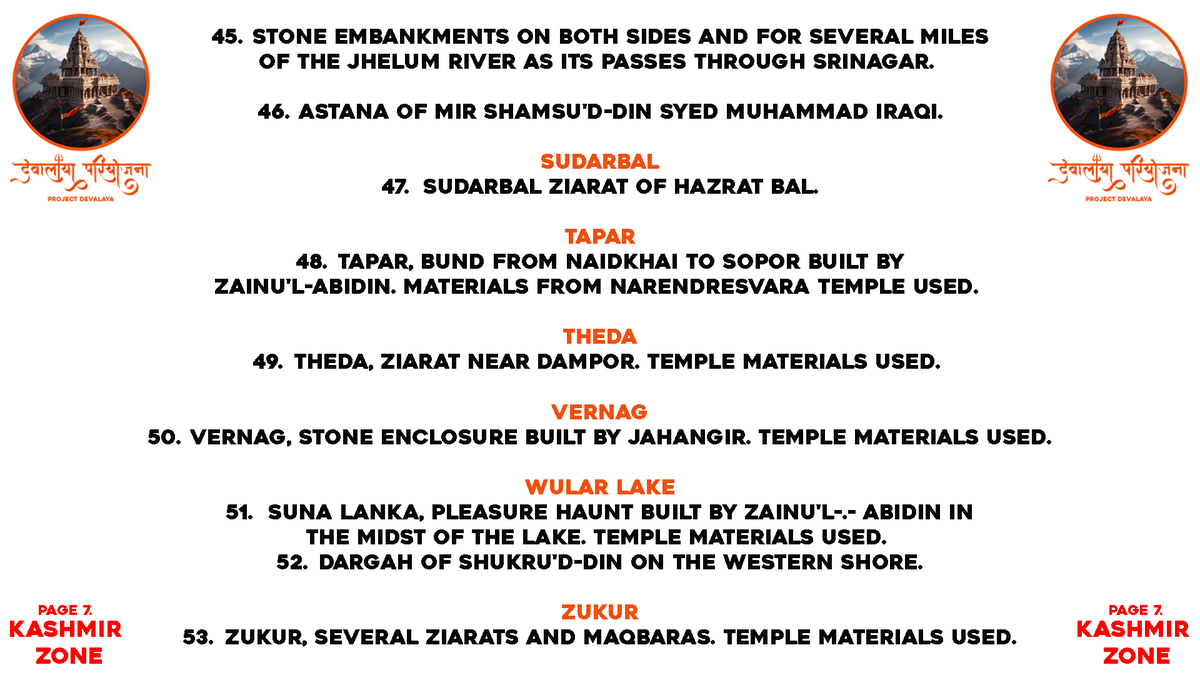
45. Stone embankments on both sides and for several miles of the Jhelum River as its passes through Srinagar.
46. Astana of Mir Shamsu'd-Din Syed Muhammad Iraqi
Sudarbal
47. Sudarbal Ziarat of Hazrat Bal.
Tapar
48. Tapar, Bund from Naidkhai to Sopor built by Zainu'l-Abidin. Materials from Narendresvara Temple used.
Theda
49. Theda, Ziarat near Dampor. Temple materials used.
Vernag
50. Vernag, Stone enclosure built by Jahangir. Temple materials used.
Wular Lake
51. Suna Lanka, pleasure haunt built by Zainu'l-.- Abidin in the midst of the Lake. Temple materials used.
52. Dargah of Shukru'd-Din on the western shore.
Zukur
53. Zukur, Several Ziarats and Maqbaras. Temple materials used.
Music: Shiv Natha Avinashay Kashmiri Bhajan by Inder Ji Kitroo
#देवालयापरियोजना #ProjectDevalaya #ReclaimTemples #KashmirTempleReclamationProject #Kashmir
देवालया परियोजना की परिकल्पना सनातनी- प्राचीन, मध्यकालीन, और आधुनिक मंदिरों को पुनः प्राप्त करने और बनाए रखने के लिए की गई है | संगठन के उद्देश्यों में पवित्र सनातनी कुंडों, गुफाओं और मैदानों की पहचान करना, उन्हें मुक्त कराना और उनका रखरखाव करना शामिल है। इसके अलावा, नदी और समुद्र के किनारे के क्षेत्रों, साथ ही पहाड़ी क्षेत्रों, पहाड़ी/पहाड़ की चोटियों और वन क्षेत्रों, जिनका सनातनियों के लिए ऐतिहासिक आध्यात्मिक महत्व है, उन्हें हिन्दूओं के आध्यात्मिक उपयोग के विशेष उद्देश्य के लिए संरक्षण के लिए चिह्नित किया जाएगा।
Project Devalaya has been envisaged to reclaim and maintain Sanatani; Ancient, Medieval and Modern Temples. The objects of the organisation include identifying, liberating and maintaining sacred Sanatani Kunds, Caves and Grounds. Further, river and sea-side areas, as also hill areas, hill/mountain tops and forest grounds which have historic spiritual importance to Sanatanis will be ear-marked for preservation for the exclusive purpose of spiritual use by Hindus.
श्री वासुदेव सवाई द्वारा ११ अगस्त २०१५ में स्थापित |
Founded by Sh. Vasudev Swain on the 11th of August, 2015.
CC: @AdvVasudevSwain
[Version 1 of our working Twitter Banner is attached.]
देवालया परियोजना की परिकल्पना सनातनी- प्राचीन, मध्यकालीन, और आधुनिक मंदिरों को पुनः प्राप्त करने और बनाए रखने के लिए की गई है | संगठन के उद्देश्यों में पवित्र सनातनी कुंडों, गुफाओं और मैदानों की पहचान करना, उन्हें मुक्त कराना और उनका रखरखाव करना शामिल है। इसके अलावा, नदी और समुद्र के किनारे के क्षेत्रों, साथ ही पहाड़ी क्षेत्रों, पहाड़ी/पहाड़ की चोटियों और वन क्षेत्रों, जिनका सनातनियों के लिए ऐतिहासिक आध्यात्मिक महत्व है, उन्हें हिन्दूओं के आध्यात्मिक उपयोग के विशेष उद्देश्य के लिए संरक्षण के लिए चिह्नित किया जाएगा।
Project Devalaya has been envisaged to reclaim and maintain Sanatani; Ancient, Medieval and Modern Temples. The objects of the organisation include identifying, liberating and maintaining sacred Sanatani Kunds, Caves and Grounds. Further, river and sea-side areas, as also hill areas, hill/mountain tops and forest grounds which have historic spiritual importance to Sanatanis will be ear-marked for preservation for the exclusive purpose of spiritual use by Hindus.
श्री वासुदेव सवाई द्वारा ११ अगस्त २०१५ में स्थापित |
Founded by Sh. Vasudev Swain on the 11th of August, 2015.
CC: @AdvVasudevSwain
[Version 1 of our working logo is attached.]
#देवालयापरियोजना #ProjectDevalaya


![DevalayaOrg's tweet photo. देवालया परियोजना की परिकल्पना सनातनी- प्राचीन, मध्यकालीन, और आधुनिक मंदिरों को पुनः प्राप्त करने और बनाए रखने के लिए की गई है | संगठन के उद्देश्यों में पवित्र सनातनी कुंडों, गुफाओं और मैदानों की पहचान करना, उन्हें मुक्त कराना और उनका रखरखाव करना शामिल है। इसके अलावा, नदी और समुद्र के किनारे के क्षेत्रों, साथ ही पहाड़ी क्षेत्रों, पहाड़ी/पहाड़ की चोटियों और वन क्षेत्रों, जिनका सनातनियों के लिए ऐतिहासिक आध्यात्मिक महत्व है, उन्हें हिन्दूओं के आध्यात्मिक उपयोग के विशेष उद्देश्य के लिए संरक्षण के लिए चिह्नित किया जाएगा।
Project Devalaya has been envisaged to reclaim and maintain Sanatani; Ancient, Medieval and Modern Temples. The objects of the organisation include identifying, liberating and maintaining sacred Sanatani Kunds, Caves and Grounds. Further, river and sea-side areas, as also hill areas, hill/mountain tops and forest grounds which have historic spiritual importance to Sanatanis will be ear-marked for preservation for the exclusive purpose of spiritual use by Hindus.
श्री वासुदेव सवाई द्वारा ११ अगस्त २०१५ में स्थापित |
Founded by Sh. Vasudev Swain on the 11th of August, 2015.
CC: @AdvVasudevSwain
[Version 1 of our working Twitter Banner is attached.]](https://pbs.twimg.com/media/GOyuAuLa0AAQZm1.jpg)
![DevalayaOrg's tweet photo. देवालया परियोजना की परिकल्पना सनातनी- प्राचीन, मध्यकालीन, और आधुनिक मंदिरों को पुनः प्राप्त करने और बनाए रखने के लिए की गई है | संगठन के उद्देश्यों में पवित्र सनातनी कुंडों, गुफाओं और मैदानों की पहचान करना, उन्हें मुक्त कराना और उनका रखरखाव करना शामिल है। इसके अलावा, नदी और समुद्र के किनारे के क्षेत्रों, साथ ही पहाड़ी क्षेत्रों, पहाड़ी/पहाड़ की चोटियों और वन क्षेत्रों, जिनका सनातनियों के लिए ऐतिहासिक आध्यात्मिक महत्व है, उन्हें हिन्दूओं के आध्यात्मिक उपयोग के विशेष उद्देश्य के लिए संरक्षण के लिए चिह्नित किया जाएगा।
Project Devalaya has been envisaged to reclaim and maintain Sanatani; Ancient, Medieval and Modern Temples. The objects of the organisation include identifying, liberating and maintaining sacred Sanatani Kunds, Caves and Grounds. Further, river and sea-side areas, as also hill areas, hill/mountain tops and forest grounds which have historic spiritual importance to Sanatanis will be ear-marked for preservation for the exclusive purpose of spiritual use by Hindus.
श्री वासुदेव सवाई द्वारा ११ अगस्त २०१५ में स्थापित |
Founded by Sh. Vasudev Swain on the 11th of August, 2015.
CC: @AdvVasudevSwain
[Version 1 of our working logo is attached.]
#देवालयापरियोजना #ProjectDevalaya](https://pbs.twimg.com/media/GOytAWcaYAAxU8c.jpg)


