Career update: I’m excited to share that I’ll be joining @mastra as a Platform Engineering Intern, starting next month!
AI agents are increasingly becoming distributed,stateful systems and I’m excited to work on the infrastructure that runs them in production.
Huge thanks to @calcsam@abhiaiyer for the opportunity.
I've come to realise that we can actually not always trust the disk. Occasionally individual bits will change by themselves, also sometimes the disk will lose power whilst writing and so only half a block will be written. Despite this, when you try and read it back it still appears perfectly fine. like No errors are recorded, although in fact the information is incorrect.
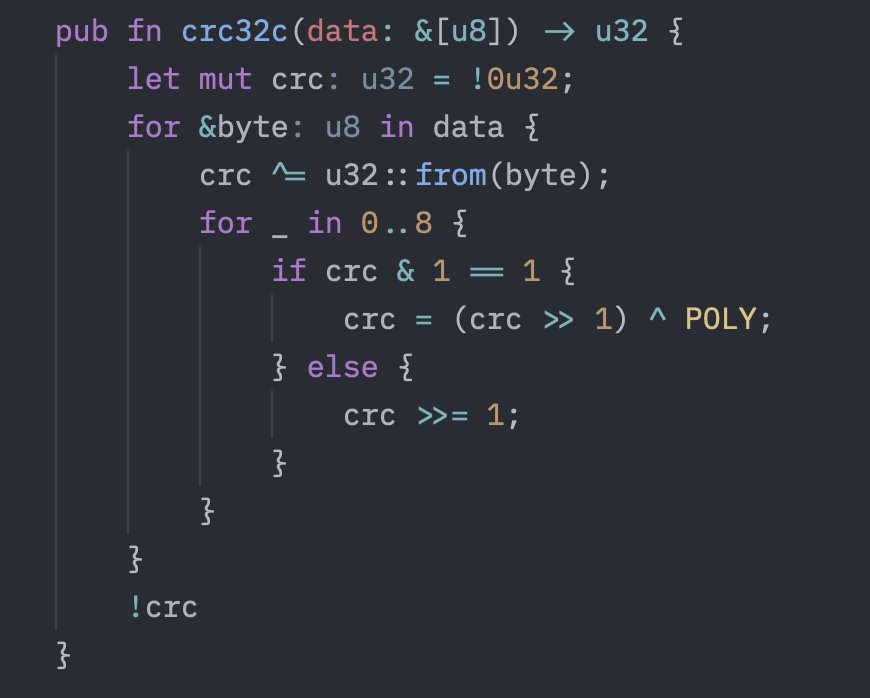
So currently I am implementing a basic ‘checksum’ method. like Whenever I write a 4kb block I input it into a CRC32c mathematical function. This takes the 4096 bytes of information and converts them into a small 4 byte value. We store this value. Then, when we reread the block we again pass it into the mathematical function and compare the result. Should there have been any changes to the block then these two values will differ. Rather than returning corrupted data, the system will therefore inform me that block x is corrupt.
Right now checksums just live in memory so i'll be needing somethig persistent later.
Working on a block store in Rust and I'm learning that "written" and "durable" are completely different things. 4KB writes go to the OS page cache which resides in RAM and takes about 3us to write.
A power cycle would lose that data. fsync (which is guaranteed by the OS to write the data to disk) takes approximately 3-4ms which is over 1000x slower. Thus, storage systems ack writes right away and only guarantee durability at a flush.
We decided to provide more transparency into pretraining progress at OpenAI for the sake of moving toward shared safety bars. In “Perplexity and Intelligence” I argue for common limits based on perplexity and other measurements, with progress beyond them gated on our ability to understand AI behavior.
https://t.co/XX35m5vq89
Working on a block store in Rust and I'm learning that "written" and "durable" are completely different things. 4KB writes go to the OS page cache which resides in RAM and takes about 3us to write.
A power cycle would lose that data. fsync (which is guaranteed by the OS to write the data to disk) takes approximately 3-4ms which is over 1000x slower. Thus, storage systems ack writes right away and only guarantee durability at a flush.
So I am building a block store system called Acheron (🦂) (inspired by Crucible @oxidecomputer) .
So the idea is that it replicates a single virtual disk across 3 machines where every write is made to all 3 replicas which means that if one node experiences delays, or fails, the other nodes can continue serving the disk.
I'm particurly interested to see how the system performs when the amount of traffic doubles, or when one of the replicas becomes 10x slower. Although most requests may be handled quickly, a few requests may take 100x longer and if your request falls into this category, it will be slow.
How can we reduce this tail latency without affecting throughput? I'm looking at limiting the number of requests that can be in the queue, making reads wait 50 writes behind, and either throttling fast replicas or allowing them to proceed while the slow replica catches up. For each of these I will compare performance with a baseline implementation. The baseline will allow unlimited requests, and perform requests in the order they arrive. I will set fixed random seeds in order to replicate the same workloads, create failure scenarios, and generate plots showing p99.9 latency and throughput. Ideally reads will represent the writes, once a flush has completed, data should exist in 2 of the 3 disks, and every block will have a checksum so any bad reads are detected before being returned to the caller. I am making this project to improve my knowledge of Rust, system programming, storage and performance engineering. Storage has many interesting elements to learn from such as stalled disks, lost packets, and process failure. This is a learning project, so I will post updates on what I discover throughout this project.
there is nothing in entertainment that compares to Game of Thrones for me.
The music transports me to so many moments. I Hated characters that ended up being some of the most complex. People I rooted for even when knowing the show usually treats hope like a game.
I miss the bliss of not knowing what happens next. Getting completely lost in its world.
I'd give anything to be able to experience it for the first time again.
pro tip if you’re doing cold DMs for a job: when you copy and paste the same message to multiple people, make sure you change the name so you’re addressing who you’re sending it to. my name isn’t Andrew