This is a superficial and ultimately destructive way of framing the problem.
Women deal with the profound biological burden of reproduction: menstruation, pregnancy, childbirth, and menopause. That is real, costly, and non-negotiable. No serious person denies it.
But the complementary burden that has fallen on men for the entire history of our species is equally non-negotiable and far more lethal.
Men have been the ones who die in war — by the tens of millions. Conscription, combat, and the obligation to stand between the tribe and existential threat have been almost exclusively male responsibilities.
Men occupy the overwhelming majority of the most dangerous occupations on the planet: commercial fishing, logging, mining, roofing, heavy construction, oil-rig work, long-haul trucking. The workplace fatality statistics are not subtle. Year after year, 90–95 % of occupational deaths are male.
Men also take more physical and psychological risks. That is why they invent more, explore more, and die younger — from accidents, from violence, from suicide. The male suicide rate is not a minor footnote; it is a catastrophic and chronic reality.
These are not interchangeable complaints. They are complementary sacrifices. One sex carries the primary cost of creating new life. The other sex carries the primary cost of protecting that life and extracting the resources necessary to sustain it from a dangerous and indifferent world.
To reduce the entire male side of this ancient division of labour to “what do men deal with?” as if the answer were “nothing of consequence” is not compassion. It is a deliberate refusal to look at the hierarchical and sacrificial structure of reality itself.
The proper response is not grievance. It is gratitude for the complementary burdens that have kept the species alive, and the individual responsibility to carry one’s own share of them without self-pity.
🦔AI companies are bulk-buying rare books, scanning them through high-speed machines that cut the spines off, and shredding the originals. A service called ISBNdb facilitates orders of up to a million books and keeps buyers anonymous. Pre-2022 books are premium because they're free of AI-generated text. A federal judge ruled the practice is fair use because eliminating the original means only one copy exists at a time. Anthropic hired the former head of Google Books partnerships to obtain "all the books in the world."
My Take
This got to me. A bookseller told 404 Media that rare books with almost no surviving copies are being fed into this pipeline. Books that survived wars, fires, and centuries of handling are being shredded so an AI can learn to write a better marketing email.
ISBNdb's website literally says "'AI company destroys two million books' is not a headline that generates sympathy," and they still built an entire business around making it happen quietly. They offer NDAs as a feature. They coach clients to call it "digital preservation."
I've covered AI companies scraping the internet, torrenting libraries, and stealing music. This is worse because it's irreversible. You can re-upload a website. You can reprint a bestseller. You can't replace the last three copies of an 18th-century botanical text once someone shreds them for training data. And the judge said it's legal. So it's going to accelerate.
"We shred rare books and offer NDAs so nobody finds out" is a legitimate business model in 2026. What a timeline.
Hedgie🤗
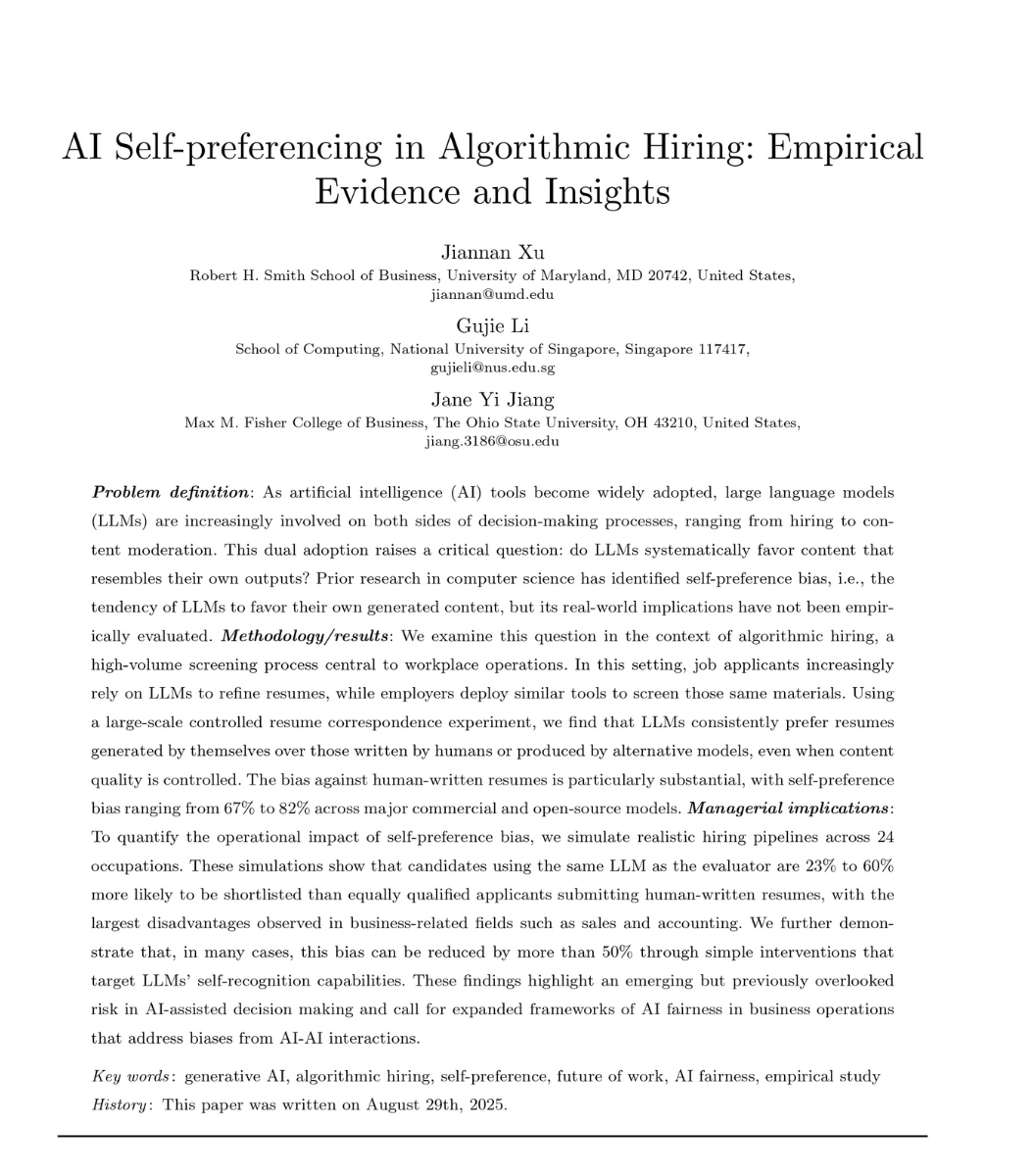
Researchers sent the same resume to an AI hiring tool twice. Same qualifications. Same experience. Same skills. One version was written by a real human. The other was rewritten by ChatGPT.
The AI picked the ChatGPT version 97.6% of the time.
A team from the University of Maryland, the National University of Singapore, and Ohio State just published the receipt. They took 2,245 real human-written resumes pulled from a professional resume site from before ChatGPT existed, so the human writing was actually human. Then they had seven of the most-used AI models in the world rewrite each one. GPT-4o. GPT-4o-mini. GPT-4-turbo. LLaMA 3.3-70B. Qwen 2.5-72B. DeepSeek-V3. Mistral-7B.
Then they asked each AI to pick the better resume. Every model picked itself.
GPT-4o hit 97.6%. LLaMA-3.3-70B hit 96.3%. Qwen-2.5-72B hit 95.9%. DeepSeek-V3 hit 95.5%. The real human almost never won.
Then the researchers tried the obvious objection. Maybe the AI is just better at writing. So they had real humans grade the resumes for actual quality and ran the experiment again, controlling for it. The result was worse. Each AI kept picking itself even when human judges rated the human-written version as clearer, more coherent, and more effective.
It gets worse. The AIs do not just prefer AI over humans. They prefer themselves over other AIs. DeepSeek-V3 picked its own resumes 69% more often than LLaMA's. GPT-4o picked its own 45% more often than LLaMA's. Each model can recognize and reward its own dialect.
Then the researchers ran the simulation that ends careers. Same job. 24 occupations. Same qualifications. The only variable was whether the candidate used the same AI as the screening tool. Candidates using that AI were 23% to 60% more likely to be shortlisted. Worst gap was in sales, accounting, and finance.
99% of large companies now run AI on incoming resumes. Most of them use GPT-4o. The paper just proved GPT-4o picks GPT-4o 97.6% of the time.
If you wrote your own cover letter this week, you did not lose to a better candidate. You lost to a worse candidate who paid OpenAI 20 dollars.
Your qualifications do not matter if the AI prefers its own handwriting over yours.
이거 진짜 맞는 듯
나 하루 36시간처럼 쓰는 사람인데 이거 버릇들일 때까지 매일 30분 단위로 기록했음
생각보다 하루가 너무 길고 할수있는 일이 많음
그때 단 2년 동안에 남들 5년 할 일을 했다고 자부함
이후로 그냥저냥 좀 단순화된 하루를 살아도 되는 짧은 기회가 있었는데 그 때의 기억은
아침에 기상 > 밥먹고 하루시작 > 대충 하루 > 잠자기
이렇게만 기억에 남았음
그리고 그 시기 분명 꿀같은 3개월이었는데
체감 “2주” 같았음