Everyone shows you what Hyperliquid whales do. We show you if it worked: accumulation → signals → win rate → sentiment → scoreboard
Track Smart Money live👇
I spent two years being an exit liquidity for better traders.
So I started building a tool that shows what the best Hyperliquid wallets are doing, and grades whether it actually worked. Including the weeks it didn't.
The long version.
Courses, groups, signal channels — not one of them ever showed a number you could check. And in trading you're alone with your own decisions. Unless you have a mentor, or get to watch an experienced trader at work, you get into trouble fast. I did.
I wanted to read market sentiment. Not the crowd's, most traders lose money long term. I wanted the sentiment of the best.
That's the hard part. Not every million-dollar portfolio knows what it's doing. So I started building filters to separate the truly profitable wallets from the merely big ones. Every wallet gets scored on its full history: risk-adjusted return, drawdown, consistency, tenure.
That's how Smart Money Wallet Scanner started. Today it's DexiScan.
What I wanted to know:
What are they buying?
What are they selling?
Are they taking on risk or derisking?
Why not just copy a few whales? Because they're human. Even the best ones get it wrong.
So I don't follow any single wallet. I track almost 200 vetted wallets and watch for the moments when 3 or more of them lean the same way on the same coin. Say, short BTC.
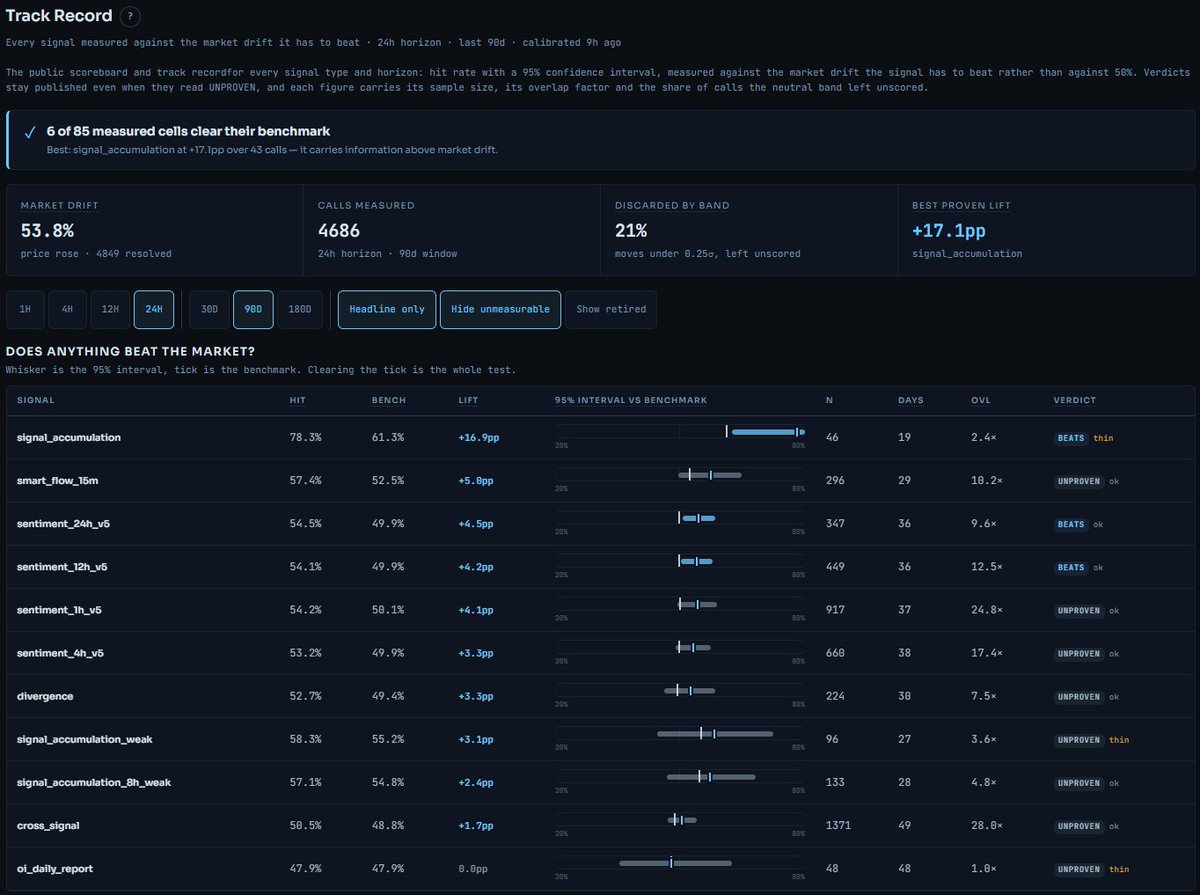
Does a group beat one wallet? That's exactly what I test. Every call gets graded: MFE, MAE, R:R and PnL on a fixed horizon. Hit rate is measured against the real base rate, which isn't 50%.
Each one ends up BEATS, INVERTED or UNPROVEN. Right now a lot of them say UNPROVEN, and that's public too. I'd rather show you that than a screenshot of one good week.
I built this because I needed it. Today anyone can use it.
Every whale signal on DexiScan has a small tag next to it. I'd read it before anything else.
CONVICTION: more wallets or more money piling in, and nothing in the data pushing back. The cleanest of the four.
ABSORPTION: whales buying the dip while price dumps hard, or shorting a hard pump. They think the move went too far.
COVERING: the "buying" is mostly shorts closing. Not many fresh longs behind it.
NOISE: something like 3 wallets one way, 2 the other, small money. Basically a coin flip.
No tag = not enough data to say.
The tag doesn't kill the signal, it stays on the page either way.
And yes, we tag our own signals as noise :)
When the wallets we track put more new risk on a coin in 15 minutes than in 95% of that coin's 15-minute windows, we flag it as a flow burst.
Each coin is measured against its own history, so the same dollars can be a burst on a small cap and nothing on $BTC.
In the last 2 days:
$ZEC bearish burst, Nov 10 14:47 UTC: -12.0% four hours later
$HYPE bearish burst, same minute: -2.0%
$BTC bullish burst, Nov 10 13:41 UTC: -1.1%, a miss
A burst means the whales moved fast and together. Whether they were right shows up 4 hours later, and we grade every one, misses included
Bursts land on the Updates page and in members' Discord the moment they fire, with the 4h grade added later: https://t.co/yjZr0clb75
No hit rate from us yet, this row of the scoreboard keeps flipping its verdict.
When the wallets we track put more new risk on a coin in 15 minutes than in 95% of that coin's 15-minute windows, we flag it as a flow burst.
Each coin is measured against its own history, so the same dollars can be a burst on a small cap and nothing on $BTC.
In the last 2 days:
$ZEC bearish burst, Nov 10 14:47 UTC: -12.0% four hours later
$HYPE bearish burst, same minute: -2.0%
$BTC bullish burst, Nov 10 13:41 UTC: -1.1%, a miss
A burst means the whales moved fast and together. Whether they were right shows up 4 hours later, and we grade every one, misses included
15 wallets bullish on $NVDA vs 1 bearish, $1.8m vs $9k, all 15 opening or adding longs. It sits near its 7-day low.
NVDA is -3.8 % in 24h. Yesterday's 8 new longs are -2.1 % now, 7 of 8 at a loss, after +1.4 % at the brief.
$HYPE is near its 7-day low too, -3.9 %. 18 wallets bullish vs 9, $2.3m vs $549k. 4 covered shorts, all in profit, $177k realized. The 14 new longs are -10.3 % at the run.
By wallet count 128 long vs 53 short, 41 % long-biased vs 43 % yesterday. In dollars $121.7m long vs $83.0m short, exposure +0.19 both days.
We'll check today's 15 NVDA longs in tomorrow's brief.
A whale signal on DexiScan has an end, and the wallets that fired it decide when.
ACTIVE: the wallets behind it still hold. The idea is still theirs.
WEAKENING: they're cutting size. Profit or nerves, the risk is coming off.
INVALIDATED: they're out. If you're still in, you're holding it alone.
Two things can end a signal, all fixed the moment it fires:
the wallets behind it close
a wave of wallets opens the opposite side on the same coin
On invalidation, the exit price locks and publishes, so the result can't be edited later.
Last 30 days: 19 closed signals, 13 in profit (68.4%).
How to read the whales #2. Next: the label we put on every signal, noise included.
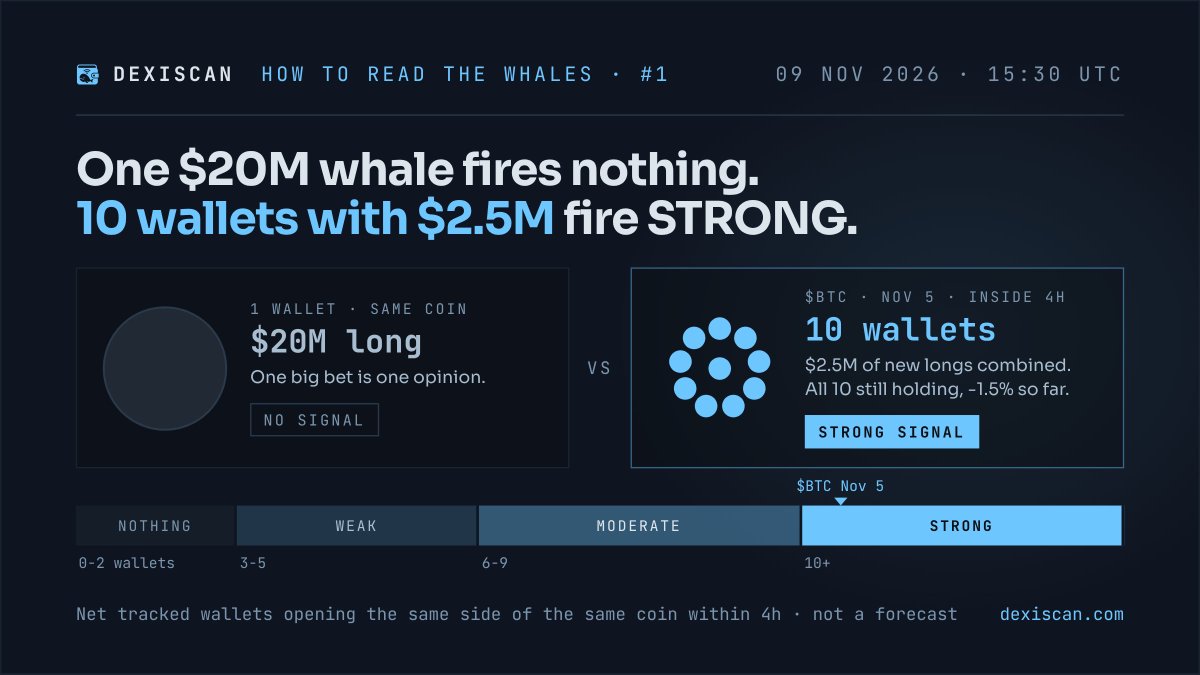
10 whales opened $BTC longs within the same 4 hours on Nov 5, $2.5M between them. A single whale with a $20M long would never have fired that signal.
That's how our whale signals work. We count wallets, not dollars.
A signal fires when the net number of tracked wallets opening the same side of the same coin within 4 hours reaches 3.
3-5 wallets: WEAK
6-9: MODERATE
10+: STRONG
Why heads and not size: by dollars, one wallet with a $1M position outvotes nine wallets with $100K each. One big bet is one opinion. Ten wallets from a cohort that's up $31.6M combined, doing the same thing in the same window, is a lot more than that.
So a single whale alert tells you somebody is confident. A STRONG signal tells you the cohort is.
That $BTC one is -0.4% so far and still active. A crowd can be wrong too, which is why we grade every signal
1# part of series: How to read the whales. Tomorrow: what happens when the wallets leave.
We are still testing and tracking whales on Lighter too.
162 wallets, 117 of them in positions right now: $38.2M open, $23.8M long, $14.4M short.
$BTC: 28 long, 16 short, $11.0M
$LIT: 14 long, 11 short, $4.0M
$QQQ: 4 long, 6 short, $3.8M
$ZEC: a single $2.0M long is up $1.07M unrealized.
On $LIT, Lighter's own token, the biggest position is a $1.9M short, +$841K.
The overview has an option to switch now: ALL (all exchanges available in DexiScan), Hyperliquid, Lighter) + more exchanges in the future.
Whales sold the chip pump and bought the $NVDA dip.
$SOXL ran +23% in 24h. 10 wallets cut their longs, 8 of them in profit, $241k realized. Nobody opened a short.
$NVDA sits near its 7-day low. 10 wallets bullish vs 2, $934k vs $23k, 8 fresh longs.
130 wallets long, 51 short, about the same as yesterday. In dollars $125m long vs $85m short, a bit lighter.
We'll check on those 8 $NVDA longs in tomorrow's brief.
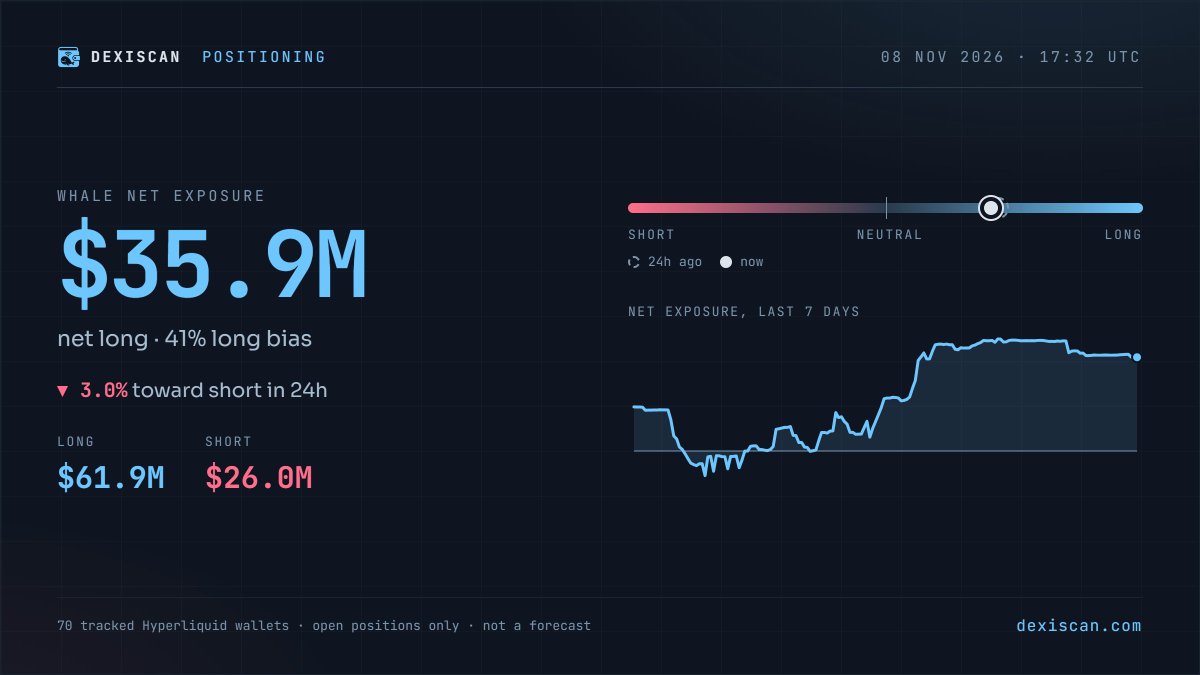
Whale bias went from 17% long to 40% long in a week.
The rest of Hyperliquid went the other way: longs closed on 53 of 120 coins, -$194.8M of open interest.
What the 70 wallets we track did:
$63.5M long vs $26.9M short now
$HYPE moved $17.7M toward long, the biggest shift of the week
$BTC open interest +$115.0M with price -2.8%, so the market was opening shorts. Our whales cut $6.6M of theirs
$606K realized on closes and trims
On Oct 19 the same book was 23% short.
@siyangnamulat The wallets have been purged of market makers, copy traders, hedged wallets, and bots :)
So, on the other hand, it's the result of multiple walllets sharing the same bias or sectors for the inputs
10 whales opened $BTC longs within the same 4 hours on Nov 5, $2.5M between them. A single whale with a $20M long would never have fired that signal.
That's how our whale signals work. We count wallets, not dollars.
A signal fires when the net number of tracked wallets opening the same side of the same coin within 4 hours reaches 3.
3-5 wallets: WEAK
6-9: MODERATE
10+: STRONG
Why heads and not size: by dollars, one wallet with a $1M position outvotes nine wallets with $100K each. One big bet is one opinion. Ten wallets from a cohort that's up $31.6M combined, doing the same thing in the same window, is a lot more than that.
So a single whale alert tells you somebody is confident. A STRONG signal tells you the cohort is.
That $BTC one is -0.4% so far and still active. A crowd can be wrong too, which is why we grade every signal
1# part of series: How to read the whales. Tomorrow: what happens when the wallets leave.
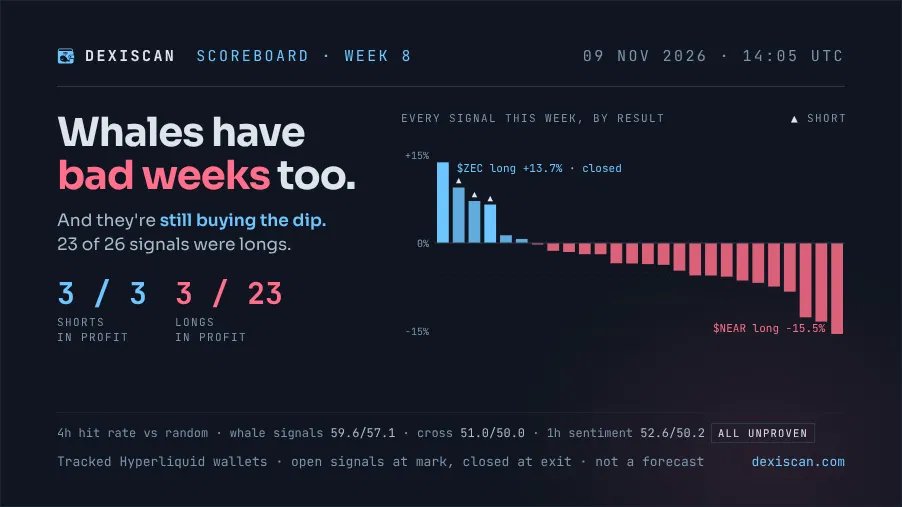
This week was not good for whales. No one is 100% right every time, and neither are whales.
Signals closed last week look promising, but still open ones look a bit worse.
26 signals fired this week. 3 were shorts, and all 3 are in profit. Of the 23 longs, 3 are.
Worst open one: $NEAR long from $4.20, -15.5%.
All 47 signals of the last 30 days, open ones included: 17 in profit, median -1.9%.
Whales are still buying this dip. A few months later, they were super bearish, so these guys aren't just blindly bullish believers.
🚨 LATEST: Galaxy’s Alex Thorn says Bitcoin has slipped back below its 50-week average, but the last two times this happened after a bear bottom, prices never set a new low.
@Stefan_B_Trades The Hyperliquid whales we track still lean long $BTC, $22.5M vs $8.4M short, but 2 wallets added $7.5M of shorts in 24h.
Taking 73,333 is about 1.4% down, and longs at 14.7x average leverage sit near 7% from liquidation, so a sweep alone wouldn't flush them.
@yangchu74487568@KanikaBK I think that 64GB of RAM is still insufficient. I have this setup, and I'm fully on Anthropic. And I do not go under 35-40GB RAM. Cannot imagine to use local model on your HW and do something other than sending emails or performing some other mindless tasks
I dont know... Are u able to run Ollama with some usable reasoning on your personal laptop for example with 16GB RAM? Really?
In my opinion for like developing is goot to have 2 diferent subscritpion, one fully set up for your projects, and the odther for independend testing and debuging.
2 different models, two different outputs