Honored to contribute to the Advanced Functional Materials special issue celebrating Prof. Ramamoorthy Ramesh's 65th birthday.
Pseudo-c/a domain walls (like those in lead-based materials) in lead-free BiFeO₃ and electrically switchable.
https://t.co/ciKhBSy6tO
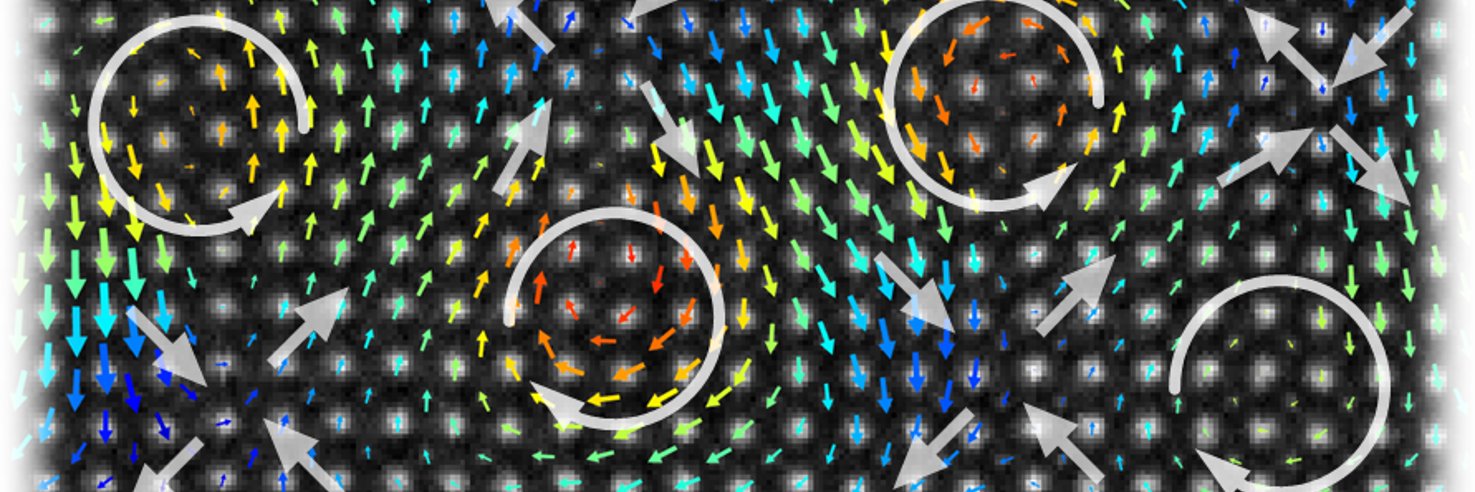
Our new BFO paper published in Advanced Materials, focusing on "Emergence of Polar Vortex-Antivortex Pair Arrays in Multiferroic Superlattices"
https://t.co/Unfi23eZyu
Our work on the achievement of room-temperature out-of-plane ferroelectric SrTiO3 thin films with giant tetragonality (c/a ~1.061) via combining effects of the strain engineering and defect engineering.https://t.co/cxx7Nf63hA
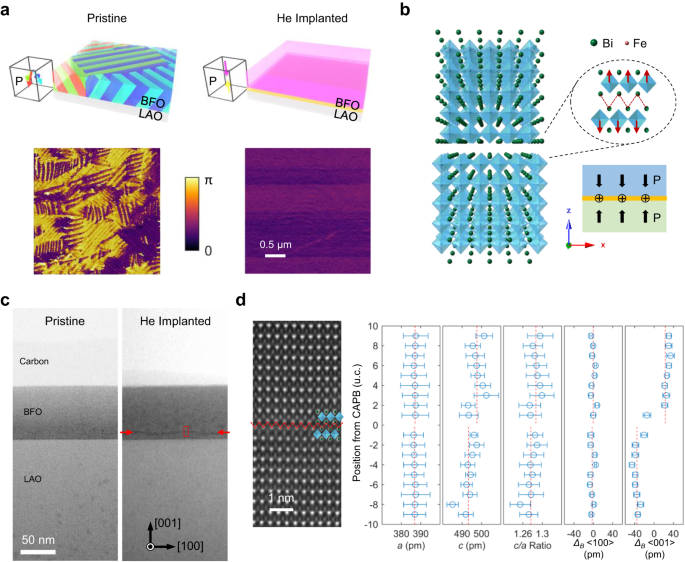
Congrats to Xiangbin and Chao. Using He-ion implantation process to fabricate in-plane charged antiphase boundary and 180° domain wall in BiFeO3 thin films.
https://t.co/ELaC2OfIbR
Our recent work on domain control: Deterministic manipulation of four-state polarization switching in multiferroic BFO thin films with 71° stripe domains.
https://t.co/2Wx5tiyDag
Congrats to Yongjian! Boost the energy storage density through the He ion implantation induced polar nanodomains in PbZrO3 thin films.
https://t.co/HbKWWCz3f4
The preview from Prof. Ying-Hao Chu on our @Matter_CP paper: "This result extends the possibility of compatibility with commercial substrate, offering a significant and practical breakthrough in the development of strain engineering."
https://t.co/s8JbboXxco
.@Deyang_Chen & coworkers overcome commercial substrate limitations & achieve continuous strain tunability of complex oxides in #MatterIssue22! #StrainEngineering#SCNU
Read it here: https://t.co/vtP768QfmA
This approach could also be used to replace the expensive single-crystal substrates (such as DyScO3, NdScO3, etc.) by growing these films on cheap LaAlO3 or SrTiO3 substrates using polycrystalline scandate targets.
https://t.co/qJNdk8IA17
Big congrats to Xiong Deng and Chao Chen. Our paper has been just published in Matter @Matter_CP@CranfordMATTER
The motivation includes:
1. Overcoming the commercial substrate limitations
2. Achieve continuous strain tunability
https://t.co/qJNdk8IA17