I’m a Ph.D. student at the University of Southern California, advised by Jonathan May and Jesse Thomason. My research focuses on self-improving agents.
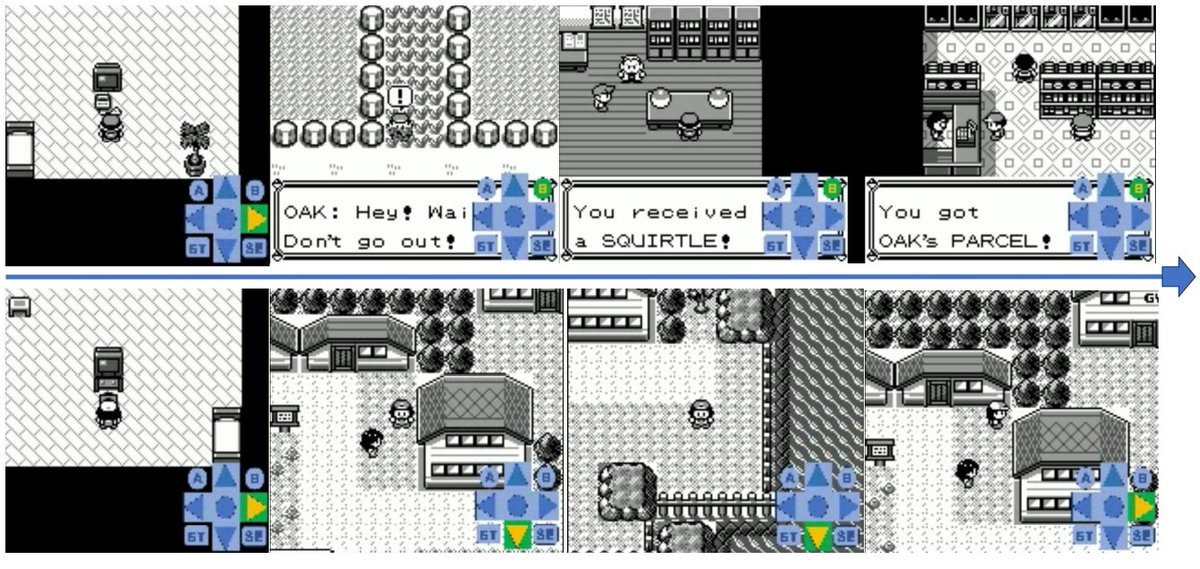
Introducing GameBoyWorlds, a new challenge testbed for self-improvement in embodied video games:
Paper: https://t.co/05Fpom1OM1
Website: https://t.co/qFUZfld80b
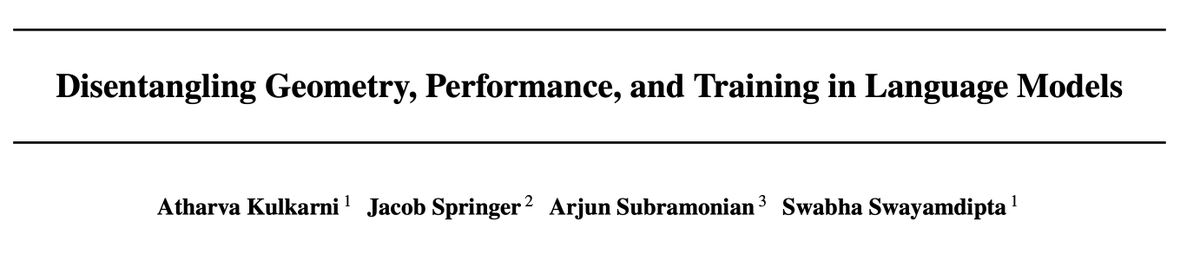
Is the geometry of language model weights really predictive of performance?🔍
Our new work challenges the popular hypothesis that low rank unembedding matrix hurts LLM performance; and the answer is more complicated than you'd think!
https://t.co/0YxcZmNpfb
(1/8)
Modern businesses run on spreadsheets. Can AI handle financial spreadsheet construction?
We’re excited to share MBABench 2.0: 101 difficult, long-horizon tasks (take up to 33h) across 6 finance areas and most financial model types.
The best AI agent passes only 16% of the tasks
How do you build the most diverse UMI dataset in robotics?
In the last 8 weeks, we scaled an international UMI data collection operation from 5 to 90 operators, built out a dataset of over 1M+ unique tasks, and continue to capture over 45k+ new tasks each day.
Robotic World Models require much higher diversity of tasks than imitation learning. Here's the why and how behind our operations. 🧵
Our next steps are to develop a self-improvement algorithm that works across games and create an agent that can acquire knowledge and clear games without relying on pretraining knowledge.
If you'd like to contribute, start here: https://t.co/BKlp0dIbdo
Introducing GameBoyWorlds, a new challenge testbed for self-improvement in embodied video games:
Paper: https://t.co/05Fpom1OM1
Website: https://t.co/qFUZfld80b
We see a drastic difference in progression between classic games and ROM hacks. For example, while in Red, the agent clears several key milestones (obtains a starter, reaches the next town, etc.), the very same agent fails to even receive a starter in Brown.
My first PhD paper, 'Sparse Layers are Critical to Scaling Looped Language Models,' is accepted at NeurIPS 2026! Looping & early exits enables adaptive depth; MoE makes it scale. First step toward compute-adaptive LMs.
w/ @jbiloki@edwardjhu@jonathanmay
https://t.co/bjxI5K1siX
We (@PantheonInc) have been working on a robotics data quality pipeline that uncovered a series of major problems in public robotics datasets, especially for world modeling.
To improve the quality of data available to open-source robotics, we're publishing annotations for four of the most popular datasets. Some examples of issues, and our report 🧵
🚨 New paper: Language Models Can Predict Their Own Behavior (NeurIPS 2025).
sequence-level
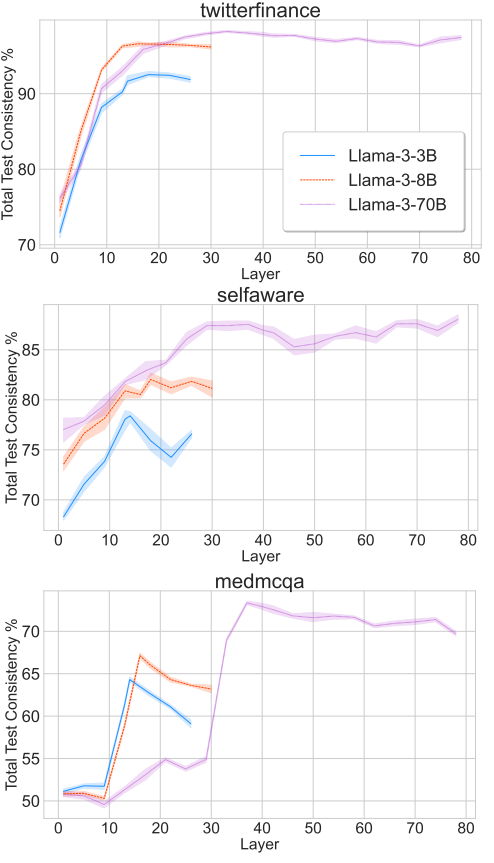
LMs "make up their minds" sooner than we thought. Despite being trained to predict the next token, hidden states are predictive goldmines for a range of sequence level behaviors. 🧵
Excitingly, the probe performance scales with model size. The hidden states of larger models contain clearer signals on how the model is going to behave: