The Soviet Union’s collapse made India rethink its experiment with state planning. China’s rise may force it to rethink caste-based affirmative action as well. [My take] v @WSJopinion
https://t.co/8E5FXkQQ7P
With the takeoff of @SkyrootA’s Vikram-1 rocket, India has become the third country (after the U.S. and China) to develop orbital launch capability in the private sector.
My 2¢ on this Mint graphic:
1. India isn’t stuck. Per capita income has risen steadily, and at a faster clip than before over the past 35 years. At some point in the coming years India will almost certainly transition to upper-middle-income status.
2. We should stop comparing India to high-growth East Asian economies like China or Vietnam, or Taiwan and South Korea at a similar stage of development. India has decisively lost the per capita GDP race with these economies. India’s peer group includes Indonesia, the Philippines and Bangladesh, basically the Asian second tier.
3. Because India is so large, even relatively modest per capita GDP gains mean large gains in total GDP. In absolute terms, India will remain a significant economy, considerably weightier than its per capita GDP peers.
@LaterAgitator India is not growing nearly as fast as China was growing at a similar level of per capita income. The Chinese economy grew at about 10% a year between 1979-2008. India has never experienced an extended period of such rapid growth.
@halleyji@makmd Yes. It’s no coincidence that VP Singh accepted Mandal’s recommendations at the fag end of India’s failed experiment with socialism. In hindsight, you could view it as a cynical decision in a hopeless time.
@swatantra54 Did you read the piece? I do not think caste-based quotas will disappear. I think it would be good for India if they disappeared, even though this is unlikely to happen.
From @WSJopinion: India’s affirmative-action lesson for America: Quotas hold the country back, even as China’s meritocracy fuels its economic advancement, writes @dhume
https://t.co/ScsfwRAvmB
Every few years, India trots out a new initiative that’s supposed to cut red tape and loosen the bureaucracy’s death grip on the economy. These efforts end up going nowhere because the people in charge of changing the system are the same people who benefit most from the system.
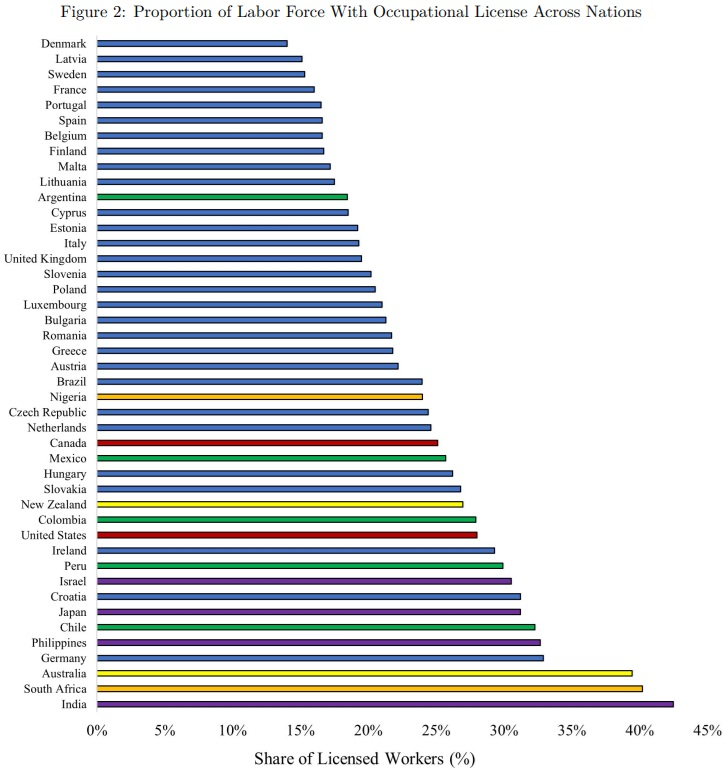
Until 1991, India was the License Raj: If you wanted to operate a business there, you needed to obtain a license, and those took a long time and cost a lot.
Perhaps one of the legacies of that era is that India is still the top-ranked country for workforce licensure.
@somnath1978 There may be a vague elite consensus that this is a suboptimal arrangement. I’m not sure that there’s an elite consensus that quotas hobble India’s competitiveness with more meritocratic countries, and that this has potentially serious consequences down the line.
@dubeyamitabh Good piece, and prescient. I do think GOI anticipated trade frictions in Trump 2.0 and tried to move quickly to put that issue to bed, albeit unsuccessfully. Where India was blindsided was on Trump’s approach toward Pakistan, and to an extent toward China.
🎧 Indian Prime Minister Narendra Modi expected Donald Trump’s second term to herald even closer U.S.-Indian relations. @dhume joined me to discuss why that hasn’t been the case.
Watch the full episode here: https://t.co/NLqojpyWDb
India remains among a handful of countries surveyed where public opinion still favors the U.S. over China. (Though the Trump administration has done a lot to reduce the gap.)
Nicely put. Though if you actually read the piece, you would notice that it talks quite a bit about the broad Indian political consensus in favor of ever-expanding caste quotas.
The point about China’s rise possibly forcing India to rethink reservations is more long-term. And I don’t say it will happen. I say it would be a good thing if it happened.
You make this argument with the benefit of hindsight. Two people having a conversation about this topic in 1972 may have reached a completely different conclusion about where things were headed.
It was never a certainty that India would end up with 60% reservations and that even that would be regarded as too low by many politicians. That things evolved in a particular way doesn’t mean they were fated to evolve in that way.
The Soviet Union’s collapse made India rethink its experiment with state planning. China’s rise may force it to rethink caste-based affirmative action as well. [My take] v @WSJopinion
https://t.co/8E5FXkQQ7P