Microsoft just banned its own engineers from using AI.
The tool was literally costing MORE than the humans it was supposed to replace.
They lied to you about AI adoption and now the whole narrative is blowing up:
Microsoft gave thousands of engineers access to Claude Code six months ago and encouraged them to use it.
Engineers loved it and adoption exploded. But then the invoices arrived.
Token-based pricing means every query, every code review, every debugging session costs money. At scale across 100,000 engineers, the numbers became so large that Microsoft issued an internal order to cancel nearly all Claude Code licenses by end of June and force everyone onto their own cheaper tool instead.
The company that invested $5 billion in Anthropic just told its own people to stop using Anthropic's product because it costs too much.
Uber's story is even worse...
Their CTO Praveen Neppalli Naga told The Information that the budget he planned for the full year was "blown away already" by April.
Uber had rolled out Claude Code in December 2025. By March, 84% of their 5,000 engineers were using it with 70% of all committed code coming from AI systems.
Heavy users were burning $500 to $2,000 per month each. Naga himself spent $1,200 in a single two-hour demo session.
The company had even built internal leaderboards ranking engineers by how much AI they used. They literally gamified the spending and then ran out of money.
Now look at what Nvidia's own VP of applied deep learning Bryan Catanzaro said to Axios last month. Direct quote:
"For my team, the cost of compute is far beyond the costs of the employees."
This is a VP at the company that SELLS the chips saying that using AI is more expensive than paying humans.
Think about what this means for the entire AI narrative.
Every CEO on every earnings call for the past two years has said the same thing:
AI will make us more efficient, reduce headcount, and cut costs.
The stock market rewarded every company that said it.
Fired workers, stock goes up. Announced AI adoption, stock goes up.
But the actual companies deploying AI at scale are discovering the math doesn't work. The MORE employees use AI, the HIGHER the bill.
Goldman Sachs forecasts a 24x increase in token consumption by 2030 as companies adopt AI agents. Gartner just published a report showing that even though individual token prices will drop 90% by 2030, total enterprise AI costs will go UP because agents consume exponentially more tokens per task than basic tools.
Meta built an internal dashboard called "Claudeonomics" to track which employees use the most AI. Amazon started pushing engineers to "tokenmaxx," their internal term for consuming as many AI tokens as possible.
Both companies are spending hundreds of billions on AI infrastructure this year alone.
And Microsoft, the company that bet its entire future on AI, just told 100,000 engineers to stop using the tool they liked best because the per-token bills got out of control.
The companies building AI are telling investors it saves money. The companies using AI are finding out it costs more than the humans it was supposed to replace. And even the company that makes the chips just admitted it through its own VP.
This is the gap nobody on Wall Street is pricing in.
$725 billion in AI infrastructure spending this year across Big Tech. And the first companies to actually deploy these tools at scale are already pulling back because the economics don't work.
What do you think?
Micron's president and CEO sat down with @tylerskendall to discuss three new fabs being built in the US to produce chips, and how the company is handling bottlenecks in the supply chain https://t.co/j3mveiuo77
$MU $DRAM $SNDK A Bloomberg journalist just asked @MicronCEO a $200 billion dollar question today
Q: Is Micron overbuilding? Could the next bust be coming?
A: Sanjay's answer centered on one word. Discipline. The shell gets built. How it gets equipped depends on real time demand assessments. His exact words: "bring up this supply with discipline." That is not a company repeating the mistakes of previous cycles. That is a company that learned from every single one of them.
Full Question:
"Historically, memory is a cyclical business. Right? Periods of boom, periods of bust. I'm wondering if a $200,000,000,000 investment here in The US signals perhaps more of a confidence that that demand, that high demand is going to be permanent, or are there concerns here that, the industry could be overbuilding capacity?
Sanjay's Full Answer:
"What we are doing is building these fabs, which are very long lead time item, as you can see in in terms of what we are doing at Boise and New York, it really takes several years just to build, construct the shell. How we equip that shell [empty cleanroom] really very much depends on our latest assessments of demand at a given time. So important thing is to have that preparedness to meet the market demand, and memory has become a key enabler. It is a strategic asset for AI across consumer as well as data center industries. Because without memory, you don't really have that intelligence that is critically import important for the future road maps that our customers have.
"Our investments, of course, will always be managed with discipline. Today, we are able to meet the demand of our key customers only about 50% to about two thirds in many cases. And it's really important that we, of course, bring up this supply with discipline and continue to really, fuel the growing demand provide and serve the necessary demand that is ahead."
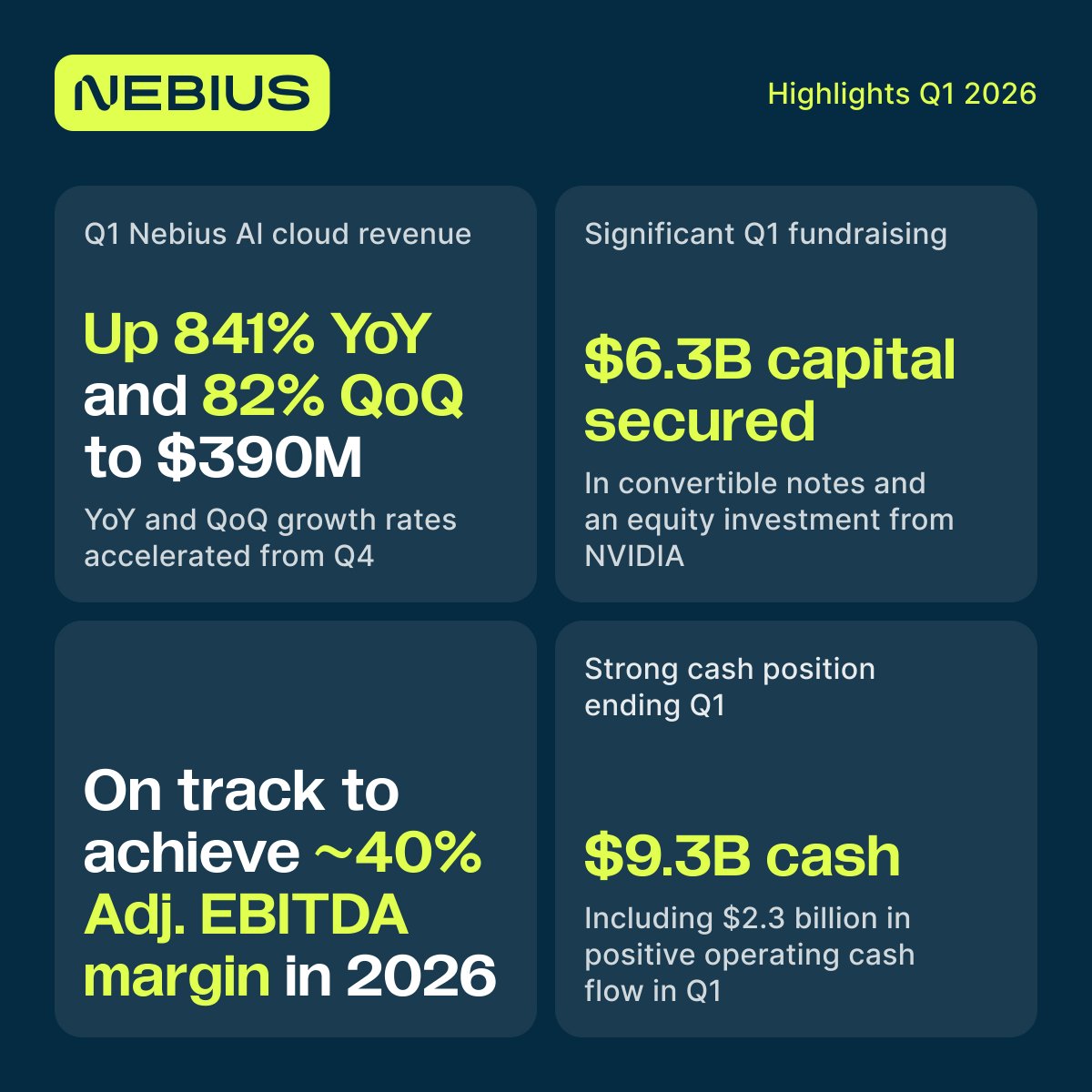
Today, we announced our Q1 2026 financial results. Here are the highlights:
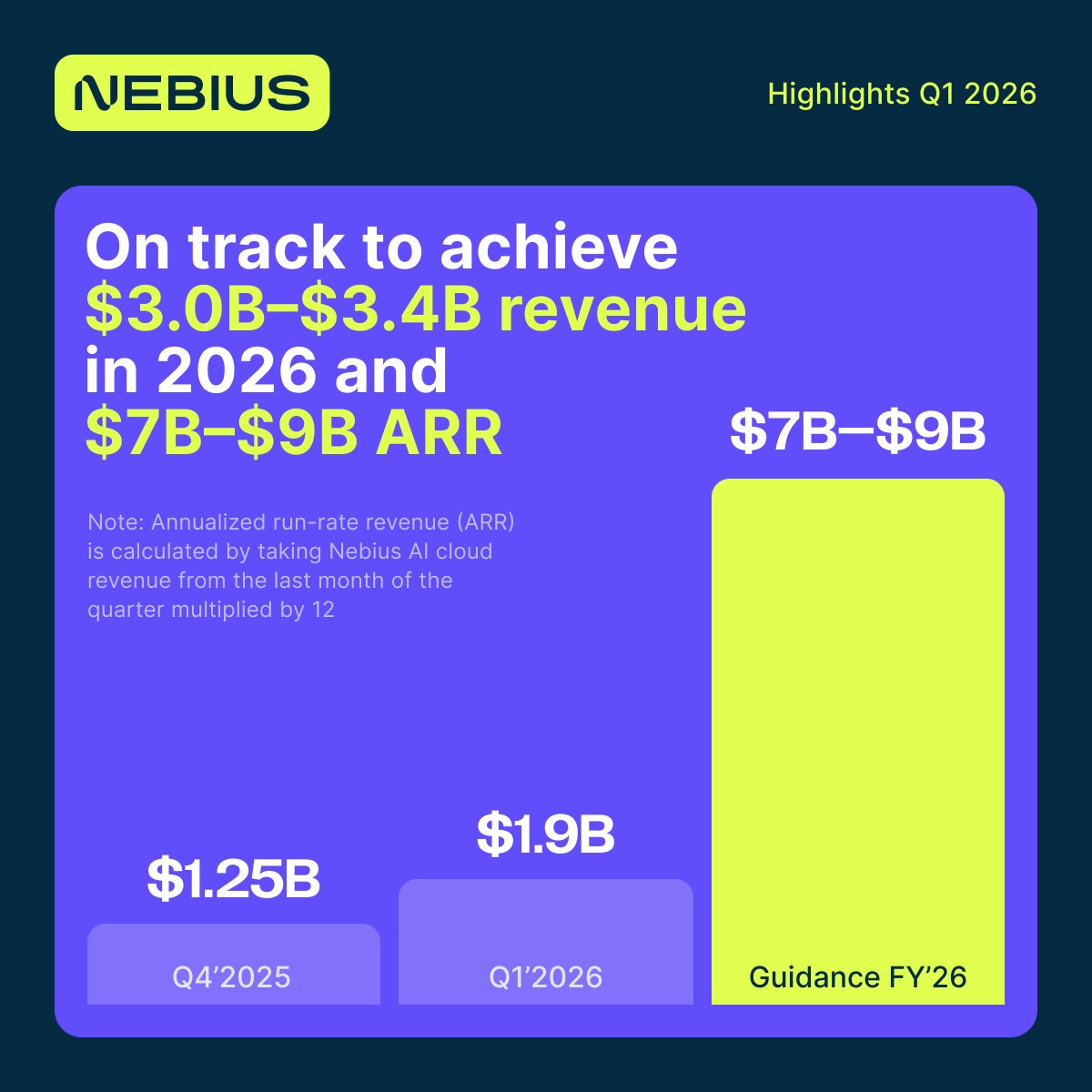
- ARR grew 674% year-over-year; full-year guidance has been updated to ARR of $7-$9 billion and revenue of $3.0-3.4 billion.
- Adjusted EBITDA margin in our AI cloud business nearly doubled quarter-on-quarter to 45%.
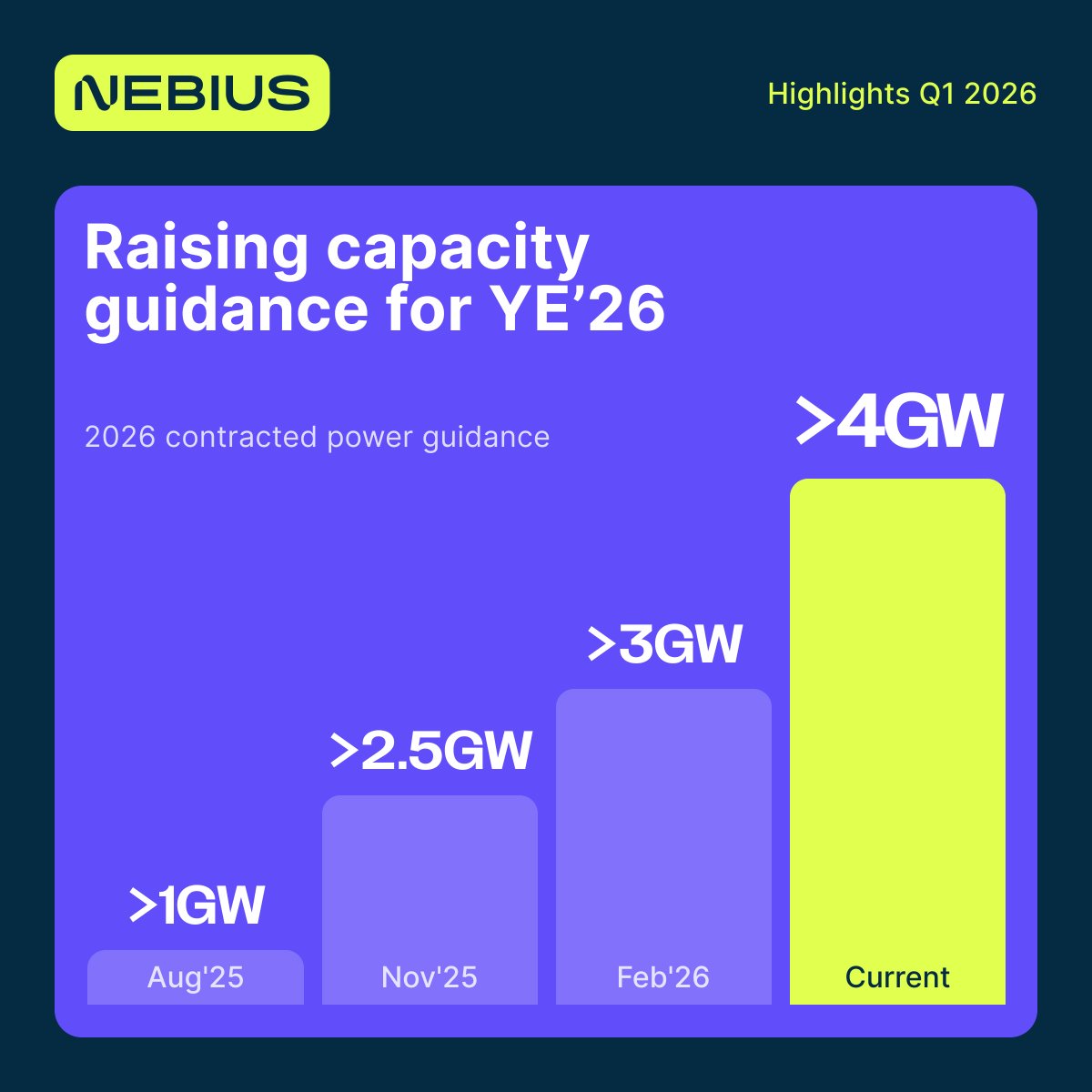
- Contracted capacity now exceeds 3.5 GW, surpassing our 3 GW target; we now expect to have more than 4 GW of contracted capacity by the end of 2026.
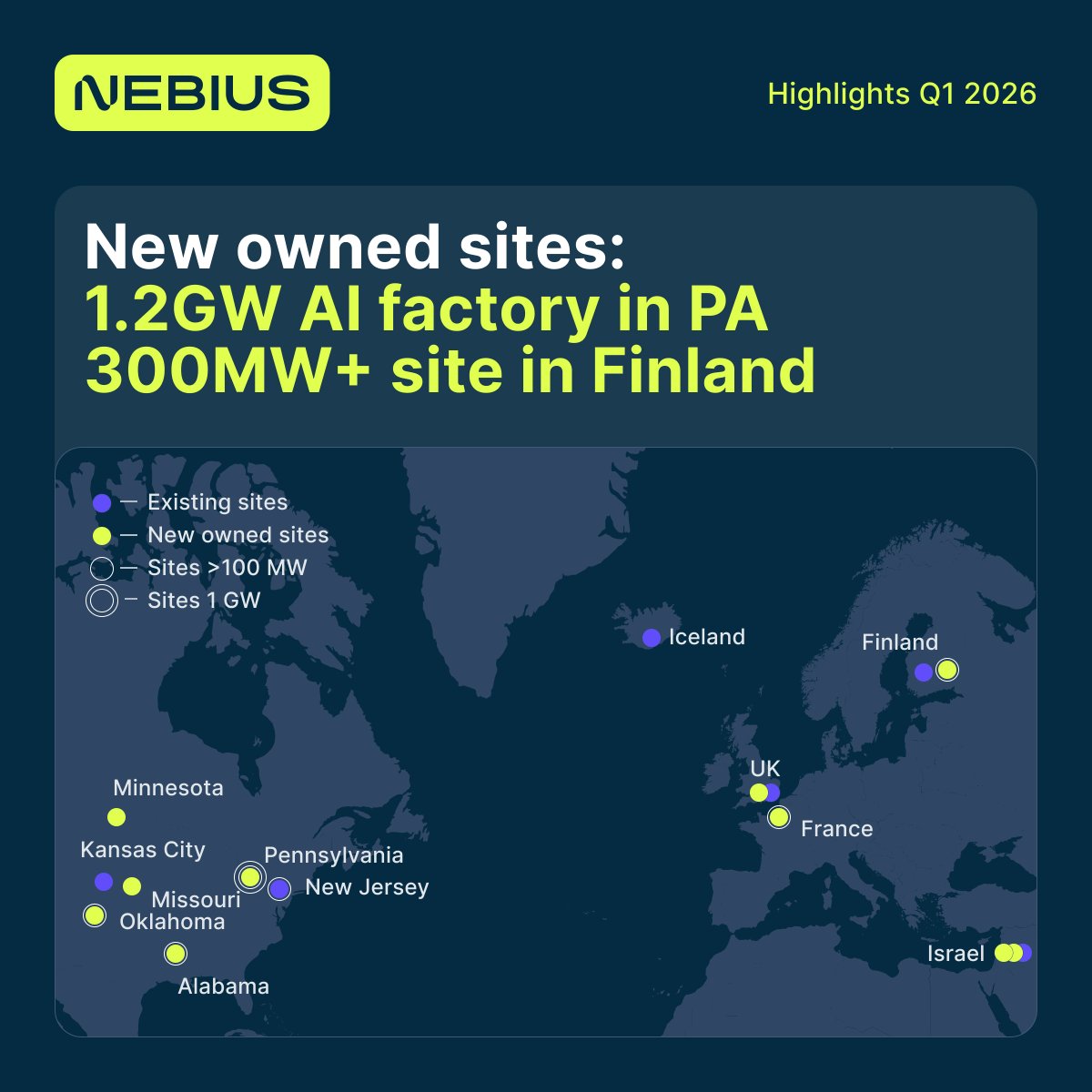
We also announced today that we have secured up to 1.2 GW of power and land for a new owned AI factory in Pennsylvania, bringing our total number of sites exceeding 100 MW to seven.
Read more in our press release: https://t.co/GJkNTg8RGG
A gigawatt of AI compute is coming to Independence, Missouri. 🏗️
@nebiusai broke ground today on a 400-acre AI factory campus — its first gigawatt-scale project in the US — with Ned Finkle, NVIDIA's Vice President of External Affairs, on hand to mark NVIDIA's commitment to building America's AI infrastructure.
Unitree Unveils: GD01, A Manned Transformable Mecha, from $650,000 👏
The world's first production-ready manned mecha. It can transform. It's a civilian vehicle. It weighs ~500kg with you inside.
Please everyone be sure to use the robot in a Friendly and Safe manner.
Researchers developed a system called LATENT that teaches humanoid robots to play tennis using small pieces of human movement data.
It learns basic motion fragments, then corrects and combines them to create natural movements and swings.
The system was tested on the Unitree G1 humanoid robot, enabling it to hit balls and rally with human players.
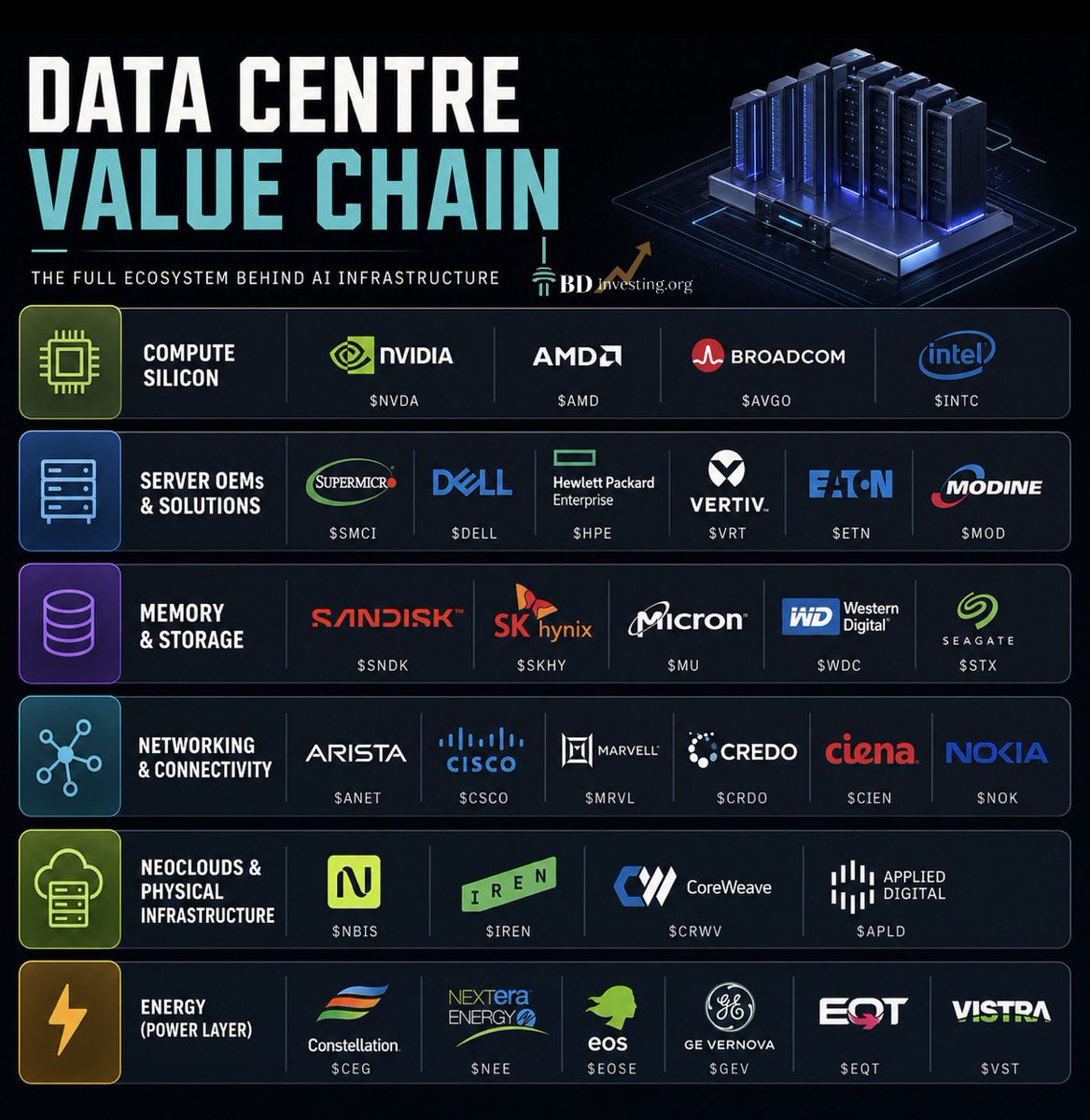
Key stocks in the data centre value chain. Ai can’t run without them
$AMD — CPU compute for AI training and inference
$VRT — Cooling and power delivery for dense GPU clusters.
$MU — HBM memory; feeds data to GPUs at speed.
$SNDK — NAND flash storage for datasets and model checkpoints.
$ANET — High-speed ethernet switching between servers and GPUs.
$NBIS — Deploys and operates GPU clusters as a service.
$IREN — Cheap-power GPU hosting; miner pivoting to AI compute.
$VST — Grid-level power generation feeding data centre demand.
$ASTS continues to fall and currently is holding onto the weekly 50SMA
If price loses this level, we see the golden pocket getting tested. More specifically, we will be targeting the 0.618 for a potential entry if we find support
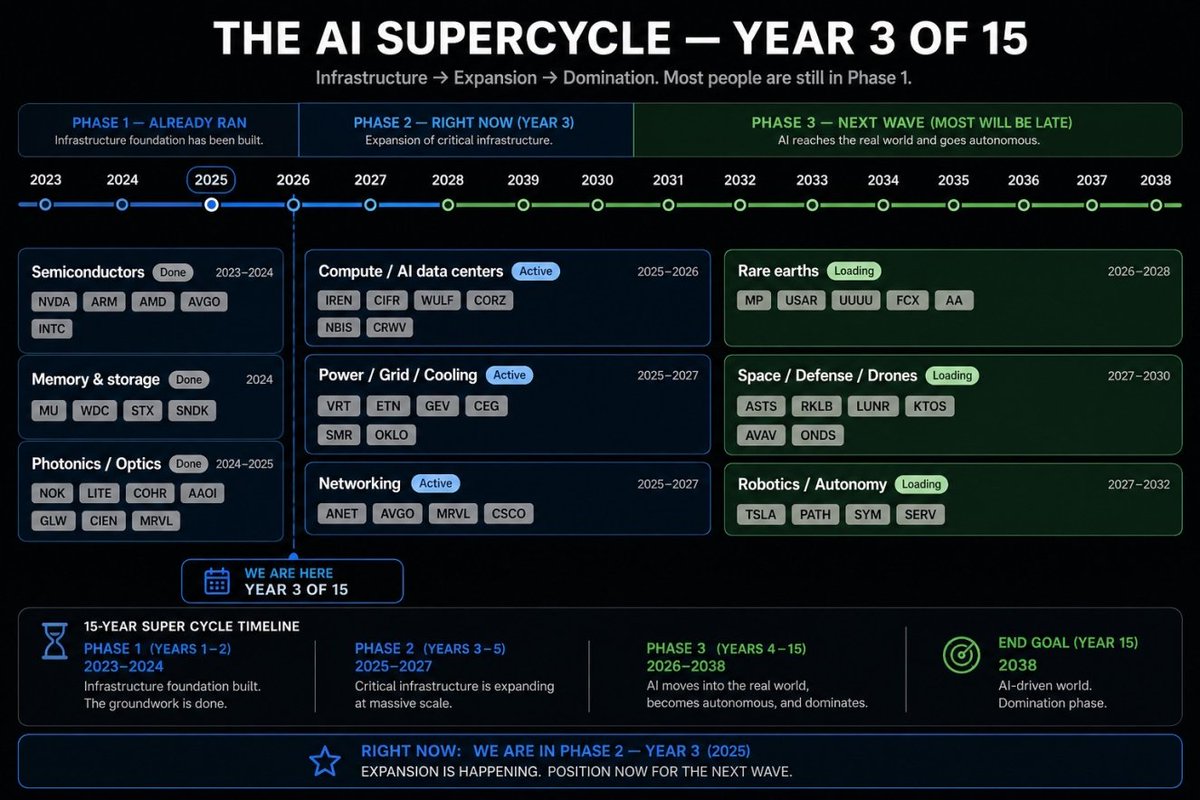
The AI Super Cycle rotates in phases
Semis like $ARM $AMD $INTC were Phase 1.
Money is already rotating:
Memory → $MU
Photonics / Optical → $NOK
Networking → $ANET
Compute → $IREN
Power → $VRT
Materials → $MP
Space → $ASTS
Defense / Drones → $KTOS $ONDS
Robotics → $TSLA
All you need to do is catch one part of one rotation of the cycle.
@MitAktien Wenn du mit "unternehmensspezifische Fragen" Quartalsberichte meinst, kann ich nur NotebookLM empfehlen. Du kannst bis zu 100 notebooks anlegen, und das bereits in der Gratisversion. Ansonsten Gemini.