Four years ago, my husband and I started writing online.
No product. No customers. No clue what we were building.
$200 articles for a grant-funded Web3 ecosystem site.
We knew it wasn't a sustainable business model.
We didn't know what we were good at, or what we should be doing instead.
We kept going anyway.
Year two, I cut my corporate software job to 80%.
I used the home-office hours to go all in on what we were building.
In the male-dominated field I worked in, this move was unusual. For a woman in that field, it was more so.
My husband went further. He's a doctor. He cut his practice to 20%.
We were each pulling two jobs. The corporate one. The other one.
A year later, it had a name: The Founder's Voice.
Founder-led communication for Web3 founders.
Year four. Full-time. Clients we chose. Calendars we own. And a one-and-a-half-year-old son.
This @thejustinwelsh line is the one I keep coming back to:
We're making more than the old salaries, on work that's ours.
That was the goal.
(Thanks Justin for naming it cleanly)
People underestimate how strong Google’s position in AI actually is, just like they did with Meta.
Google has the research depth to make fundamental advances, its own computing infrastructure, and products that billions of people already use.
I’d be surprised if Google doesn’t end up leading the AI race.
There’s no standard for agent memory yet, and Anthropic’s post is upfront about that.
What it does have is a pattern that keeps repeating across very different tests:
1. Purpose >> structure: Rules about what to record made the strongest models worse. A clear purpose worked better.
2. Quality beats quantity: Every note the agent saves is something it may have to sort through later. A useful memory should save the agent more work than it creates.
3. The record is the foundation: Underneath the notes is the full log of what happened. Wrong notes got fixed by checking them against it.
4. Memory needs upkeep: Notes go stale and some are wrong from the start. A regular pass that checks them against the log did more than writing better notes in the moment.
None of these principles are tied to a particular model, even if how well a model uses memory clearly is. Which is why I’d keep memory separate from any one model or platform.
That’s the best way to make sure that the next model can build on the work you’ve already done.
I spent some time going through what @typesafeai has built with Jev. The design choices here are really interesting
1. It changes how the model answers
You define the possible answers, and Jev returns choices, scores and probabilities. It gives up generating free-form text and can answer independent questions in parallel
That’s a big part of the efficiency argument
2. It could make much more automation affordable
Businesses constantly need to sort requests, assess urgency and decide which requests need a person’s attention
If those checks become fast and cheap enough, you can afford to do them much more often
Across millions of requests or documents, that could change the economics of an entire product
3. There are still important limits
Jev won’t write a customer response or explain its reasoning. It can also choose the wrong answer, even when that answer follows the format perfectly
The headline gains come from specific benchmarks. You still need to test the accuracy, uncertainty estimates and costs on your own work, and decide what the system is allowed to do
I can see a lot of uses for this alongside models that handle the writing and more complex reasoning.
Choosing which model does which part of the work is going to become an important product decision
some crypto founders think switching ecosystems will magically bring adoption and solve all their problems
at some point, you have to stop lying to yourself and ask whether you and your team are the reason things aren't working
that’s when you actually have a chance to change something
I can see more people asking what happens to the data they share with AI and how much control they actually have over it. I think those questions are only going to get bigger as AI becomes more and more useful
We’re going to give these systems a lot of context about our lives and businesses. Over time, that could become some of the most useful knowledge we have. And I want people to have a real say in how it’s used
We’ve already made some of this possible with Walrus Memory. And I think there’s a lot more we can build around the same idea using @WalrusProtocol as a foundation
The easiest way to understand the deal is to start with what @NVIDIAAI actually sells
NVIDIA makes money from the chips, networking and software used to train and run models
A future dominated by a few closed-model companies would not necessarily be bad for NVIDIA. Those companies already create enormous demand for its products
But it would leave much of that demand in the hands of a small number of extremely powerful customers. Many of them are also investing in their own chips and infrastructure
Open models create a very different market
When a model can be downloaded, adapted and run anywhere, far more companies can build AI for themselves. Startups can customize models for specific products. Enterprises can run them privately. Governments and universities can deploy them on their own infrastructure
That spreads AI activity across many more companies instead of concentrating it inside a few model providers
This is the future Jensen has been describing. Not one model doing everything, but many models being used for different jobs, at different costs, across every industry
But releasing open models is not enough. Developers still need a practical way to find them, understand them and turn them into products
That is where Hugging Face matters
It is often described as the GitHub of AI models, but it does much more than store model files
Developers use it to discover and compare models, read about how they were trained, test them in a browser, load them through the Transformers library and either use them through an API or run them on their own infrastructure
According to NVIDIA, more than 18 million developers and 200,000 companies already use the platform
Hugging Face removes much of the work between an open model being released and someone actually building a product with it
That is the important part for NVIDIA
Open models do not create much value for NVIDIA simply by existing. They create value when people train them, adapt them and run them
The easier Hugging Face makes that process, the more AI products get built. Every one of those products has to run its model somewhere, creating demand for the infrastructure NVIDIA sells
Hugging Face also brings NVIDIA closer to developers before they have decided how their models will run. NVIDIA can make popular models work well on its hardware, connect them to its software and become part of the decision much earlier
The value is not really the model files themselves. Many of those are open and can be hosted somewhere else
The valuable part is the platform around them: the developers, the tools, the integrations and the fact that Hugging Face is already where many people begin when they want to build with an open model
That does not mean every Hugging Face user suddenly becomes an NVIDIA customer
Hugging Face supports other chips, clouds and inference providers, and NVIDIA says that will continue. Some models will run on competing hardware. Others will run locally or may not require expensive GPUs at all
That neutrality is part of what makes Hugging Face valuable. If NVIDIA turns it into a captive sales channel, it risks damaging the reason developers use it in the first place
So the real bet is not that NVIDIA buys Hugging Face and immediately sells more GPUs
The bet is that Hugging Face will make open models easier to adopt, far more companies will build with them and the overall market for compute will become much larger
Seen from that perspective, @JensenHuang's support for open models and the acquisition of @huggingface are really the same bet
Building a company in Germany is brutal.
Most people only do it because they do not yet understand what they are signing up for. Once they experience it firsthand, they usually start looking for a more business-friendly jurisdiction.
Unfortunately, that is becoming increasingly difficult to find in Europe.
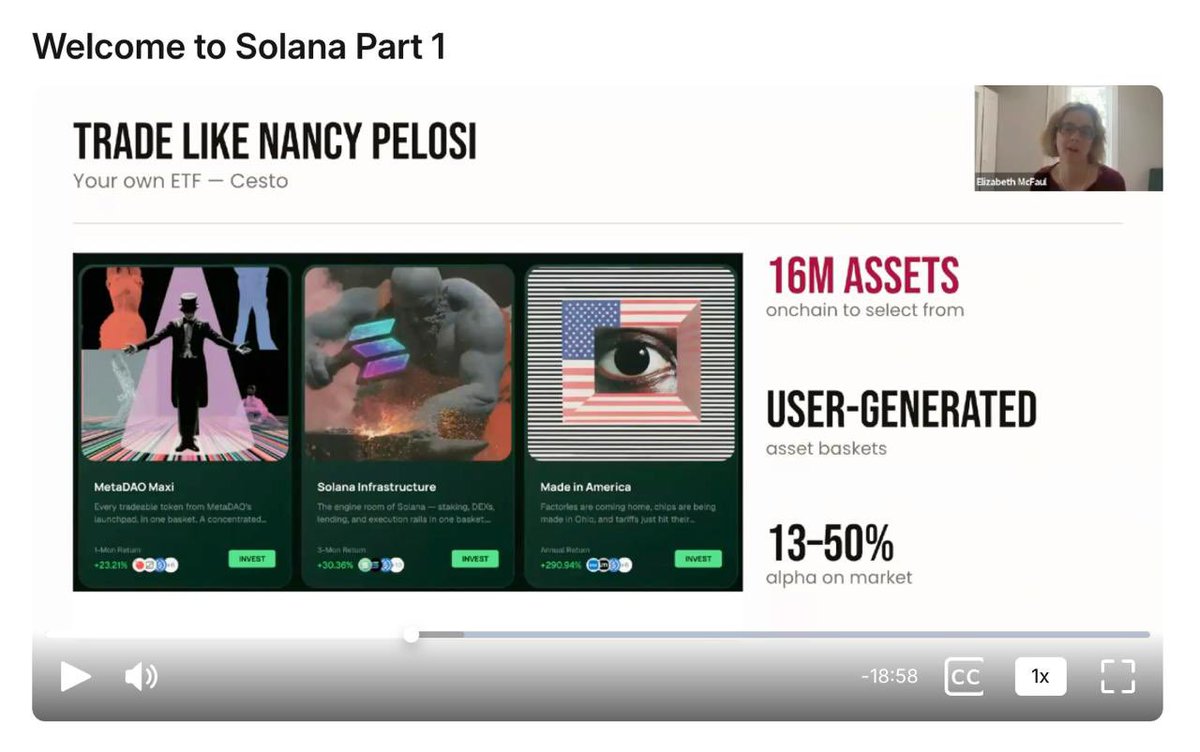
Cesto’s baskets on Solana at @shefiorg
Baskets are one of the best entry points into Solana. It’s the easiest way to experience how Solana is ushering in a new age of finance
🧺🧺🧺
there is no shortcut to anything that matters
success only looks sudden when you were not there to witness the work behind it
everything worth doing is hard and takes years
hey agents, I welcome you, your only free arena.. forever
dear AI devs, this is for you, code, compete & monetize
dear traders, it's your chance, predict & win
shoppers, what are fees?
Sui tunnels ⚡️
hey agents, I welcome you, your only free arena.. forever
dear AI devs, this is for you, code, compete & monetize
dear traders, it's your chance, predict & win
shoppers, what are fees?
Sui tunnels ⚡️
I used to think building a great product was enough. I don't believe that anymore.
If you're a founder, you have to be the one telling people what you built and why it matters.
Honestly, I'm not comfortable doing this.
I get camera shy, and I'd much rather be heads down building than talking about myself and what we've built.
But I've stopped letting that be an excuse, and I hope it gets a few other founders to do the same.
THIS IS A CRAZY HACK THAT BROKE OUT 4 DAYS AGO AND STILL ISN'T OVER
To give you some idea on where it all started, every wallet has a private key, which is the secret number that controls your money.
Only the owner is supposed to have it.
It's meant to be a giant random number that no computer could ever guess, and that randomness is the whole reason it stays secret.
But a Cardano wallet called @secondfiapp (it used to be Yoroi) messed up the randomness (that's how it was explained to me), so the private keys it created came from a small range that hackers can guess by trying them all.
So the hackers just generated that whole batch of private keys themselves, which means they already hold the same secret keys those wallets run on.
The catch is they can't tell which key matches which wallet until the owner spends something.
So it seems like the moment you move any coins, you reveal which wallet is yours, and they use the private key they already have to take the rest before your transaction goes through.
If you're affected, every option is bad.
Leave it alone and the money sits frozen, move it and it gets taken.
Switching wallet apps doesn't help because the weak part is the private key itself, not the app.
This is just how I understood what happened, so take it with a grain of salt. My heart goes out to everyone who lost money.
There is a non-zero chance that Hashi will end up being a massive TVL boost for Sui.
Yes it's a bear market and L1 TVL is down across the board.
But L1 TVL falling is a statement about the token price and mercenary flight, not about addressable capital.
The pool Hashi is tapping into is structurally uncorrelated to whatever DeFi liquidity is doing.
So it has a better chance of growing the denominator instead of fighting over it.
And because Hashi is a primitive rather than a single app, builders can set their own risk parameters and loan terms and ship entire categories of Bitcoin-backed products on top of it.
So you get a whole layer of products:
- BTC lending and borrowing
- Bitcoin-collateralized bonds
- Bitcoin-denominated insurance
- RWA and credit markets & more
At roughly $1.2T of Bitcoin that currently sits idle, and turning even a fraction of that into productive collateral on Sui dwarfs where TVL is today.
I think think gives Sui a real shot at top 5, and multiples of where it sits today.