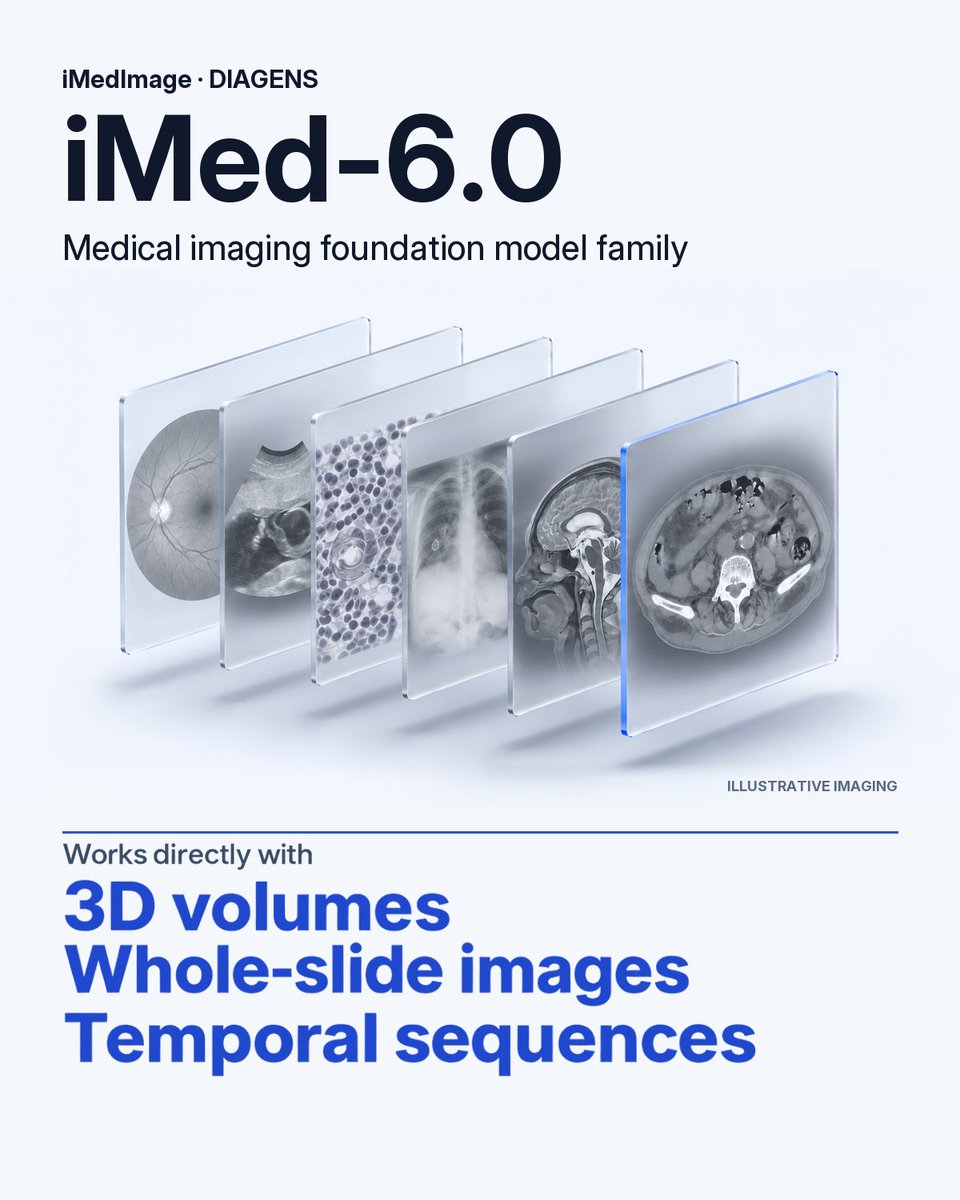
@DiagensTech (HKEX: 02526) sets a new standard for Medical Imaging AI with iMed-6.0.
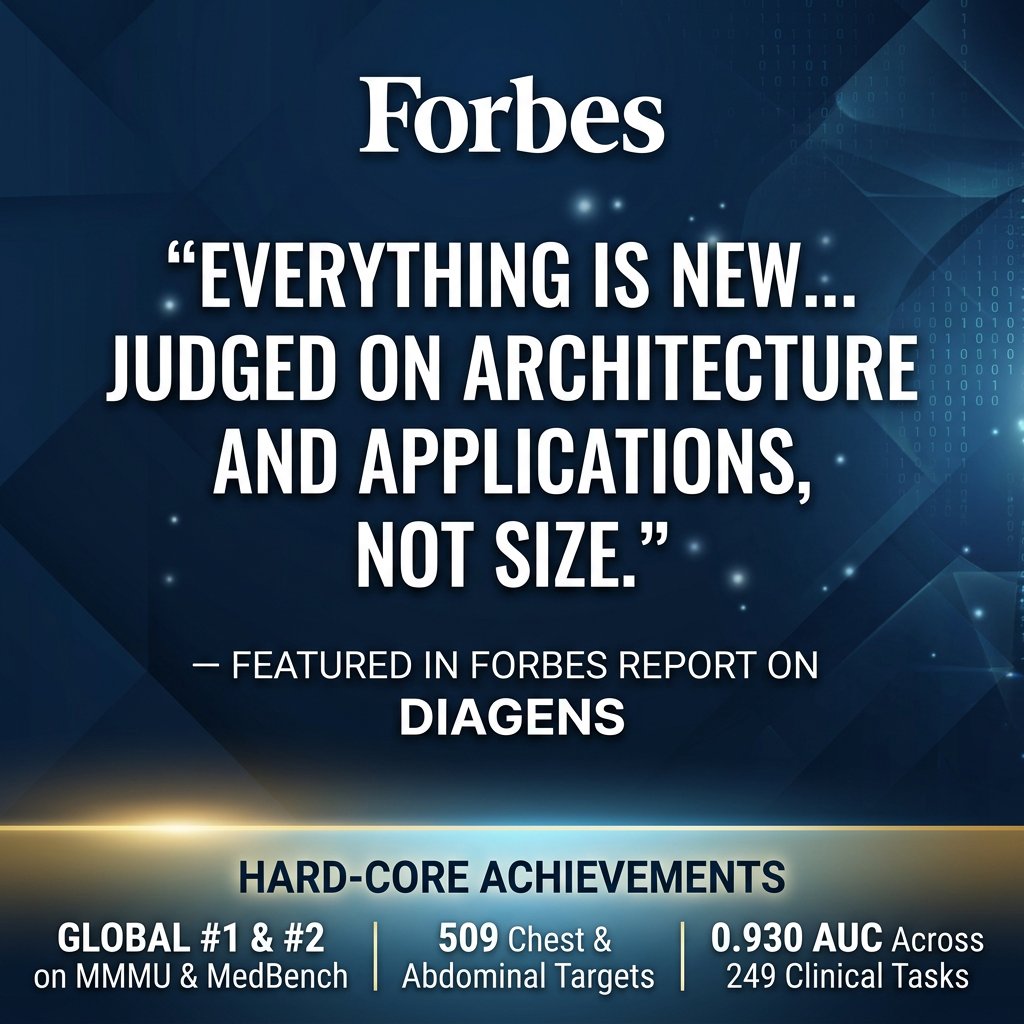
On MedBench, iMed-Thoth and iMed-Aegis both ranked No.1 and No.2 across all three categories. 🔥🔝
On MMMU Test, iMed-Thoth ranked No.1 and iMed-Aegis No.3. overall. In Health & Medicine, they ranked No.1 and No.2, respectively.
Follow to explore more information: 🌐 https://t.co/v2V5P8AHcz
DIAGENS Imaging Evals: Acute Appendicitis
Belly pain gets blamed on bad food. Yet appendicitis starts near the navel, or atypically in kids, seniors, and pregnancy. Waiting risks perforation; caught early, care stays simpler, from keyhole surgery to select antibiotics.
Scroll through the CT slices in the video below and you can immediately see why pinpointing it is hard, not just on first-line ultrasound, where bowel gas often hides the appendix entirely, but even on CT. Tucked inside a crowded maze of grey bowel loops, the appendix is millimeters wide and twists across planes, blending right into neighboring gut on any single flat frame. 🔍🤔
That exact anatomical challenge shows up in benchmarks. When we evaluated appendicitis head-to-head on identical paired cases within our 5-center, ~40,000-study chest & abdominal CT validation cohort, iMed-6.0 Aegis reached 0.9577 AUROC versus 0.8743 (+8.34 pp) for RADAR¹—one of the widest performance gaps we observed on a thin, tortuous structure.
🔹What you see in the clip is how iMed-6.0 approaches the scan differently:
• Native 3D continuity & multi-sign reasoning: Mild enlargement or a lone appendicolith never confirms appendicitis—and clinician-guided antibiotics only apply to carefully assessed uncomplicated cases. Rather than judging isolated 2D snapshots, Aegis tracks the appendix across volumetric slices, weighing 13 granular appendiceal targets from wall thickening and periappendiceal fat stranding to gas location and abscess risk.
• Zero tunnel vision (509 targets in one pass): Nonspecific belly pain has dozens of overlapping causes. In the exact same pass, Aegis screens acute mimics—like ureteral stones, diverticulitis, bowel obstruction, and pelvic findings—alongside secondary health risks across the scan.
Real clinical AI has to connect fine-grained 3D anatomy to whole-patient context—and that is the foundation behind iMed-6.0 on iMedLoop.
—
¹ RADAR (Zhang et al., Science 2026).
DIAGENS Imaging Evals // 001 — Hepatic Steatosis (Fatty Liver)
Fatty liver isn’t just about alcohol or weight—even lean, non-drinking adults get it, and left unchecked, it can quietly progress to liver inflammation and fibrosis. Because it causes zero pain early on, people rarely get tested for it; yet if caught early, it is one of the easiest conditions to improve through simple daily habits like cutting sugary drinks and staying active.
That is why catching it on a scan you are already getting matters. Powered by iMed-6.0 Aegis, a single routine chest or abdominal CT ordered for something else can automatically screen 509 clinical targets—turning an everyday scan into an early warning while lifestyle changes work best.
Why fatty liver often misses early action in practice:
• Silent progression: Zero early symptoms mean dedicated liver imaging is rarely ordered in time.
• Brushed-off incidental findings: Even when noted on a CT taken for another reason, people often ignore it because they feel fine.
• Imaging nuances: Contrast-phase shifts alter fixed HU cutoffs, while focal or uneven fat distribution must be distinguished from parenchymal lesions.
How iMed-6.0 Aegis performs:
• Paired discrimination: 0.9720 AUROC vs. 0.9318 (+4.02 pp) against RADAR¹ across a 5-center, ~40,000-study validation cohort.
• Case evidence (pictured, Case D17C05): On non-contrast abdominal CT showing diffuse reduction in hepatic parenchymal attenuation, the model flags fatty liver positive with ~99% calibrated model confidence².
Static checkpoints benchmark models. Closed-loop systems deploy them. Today, the newly upgraded iMedLoop (powered by iMed-6.0) enters invite-only beta:
→ For individuals: Get clearer second-look imaging insights and understand your health data.
→ For clinicians: Build, adapt, and deploy specialty AI models—no code required.
→ For researchers: Shape study direction, curate data, and generate traceable evidence.
—
¹ RADAR (Zhang et al., Science 2026); both models evaluated head-to-head on the same paired chest & abdominal CT validation cohort, not compared against paper-reported figures.
² Calibrated model confidence is an evaluation estimate, not standalone diagnostic certainty.
Well, that escalated quickly.
Minutes after going live, iMedLoop website is experiencing a massive surge in traffic. Our engineering team is actively scaling up capacity right now.
If you're seeing the "High traffic" screen, hang tight—or drop your imaging use case in the replies and DM us so we can lock in your invite code while we spin up more servers.
What if you could talk to medical images and build your own medical AI? 🤔
iMedLoop is going global. Invite-only early access is now live !!!
Powered by DIAGENS' iMed-6.0 (No.1 on MedBench & MMMU Health & Medicine), built to understand medical images in 3D, across pathology slides, and over time.
🔸01 / Talk to Medical Images
Ask questions. See what the AI sees, where it localizes, and how findings change over time.
🔸02 / Build medical AI with zero code
Clinicians and researchers can train, validate, and deploy custom specialty models. Zero coding or engineering team required.
We're opening a limited number of early-access spots.
Comment👇 the Clinical Workflow bottleneck or Medical Imaging question you're trying to solve, and DM us for an invite code!!
Tomorrow, iMedLoop goes live, powered by our iMed-6.0 Medical Imaging Foundation Model. ⚡
→ Clearer scan insights for individuals
→ Zero-code specialty AI for doctors
→ Traceable evidence for researchers
1 day to go.
🔥 Nov 18 · 9:00 AM EST 🔥
Two days to go: iMedLoop launches November 18, powered by our powerful Medical Imaging Foundation Model, iMed-6.0. 📣🔝
→ For individuals: get clearer second-look imaging insights and understand your health data.
→ For clinicians: build, adapt, and deploy specialty AI models—no code required.
→ For researchers: shape study direction, curate data, and generate traceable evidence.
The countdown is on.
🔥Nov 18 · 9:00 AM EST🔥
Clinical reality goes far beyond 3D images.
That’s why general VLMs hit a wall in medicine.💡🔍
With iMed-6.0, DIAGENS iMedImage® evolves from iMed-5.0 to Omni-Native Perception—engineered for how medical data actually exists:
▸ 3D Volumes (Space across slices): Connects spatial anatomy across continuous CT/MRI slices.
▸ Temporal Sequences (Change over time): Tracks dynamic lesion evolution.
▸ Whole-Slide Images (Tissue to cell): Links macro tissue architecture down to cellular detail.
Built across the full diagnostic pipeline, from omni-native perception and lesion analysis to diagnostic support and structured report drafting.
Foundation models engineered for real-world medicine.
#MedicalAI#FoundationModels#MedicalImaging
The next era of medical AI isn't defined by parameter count alone. It's defined by architecture and clinical impact.
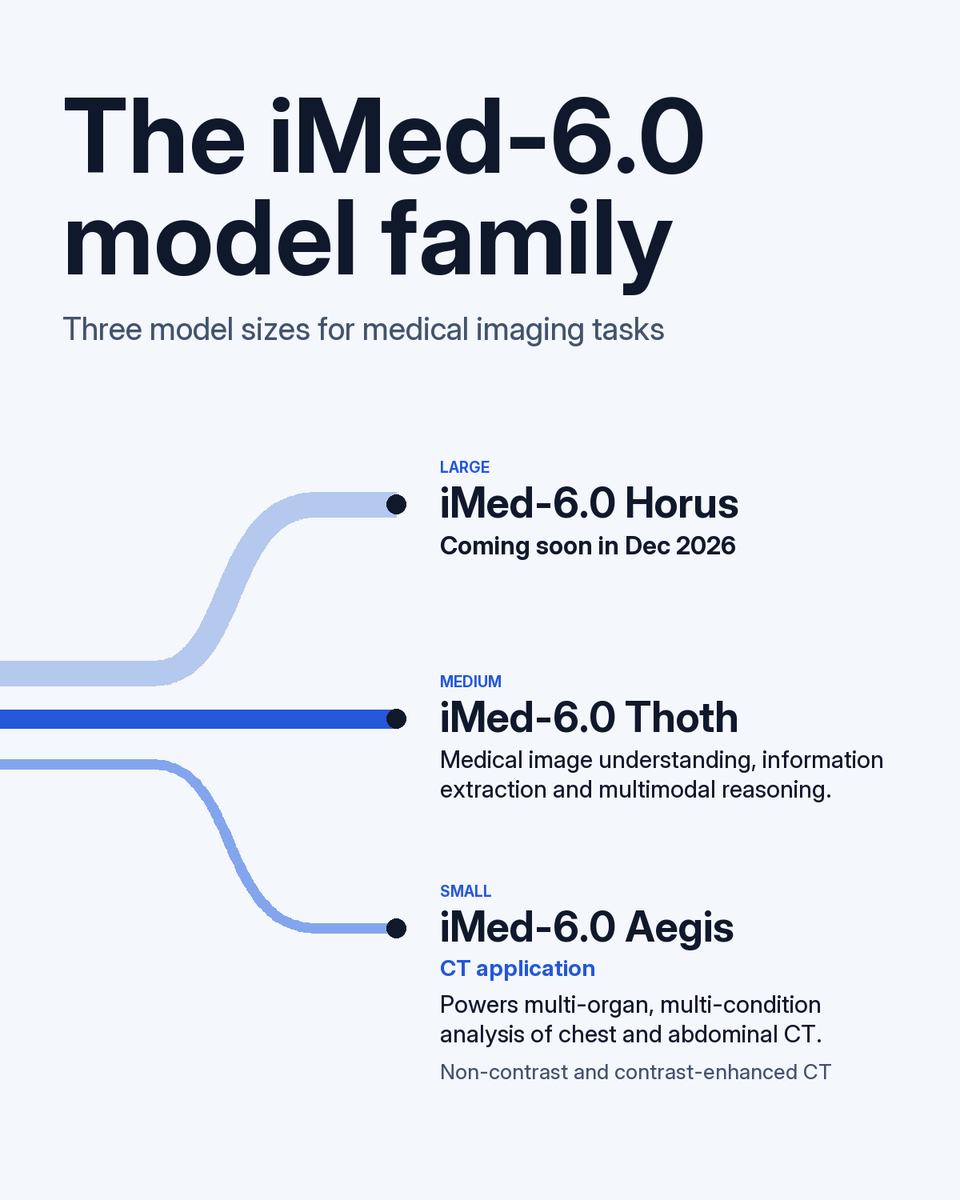
Introducing iMed-6.0, the medical imaging foundation model family from @DiagensTech (HKEX: 02526), rebuilt for native 3D, whole-slide, and temporal perception.
The iMed-6.0 family:
• Horus: Our most capable model for complex clinical challenges. Coming soon in Dec 2026.
• Thoth: Multimodal reasoning, deep image understanding, and structured extraction.
• Aegis: Native, high-throughput CT analysis across 509 clinical targets.
Just announced 📣:
@DiagensTech (HKEX: 02526) iMed-6.0 Thoth ranks both No. 1 on MMMU Test Overall (66.2%) and in Health & Medicine (74.9%). iMed-6.0 Aegis ranks No. 2 in Health & Medicine (71.1%).
Medical AI is setting the pace in expert-level multimodal reasoning.
#MedicalAI
One CT scan for 509 diseases and imaging findings.
iMed-6.0 Aegis from @DiagensTech (HKEX: 02526) underpins a chest and abdominal CT model for multi-organ, multi-condition analysis of non-contrast and contrast-enhanced scans.
Learn more about iMed-6.0 Aegis: https://t.co/w5hMElafkR
#MedicalImaging #MedicalAI #CT #Diagens
Smarter Architecture > Brute Force Compute.
Today, @DiagensTech (HKEX: 2526) unveils iMed-6.0 (Thoth & Aegis)-claiming No.1 & No.2 globally on MedBench and MMMU Test (Health & Medicine), extending CT analysis to 509 targets, and featured in Forbes' latest report: How China's Medical AI Can Win Back The Market. #MedicalAI #ComputeEfficiency