@TikCoin_Network You can’t pay for marketing only couple of days prior to listing as is NOT enough to get heard and attract investors, SO THEY ONLY MESSING AROUND THIS FUCKING CLOWNS 🤡
@TikCoin_Network They knew will not gonna list a shit that’s why you never seen any marketing kick in, they keep the money for themselves without spend a cent for marketing … otherwise everyone saw at least this project was paid for marketing by seeing influencers from all social media
@TikCoin_Network All this time they had pleeeeeeenty time of finalizing everything need to and list the coin as they promise to, but they only coming with silly excuses like they hard working for finalizing everything and in the meantime they laughing so bad when they see how many are mining
@TikCoin_Network Yeah, they only trying to win time so they can earn more money when people watching their ads, that’s why they even don’t bother anymore to say at least what month will be the listing
CLARITY ACT UPDATE 💥✅
📅 July 4: Final Senate text expected.
🗳️ July 20–30: Expected Senate floor vote.
The countdown to U.S. crypto market structure legislation is on. 🇺🇸📃
@TikCoin_Network Those clowns 🤡 are only making money from ad revenue, they are not here for listing a coin, already been postponed and they even didn’t come with an announcement regarding this!! My opinion,I think we should stop mining everyone as they only care about the money coming from ads
This is the moment a £120,000 Range Rover slowly submerged beneath the rising tide after the owner attempted to tow his friend's van when it became stuck on the beach.
🧵 Ethereum. Algorand. Stellar.
All three were named in VersaBank’s latest SEC filing.
Not for a new cryptocurrency.
Not for a stablecoin.
But for tokenized bank deposits.
And that could become one of the most important blockchain adoption stories of this decade.
👇
@VersaBank recently provided an update to the @SECGov regarding its Digital Meteor initiative and Real Bank Tokenized Deposits (RBTDs), formerly known as Digital Deposit Receipts (DDRs).
The filing states that these tokenized deposits may be generated and recorded on public blockchain networks including:
• Ethereum
• Algorand
• Stellar
That is noteworthy.
Unlike most digital assets, RBTDs are not designed as stablecoins.
VersaBank describes them as tokenized deposits representing actual demand deposit liabilities of the bank.
In simple terms:
This is bank money moving on-chain.
According to the filing, each RBTD would represent either a CAD$1 demand deposit liability of VersaBank or a US$1 demand deposit liability of VersaBank USA.
The deposits remain liabilities of the bank while ownership and transfers are recorded on public blockchain infrastructure.
That distinction matters.
Stablecoins are typically issued by private companies and backed by reserve assets.
Tokenized deposits originate directly from regulated banking institutions.
As a result, many industry observers view them as a potential bridge between traditional banking and blockchain-based financial infrastructure.
VersaBank’s filing suggests the bank sees public blockchain networks as part of that future.
The proposed use cases include:
• Payments
• Settlement
• Digital asset custody
• Mainstream financial applications
This is not a speculative crypto experiment.
It is a regulated financial institution evaluating how banking products can operate on public blockchain rails.
The choice of networks is also notable.
@ethereum remains the dominant smart contract ecosystem.
@Algorand has established itself as infrastructure for institutional tokenization initiatives.
@StellarOrg has built a strong presence in cross-border payments, tokenized assets and digital dollar infrastructure.
Seeing all three referenced in the same filing highlights how financial institutions are evaluating multiple public blockchain networks for real-world deployment.
The broader implication extends beyond any single blockchain.
For years, the industry focused on tokenizing assets such as funds, bonds and real estate.
Now the conversation is beginning to shift toward the tokenization of deposits themselves.
That represents a fundamentally different stage of adoption.
Whether VersaBank ultimately launches these products at commercial scale remains to be seen.
However, the message from this filing is clear:
Traditional banks are no longer asking whether blockchain can support regulated financial products.
They are actively evaluating which blockchain networks will support them.
And Ethereum, Algorand and Stellar are already part of that conversation.
Source: SEC filing dated June 3, 2026. 📄
Great research, @algerstmehn. 👏
Credit where credit is due.
🚀 KYC Has Reopened!
The TikCoin KYC process is now officially available again.
After extensive testing, optimization, and infrastructure upgrades, KYC verification has been integrated directly into the TikChain application for a smoother and more secure experience.
📱 How to complete KYC:
Open the TikChain App
Go to Profile
Select KYC
Log in using your TikCoin account credentials
Follow the instructions to submit your application
⚠️ It is important that you log in with the same TikCoin account that you use for mining. KYC approvals are linked directly to your TikCoin account and cannot be transferred to another account.
Please ensure that all submitted information is accurate and matches your official identification documents. Incorrect or incomplete applications may result in delays or rejection.
KYC verification will be required for future TikCoin transfers, wallet activation, ecosystem access, and upcoming platform features.
The Tik ecosystem continues to grow stronger every day. Thank you for your patience, trust, and support throughout this journey.
One Community. One Vision. One Future.
Tik Network 🚀💜
.@Mastercard is expanding its settlement capabilities with additional intraday, weekend and holiday card settlement using regulated stablecoins.
Programmable, always-on payments now on Stellar.
Numbers that leave an impression.
@The_DTCC is the "premier post-trade market infrastructure for the global financial services industry," and it's coming onchain with Stellar.
$XLM retrace after the May pump has people nervous.
Let me explain why it shouldn't. Because nothing that caused the rally has changed.
And I'll break down every catalyst in the simplest way possible. 👀
Markets move. Breakout. Retest. Continuation. That's the pattern playing out right now.
The May surge happened because nine institutional developments landed simultaneously.
The retrace is the market digesting those moves. Normal. Healthy. Expected.
Here's what actually drove the pump.
The DTCC development alone would have justified the entire rally. $114 trillion institution choosing Stellar as its first public blockchain for tokenized securities.
Russell 1000 stocks.
ETFs.
Treasuries.
All heading to Stellar by H1 2027.
Then Circle went live with native USDC cross-chain transfers on Stellar.
No bridges.
No wrapping.
Native movement across chains.
That's infrastructure permanence.
Then Bermuda announced moving an entire country's payment system on-chain using Stellar.
Wages.
Government fees.
Merchant settlements.
National digital currency.
Sovereign adoption.
Then 21X launched the first EU-regulated DLT securities trading system on Stellar.
Then MoneyGram deployed MGUSD for 60 million customers.
Then Figure launched regulated yield. Then Protocol 26 upgraded the network.
Then Mesh integrated settlement.
Then SDF funded credit infrastructure.
The retrace didn't undo any of it. DTCC is still building. Circle CCTP is still live. Bermuda is still moving forward. 21X is still trading. MoneyGram is still deploying.
Profit-taking after a 30-day sprint of institutional catalysts is the most predictable market behavior in existence.
The question for $XLM holders is simple: are the catalysts permanent? Every single one is.
The retrace is the market catching its breath.
The next leg will be the market pricing in what it hasn't finished absorbing.
🚀 KYC TEST PHASE HAS STARTED!
You can now complete your KYC verification at:
https://t.co/wW5xoz4lpZ
The process is simple and self-explanatory.
⚠️ The KYC test phase will be available for the next 48 hours only.
After that, we will review the results and prepare for the full public rollout.
🔒 This is another important step towards the future of TikCoin.
📅 Starting July 1, 2026, TikCoin transfers will be activated within the TikCoin app, followed by the official listing process.
Thank you for being part of this journey. Together, we are building something extraordinary.
NEW: @MoneyGram launches $MGUSD, a U.S. dollar-backed stablecoin on the @StellarOrg network, giving its 60 million customers access to digital dollar transfers across its global payments network.
$XLM : Review 📜
What if the company that clears $2.5 quadrillion in securities annually chose your blockchain as the first public chain to host tokenized U.S. stocks, ETFs, and Treasuries, and that announcement happened two days ago?
Meet Stellar - a Layer-1 blockchain built for cross-border payments and asset tokenization, founded by the man who created Mt. Gox and co-founded Ripple. 2-5 second finality. Near-zero fees. Connected to Visa, PayPal, Circle, and Franklin Templeton. And as of May 27, 2026, DTCC, the backbone of American capital markets, announced it will bring tokenized Russell 1000 stocks, ETFs, and U.S. Treasuries to Stellar by H1 2027 under an SEC no-action letter.
The first public blockchain ever selected by DTCC.
Let's explore how Stellar went from quiet payments chain to Wall Street's chosen infrastructure. 👇
⚪ Stellar at a Glance
Stellar is a decentralized, open-source blockchain platform focused on facilitating low-cost international money transfers, connecting financial institutions, and enabling asset tokenization. Launched in 2014 by Jed McCaleb and Joyce Kim through the Stellar Development Foundation, the network operates with its native cryptocurrency XLM (Lumens).
The $XLM token prevents spam, facilitates transactions, and serves as a bridge currency for cross-border transfers. Total supply is ~50 billion XLM with ~30.6B in circulation.
Marketplace Insight: DTCC, which processes $2.5 quadrillion in securities transactions annually, announced it plans to connect its tokenized securities platform to Stellar by 2027. This is the first time DTC-custodied securities will live on a public blockchain. More than 50 financial firms, including JPMorgan, Goldman Sachs, Morgan Stanley, Bank of America, BlackRock, and Ondo Finance, are part of the industry working group. This isn't a partnership. This is the central securities depository of the United States choosing Stellar as its public blockchain.
⚪ Mission
Stellar's mission is to create an open financial system where money flows as freely and cheaply as email. Unlike many blockchain projects that prioritize decentralization above all else, Stellar emphasizes transaction speed, minimal fees, and regulatory compliance, positioning itself as infrastructure for traditional financial institutions seeking blockchain integration.
🔵 A Brief History
Stellar was founded in 2014 by Ripple co-founder Jed McCaleb and Joyce Kim, with the aim of facilitating fast, low-cost cross-border payments, while including unbanked populations in the global economy.
McCaleb is one of the most important figures in crypto history. He created Mt. Gox (the first major Bitcoin exchange), co-founded Ripple, and then left to build Stellar after disagreements over Ripple's direction. He wanted a bottom-up, nonprofit approach focused on financial inclusion rather than enterprise sales.
David Mazieres, a Stanford professor, co-founded Stellar and created the Stellar Consensus Protocol (SCP), a fast, energy-efficient alternative to proof-of-work. SCP provides 2-5 second finality without mining.
The Stellar Development Foundation (SDF) was established as a nonprofit. Denelle Dixon, former COO of Mozilla, was appointed CEO and Executive Director, bringing operational excellence from one of the internet's most important nonprofits.
Early partnerships established Stellar's institutional credibility: IBM launched World Wire on Stellar for cross-border payments, Deloitte tested blockchain-powered transfers, and regional integrations launched across the Philippines (Coins ph), India (ICICI Bank), Africa (Flutterwave), and Latin America (Tempo Money Transfer).
By 2024-2025, Stellar had cemented its position as the compliance-first payments chain. Circle launched native USDC on Stellar. Franklin Templeton ($380B AUM) chose Stellar for its OnChain U.S. Government Money Market Fund. Visa explored Stellar for stablecoin settlements. PayPal integrated Stellar for PYUSD transfers. Moneygram leveraged the network for mobile money corridors.
Stellar in 2025 reinforced its original mandate of fast, low-cost, and accessible payments. Network development stayed centered on cross-border transfers and financial access within emerging markets.
Then came May 27, 2026. DTCC said it plans to connect its tokenized securities platform to Stellar by 2027. The plan follows a No-Action Letter issued by the SEC in December 2025 that authorized DTC to implement a tokenization service. DTCC oversees more than $114 trillion in assets across U.S. capital markets. Stellar became the first public blockchain selected for DTCC's multi-chain tokenization strategy. Russell 1000 stocks, major ETFs, and U.S. Treasuries will live on Stellar by H1 2027.
🔵 Ecosystem Narrative
Stellar's ecosystem is built on a decade of institutional trust, regulatory compliance, and real-world payment corridors. It's not the flashiest chain. It's the one that Visa, PayPal, Franklin Templeton, Circle, and now DTCC chose for production infrastructure.
Key dynamics include:
➛ DTCC Integration (May 2026) brings tokenized DTC-custodied Russell 1000 stocks, ETFs, and U.S. Treasuries to Stellar by H1 2027. First public blockchain for DTCC. 50+ firms in working group including JPMorgan, Goldman Sachs, BlackRock, and Ondo Finance. SEC no-action letter provides legal framework.
➛ Stellar Consensus Protocol (SCP) provides 2-5 second finality without mining or staking. Energy-efficient. No slashing risk. Designed for institutional compliance and deterministic settlement.
➛ Built-in Decentralized Exchange (SDEX) provides native order book functionality on the protocol level. Every asset on Stellar is automatically exchangeable without external DEX contracts.
➛ Anchor system connects traditional currencies to Stellar. Licensed financial institutions (anchors) accept fiat deposits and issue equivalent digital representations, bridging traditional banking with blockchain.
➛ Circle USDC is issued natively on Stellar, providing regulated stablecoin infrastructure for cross-border payments.
➛ Franklin Templeton OnChain U.S. Government Money Market Fund ($380B AUM) operates on Stellar, one of the largest traditional asset managers using a public blockchain in production.
➛ Protocol 23 upgrade (upcoming) introduces parallel transaction processing, enhanced scalability, and improved developer tooling.
➛ Soroban smart contracts platform extends Stellar beyond payments into DeFi, tokenization, and programmable finance with Rust-based contracts.
⚪ Token Utilities
$XLM powers the Stellar payments infrastructure:
➛ Transaction Fees - Near-zero fees (~0.00001 XLM per transaction) prevent spam while keeping transfers accessible. Fees are burned, creating deflationary pressure.
➛ Bridge Currency - XLM acts as intermediary in cross-border transfers when two currencies lack a direct trading pair. Conversions happen automatically through SDEX.
➛ Account Reserves - Users must hold a minimum XLM balance (1 XLM base reserve + 0.5 XLM per additional entry) to maintain accounts, preventing network spam.
➛ Liquidity Provisioning - Provide liquidity on SDEX and AMM pools for yield from trading activity.
➛ Staking (Soroban) - Stake XLM to participate in Soroban smart contract execution and earn rewards.
➛ Governance - XLM holders participate in SDF governance and network upgrade decisions.
⚪ Key Features
➛ DTCC's First Public Blockchain - Tokenized Russell 1000 stocks, ETFs, and U.S. Treasuries coming to Stellar H1 2027. SEC no-action letter. 50+ firms in working group. The most significant institutional validation any public blockchain has ever received.
➛ 2-5 Second Finality - Stellar Consensus Protocol provides deterministic settlement without mining. No probabilistic confirmation. No chain reorgs. Designed for institutional settlement.
➛ Near-Zero Fees - Fractions of a cent per transaction regardless of transfer size. Fees are burned. Designed for remittances, micropayments, and high-volume enterprise use.
➛ Visa, PayPal, Circle, Franklin Templeton - The most prestigious institutional partnership roster in blockchain. All live in production, not pilot programs.
➛ Built-in DEX (SDEX) - Native order book at the protocol level. Every asset automatically exchangeable. No external smart contracts required.
➛ Soroban Smart Contracts - Rust-based programmable finance platform extending Stellar beyond payments into DeFi, tokenization, and automated financial logic.
➛ Compliance-First Architecture - Built for regulated financial institutions. KYC/AML-friendly. Anchor system bridges traditional banking. View keys for selective transparency.
➛ 10 Years in Production - Operating since 2014 without a major security breach. The most battle-tested payments blockchain in existence.
🔵 Meet the Stellar Team
Stellar is led by one of the most experienced and credentialed teams in all of blockchain, with a founder who created Mt. Gox and co-founded Ripple, a CEO from Mozilla, a CTO building institutional-grade infrastructure, and a chief scientist from Stanford.
▶️ Core Members:
➛ Jed McCaleb [ @JedMcCaleb ] - Founder, Chief Scientist & Board Member | Created Mt. Gox, the first major Bitcoin exchange. Co-founded Ripple before leaving to build Stellar with a nonprofit, financial inclusion focus. One of the earliest and most influential figures in crypto history. Now leads Stellar's technical research and scientific direction.
➛ Denelle Dixon [ @DenelleDixon ] - CEO & Executive Director, SDF | Former COO of Mozilla, where she led the organization through significant growth and regulatory navigation. Brings nonprofit leadership, regulatory expertise, and institutional credibility to Stellar's operations. Described the DTCC partnership as bringing "public blockchain infrastructure closer to regulated market systems."
➛ Nicolas Barry [ @nicolassf ] - CTO | Leads protocol development, network upgrades (Protocol 23), and Soroban smart contract platform engineering.
➛ Jason Karsh [ @jasonkarsh ] - CMO | Founder of Karsh Consulting. Formerly at Google, Coinbase, Blockchain com Blocks (Square), BlockAid, and Geteero. Brings deep experience from the biggest names in both tech and crypto. Based in San Francisco.
➛ Jason Chlipala - COO | Oversees day-to-day operations, organizational execution, and strategic planning for SDF.
➛ Candace Kelly - CLO | Chief Legal Officer overseeing regulatory compliance and legal strategy across multiple jurisdictions.
➛ David Mazieres [ @dmazieres ] - Co-Founder & Chief Scientist | Stanford professor who created the Stellar Consensus Protocol (SCP). Provides the academic and scientific rigor underpinning Stellar's consensus mechanism.
▶️ Board Members:
➛ Lauren Thorbjornsen - Chief of Staff & VP of Communications ➛ Lin-Hua Wu - Board Member ➛ Ronaldo Lemos - Board Member ➛ Ginger Baker - Board Member ➛ Asiff Hirji - Board Member
➛ Stellar Development Foundation (San Francisco) - Nonprofit organization founded to support the development and growth of the Stellar network. Manages ecosystem grants, partnerships, and protocol governance.
🔵 Ratings
➛ Use Case: ★★★★★ (5/5) - The DTCC announcement on May 27, 2026 fundamentally changes Stellar's use case rating. The company that clears $2.5 quadrillion in annual securities volume chose Stellar as its first public blockchain for tokenized stocks, ETFs, and Treasuries. Under an SEC no-action letter. With 50+ firms including JPMorgan, Goldman Sachs, BlackRock, and Ondo Finance in the working group. Russell 1000 stocks will live on Stellar by H1 2027. Add to that Visa, PayPal, Circle (USDC), Franklin Templeton ($380B AUM), and Moneygram already live in production, and Stellar has the most impressive institutional adoption roster in all of blockchain. 10 years of operation. 2-5 second finality. Near-zero fees. Compliance-first architecture. This is no longer just a payments chain. It's the public blockchain that Wall Street's central infrastructure chose.
➛ Tokenomics: ★★★✦ (3.5/5) - Total supply of ~50 billion XLM with ~30.6B in circulation. Transaction fees are burned, creating deflationary pressure, but the burn rate is minimal relative to supply. The large supply creates psychological barriers for retail investors. SDF holds a significant portion of remaining supply as ecosystem reserves. XLM is down 81% from ATH ($0.94 in 2018). The token's primary utility is as a bridge currency and fee mechanism rather than a direct value capture asset like governance or burn tokens. The DTCC integration could significantly increase transaction volume and fee burns, but the tokenomics remain the weakest element of an otherwise institutional-grade infrastructure. The 1.5-point deduction reflects the massive supply, limited direct value accrual mechanisms, SDF's large holdings, and the 8-year price decline from ATH.
➛ Audits: ★★★★✦ (4.5/5) - Stellar has been operating since 2014 without a major security breach or consensus failure, making it the most battle-tested payments blockchain in existence. The Stellar Consensus Protocol was designed by Stanford professor David Mazieres and has been academically peer-reviewed. The fact that DTCC, Visa, PayPal, Franklin Templeton, and Circle all passed their own rigorous internal security assessments before integrating with Stellar speaks louder than any third-party audit. The SEC no-action letter implies regulatory-grade scrutiny of the network's security and compliance architecture. The codebase is fully open-source. The 0.5 deduction is for the complexity of the upcoming Soroban smart contract platform (new code, new attack surface) and the transition challenges that Protocol 23 may introduce.
➛ Community: ★★★★ (4/5) - Stellar has a loyal, long-term community that has held through an 81% drawdown from 2018 ATH with conviction built on institutional adoption rather than speculation. The DTCC announcement energized the community with a 244% volume surge. Active on Reddit, Discord, and X. The community spans crypto natives, fintech builders, and financial inclusion advocates, particularly strong in emerging markets where Stellar's remittance corridors operate. The SDF's nonprofit structure creates trust. The deduction is that Stellar's community is quieter and smaller than competing chains like Solana or XRP despite having arguably stronger institutional adoption. Developer ecosystem around Soroban is still growing. The community doesn't generate viral retail energy, preferring to let the partnerships speak.
🔵 Conclusion
Stellar just received the most significant institutional validation any public blockchain has ever received. DTCC, the company that clears $2.5 quadrillion in annual securities transactions and oversees $114 trillion in assets, chose Stellar as its first public blockchain for tokenized securities.
Russell 1000 stocks, major ETFs, and U.S. Treasuries will live on Stellar by H1 2027, under an SEC no-action letter, with JPMorgan, Goldman Sachs, BlackRock, and 47 other firms in the working group.
This isn't a partnership announcement. This is the central securities depository of the United States integrating with a public blockchain for the first time. And they chose the chain that Visa, PayPal, Circle, Franklin Templeton, and Moneygram already use in production. The chain that's been operating since 2014 without a security breach. The chain built by the man who created Mt. Gox and co-founded Ripple. The chain with a Stanford professor's consensus protocol and a former Mozilla COO running the foundation.
Hhere's the math that matters: DTCC processes $2.5 quadrillion annually. Even tokenizing a fraction of 1% of that volume on Stellar would dwarf every DeFi protocol's TVL combined. And DTCC didn't choose Stellar for a pilot.
They chose it for their multi-chain tokenization strategy under an SEC no-action letter, with 50+ of the world's largest financial institutions in the working group. When you spend a decade building the most compliant, most institutional, most boring payments chain in crypto, and then the backbone of American capital markets picks you as their first public blockchain, "boring" becomes the most bullish word in the market.
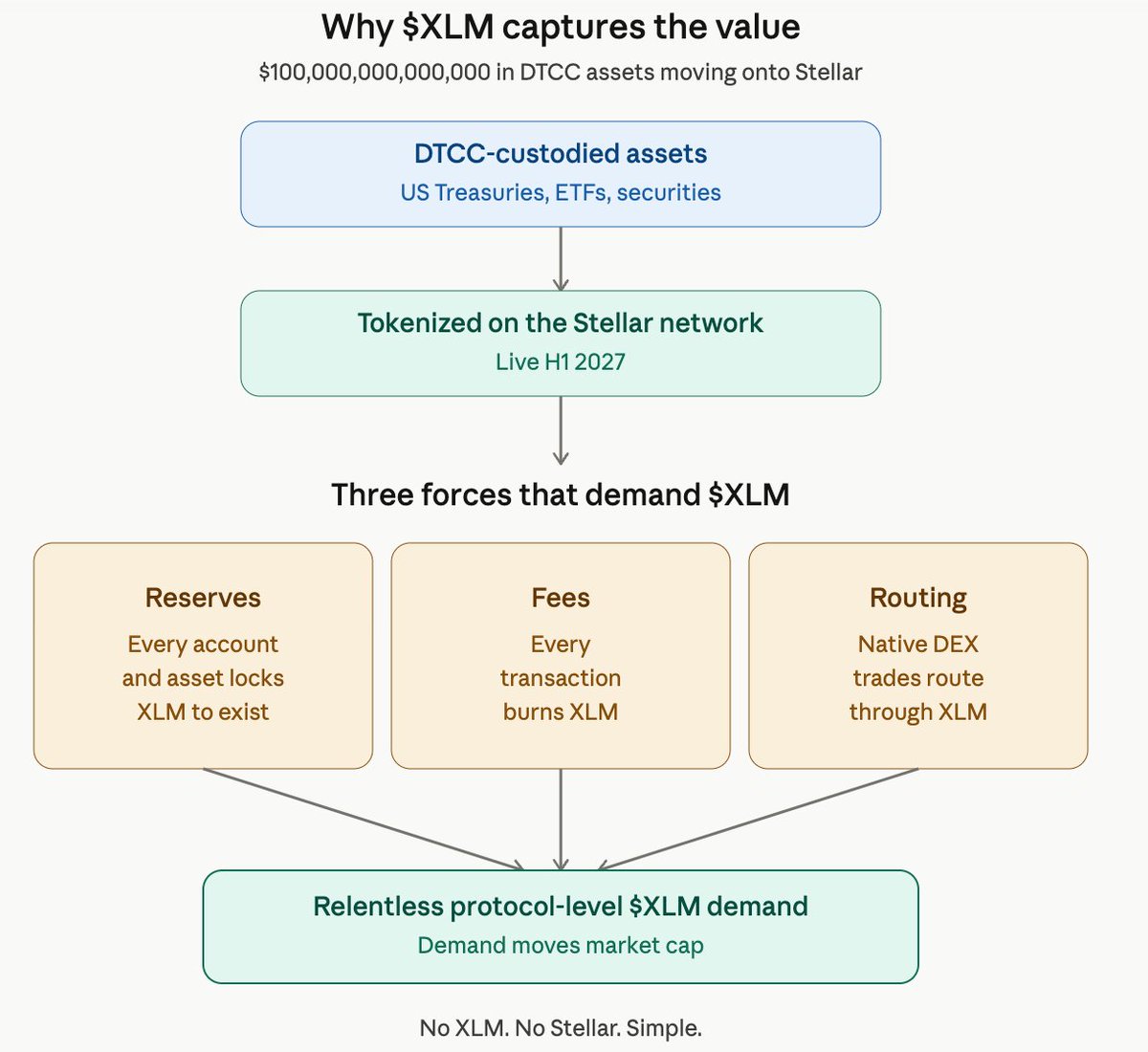
"XLM won't play a role in DTCC tokenization." 🤡
Wrong.
Every asset on #Stellar needs stellar:native reserves to exist.
Every transaction burns stellar:native.
Every trade routes through stellar:native on the native DEX.
$100,000,000,000,000 in → Reserves, Fees, Routing → Relentless stellar:native demand.
DTCC and the Stellar Development Foundation announced today plans to enable the tokenization of DTC‑custodied assets on the @StellarOrg network. This collaboration advances DTCC’s multi chain strategy and expands how traditional assets move across digital ecosystems.
DTC‑tokenized assets are expected to be made available on the Stellar network in the first half of 2027, supporting the evolution of a more open, interoperable, and efficient financial ecosystem.
Get the full story: https://t.co/YCWHZDiLl5




![0xchainink's tweet photo. $XLM : Review 📜
What if the company that clears $2.5 quadrillion in securities annually chose your blockchain as the first public chain to host tokenized U.S. stocks, ETFs, and Treasuries, and that announcement happened two days ago?
Meet Stellar - a Layer-1 blockchain built for cross-border payments and asset tokenization, founded by the man who created Mt. Gox and co-founded Ripple. 2-5 second finality. Near-zero fees. Connected to Visa, PayPal, Circle, and Franklin Templeton. And as of May 27, 2026, DTCC, the backbone of American capital markets, announced it will bring tokenized Russell 1000 stocks, ETFs, and U.S. Treasuries to Stellar by H1 2027 under an SEC no-action letter.
The first public blockchain ever selected by DTCC.
Let's explore how Stellar went from quiet payments chain to Wall Street's chosen infrastructure. 👇
⚪ Stellar at a Glance
Stellar is a decentralized, open-source blockchain platform focused on facilitating low-cost international money transfers, connecting financial institutions, and enabling asset tokenization. Launched in 2014 by Jed McCaleb and Joyce Kim through the Stellar Development Foundation, the network operates with its native cryptocurrency XLM (Lumens).
The $XLM token prevents spam, facilitates transactions, and serves as a bridge currency for cross-border transfers. Total supply is ~50 billion XLM with ~30.6B in circulation.
Marketplace Insight: DTCC, which processes $2.5 quadrillion in securities transactions annually, announced it plans to connect its tokenized securities platform to Stellar by 2027. This is the first time DTC-custodied securities will live on a public blockchain. More than 50 financial firms, including JPMorgan, Goldman Sachs, Morgan Stanley, Bank of America, BlackRock, and Ondo Finance, are part of the industry working group. This isn't a partnership. This is the central securities depository of the United States choosing Stellar as its public blockchain.
⚪ Mission
Stellar's mission is to create an open financial system where money flows as freely and cheaply as email. Unlike many blockchain projects that prioritize decentralization above all else, Stellar emphasizes transaction speed, minimal fees, and regulatory compliance, positioning itself as infrastructure for traditional financial institutions seeking blockchain integration.
🔵 A Brief History
Stellar was founded in 2014 by Ripple co-founder Jed McCaleb and Joyce Kim, with the aim of facilitating fast, low-cost cross-border payments, while including unbanked populations in the global economy.
McCaleb is one of the most important figures in crypto history. He created Mt. Gox (the first major Bitcoin exchange), co-founded Ripple, and then left to build Stellar after disagreements over Ripple's direction. He wanted a bottom-up, nonprofit approach focused on financial inclusion rather than enterprise sales.
David Mazieres, a Stanford professor, co-founded Stellar and created the Stellar Consensus Protocol (SCP), a fast, energy-efficient alternative to proof-of-work. SCP provides 2-5 second finality without mining.
The Stellar Development Foundation (SDF) was established as a nonprofit. Denelle Dixon, former COO of Mozilla, was appointed CEO and Executive Director, bringing operational excellence from one of the internet's most important nonprofits.
Early partnerships established Stellar's institutional credibility: IBM launched World Wire on Stellar for cross-border payments, Deloitte tested blockchain-powered transfers, and regional integrations launched across the Philippines (Coins ph), India (ICICI Bank), Africa (Flutterwave), and Latin America (Tempo Money Transfer).
By 2024-2025, Stellar had cemented its position as the compliance-first payments chain. Circle launched native USDC on Stellar. Franklin Templeton ($380B AUM) chose Stellar for its OnChain U.S. Government Money Market Fund. Visa explored Stellar for stablecoin settlements. PayPal integrated Stellar for PYUSD transfers. Moneygram leveraged the network for mobile money corridors.
Stellar in 2025 reinforced its original mandate of fast, low-cost, and accessible payments. Network development stayed centered on cross-border transfers and financial access within emerging markets.
Then came May 27, 2026. DTCC said it plans to connect its tokenized securities platform to Stellar by 2027. The plan follows a No-Action Letter issued by the SEC in December 2025 that authorized DTC to implement a tokenization service. DTCC oversees more than $114 trillion in assets across U.S. capital markets. Stellar became the first public blockchain selected for DTCC's multi-chain tokenization strategy. Russell 1000 stocks, major ETFs, and U.S. Treasuries will live on Stellar by H1 2027.
🔵 Ecosystem Narrative
Stellar's ecosystem is built on a decade of institutional trust, regulatory compliance, and real-world payment corridors. It's not the flashiest chain. It's the one that Visa, PayPal, Franklin Templeton, Circle, and now DTCC chose for production infrastructure.
Key dynamics include:
➛ DTCC Integration (May 2026) brings tokenized DTC-custodied Russell 1000 stocks, ETFs, and U.S. Treasuries to Stellar by H1 2027. First public blockchain for DTCC. 50+ firms in working group including JPMorgan, Goldman Sachs, BlackRock, and Ondo Finance. SEC no-action letter provides legal framework.
➛ Stellar Consensus Protocol (SCP) provides 2-5 second finality without mining or staking. Energy-efficient. No slashing risk. Designed for institutional compliance and deterministic settlement.
➛ Built-in Decentralized Exchange (SDEX) provides native order book functionality on the protocol level. Every asset on Stellar is automatically exchangeable without external DEX contracts.
➛ Anchor system connects traditional currencies to Stellar. Licensed financial institutions (anchors) accept fiat deposits and issue equivalent digital representations, bridging traditional banking with blockchain.
➛ Circle USDC is issued natively on Stellar, providing regulated stablecoin infrastructure for cross-border payments.
➛ Franklin Templeton OnChain U.S. Government Money Market Fund ($380B AUM) operates on Stellar, one of the largest traditional asset managers using a public blockchain in production.
➛ Protocol 23 upgrade (upcoming) introduces parallel transaction processing, enhanced scalability, and improved developer tooling.
➛ Soroban smart contracts platform extends Stellar beyond payments into DeFi, tokenization, and programmable finance with Rust-based contracts.
⚪ Token Utilities
$XLM powers the Stellar payments infrastructure:
➛ Transaction Fees - Near-zero fees (~0.00001 XLM per transaction) prevent spam while keeping transfers accessible. Fees are burned, creating deflationary pressure.
➛ Bridge Currency - XLM acts as intermediary in cross-border transfers when two currencies lack a direct trading pair. Conversions happen automatically through SDEX.
➛ Account Reserves - Users must hold a minimum XLM balance (1 XLM base reserve + 0.5 XLM per additional entry) to maintain accounts, preventing network spam.
➛ Liquidity Provisioning - Provide liquidity on SDEX and AMM pools for yield from trading activity.
➛ Staking (Soroban) - Stake XLM to participate in Soroban smart contract execution and earn rewards.
➛ Governance - XLM holders participate in SDF governance and network upgrade decisions.
⚪ Key Features
➛ DTCC's First Public Blockchain - Tokenized Russell 1000 stocks, ETFs, and U.S. Treasuries coming to Stellar H1 2027. SEC no-action letter. 50+ firms in working group. The most significant institutional validation any public blockchain has ever received.
➛ 2-5 Second Finality - Stellar Consensus Protocol provides deterministic settlement without mining. No probabilistic confirmation. No chain reorgs. Designed for institutional settlement.
➛ Near-Zero Fees - Fractions of a cent per transaction regardless of transfer size. Fees are burned. Designed for remittances, micropayments, and high-volume enterprise use.
➛ Visa, PayPal, Circle, Franklin Templeton - The most prestigious institutional partnership roster in blockchain. All live in production, not pilot programs.
➛ Built-in DEX (SDEX) - Native order book at the protocol level. Every asset automatically exchangeable. No external smart contracts required.
➛ Soroban Smart Contracts - Rust-based programmable finance platform extending Stellar beyond payments into DeFi, tokenization, and automated financial logic.
➛ Compliance-First Architecture - Built for regulated financial institutions. KYC/AML-friendly. Anchor system bridges traditional banking. View keys for selective transparency.
➛ 10 Years in Production - Operating since 2014 without a major security breach. The most battle-tested payments blockchain in existence.
🔵 Meet the Stellar Team
Stellar is led by one of the most experienced and credentialed teams in all of blockchain, with a founder who created Mt. Gox and co-founded Ripple, a CEO from Mozilla, a CTO building institutional-grade infrastructure, and a chief scientist from Stanford.
▶️ Core Members:
➛ Jed McCaleb [ @JedMcCaleb ] - Founder, Chief Scientist & Board Member | Created Mt. Gox, the first major Bitcoin exchange. Co-founded Ripple before leaving to build Stellar with a nonprofit, financial inclusion focus. One of the earliest and most influential figures in crypto history. Now leads Stellar's technical research and scientific direction.
➛ Denelle Dixon [ @DenelleDixon ] - CEO & Executive Director, SDF | Former COO of Mozilla, where she led the organization through significant growth and regulatory navigation. Brings nonprofit leadership, regulatory expertise, and institutional credibility to Stellar's operations. Described the DTCC partnership as bringing "public blockchain infrastructure closer to regulated market systems."
➛ Nicolas Barry [ @nicolassf ] - CTO | Leads protocol development, network upgrades (Protocol 23), and Soroban smart contract platform engineering.
➛ Jason Karsh [ @jasonkarsh ] - CMO | Founder of Karsh Consulting. Formerly at Google, Coinbase, Blockchain com Blocks (Square), BlockAid, and Geteero. Brings deep experience from the biggest names in both tech and crypto. Based in San Francisco.
➛ Jason Chlipala - COO | Oversees day-to-day operations, organizational execution, and strategic planning for SDF.
➛ Candace Kelly - CLO | Chief Legal Officer overseeing regulatory compliance and legal strategy across multiple jurisdictions.
➛ David Mazieres [ @dmazieres ] - Co-Founder & Chief Scientist | Stanford professor who created the Stellar Consensus Protocol (SCP). Provides the academic and scientific rigor underpinning Stellar's consensus mechanism.
▶️ Board Members:
➛ Lauren Thorbjornsen - Chief of Staff & VP of Communications ➛ Lin-Hua Wu - Board Member ➛ Ronaldo Lemos - Board Member ➛ Ginger Baker - Board Member ➛ Asiff Hirji - Board Member
➛ Stellar Development Foundation (San Francisco) - Nonprofit organization founded to support the development and growth of the Stellar network. Manages ecosystem grants, partnerships, and protocol governance.
🔵 Ratings
➛ Use Case: ★★★★★ (5/5) - The DTCC announcement on May 27, 2026 fundamentally changes Stellar's use case rating. The company that clears $2.5 quadrillion in annual securities volume chose Stellar as its first public blockchain for tokenized stocks, ETFs, and Treasuries. Under an SEC no-action letter. With 50+ firms including JPMorgan, Goldman Sachs, BlackRock, and Ondo Finance in the working group. Russell 1000 stocks will live on Stellar by H1 2027. Add to that Visa, PayPal, Circle (USDC), Franklin Templeton ($380B AUM), and Moneygram already live in production, and Stellar has the most impressive institutional adoption roster in all of blockchain. 10 years of operation. 2-5 second finality. Near-zero fees. Compliance-first architecture. This is no longer just a payments chain. It's the public blockchain that Wall Street's central infrastructure chose.
➛ Tokenomics: ★★★✦ (3.5/5) - Total supply of ~50 billion XLM with ~30.6B in circulation. Transaction fees are burned, creating deflationary pressure, but the burn rate is minimal relative to supply. The large supply creates psychological barriers for retail investors. SDF holds a significant portion of remaining supply as ecosystem reserves. XLM is down 81% from ATH ($0.94 in 2018). The token's primary utility is as a bridge currency and fee mechanism rather than a direct value capture asset like governance or burn tokens. The DTCC integration could significantly increase transaction volume and fee burns, but the tokenomics remain the weakest element of an otherwise institutional-grade infrastructure. The 1.5-point deduction reflects the massive supply, limited direct value accrual mechanisms, SDF's large holdings, and the 8-year price decline from ATH.
➛ Audits: ★★★★✦ (4.5/5) - Stellar has been operating since 2014 without a major security breach or consensus failure, making it the most battle-tested payments blockchain in existence. The Stellar Consensus Protocol was designed by Stanford professor David Mazieres and has been academically peer-reviewed. The fact that DTCC, Visa, PayPal, Franklin Templeton, and Circle all passed their own rigorous internal security assessments before integrating with Stellar speaks louder than any third-party audit. The SEC no-action letter implies regulatory-grade scrutiny of the network's security and compliance architecture. The codebase is fully open-source. The 0.5 deduction is for the complexity of the upcoming Soroban smart contract platform (new code, new attack surface) and the transition challenges that Protocol 23 may introduce.
➛ Community: ★★★★ (4/5) - Stellar has a loyal, long-term community that has held through an 81% drawdown from 2018 ATH with conviction built on institutional adoption rather than speculation. The DTCC announcement energized the community with a 244% volume surge. Active on Reddit, Discord, and X. The community spans crypto natives, fintech builders, and financial inclusion advocates, particularly strong in emerging markets where Stellar's remittance corridors operate. The SDF's nonprofit structure creates trust. The deduction is that Stellar's community is quieter and smaller than competing chains like Solana or XRP despite having arguably stronger institutional adoption. Developer ecosystem around Soroban is still growing. The community doesn't generate viral retail energy, preferring to let the partnerships speak.
🔵 Conclusion
Stellar just received the most significant institutional validation any public blockchain has ever received. DTCC, the company that clears $2.5 quadrillion in annual securities transactions and oversees $114 trillion in assets, chose Stellar as its first public blockchain for tokenized securities.
Russell 1000 stocks, major ETFs, and U.S. Treasuries will live on Stellar by H1 2027, under an SEC no-action letter, with JPMorgan, Goldman Sachs, BlackRock, and 47 other firms in the working group.
This isn't a partnership announcement. This is the central securities depository of the United States integrating with a public blockchain for the first time. And they chose the chain that Visa, PayPal, Circle, Franklin Templeton, and Moneygram already use in production. The chain that's been operating since 2014 without a security breach. The chain built by the man who created Mt. Gox and co-founded Ripple. The chain with a Stanford professor's consensus protocol and a former Mozilla COO running the foundation.
Hhere's the math that matters: DTCC processes $2.5 quadrillion annually. Even tokenizing a fraction of 1% of that volume on Stellar would dwarf every DeFi protocol's TVL combined. And DTCC didn't choose Stellar for a pilot.
They chose it for their multi-chain tokenization strategy under an SEC no-action letter, with 50+ of the world's largest financial institutions in the working group. When you spend a decade building the most compliant, most institutional, most boring payments chain in crypto, and then the backbone of American capital markets picks you as their first public blockchain, "boring" becomes the most bullish word in the market.](https://pbs.twimg.com/media/HJkombuaIAArSAt.jpg)