The Hollow Men
American capitalism is rotting from the head down. We have replaced the "Owner-Operator"—the risk-taker-with a new, parasitic class of corporate bureaucrat: The Risk-Free Insider.
By "Insider," I am not referring to a specific title. I am referring to the entire administrative state that has captured the modern corporation. This includes the Directors who exist solely to collect fees, the Executives who exist solely to collect bonuses, and the Managers who exist solely to hire consultants.
These are the hollow men of the boardroom. They are masters of PowerPoint. They wear the right suits. They say the right buzzwords about "governance" and "ESG." But they are mercenaries fighting a war with someone else’s ammunition.
In a functioning economy, authority is tied to liability. If you make a bad decision, you lose your own money. That fear of loss is the only thing that keeps a business honest. It forces you to cut waste, obsess over the customer, and stay late to fix what is broken.
Today, we have severed that link.
We have rigged the game so that heads, the Insider wins; tails, the shareholder loses.
If the stock goes up, the Insider collects a massive performance bonus. If the stock crashes due to their own incompetence, they are fired with a "Golden Parachute" worth tens of millions. They are gambling with the house’s money, and they never leave the table poorer than they arrived.
This looting starts in the boardroom.
We have normalized a "Country Club" culture where directors are selected based on social profiling rather than their ability to build a business. The modern board member is often a professional tourist—paid an average of $350,000 a year.
Let’s be brutally honest about what that number represents. The average director is paid nearly five times the GDP per capita of the United States. They earn more for attending four quarterly lunches than the vast majority of Americans earn in five years of hard labor.
And for what?
Most of these directors are "over-boarded," sitting on three or four boards simultaneously. They treat directorships as a gig economy for the elite. They fly in, rubber-stamp a compensation package they didn't read, and fly out. They collect checks from companies they do not understand, do not use, and certainly do not love.
They are not there to ask hard questions. They are there to be collegial. They are there to protect the other Insiders.
And what happens when these boards hire executives who also have no personal capital at risk?
We get the Delegation Economy.
When a Risk-Free Insider faces a crisis—bloated expenses, a broken supply chain, or a stale product—they do not roll up their sleeves. They hire a consultant. They pay a strategy firm millions of shareholder dollars to produce a 100-page deck telling them what they already know.
This is not management. It is intellectual money laundering.
They use shareholder capital to buy an insurance policy for their own careers. If the plan fails, they can blame the consultants. They delegate the work because they are terrified of the responsibility. They would rather preside over a slow, comfortable decline than risk a bold mistake.
While American Insiders are busy optimizing their severance packages, our global competitors are optimizing their products. They are not slowed down by bureaucracy. They are not waiting for a slide deck. They are outworking us.
If we continue to fill our C-suites with administrators instead of operators, we will lose our edge. We will see iconic American franchises hollowed out by fees, managed for the benefit of the Insiders, while the true owners—the shareholders—are left holding the bag.
The time for polite governance is over.
If we want to save the American economy from mediocrity, we must demand a return to the "Owner’s Mentality." We need leaders who treat shareholder capital with the same reverence they treat their own savings. The era of the Risk-Free Insider must end.
🚨 California Passed "The Stop Nick Shirley Act":
This week the California Assembly passed AB 2624. This bill will criminalize investigative journalism involving the immigrant population. It would have made it illegal to expose the Somali "Learing" center if it were in California or the Armenian hospice fraud in LA if they claimed "reasonable fear."
The bill protects "immigration support services providers," which means services provided to immigrants, including health care. It has been proven that millions, potentially billions, of dollars in fraud has taken place in "immigrant support services” which includes nonprofits and NGOs the state funds.
California is trying to make it harder to expose fraud and scare individuals from investigating it as they could be forced and sued to remove the video, forced to pay attorney fees, and ordered to pay a minimum of $4,000 in damages.
This bill was created by Mia Bonta (the attorney general's wife). She has made 4 separate versions of this bill because each version violates the 1st Amendment and is extremely unconstitutional.
Plain and simple, California politicians need the fraud to continue because they depend on the fraud to push their agendas. END ALL THE FRAUD.
Question of the day is where's the Babe Ruth.
Welp, we're very close to the cash per share floor on low volume with extremely negative social sentiment. That's a pretty great setup.
Is it soon? Tough to say.
People might remember that on 2/2 I said that was probably our top and we'd likely fall down into Feb Opex and then March Opex before bottoming 5 weeks after earnings 5/1 when IV typically hits a low.
Instead, Implied Volatility hit a 7 year low April 13th, bonds le-legended (if that matters) and we spiked on 5/1 into the eBay announcement. Now we are deeply compressed a month later following the request to increase authorized shares leading into Q1 earnings.
So our cadence is a month off from what I had expected back on 2/2 but we got our dip.
Could the stock rally strongly here into 11 days of volume?
Perhaps.
I like the setup here a lot, it's just later than I expected back in January, but does make sense given all the events that have happened this year.
The more important thing I want to remind anybody following along is that this is likely to happen again. I'm not saying it will, but the chart below is fairly self evident. For some reason the stock returns to the cash per share floor on a somewhat regular cadence.
So the pain I feel right now I want to remember. And the social sentiment I want to remember. Because when it comes again in the months to come, I am going to be reading the same posts on Reddit, 4chan, and Twitter, about how GameStop is a terrible investment, opportunity cost, bagholding, etc.
But I will remember and I will look back to the last time all those things happened and what I did that was correct and what I did that was incorrect and I will try to make good decisions (for me) again.
I hope you are able to make good decisions for you, too. I don't know what those are.
These moments are challenging, though, but after 20+ times I am honestly kind of numb to it and just mechanically buy the dip and wait patiently for the rip.
If you are new, well, welcome to the show.
Allow me to translate this letter from eBay for those who don’t speak legalese:
Ryan,
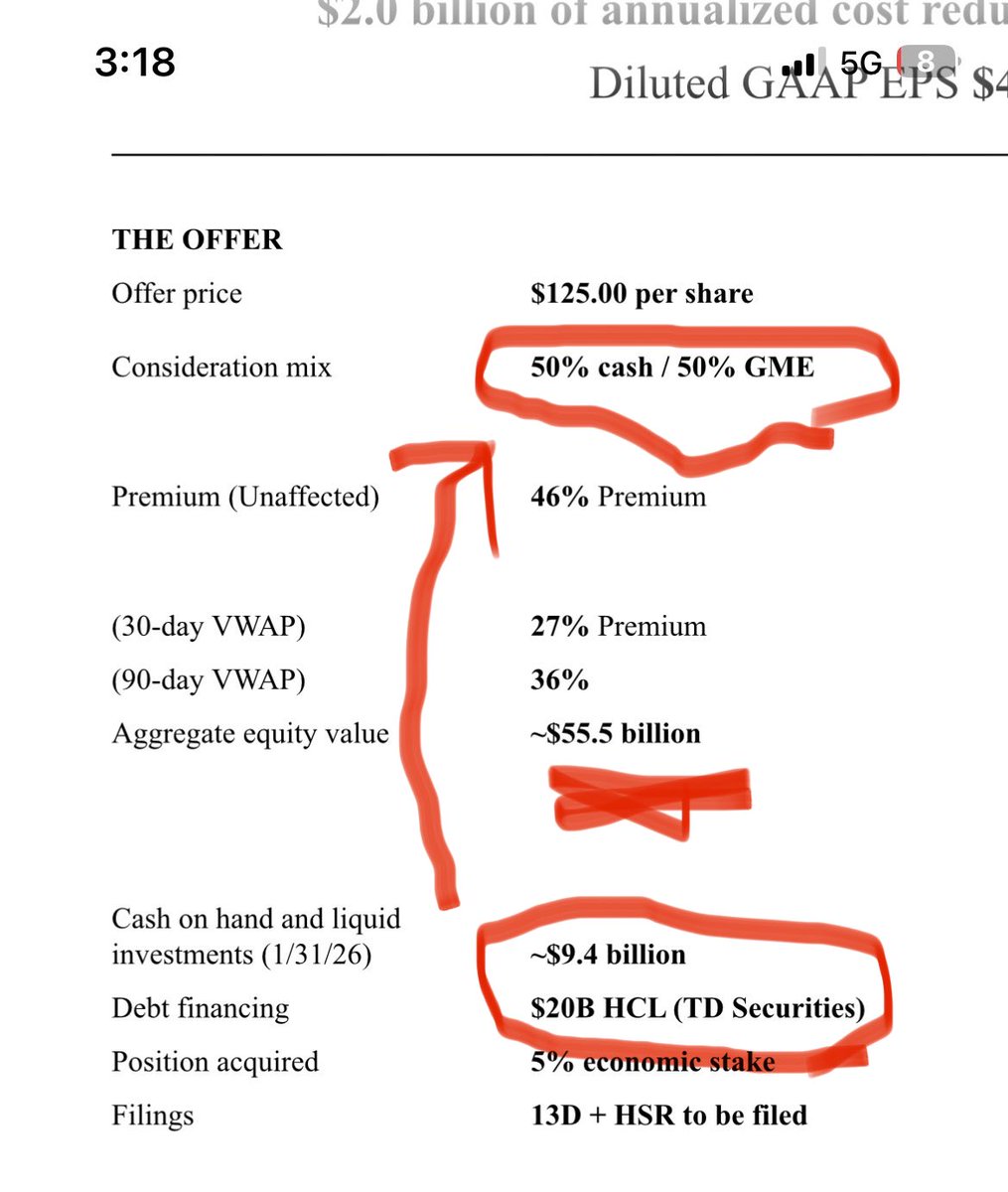
We got your unsolicited offer to buy eBay for $125/share (half cash, half stock) supported by your 5% economic interest in eBay.
Our board, backed by the usual crew of bankers and lawyers who get paid either way, “thoroughly reviewed” it.
We’re rejecting it. Not because the math doesn’t work. Not because the highly confident letter from TD Securities for up to $20B on top of your $9B+ cash pile is fake. None of that.
We’re rejecting it because your entire approach to running a company is an existential threat to how we like to operate here.
Here are the reasons we feel this way, and the things we considered before paying consultants to write this:
1) We’d rather keep milking eBay as a “standalone” cash cow than let you turn it into something bigger and better.
2) Sure, you’ve got real financing lined up and you “know people” with deep pockets, but we’re going to call it “uncertain” anyway so we don’t have to engage.
3) Your plan would actually force real long-term growth and profitability changes we’d rather not be held accountable for.
4) The debt we pretended you can’t even obtain, the operational integration and focus on seller satisfaction, and most importantly, putting someone like you in charge of the combined entity all sound like a nightmare for our current leadership structure because all of us would have zero job security.
5) The valuation math only looks bad if you ignore the 46% premium you’re offering our shareholders and the upside from fixing eBay the way you fixed GameStop, which we are choosing to do and hoping nobody notices.
6) And I hope we buried the lede far enough here: Your governance and executive incentives are completely incompatible with ours. You and your board take zero cash, no salary, no bonuses, no golden parachutes. You buy shares with your own money and only get paid if shareholders win. We, on the other hand, like our nice, reliable annual payouts regardless of whether the stock is flat or the company is just coasting. We’re not about to hand over our golden goose to a guy who eats only what he kills.
Look, eBay is “strong” and “resilient” in the way every entrenched public company says it is while handing out eight-figure checks and perks to the C-suite. We’ve done the usual incremental stuff: tweaked the marketplace a bit, returned some capital, and we’d like to keep doing that without any cowboy from GameStop coming in and demanding actual skin-in-the-game accountability. Can you just leave us alone?
Our team remains focused on protecting the current regime and delivering “value”… mostly to ourselves and our consultants.
Thanks, but no thanks,
Paul S. Pressler Chairman of the Board, eBay (And proud beneficiary of the status quo)
@InvestorTurf Because the people running eBay are lazy, the exact people Ryan hates. They’re just letting eBay ride where it’s at and never having anything new to offer