Jo Nagai was raising swallowtail butterflies at his home in Kobe, Japan, when he noticed something odd. The ones he had looked after as caterpillars seemed to recognize him. Wild butterflies fled. His didn't.
He was in second grade. He wrote a four-page letter to Dr. Martha Weiss, an entomologist at Georgetown University who had studied whether moths could retain memories through metamorphosis. He asked if she could help him design a version of her experiment for butterflies.
She said yes.
Using a muscle therapy device, Jo trained caterpillars to associate the scent of lavender with a mild vibration. When the caterpillars became butterflies, 70 per cent of them still avoided the lavender. Their brains had been completely rebuilt during metamorphosis. The memory survived anyway.
Then he bred them.
The offspring, which had never been trained, also avoided lavender. So did their grandchildren. Without ever experiencing the vibration, two generations of butterflies inherited an aversion to a scent their grandmother had been taught to fear.
Jo documented it all in a 33-page research paper and presented his findings at the International Congress of Entomology in Kobe in 2024. He was 10.
A second grader wrote a letter to a Georgetown professor, and together they found evidence that butterflies can pass memories down through generations.
-Wilderness Whisper
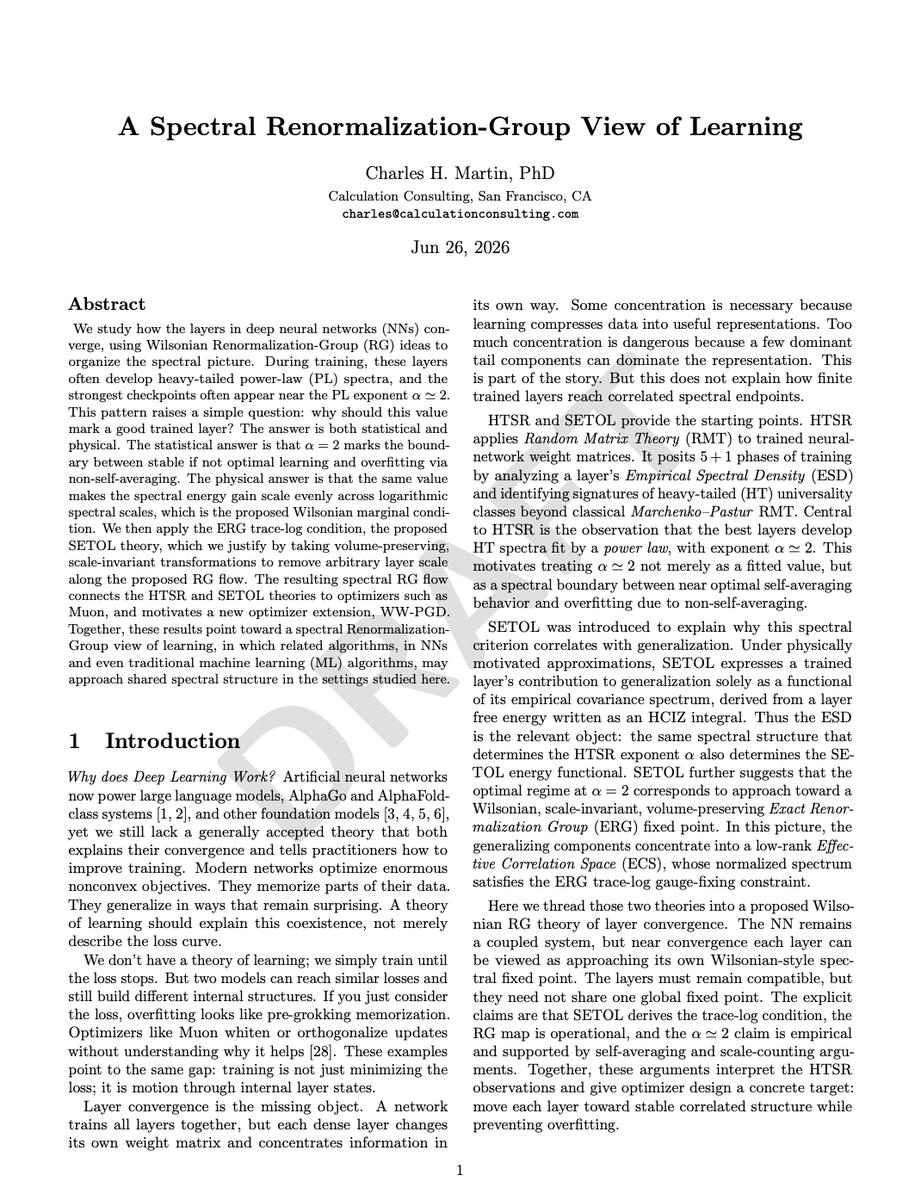
Latest draft of the Renormalization Group Theory of Learning paper is ready.
It’s the full Wilsonian RG treatment that ties HTSR + SETOL together, explains the WeightWatcher magic, and has some new bits on Muon / redundant directions and the ww-pgd optimizer extension
Comments, questions, critiques, “this part is unclear”, whatever — fire away. All feedback welcome.
Join us on the weightwatcher community discord to get the draft and discuss