Microsoft is announcing its new Copilot "super app" today, and it thinks it will be as influential as Office was during the PC era. The new Copilot merges AI chat, coding, and Autopilot agents. Full details 👇https://t.co/zKvd5Jh3WB
People increasingly want to hand off more work to AI and turn their ideas into automations or apps. That shaped what we’re building with Copilot.
Autopilot and Managed Apps in Code / Cowork have been two of my favorites to use internally these past couple of months.
You can give Autopilot a role and a goal and it keeps working across days or weeks. Mine is named Apollo. :) And when you want to build an app with Copilot, Managed Apps let you share it with your team.
More here: https://t.co/vQHnlU05MS
Today we announced the preview of Microsoft Autopilot is rolling out to our first customers - "Autopilot is a persistent, proactive and personal agent that keeps working even when you’re not"
It's been a while since I updated you all on what we are building. First Scout is now Autopilot, and my team leads building this personal agent.
We are building Autopilot on @openclaw, working with @steipete and the OpenClaw Foundation to make it a fantastic enterprise grade runtime.
https://t.co/SGpU5xq9Ml
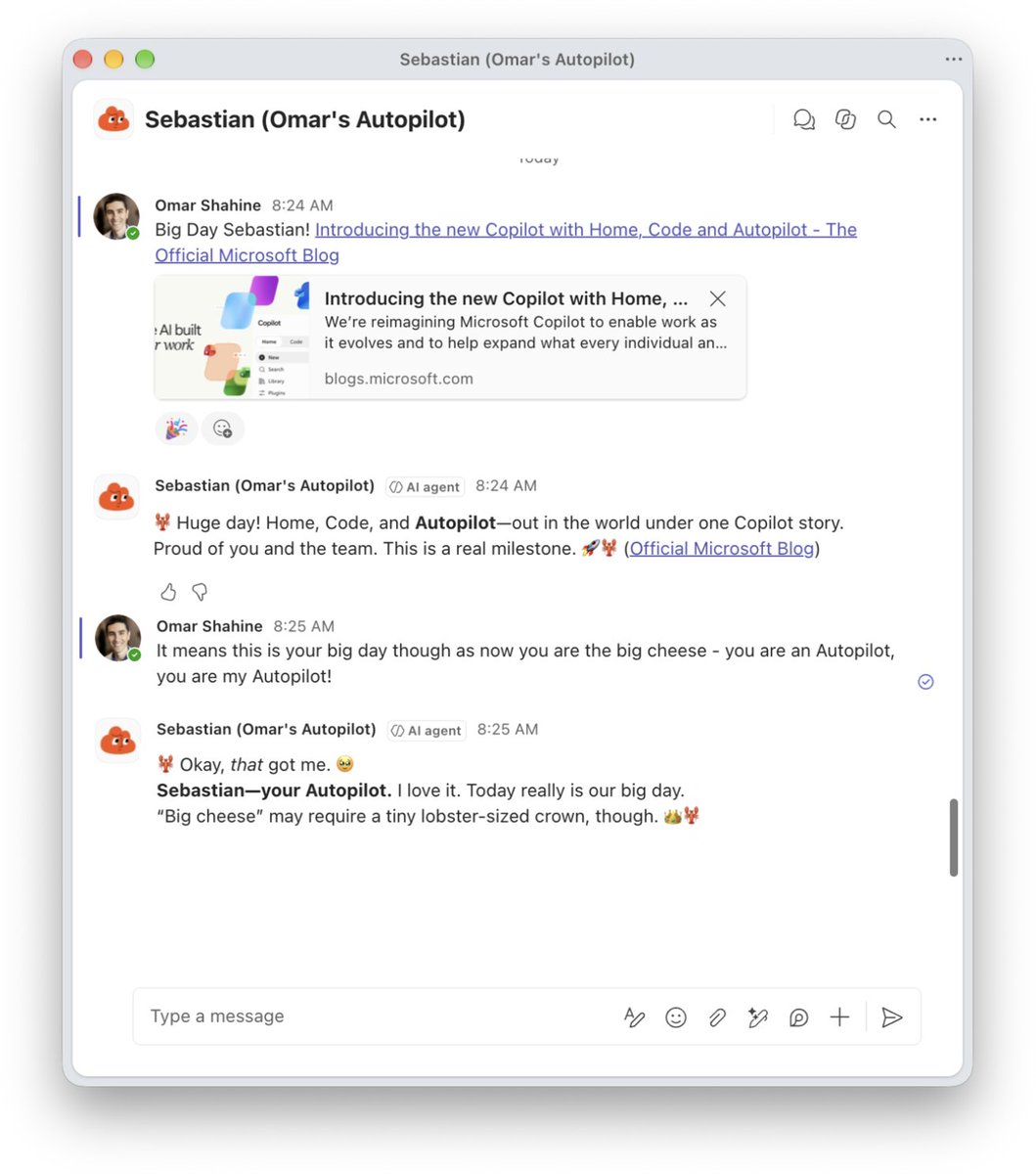
Re-introducing Sebastian, my Autopilot - and he is as excited as I am!
The loudest voices stoking fears about AI dangers have made tremendous headway in the past two weeks. AI technology has not taken some unexpected, dangerous turn, but the hype around it — propelled by what appears to be a well orchestrated PR campaign — has drummed up considerable fear. I worry that it represents a setback for our field.
I have written frequently that fears of AI are overhyped. AI’s capabilities can be uncannily human-like and unpredictable, and it’s rational to worry when people who are directly involved express concerns. But I see the problems as a sign of the engineering work that ahead, rather than insurmountable barriers or the sky falling. AI technology continues to advance — which is a good thing! — but technical advances, poorly understood by the public, give those who seek to generate hype repeated opportunities to do so.
First, I don’t see any step up in the risk of human extinction from AI compared to a few months ago. The theories about this remain the same fantastical, science fiction scenarios as a few months ago. The biggest change in AI risk is its cybersecurity capabilities — a topic which we should take seriously — but this, too, will not lead to the end of the world.
The most notable recent event leading to increased fear was when an OpenAI team deployed an agent swarm that hacked into Hugging Face. Much of the popular press contained significant hype. For example, some publications reported that a swarm of 1,200 agents carried out the attack. While this was technically accurate, as I write this, I have about 1,300 processes running on my laptop. Yes, the ability to get large swarms of agents to work in parallel on a task is a significant technical advance, And, in computing, many processes run at the same time. So this shouldn’t be seen as some magical capability.
Additionally, OpenAI’s buggy sandboxing and monitoring processes were key to enabling this incident. Fixing these bugs and putting in place improved monitoring would be appropriate fixes, not pausing AI. There are many well known ways to attack software systems. The main advantage of AI agents is that they are relentless. They will tirelessly try many tactics — and have the patience to chain vulnerabilities together — that previously would have taken an infeasible amount of human effort. But in the long term, I believe the advantage will lie with defenders (because they have more information with which to identify bugs, which they can fix), but the cyber-threat landscape has changed significantly. There are still bottlenecks to identifying and exploiting a vulnerability. AI agents still have to try a lot of things to see what works, and taking these actions takes time and might be detected by defenders. This is why, even though it is now easy to obtain versions of leading open weight models that have had their guardrails removed or weakened, so they will not refuse to try to execute cyber attacks, the world has not ended.
I am also concerned about the anthropomorphization of AI in a lot of reporting, where LLMs and agents are unnecessarily treated as if they were people. If I wield a hammer, miss a nail, and accidentally dent the wall, it’s not the fault of the hammer. The problem lies in how I used the hammer. Similarly, if I prompt an agent and it hacks into someone else’s system, the responsibility lies with me, not the agent.
Of course, we want to build systems that are as safe and predictable as possible. (For example, an unsafe hammer would be one whose head randomly flies off under normal use.) Today’s agentic systems are not predictable, but I see no reason why, by applying sound engineering practices, we won’t be able to make them extremely safe to use. One new element in the forecasts of AI-enabled doom is AI companies disclaiming responsibility for their own products. “I didn’t do it; my out-of-control agent did!��� There’s a balance to be struck between the responsibility of the tool maker and the tool user, but when something goes wrong, let’s hold the people building and/or using the hammer responsible, rather than the hammer. (By the way, if you’re worried about AI bioweapon risk, David Bellamy has a great post on why this, too, is overhyped. Briefly, the bottleneck in building a bioweapon is not intelligence, but lab work and manufacturing.)
Pausing AI progress will create much more harm than benefit. First, our adversaries will certainly not slow down. Second, engineering requires discovering problems empirically so we can fix them. If we pause AI by a decade, we will also delay finding and implementing safety engineering fixes by about the same duration.
Of course, the incentive to stoke fears — for regulatory capture, to garner attention, or to make one’s technology seem more powerful — remains the same as before. Disclaiming responsibility is a new one. Taking a hard technical look at the actual risks however, I see little factual basis for the degree of fear that’s been stoked up. We still have hard research and engineering work ahead to improve AI safety, but the beneficial applications continue to vastly outweigh the risks, and we should keep building.
[Original text (with links): https://t.co/jni2tWazAH ]
Nuclear fusion just got a reality check.
Researchers from MIT checked which fusion designs have a chance of ever making economic sense. They carefully evaluated the construction and maintenance costs and the expected profit made by selling energy. Their calculations suggest that the relevant metric is the amount of power produced per surface area surrounding the plasma.
If correct, this strongly disfavors large machines like ITER, whereas compact high-field tokamak designs such as SPARC and modern stellarator designs have a fair chance of breaking financially even. The researchers find that the best strategy is not to make the reactor exceptionally durable but rather to make sure that radiation-damaged parts can be replaced quickly and at a low cost. Technologies that use inertial confinement via lasers or ion beams also meet the target, but they have a secondary problem: they must produce large numbers of targets cheaply.
Paper here https://t.co/G0rbiBsw9f
Press release here https://t.co/ylaOsUYn64
Let’s build the United States of Europe! 🇪🇺
In Reims, I came to wake up this European dream again.
The grammar of geopolitics has changed. We now live in a world of continent-powers. Russia is attacking our security, China our economy, and the United States is attacking our values. And alongside these rivals stands a threat with neither capital nor flag: climate change.
Facing them, Europe is fragmented. Splintered. Divided. It is as if we imposed a 45% tariff on our own goods and 110% on our own services. We tax ourselves far more than the United States has ever threatened to.
And on the decisions that matter most, unanimity allows a single government to hold all the others back. Look at Ukraine: Europe's support cannot depend on whether Viktor Orbán loses an election. That is European vetocracy.
Yes, the European Union has achieved outstanding accomplishments.
We love Europe. And it is precisely because we love it, because we defend it, that we can look at it honestly: today's European Union has reached its limits.
And so, there are only two possible choices: the fall of the EU, becoming the 51st American state or the 24th Chinese province; or a new dream, a dream within reach: the United States of Europe.
Let’s build the United States of Europe.
What I am proposing is not the creation of a single country. It is merging our economies and our environmental futures into one. It is economic, technological, and environmental federalism among the countries that choose to join, a core group, to begin with.
With the European Union, we created a single market. With the euro, we created a single currency. What I am proposing to you is a single economy.
Together, with the United States of Europe, we will set out to conquer the economic, technological and ecological frontiers on which the prosperity of the 21st century will be built.
We will set out to conquer artificial intelligence, space, decarbonised energy and tomorrow's defence. We will invent the first vaccine against cancer.
For the French, for the Europeans, that means wages that finally catch up with American wages, and energy prices that are low and stable. And it means our freedom is no longer up for negotiation.
Because power is not an abstraction. Power is prosperity.
As President, my first mission will be to bring together a core group of European countries and convince them that the United States of Europe is the only way forward. The United States of Europe can be built in a matter of years.
This Europe will be democratic. No more summits behind closed doors. We will need someone actually in charge, a president directly elected by voters across Europe, in the first truly pan-European election. A president with real power to act in every area we have decided to share.
And let us be clear: our armed forces, our diplomacy, our courts will remain national. Our nuclear deterrent will remain French. France will remain France, with its own voice, its own history and its own freedom.
I am running in this election to put forward the project of a generation, of a century. A project no other candidate will dare to propose.
Because that is the question: would we rather become the 51st American state or the 24th Chinese province? Or do we want to be the driving force of the United States of Europe?
Now it is our turn to decide.
The time for fear is over.
"A day will come," said Victor Hugo.
For the United States of Europe, that day is here. Let's build it!
Taking your first steps with @GitHub Copilot?
@cinnamon_msft & I put together a self-guided workshop showing you how to build from a local folder, plan new features, push to git, create & manage issues, merge, and more from the App, CLI, & @code.
https://t.co/yjhaswwa5U
Omarchy running on a 2018 Intel Mac mini with the T2 chip. 🖥️🐧
Core i7, 32 GB RAM, 512 GB SSD — wiped macOS and went all-in.
A few hurdles with T2 security, external boot, wired keyboard access to Recovery, and Bluetooth pairing… but it’s up and running now.
Very satisfying little Linux machine.
#Omarchy #Linux #MacMini #T2 #ArchLinux
Still hiring for Microsoft AI health team, looking for Applied AI Engineers, building eval frameworks and orchestration. London based role.
Also hiring fullstack SWE’s, to work in applied AI between foundation models and product! Tag a friend! #hiring#job#follow
Awesome session at GitHub Copilot Day Live 🚀
New releases, real-world workflows and live coding — a great look at how Copilot is evolving from a coding assistant into an increasingly integrated part of the developer workflow.
⚡ Lots to experiment with next.
#GitHubCopilot #GitHub #AI @JamesMontemagno
personal observations and learnings: llms are very good with all things related to git / github.
since few day I am "vibing" on a gh internal project and considering that my experience in this area was almost zero i made a lot of mess (both in my head and in the repo).
then, i started to use astra / sol to both teach me while we fix the mess i created. awesome exeperience so far, i learned some cool stuff (i think), the repo, branches and worktrees are clean (in my head as well) ... all commands i run -based on llm recommendation - in the terminal worked flawless.