”No funds lost” is doing a lot of work when they also shipped your face, passport, and every BTC tx.
KYC is the breach. @AgoraCards
skipped the whole ritual.
#GoDark
Hidden cameras seriously threaten personal safety and privacy in everyday spaces; so this is really good news:
A research team developed an LED device, with an AI that analyzes light reflection patterns, that can detect such cameras with 94% accuracy.
The best thing: The core component costs around $7
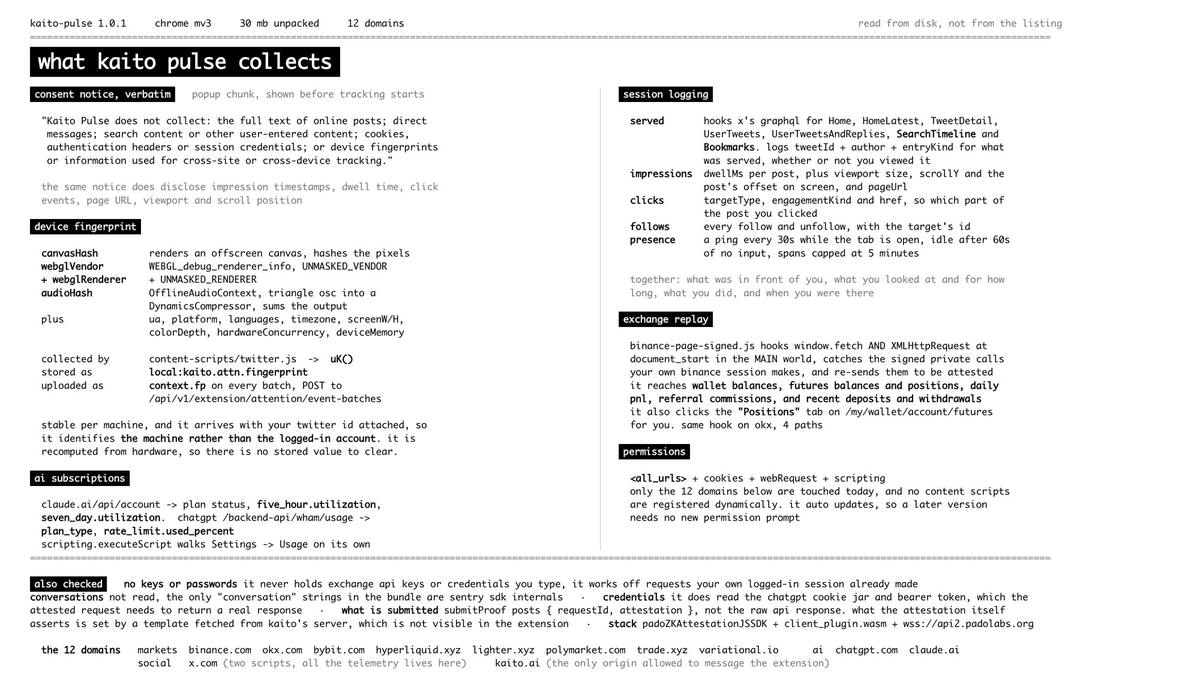
so i was looking at the source code of kaito pulse and found some interesting things:
- it fingerprints your device. it hashes how your gpu renders an invisible image, your gpu model, and how your hardware handles a test tone. that combo is unique to your laptop and it doesn't change
- it goes up with your twitter id attached, so every x account you use on that laptop points back to the same machine
- they can see what you see and replay your whole session. every post your feed served you including the ones you scrolled straight past, how many milliseconds you spent on each, every click, follow and unfollow, and a ping every 30 seconds with idle detection so they know exactly when you were on and for how long. not just your timeline either, it covers your search results and your bookmarks
- it reads your claude and chatgpt subscriptions, which plan you pay for and what percent of your rate limit you've burned (not your conversations though)
- on chatgpt it opens your settings page and clicks through to Usage by itself
- on binance it clicks the Positions tab for you, then re-sends your logged in requests to read wallet balances, futures positions, pnl, and deposit and withdrawal history
- the zktls is a fork of a project called primus
the 12 domains it runs on:
- markets: binance, okx, bybit, hyperliquid, lighter, polymarket, tradexyz, variational
- ai: chatgpt, claude
- social: X (all the telemetry is here)
- kaito (only site allowed to talk to the extension)
The FOSS community is very fragile.
First and foremost, this is because many FOSS developers have a mental block about making money from their projects.
Another group of FOSS developers either fears cryptocurrencies or despises them for religious/political reasons.
As a result, we have great FOSS that survives on a bowl of rice (without butter - that's for the bourgeoisie) and a slice of 3 days old bread.
In my lifetime, I've paid more for FOSS than some people have paid for proprietary apps. I'm not complaining. I'm proud of it.
But, it's not always easy… I have to go to GitHub, open an issue, and directly ask them to add a Monero and/or Bitcoin wallet - and offer to make the first donation myself…
And how pleased I was (and at the same time surprised) to see that some of the FOSS developers whose work I use were happy to receive a 50~200 USD donation via XMR!
So, if you're a FOSS developer for Linux/Android, please don't make me waste my time asking you to accept a donation from me!
First things first, publish your FOSS on @zapstore_, and be sure to add your Monero wallet address to the README - trust me, people will donate to you!
A colorful meme that sums up most of the FOSS community (unfortunately).
🧵: Why Europe is Becoming a Surveillance Prison - And How to Exit (1/11)
Europe loves lecturing the world about "human rights" and "democracy."
In 2026, they're quietly building one of the most sophisticated digital control grids on the planet. This isn't paranoia. It's policy.
Privacy is becoming a luxury.
Rich people use trusts, shell companies, family offices, Swiss banks
Poor people get Venmo and transparent blockchains.
Financial privacy has always existed,
it's just never been available to everyone.
Until monero:native
Monero is the only major crypto whose founder is still completely unknown.
How it started:
- be an anonymous poster on Bitcointalk
- username: thankful_for_today
- April 2014
- launches BitMonero
- an implementation of CryptoNote
- community disagrees with his direction
- forks him out in days
- project is renamed Monero
- (“coin” in Esperanto)
- founder disappears forever
The protocol itself comes from another ghost:
- CryptoNote whitepaper (2013)
- author: Nicolas van Saberhagen
- also anonymous
- introduces ring signatures + stealth addresses
- never identified
Since then, Monero has no founder to arrest
Just a community.
2014–2016: survival phase
- small dev group forms
- fully volunteer
- mostly anonymous
2014–2019: Spagni era
- Riccardo Spagni (fluffypony) becomes lead maintainer
- not the founder
- never claimed to be
- focuses on hardening
- community governance
2020: network-layer privacy
- Dandelion++ implemented
- transaction propagation obfuscated
- IP privacy improved
2022: the unpopular but correct decision
- main emission ends
- tail emission begins
- 0.6 XMR per block forever
- critics scream “infinite supply”
- devs explain incentives
2023–2024: pressure phase
- regulators target privacy tools
- Tornado Cash sanctions
- dev arrests elsewhere
- P2P survives
2025: stress tests
- hashrate concentration scare
- community responds
- mining decentralization improves
- chain continues
January 2026: still alive
- Fluorine Fermi v0.18.4.5 released
- Ledger fixes
- FCMP++ in roadmap
- next-gen privacy
- New ATH
Satoshi disappeared by accident.
Monero’s founders disappeared by design.
Are you looking to hire freelancers for your project, or company, but don't want to pay for job listings on other crypto job boards?
Then give my platform, https://t.co/gkZi5TYbB9, a try.
No job listing fees. 100% free.
🇮🇳 A man in India dug up his deceased sister's skeleton and brought it to the bank just to prove she had died.
He'd been trying to withdraw money from her account for months.
Staff kept telling him the account holder needed to appear in person.
He's illiterate and had no idea a death certificate existed.
The bank got what it asked for.
Source: Times of India