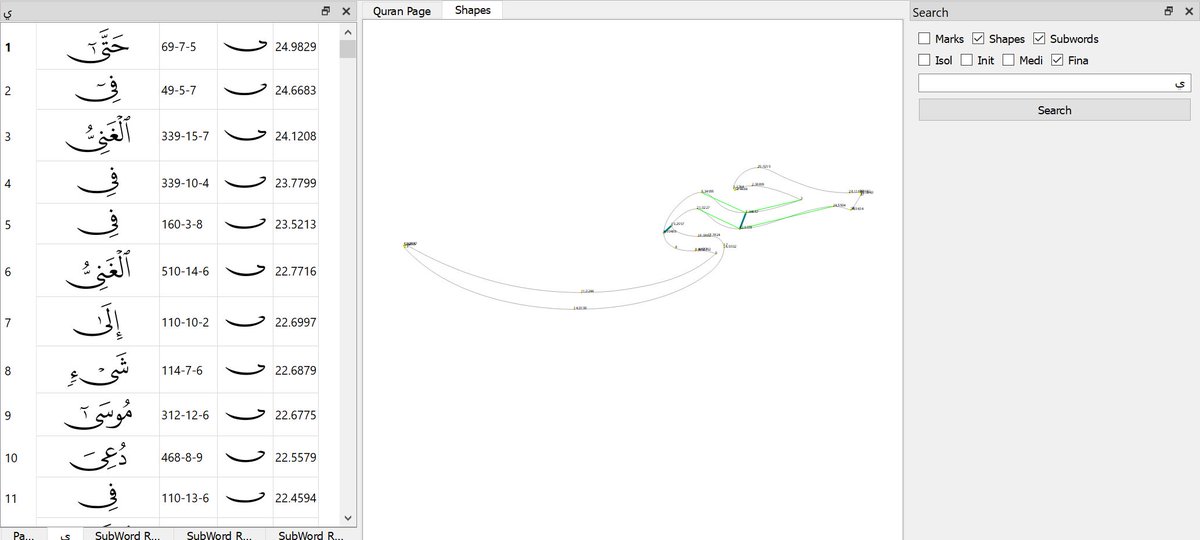
All 604 pages of the 1441 Hafs Mushaf were segmented into letters, dots, marks, and kashidas.
Catalog https://t.co/uzggYc6Edl
Source code https://t.co/aJ4HjBgWOO
I wanted to add Donald Knuth’s Computer Modern to the DigitalKhatt fonts. I ended up creating an experimental variable font based on it, with weight, width and slant axes.
https://t.co/vd3pZTh2JF
The old Madinah font is available on GitHub:
https://t.co/iF3CtFZWBv
⚠️ Currently, the font supports only Qur’anic text in Riwayat Hafs and has been primarily tested for web use.
If you encounter any errors or have suggestions please file an issue on the GitHub repository.
To preserve the traditional mushaf layout, text width is reduced through shrinking rules rather than by changing font size or horizontal scaling.
Rather than maintaining countless OpenType positioning rules, a constraint solver automatically resolves collisions and adjusts marks.
Here is a demo of an editor that defines a trajectory using MetaFont-style knots, directions, and tensions, while interactively adjusting the pen’s roundness, size, and orientation.
The resulting envelope is generated directly by MetaPost using the MetaType1 pen stroke package.
@Arabic_Type The example uses Visual MetaFont (https://t.co/SzfIxY2dZZ) and MetaType1 to approximate the envelope of the pen using Bézier curves which are ultimately needed to generate the OpenType font outlines.
Do you know of a better approach for approximating the envelope of a pen ?
A new direction I’m exploring for DigitalKhatt:
Model how a calligrapher writes instead of drawing glyph outlines.
A parametric qalam follows a trajectory with a variable pen angle.
Different styles and weights can then emerge naturally by changing the qalam geometry.
Here is an experimental Old Madinah Mushaf with tajweed coloring.
It uses a constraint solver for automatic mark positioning and collision avoidance, alongside advanced Arabic justification.
This work is still under development and may contain errors.
https://t.co/swmivwvAKB
A new demo of the old Mushaf al-Madinah is available at https://t.co/gau0qMlPvX (not yet available on WebKit browser).
The demo uses JavaScript, CSS and OpenType instead of WebAssembly and MetaFont (https://t.co/nLfq9SjqEP).
Source code and font : https://t.co/xkHEvUUVYR).
@MohamedTahhan For an Android App you can find an example using Skia at https://t.co/6SsGpu1Bhy. You can adapt it to use the new implementation at https://t.co/MWZt8myZEI. If you don't need justification you can use the font as any other OpenType font.
A new version of the DigitalKhatt font based on Madinah Mushaf from 1441 Hijri is available at https://t.co/3oHr6giqjY (not yet supported on Safari).
Here is a demo of the Mushaf using harfbuzzjs and a frontend justification: https://t.co/1hfzT0tm5L.
I have started preparing documentation if anyone wants to design a new font or improve existing fonts using the Visual MetaFont tool.
https://t.co/SzfIxY2LPx
I continued working on character segmentation at https://t.co/aJ4HjBgoZg. There are still many incorrectly segmented words, but for correct words, the character shapes resulting from a search are displayed in the order of their widths as for the final Yeh below.
A new demo using harfbuzzjs is available at https://t.co/ploQaBuKlC.
Using HarfBuzz directly allows different features per character in the same run. The justification logic is now on the frontend, which makes it possible to study and implement different justification strategies.