92% of Polymarket's trades LOST money.
https://t.co/0UkKFFDr6V
The top 0.04% took 70% of all profits or $3.7 BILLION.
I spent 6 months and 15,000 lines of code trying to be in the 0.04%.
No Bueno!
Here's exactly why and why you would too. 🧵👇
So this is the reason Grok gave for why Dems didn't support this 'critical' bill on insider trading, that removes the 'corruption' of our politicians:
'Democrats cited the stock trading limits as too weak, with loopholes allowing existing holdings, private trades, and excluding the president. Schumer called it toothless and Swiss cheese legislating. They also labeled the attached photo voter ID rules a poison pill and skullduggery meant to force opposition.'
Sound familiar you hypocritical self serving political morons!!
I think we got your agenda fully now!
🇺🇸 BREAKING: Senate Democrats voted 53-47 against a bill that would have mandated photo voter ID and prohibited stock trading by members of Congress, with all Democrats voting against it.
The proposal would have restricted certain stock purchases by lawmakers, their spouses and dependent children, without requiring immediate sales of existing holdings.
Chuck Schumer called the combined measure “skullduggery,” accusing Republicans of attaching voter ID requirements to force Democratic opposition.
Let’s fact-check this debate rather than just repeat the same old political talking points shall we
1. “Not in the public interest.”
That’s an argument, not a fact.
Consumers clearly have an interest in earning a return on their savings. The legitimate policy question is how crypto/stablecoin yield should be regulated, what risks consumers assume, and what protections should apply, not whether earning yield is inherently against the public interest.
2. “Crypto is spending huge amounts to influence politicians.”
True. Crypto backed Super PACs are significant political spenders.
But political spending isn’t unique to crypto. PACs across industries spent billions during the 2024 election cycle.
Banks spend Multi Millions arguing the other side.
So the broader question should be: how much influence should ANY industry be able to buy in Washington?
Don’t just scrutinize crypto money. Scrutinize the system.
3. “Crypto creates conflicts of interest and ethics problems.”
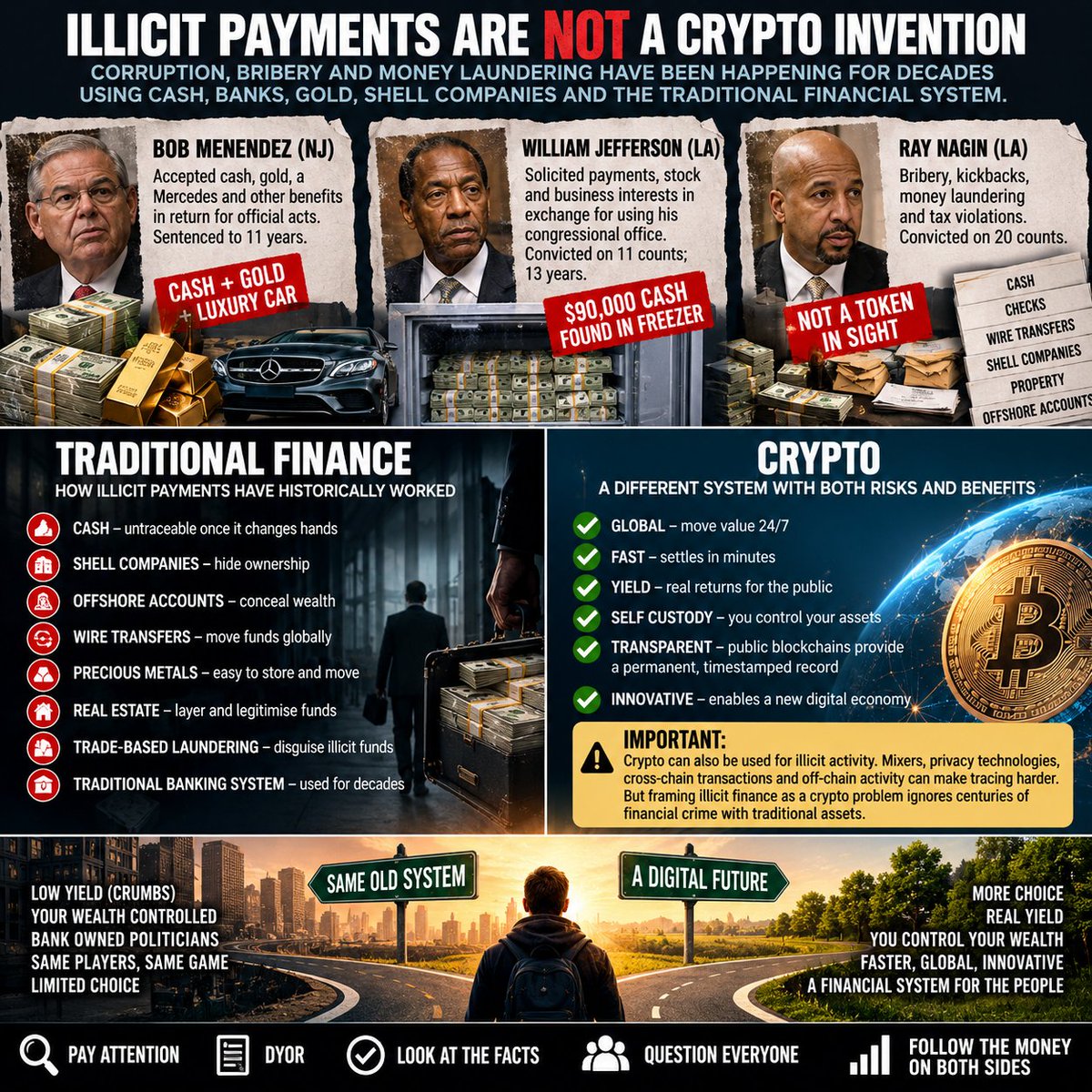
Political corruption existed long before Bitcoin.
Bob Menendez: convicted in a bribery scheme involving cash, gold and a Mercedes; sentenced to 11 years.
William Jefferson: convicted on 11 counts after a corruption investigation in which $90,000 cash was famously found in his freezer; sentenced to 13 years.
Ray Nagin: convicted on 20 counts involving bribery, kickbacks, money laundering and tax violations.
None of those cases required crypto.
Corruption is the problem. The payment technology is the tool.
4. “Crypto enables illicit finance.”
Yes, it can, and it does.
That risk shouldn't be dismissed.
But illicit finance did not begin with crypto, and it certainly isn't exclusive to crypto.
For decades, criminals, corrupt officials and organized crime have used CASH, shell companies, offshore accounts, wire transfers, precious metals, property, trade based laundering and the traditional banking on and off shore systems to move or conceal illicit wealth.
Look at the examples above:
Menendez — cash + gold.
Jefferson — $90,000 CASH literally found in his freezer.
Nagin — cash, checks, wire transfers and money laundering.
Not a token in sight!
Physical cash has an obvious characteristic: once it changes hands, there is no public ledger recording that transaction.
Public blockchains can be very different. Transactions can leave a permanent, timestamped record visible on-chain and available for investigators to analyze.
That does NOT mean all crypto is perfectly traceable. Mixers, privacy technologies, cross-chain transactions, off-chain activity and other techniques can make investigations substantially harder.
But framing illicit finance as uniquely a “crypto problem” ignores centuries of financial crime conducted with traditional assets and financial infrastructure.
Crypto can be used for crime.
So can dollars.
So can gold.
So can banks.
The relevant question isn't whether criminals can use a financial technology.
It's how effectively we can detect, trace and prosecute the criminals who do.
5. Here’s where I completely agree with the warning to the public:
PAY ATTENTION
DYOR.
Check the evidence.
Question the crypto industry.
Question the banks.
Question politicians.
Question people whose livelihoods depend on convincing you that one side is right.
Then ask the bigger questions:
Is finance becoming increasingly digital?
Can today's financial infrastructure meet everything a digital economy will demand?
What role should stablecoins, tokenized assets and decentralized networks play?
Who should control your assets?
Who should earn the economic benefit generated by them?
And how much choice should consumers have?
Those are debates worth having.
Not “crypto good” versus “crypto bad.”
Follow the money—on BOTH sides.
@SenWarren I mean we cant trust you or your colleagues to have Americas best financial interests at heart, despite being voted in for that very reason either, so who can we really trust now days Liz!
@SenWarren If there is a more Karen Karen for our times it's you lizzy.
You're anti Crypto, Anti AI, Anti everything.
Try to open your mind to the possibilities. The adults of our future aren't doing anything at the pace we are today. Times have to change. you cant stand still. Move on.
@BSCNews@HawleyMO This is so transparent. Hawley saw the vote not getting enough Yes's, made a call to make it look like he was holding out for his constituents, then went on camera to say it was about the farmers getting funding from local banks which just made him look COMPLETLY out of touch!
Big shout out to Jamie Dimon and the fake banker BS crew.
As a result of the Clarity Act not getting through we have higher interest, higher Yield and higher Crypto.
Things turned out again.
De banking Phase 2 in full swing. Moron