🚨 Fonderies de Bretagne : M. le ministre de l'Industrie, il y a urgence. Je vous ai demandé un rendez-vous pour sauver les 260 salariés que j'ai vus la semaine dernière.
Un fonds prédateur, Alpha Blue Ocean, pille plusieurs usines stratégiques du pays, avec l'autorisation du gouvernement !
Allez-vous rester spectateur ?
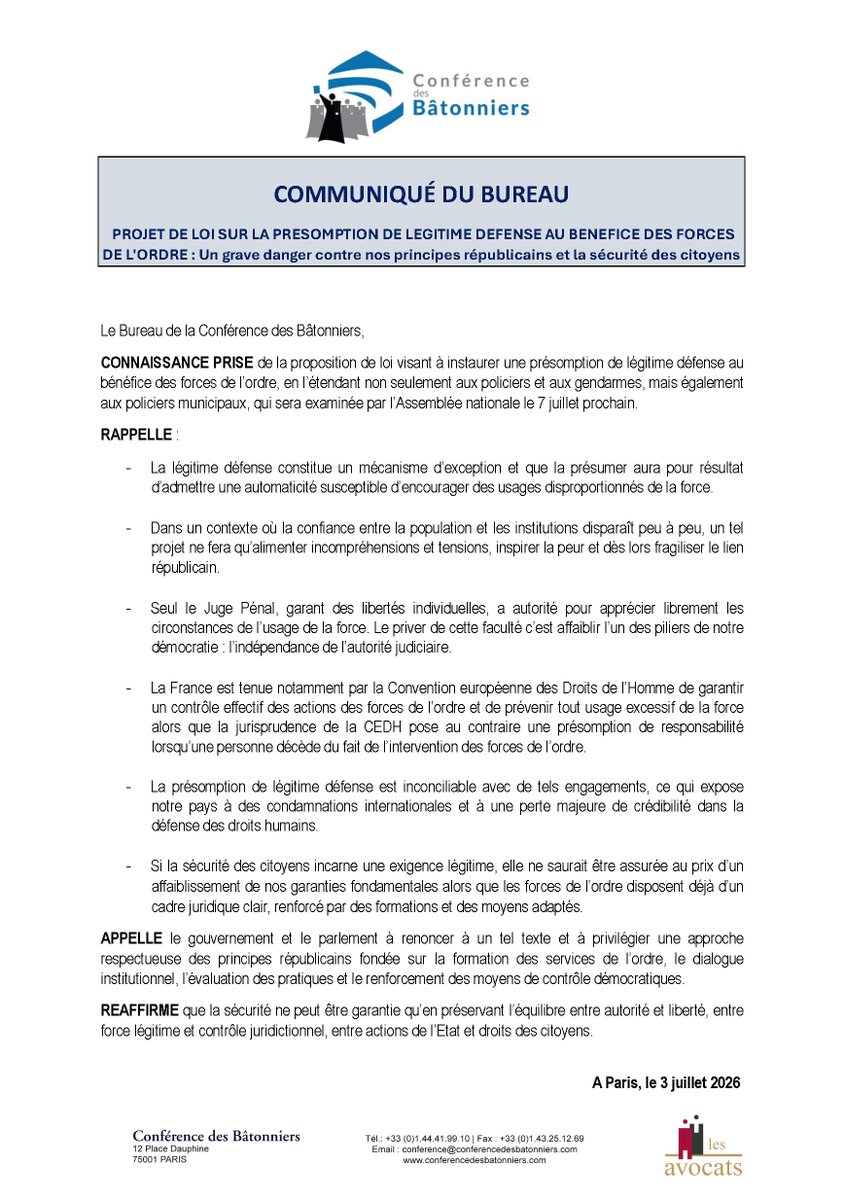
Le Conseil de l'Ordre du barreau de Paris S’OPPOSE formellement à la création d’une présomption de légitime défense pour les forces de l’ordre.
Défendons l'Etat de droit.
Une proposition de loi visant à instaurer une présomption de légitime défense au bénéfice des forces de l’ordre sera examinée par l’Assemblée nationale le 7 juillet prochain.
Le dispositif prévoit d’étendre ce dispositif aux policiers, gendarmes ainsi qu’aux policiers municipaux.
Ce texte s’inscrit dans un contexte de recul progressif de la confiance entre la population et les institutions. Il s'agit d’une réforme extrêmement dangereuse de nature à accentuer grandement les risques d’incidents et d’accidents gravissimes.
Le Bureau de la Conférence des Bâtonniers exprime une opposition ferme à ce dispositif et rappelle que la légitime défense ne peut être présumée sans fragiliser les garanties fondamentales de l’État de droit et le rôle du juge.
👇Lire le communiqué👇
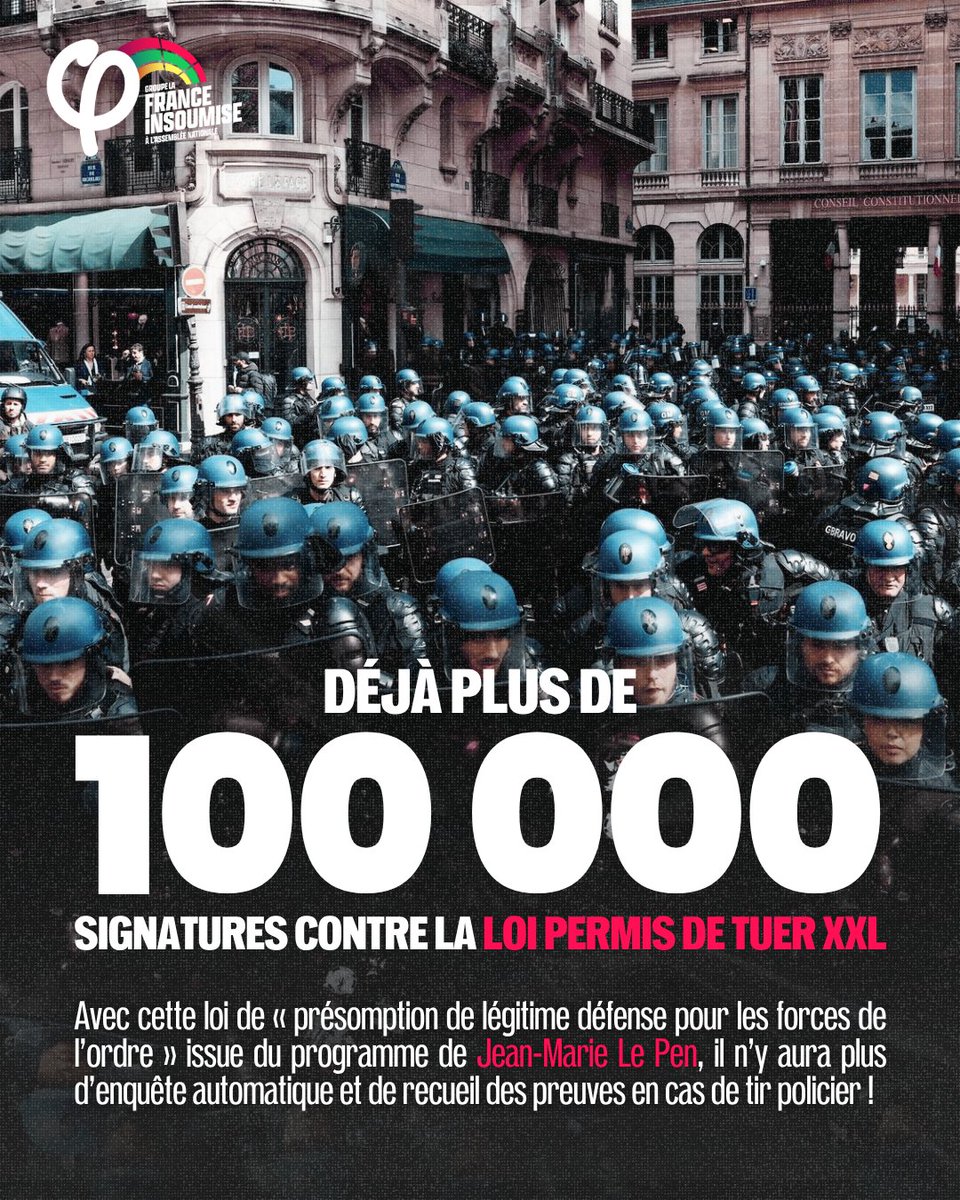
🔴⚡️ Déjà plus de 100 000 signatures pour la pétition citoyenne contre la loi Permis de tuer XXL !
Mardi, l'Assemblée votera un texte qui mettrait fin aux enquêtes automatiques et au recueil immédiat des preuves après un tir policier.
C'est inacceptable.
📢 Objectif 500 000 : https://t.co/601yMo8l7s
Swiss farmers planted flowers between their crops and watched pest damage drop by over half. The UK is now running the same trial across 15 farms. The reason this works is embarrassingly simple.
A Swiss study on winter wheat found that fields with wildflower strips had 40 to 53% fewer leaf beetle pests than fields without. Crop damage dropped 61%.
The mechanism is simple. Wildflowers feed hoverflies, lacewings, parasitic wasps, ladybugs, and ground beetles. Those insects eat the aphids, beetle larvae, and caterpillars that farmers would otherwise spray for. A few meters of wildflowers hosts an unpaid pest control crew that would jump at the chance to whoop some aphid ass.
In apple orchards where no insecticides had been used for five years, plots with wildflower alleyways had 9.2% damaged fruit. Control plots without flowers had 32.5%.
The UK is now running a five-year trial across 15 farms placing 6-meter flower strips through the middle of fields, not just at the edges, because the beneficial insects can't reach the center of a large field otherwise.
This works the same way in a backyard vegetable garden as it does on a commercial farm. Plant native flowering species near your tomatoes, beans, and squash. The pests still show up, but the predators show up too.
Study doi: 20151369
La France compte « le plus grand nombre de personnes tuées ou blessées par des agents de la force publique » dans l'UE. Une proposition de loi Retailleau, sur la base d’une idée du RN, présume que tout tir policier, même mortel, bénéficiera d’une « présomption de légitime défense », en « violation de la jurisprudence de la Cour européenne des droits de l’homme ». Le Conseil de l'Ordre du barreau de Paris a martelé dans un communiqué, jeudi, que « l’État de droit suppose que les forces de l'ordre (...) ne puissent bénéficier d'une immunité de principe ».
Le groupe LFI a estimé qu’elle « porterait un coup historique à l'État de droit ». Il est temps de signer sur le site de l’Assemblée la pétition contre ce mauvais coup. Si les droites et le centre votent avec le RN, nous abrogerons quand même cette loi en 2027.
Deux constats un peu accablants pour la gauche :
-Le seul cas de figure où elle gagnerait , c’est un final Melenchon /Glucksmann , autant dire les poules ont des dents
- Dans tous les cas de figure , Jean Luc Melenchon est battu , que ce soit par #LePen#Bardella , #Philippe .
C’est la qu’on réalise à quel point la détestation qu’il a générée depuis le #7Octobre est la meilleure assurance vie pour tous les autres candidats . Sourire et faire patte de velours n’atténuera pas cet effet cliquet dans l’opinion .
-Raphaël Glucksmann est lui aussi battu à coup sûr ( sauf duel avec Mélenchon )
À droite et à l’extrême droite , une évidence :
- Le RN gagne toujours , sauf face à Édouard Philippe qui bat Marine Le Pen
Nous sommes loin mais , à ce stade , la gauche ne joue pas la partie , condamnée pour le moment au rôle utile mais désespérant du barrage républicain .
( photo via @clement_mci )
"on traite les milliardaires comme si on en avait besoin et on traite la nature comme si on n'en avait pas besoin"
Waly Dia dans la Riposte, ça ne pouvait être qu'un banger ! 🤩👍👏
Merci Waly, merci Akim !
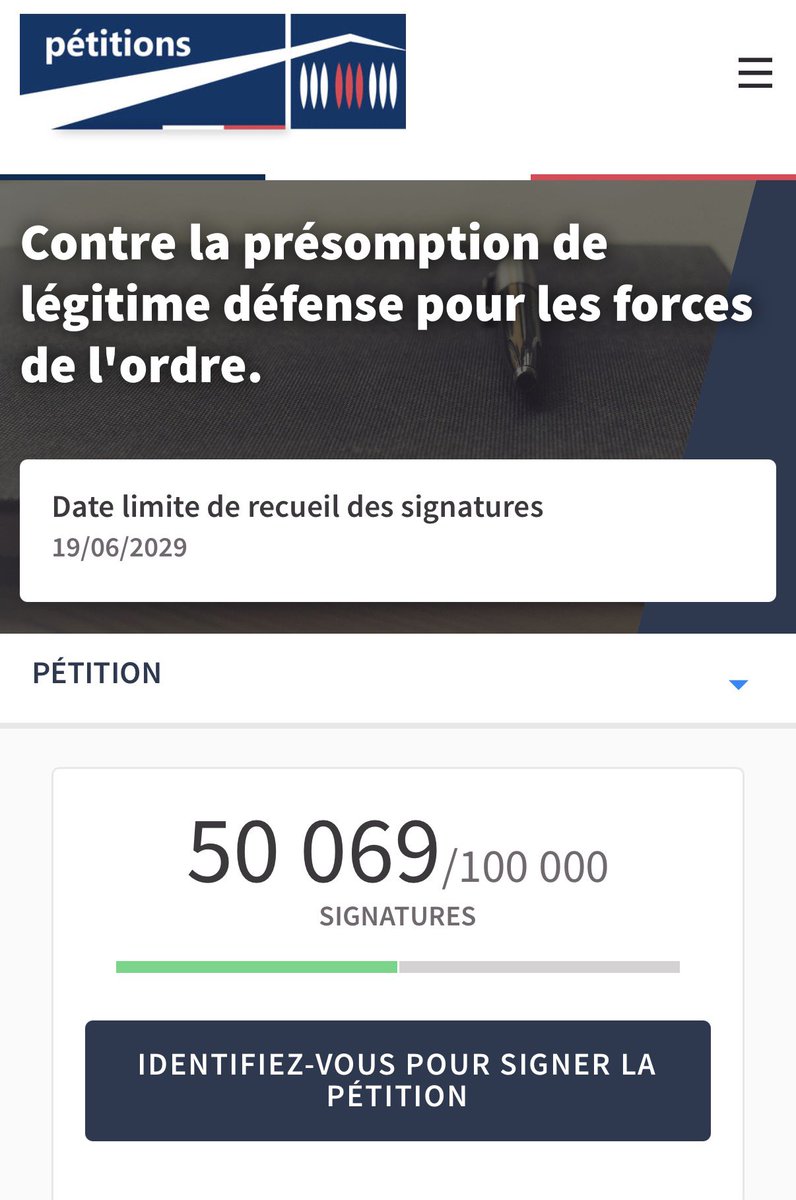
Plus de 50.000 signatures contre la loi qui propose de donner un permis de tuer aux policiers et aux gendarmes !
Continuez de signer et faites circuler autour de vous !
Lien : https://t.co/AZykBRzxHp
POINT CONGRES PS.
Deux lignes s’affrontaient.
1/ TOA : non au vote uniquement en présence, ca permet à TOB et TOC de bourrer les urnes
2/ TOB et TOC : non au vote a distance, ca permet à TOA de magouiller le résultat
La ligne 2 a gagné : ce sera donc bourrage des urnes 🤷🏻♂️
À Lyon l’extrême droite déchaîne à nouveau sa violence raciste dans la rue.
Le 23 juin dernier plusieurs individus ont lynché un homme, le frappant à la tête et le laissant inanimé au sol plusieurs minutes.
Depuis des années l’extrême droite multiplie ces opérations à Lyon dans un silence médiatique assourdissant.
L’extrême droite est un danger mortel pour le pays.
🔴 Ce jeudi 2 juillet, rendez-vous à 11h pour suivre en direct une allocution de Jean-Luc Mélenchon sur les écorégions et la 6e République, suivie d'une conférence de presse avec Manuel Bompard.
👉 Le direct sur Youtube : https://t.co/RIbGp61NDu
🔴⚡Coup de tonnerre en Allemagne, la gauche en tête dans les intentions de vote pour les élections dans la capitale |
🟥Die Linke | 20% (+2)
🟩Grüne | 19% (+1)
卐AFD | 18%
🟦CDU | 17% (-2)
🌹SPD | 13% (-1)
🗞️ Nous apprenons aujourd’hui par Médiapart que l’usine BASF de Genay dans le #Rhône utilise encore des insecticides chimiques interdits en France.
Cela n’est pas la première fois que cette usine met en danger la santé des habitant•es et du vivant.
L’usine a déjà été sanctionnée en 2025 pour la présence de plusieurs tonnes de #pesticides interdits dans ses locaux.
✊ Je remercie les citoyennes et citoyens à l’origine de cette « inspection citoyenne » qui a permis de mettre en lumière les violations graves de cette entreprise. Comme eux, j’appelle à ce que les services de l’État, en premier lieu la Préfecture du Rhône, prennent de lourdes sanctions face à ces violations à répétition.
L’impunité écologique et sanitaire n’a plus sa place en 2026. En 2027 vite la planification écologique et les Eco-Régions par bassin de rivières.
#BASF
#Rhône
👉🏼 https://t.co/br1N8P9zh4