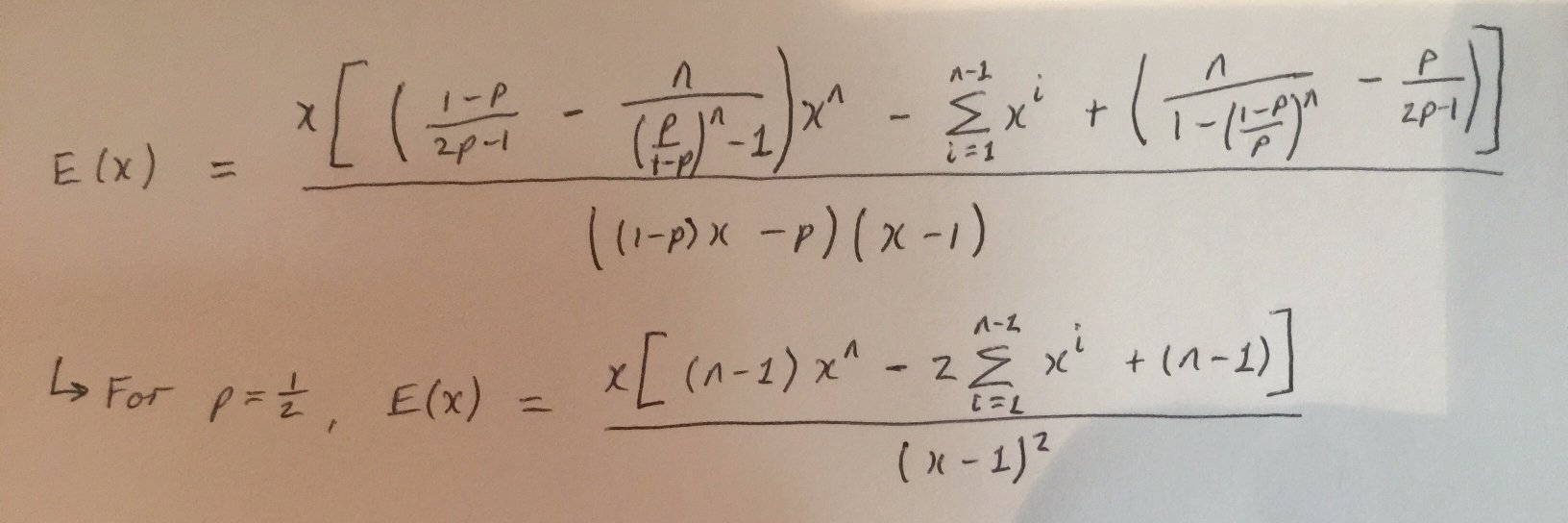
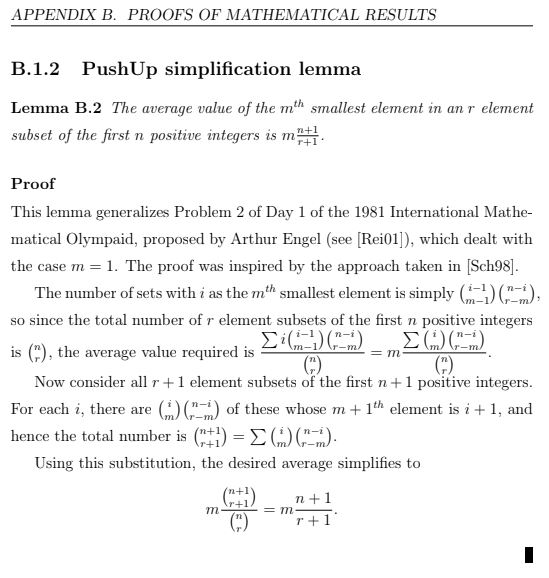
@KDCochran1 @ShengwuLi I remember that debate, and the theorem 😂
(One of many in which Shengwu claimed that 'everything the other side has said is irrelevant'!)
Just when I thought I was done with posting on Twitter...
@xaqwg Riddler extension for this week: what's the biggest number that can't be encoded in a triple (m,n,q), as a function of q? With a modified Chicken McNugget Theorem and some Fibonacci magic, you can show it's F_q * F_(q+1).
@LaurentLessard @xaqwg Nice write-up, as always Laurent!
On your question at the end, there are infinitely many solutions. One way to see that: any 8 primes in arithmetic progression work, and there exist arbitrarily long APs of primes (ref: https://t.co/OKUufsUzC8).
@ptrajeev @xaqwg @LaurentLessard @HectorPefo I know the feeling : )
I thought it must have been about 2 years since I posted a solution - was a little jarred to find that it’s been almost 5!
For #thisweeksriddler, it's easier to see the pattern if you look at the number of cells being added in each generation.
@xaqwg @LaurentLessard (@ptrajeev, @HectorPefo - do you guys still do this?? Admittedly, I haven't been around here for a while...)
@MrExcel Here's one way (with "XFD" in A1):
=LET(OneToN, SEQUENCE(LEN(A1)), Chars, MID(A1,OneToN,1), CharNums, DECIMAL(Chars,36)-9, SUM((CharNums)*26^(LEN(A1)-OneToN)))
This works with longer strings too - e.g. if we ever get there, this says col ABCDE will be #494,265
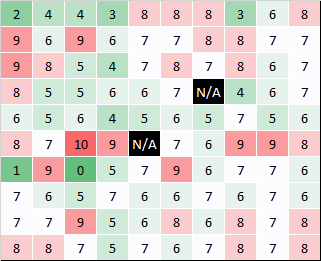
@chapmajw @xaqwg Oops, you're right, I was looking at the one next to it. So your 9 is right.
To be honest, I did it mostly by hand, with some help from Excel. I should have been more careful!
@chapmajw @xaqwg Snap! Except I have one different from you - I think your 9 in the 7th row and 7th col should be a 6 (you can move 2 up from there to get to the 5).
Full disclosure - I used yours to fix a mistake in my first version too!
@lotterdata @xaqwg I think you can take it a (small) step further - there's always a max unless D and P share a common factor, and in that case you use a similar formula to get the max mult of their GCD.
@xaqwg The maze should have been the classic - so much to it!
Some extensions:
Can you finish from every starting square?
Which start is most moves away from the finish? (Interestingly, there's a unique answer, and it's adjacent to the finish square!)
@lotterdata @AtDrunkTweeting @xaqwg @Mathgarden Do you see more than one way to get two consecutive with -1 or -2? It has to be the highest power of 2 and an adjacent prime, and as long as you’re below n = 2^82,589,934 that’s n/2 and n/2 - 1 (I think).
@AtDrunkTweeting @xaqwg @Mathgarden A couple more extensions to push this further... if the stadium size has to be between 2 and 100,000, which possible sizes work? If the stadium size is unlimited, what's the largest known size the claim could work for? I think it's 2^82,589,934 - 1.
@HectorPefo @xaqwg I read it as meaning you can pick a pace for any probability p (so you’re really just picking p) - seems reasonable to assume there is some pace at which a competitive team can almost surely finish the distance.