I am delighted to announce the next round of the Webinar Series in #Finance and #Development, #WEFIDEV, for the 2026-2027 academic year co-organized with @nish_vats, @KimFeCramer, @giorgiabarboni and #SeanHiggins.
WEFIDEV brings together scholars working on finance in developing countries, with a particular commitment to creating a thoughtful, constructive, and intellectually generous space for new ideas.
For the Fall 2026 webinar series, we especially welcome preliminary and early-stage ideas. The goal is to offer a low-stakes environment where scholars can present work in progress, receive helpful feedback, and build connections with others working on related questions.
As always, we are particularly eager to give visibility to junior researchers. We also hope to devote at least one session to job market papers by candidates going on the market this academic year. Faculty, please do share this opportunity with your students working on finance and development.
More mature papers will be a better fit for the Spring 2027 call, which will include the WEFIDEV webinars and conference in collaboration with the Review of Financial Studies, with dual submission to the RFS.
The Fall 2026 webinars will meet on the 2nd and 4th Monday of the fall months, from 11am to 12pm US Eastern time, 5pm to 6pm Central European time. Exact dates will be announced soon.
Submissions for the Fall 2026 webinar are due by the end of the day on Thursday, August 27, 2026.
And if you know someone who would like to join the WEFIDEV community, please encourage them to contact us via mail, DM or writing at [email protected].
We look forward to seeing many exciting new ideas, welcoming new colleagues, and continuing to build a generous and vibrant community around finance and development.
OPINIÃO | 📊 ECONOMETRIA FÁCIL | A manchete diz que brasileiros preferem pagar menos impostos a receber serviços públicos. Mas será que a pergunta do survey permite concluir isso?
Neste vídeo, mostro por que o desenho de uma pergunta importa tanto quanto a resposta. Quando uma mesma questão mistura impostos, saúde, educação, serviços privados e confiança no governo, diferentes motivações acabam produzindo a mesma resposta.
Em pesquisa, uma boa pergunta é aquela que consegue medir exatamente o que pretende medir.
📌 Referência: Stantcheva, S. (2023). How to Run Surveys: A Guide to Creating Your Own Identifying Variation and Revealing the Invisible. Annual Review of Economics, 15, 205–234.
📲Leia mais na #Folha: https://t.co/5dWo8gUpj9
📊 Victor Rangel (@EconometriaFaci) é bacharel em economia e mestrando do Insper
🚨 New research: Generative AI Can Harm Teaching
Most teachers now use AI. But what does it do to students?
@angeladuckw, @lirabenjamin and I ran an RCT:
Students of AI-equipped teachers lost motivation and confidence. Some learned less. 👇
https://t.co/FxAtLP4t5b
🧵
Within a network of middle and high schools in Turkey (~200 teachers, ~3,000 students), teachers were randomized to a custom AI teaching tool or a business-as-usual control for a semester.
Students rated AI-assisted teachers' courses as less important, less enjoyable, and less interesting. Intrinsic motivation ↓ 0.11 SD 📉 The effect was ~3x larger for teachers who were already heavy AI users.
No average effect on academic performance. But the null hides two offsetting stories. Students of lower-performing teachers scored 0.13 SD worse — and lost confidence too! Effects on higher-performing teachers' students are directionally positive, but not significant.
What might explain these findings?
We analyzed teachers' conversations with AI. The median conversation is just 2 prompts long, and 2/3 of use is generating course materials (lecture notes, homework, exams, etc.). Minimal iteration, minimal instructional support. This looks like a substitution of pedagogical effort, not augmentation.
After a semester of access, teachers who had used AI heavily before the experiment became more pessimistic about AI's effect on learning. Novices became more optimistic.
Familiarity did not breed acceptance. Experience bred concern.
AI-generated materials may be competent but generic. Students notice when their teacher's own voice disappears. And weaker teachers seem least equipped (or motivated) to critically adapt AI output.
This doesn't mean AI has no place in schools. It means productivity gains from other knowledge work don't automatically transfer to classrooms — where relationships, not just output, drive learning. Successful deployment might need guardrails and training, especially for the teachers most eager to adopt.
Updated version of "The Two Sides of Discretion"! Hospitals using discretion to procure essential medicines buy from higher-quality manufacturers and see ~8% lower mortality. Procurement under discretion is 17% pricier, but part reflects better brands https://t.co/2WTi31ocM2
Updated version of "The Two Sides of Discretion"! Hospitals using discretion to procure essential medicines buy from higher-quality manufacturers and see ~8% lower mortality. Procurement under discretion is 17% pricier, but part reflects better brands https://t.co/2WTi31ocM2
1/4
📣 Nova vaga | Data Research Associate – Brasil
Estamos contratando um(a) Data Research Associate para apoiar um projeto de pesquisa sobre os efeitos do PIX na inclusão financeira e no bem-estar econômico de pessoas de baixa renda e de micro e pequenas empresas no Brasil.🧵
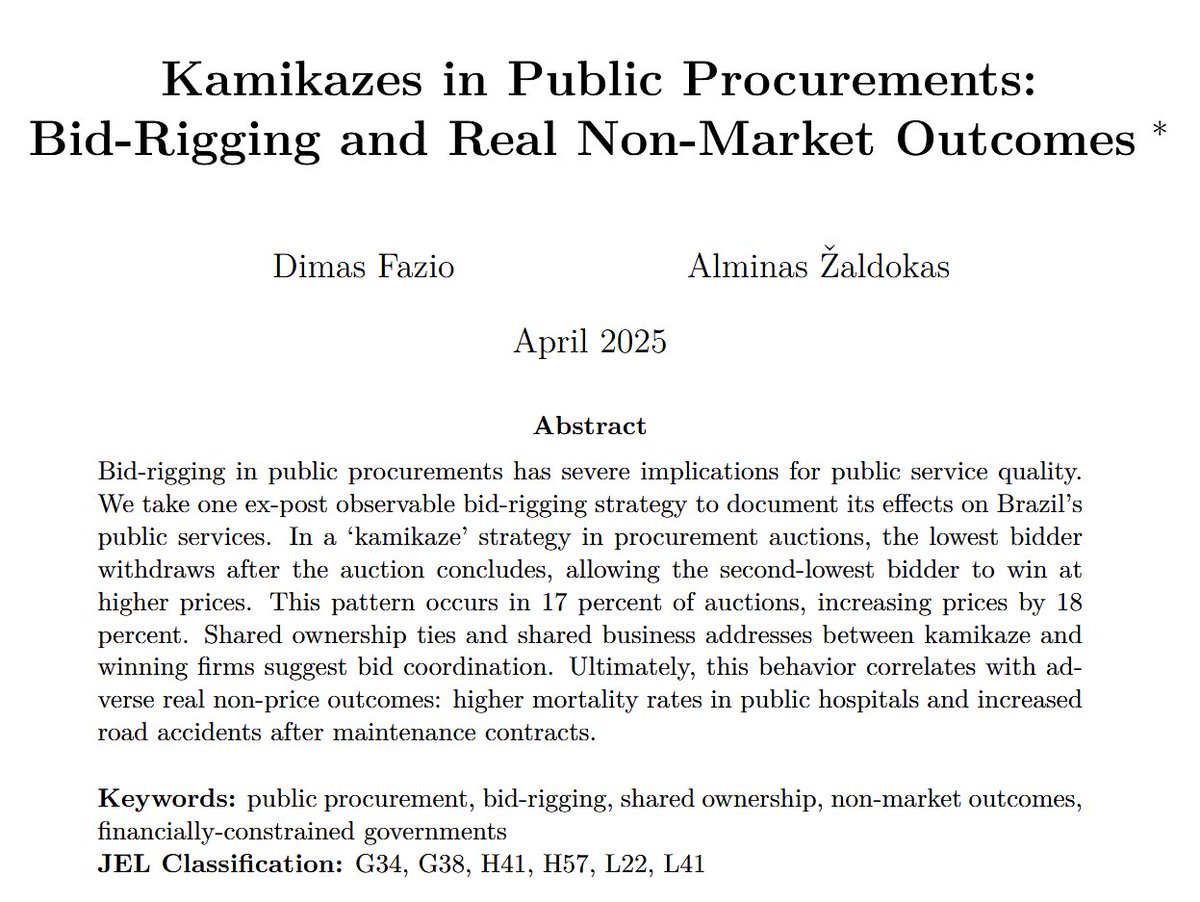
How does bid-rigging impact public procurement? 🏗️ Read the new thought leadership brief for "Kamikazes in Public Procurements" (co-authored with @alminas). Grateful to the HKUST Institute for Emerging Market Studies for funding this research! https://t.co/ecbShgS0RV
I know this question was already asked so many times here, but I am looking for teaching materials to help #Finance or #Economics PhD students use AI techniques for research. Focus: empirical work (data, analysis) and writing (proofreading, etc). Thanks! #PhD#AI#LLM
One of my RAs, Jiawei Zhang, is looking for a PhD position in Finance. MSc in Fin Eng from NUS (top 2 students) and RA since 2023. Strong technical skills (Python, R, Stata, C++) and solid training including auditing PhD courses. Please reach out if you know of any openings!
One of my RAs, Jiawei Zhang, is looking for a PhD position in Finance. MSc in Fin Eng from NUS (top 2 students) and RA since 2023. Strong technical skills (Python, R, Stata, C++) and solid training including auditing PhD courses. Please reach out if you know of any openings!
We are hiring in Singapore! Finance faculty positions at the junior & senior levels! Come and work with us: amazing department, city, compensation package, and more importantly - stable politics/economy
https://t.co/iwlIR3K0YA
We are hiring in Singapore! Finance faculty positions at the junior & senior levels! Come and work with us: amazing department, city, compensation package, and more importantly - stable politics/economy
https://t.co/iwlIR3K0YA
@florianederer Great guide! Just as another example, we have a paper that shows that shared ownership also affects prices in public procurement and ultimately public services provision https://t.co/MALWwDA3N3
In case you need a distraction from the daily news and want to learn more about the effects of bid-rigging in public procurement auctions on health outcomes, road accidents, and government contracts more broadly...
Join us this Thursday as we will present our research on "Kamikazes in Public Procurements" at the HKUST-IEMS Webinar!
🕓 Times:
4pm SGT/HKT
9am BST
4am EDT
1am PDT
Register here to participate: https://t.co/0bvAi0br3o #Economics#CorporateGovernance#BidRigging#Procurement
Join us this Thursday as we will present our research on "Kamikazes in Public Procurements" at the HKUST-IEMS Webinar!
🕓 Times:
4pm SGT/HKT
9am BST
4am EDT
1am PDT
Register here to participate: https://t.co/0bvAi0br3o #Economics#CorporateGovernance#BidRigging#Procurement