A really, really lazy thread on original/ancestral sin that may (or not) end this debate🧵:
It seems to me that some orthobros don't know the real problem and the real issue, so I decided to make this thread.
– Jay Dyer isn't bad bro 999k♥️ 999k🔁
– He is + his teachings are wrong. 0♥️
– Prove it 999k♥️ 999k🔁
– He says Christ is a divine only person for example. 0♥️
– He doesn't teach anything wrong. 999k♥️ 999k🔁
Those dyerists are disgusting NPCs.
No, actually, if Catholicism were, per impossible, falsified I would not become orthodox, protestant or any other religion. I would become a deist, simply because if proofs for Catholicism didn't suffice, no other proofs for any other religion could.
Small correction first: the passage
is John 7:53–8:11, not John 7:5–8:11.
But the bigger issue is this: you are
turning a complex textual-critical
discussion into an Ehrman meme.
No serious person denies that
Mark 16:9–20 and John 7:53–8:11
have textual difficulties.
The question is what those
difficulties actually prove.
The consensus concerns textual placement and original composition
not whether these traditions were
ancient or known in early Christianity.
For Mark 16:9–20,
this is not “Ehrman settled it”
There is an entire academic volume,
Perspectives on the Ending of Mark:
Four Views, where Robinson
and Black argue for the verses’
authenticity, Elliott and Wallace
argue against originality,
and Bock responds to both sides.
That is a real scholarly debate,
not a Twitter slogan.
And the longer ending is not some late invention.
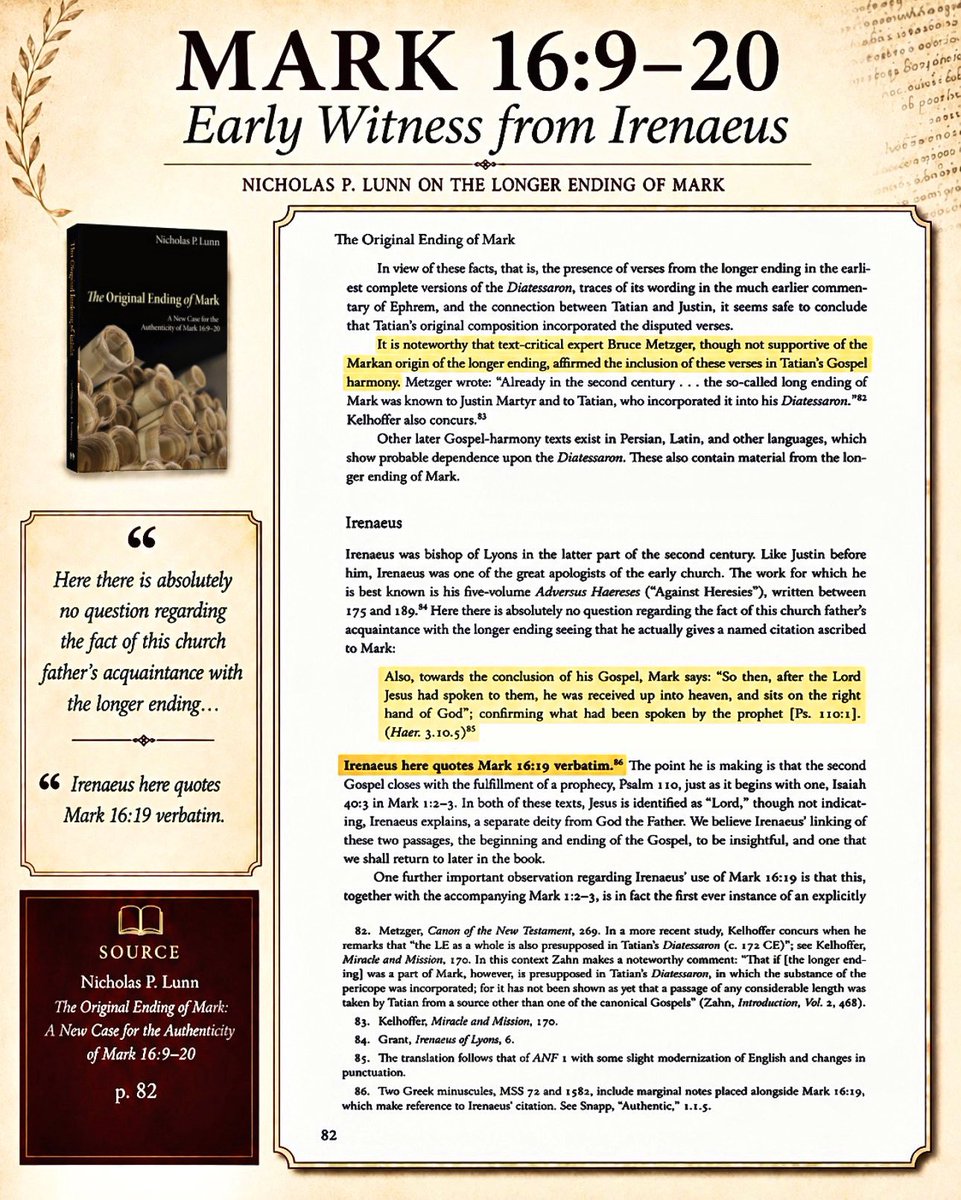
Irenaeus, writing in the late second century, explicitly quotes Mark 16:19 and attributes the words to Mark.
Nicholas Lunn notes that Irenaeus quotes Mark 16:19 verbatim,
and the foreword to David Hester’s Does Mark 16:9–20 Belong in the New Testament? calls Irenaeus the first indisputable witness to how Mark’s Gospel ended.
For John 7:53–8:11, the same problem appears.
Knust and Wasserman note in To Cast the First Stone that the Didascalia Apostolorum, a third-century church order, gives the earliest explicit Christian reference to an episode involving Jesus and a woman caught in adultery.
And Augustine later says some removed the story from manuscripts out of fear it could be misused
while still treating the passage as genuine.
Even the scholarly discussion
in The Pericope of the Adulteress
in Contemporary Research notes
that this does not negate the fact
that Augustine regards the passage as genuine.
So yes, textual variants exist.
No, that does not prove
“the Bible was forged”
It proves something much less convenient for the meme:
Christians preserved the evidence,
marked the variants, debated the data, and transmitted the textual history openly.
That is not corruption.
That is textual honesty.