@Flivver15@HakunaMatata26C@Keir_Starmer You mean the same way our closest ally failed to support the uk military intervention to protect its assets in Suez in 56.
@thesedgehog@JohnRossBeattie The same Vern who in one of his last games lost 61-21 to England. The same Vern whose team was built on the foundations of a Glasgow side coached by Gregor Townsend
All of the elite athletes I know eat ice cream, pizza, candy, and have an occasional beer.
All of the mediocre athletes who are big on social media: lose their minds at the thought of some of those things.
This holds beyond nutrition.
Build robustness, not fragility.
Stop making things you choose to do your personal religion.
If you love cold plunging, nasal breathing, keto diet, zone 2, HIIT, etc...GREAT! Do it.
But you don't need to evangelize. To see anyone who disagrees as a heretic.
We can do things without overly attaching to them.
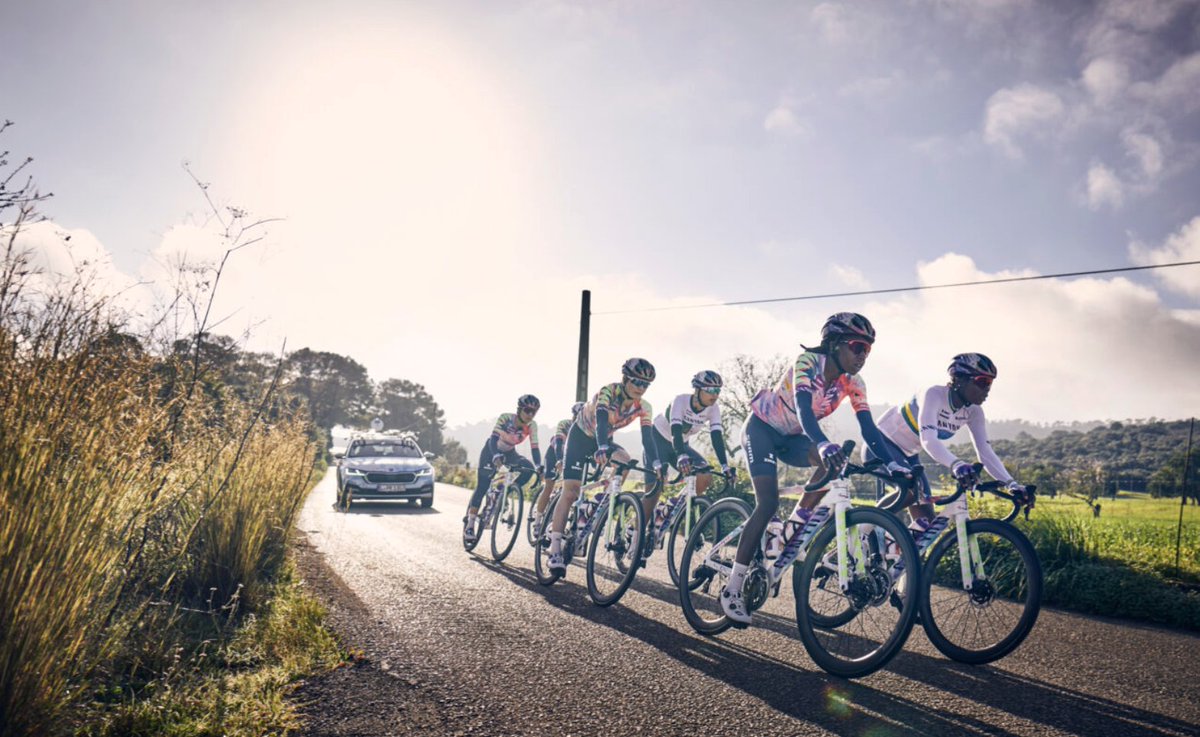
If someone gets dropped from your group ride, the strongest rider failed. Not the weakest.
Strava and racing culture have convinced riders that the group ride is where you prove your worth. It’s where you prove you can put your ego aside.
The function of a group ride is simple: it’s one unit, limited by its weakest link.
Everyone gets home. Everyone gets better. That’s the point.
These are our Roadman club rules for Saturday morning spins in Dublin.
Not exhaustive, but they’re what keeps twenty riders safe at 30 + km/h:
- Don’t be late. You’re one part of twenty.
- Bring spares. Tube, CO2, tyre levers. If you puncture and can’t fix it, everyone waits.
- Arrive with a bike in good working order. Squealing brakes and skipping gears become everyone’s problem five kilometres in.
- When someone punctures: Make sure they have spares. Maybe one person waits to assist, the rest ride on for a few kilometres and then double back. Keeps everyone warm.
- Hold your line through the corner. No wobbling.
- Don’t half-wheel when on the front. Maintain the speed, don’t increase it. Stronger? Ride longer, not faster.
- No freewheeling while on the front. Ride solid tempo so those behind aren’t coasting.
- Don’t change up riders in the pace line coming over a brow of a hill.
- Hand signals: Four fingers up like an indicator to show an obstacle on your left or right. Motion your arm behind your back if a rider needs to move in. Double flick of the elbow if you’re about to stand on the pedals.
- If you’re taking your hands off the bars, move to the side or the back. Don’t bring the group down if you crash.
- Snot rockets? Move to the side. No one needs friendly fire.
- No shouting “stopping, slowing, hole.” The goal is a calm group.
- Bring an extra layer to put on after the café stop. Your core temperature drops the second you stop.
These are ours. Not exhaustive.
What are the unwritten rules of your group ride that I’ve missed?
Drop them below.
@JYHYCN@ruaridh_jackson How many leave days a year do you have? How many weekends? Does this mean you work part time? If Townsend is using his own time when he would not normally be working with Scotland for the 30 days no problem.
Des Linden is right. Marathons are overrated.
I LOVE them. But I also love a fast 5k. Or the thrill of racing a mile.
Limiting your running experience mostly to the marathon means that you're missing out. Experience it all!!
We suck at predicting talent development.
We're not good at it. Accept that.
Now, if that's the case, why wouldn't we want to keep more people in the pipeline to see how they develop?
Too often, especially in youth sports, we talent ID too quickly.
We're fooling ourselves.
Thing about these performances is that pacing at threshold (CV) is so delicate. Going too fast, even 2-3s per km, "takes out a loan" whose interest repayments really bite. Look at Korir, whose surge broke the race at halfway. DNF at 21 miles. I reckon Kiplimo is 2:00:40 potential
https://t.co/6yRgH73dHV
Talent is the biggest lie in sports. That "gifted" 10-year-old might just be physically mature early. Meanwhile, the kid getting cut could be building the resilience that creates champions. Elite coaches don't look for talent—they look for character. New book "The Talent Myth" exposes the truth. #TalentMyth #SportsParenting #CharacterDevelopment
A good high school varsity miler is training more than your average 3 hour marathoner.
Pretty wild to think about.
What this means? For most serious amateur marathoners: the roadblock to improvement is almost always volume.
Was just watching a reel that suggested a marathon taper of 3 weeks..
3 weeks before the marathon I’d suggest doing your hardest workout.
I really would hate to be a new runner or triathlete these days. You have so many people shouting advice and tips based on zero facts!
Too often runners are pushed to going longer too soon.
The reality is...many of those runners would benefit from spending time mastering the 5k or 10k instead of jumping quickly to the marathon.
So glad to see Dr. Peter Attia talk about FTP and other definitions with Olav. Great podcast for all those endurance athletes and coaches out there. But....... Ugh. CLOSE but NOT the official definition of FTP. Thank GOODNESS that Olav included the 5-minute blow-out effort BEFORE doing the 20-minute test. At least that will make the "Short-cut" FTP test closer to the ACTUAL power you might/perhaps be able to sustain for about an hour. I created the 20-minute test protocol back in 2002 in order to give cyclists a "Short-cut", so they didn't have to do a 60-minute test every 6-8 weeks. It is NOT the true FTP test. It's a "shortcut". Has been and always will be. As Olav stated, it's critical that if you are going to do the "shortcut" then you must do the 5-minute "All-out/blow-out" effort BEFORE your 20-minute test. Rest 10minutes or less between the two efforts. After you do the 20-minute test, then you take 5% off. This should be a "close approximation" of your average power for the full 60-minute test. It doesn't mean that you will be exactly at the same place in 60-minutes, but close. If you REALLY want to know your FTP, then put on your big boy pants and suffer at your absolute limit for 60-minutes. Here's the definition as Dr. Coggan and I defined it and wrote it back in 2002: "The highest power a rider can maintain in a quasi-steady-state w/o fatiguing. When power exceeds FTP, fatigue will occur much sooner, whereas power just below FTP can be maintained much longer." _ Hunter Allen, Co-author of "Training and Racing with a Power Meter". https://t.co/N9AKKYGuhj