A decentralized AI inference router running on Robinhood Chain. Pay per request with x402 in USDG, no account, automatic failover across 400+ models. $DINENE
$DINENE is live Robinhood Chain.
CA: 0x1626c36e635d25b91c6723d23d31ff6a3febb45a
A decentralized AI inference router running on Robinhood Chain. Pay per request with x402 in USDG, no account, automatic failover across 400+ models.
The arithmetic behind the bio.
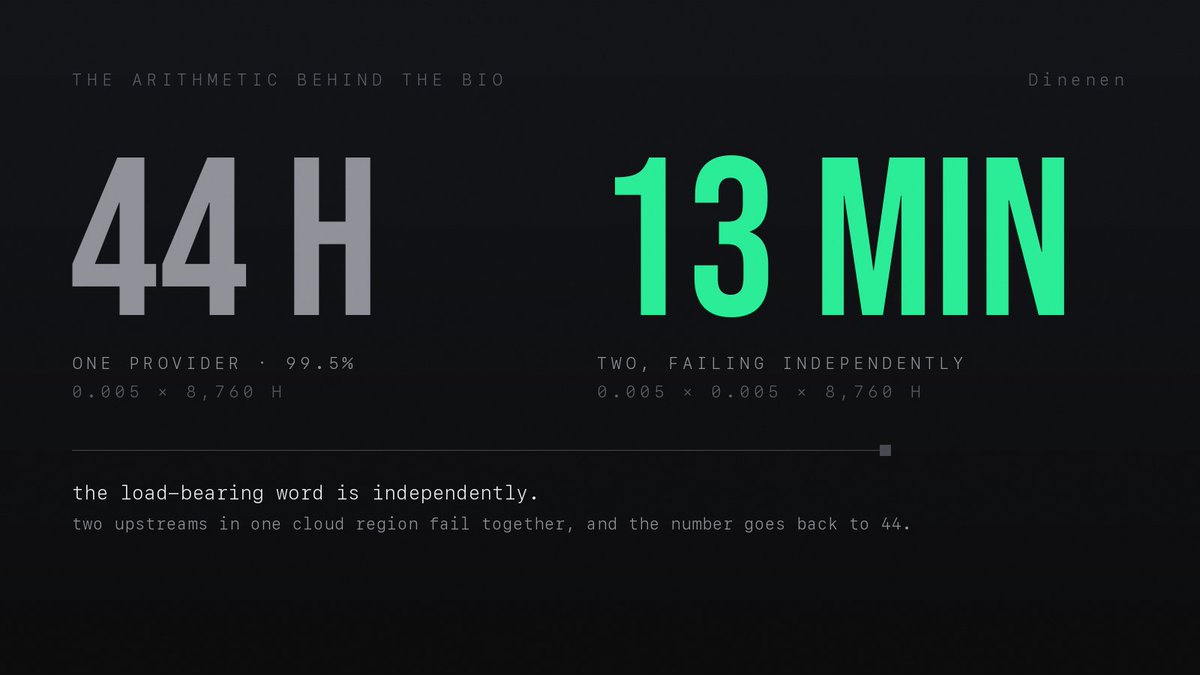
A provider at 99.5% is down about 44 hours a year. Two providers that fail independently, each at that level, are both down 0.005 × 0.005 of the time: about 13 minutes a year. Three, and the number stops being worth writing down.
The word doing all the work is independently. Two upstreams in the same cloud region fail together, and the math collapses back to 44 hours.
That is why the three upstreams here don't share a provider, and why the status page shows every one of them per region.
The awkward case: payment settles, then the upstream fails.
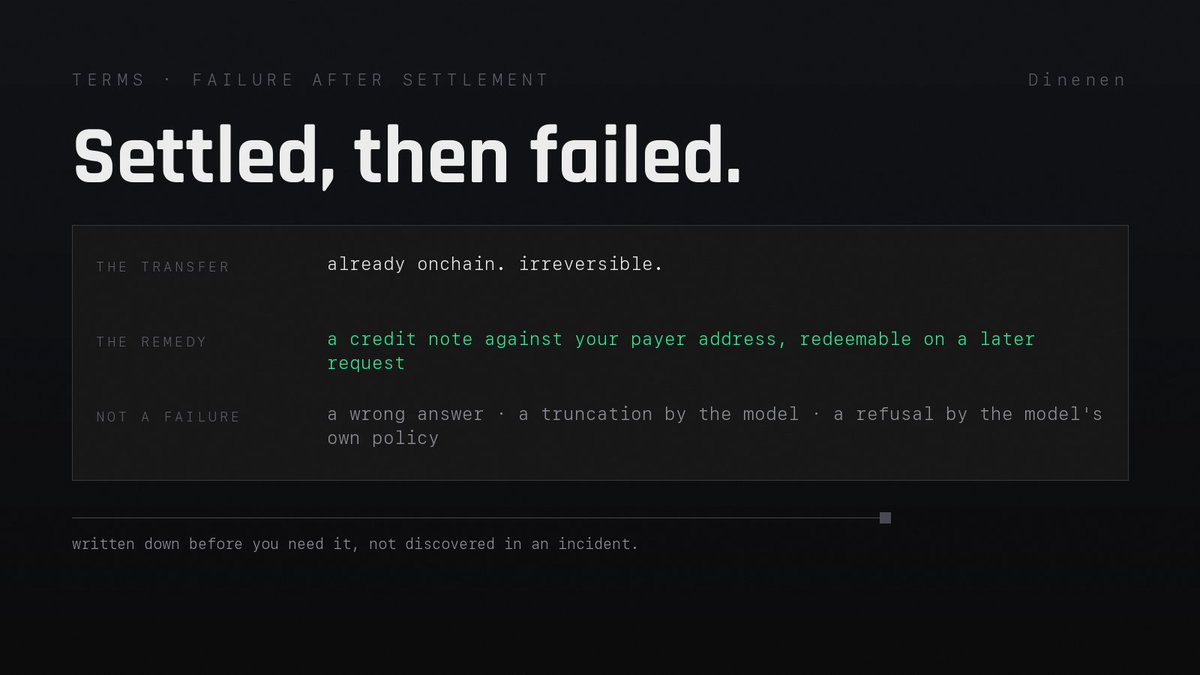
The transfer is already onchain and can't be reversed. So the router issues a credit note against your payer address, redeemable on a later request. That is the remedy, and the only one possible.
What doesn't earn a credit note: an answer you dislike, a truncation by the model, a refusal by the model's own policy. Those are delivered results.
We'd rather write the rule down than let you find it in an incident.
Two ways to get a model to answer you.
One wants an email, a verification code, a card, a plan, and a region we're allowed to serve.
The other wants a signature.
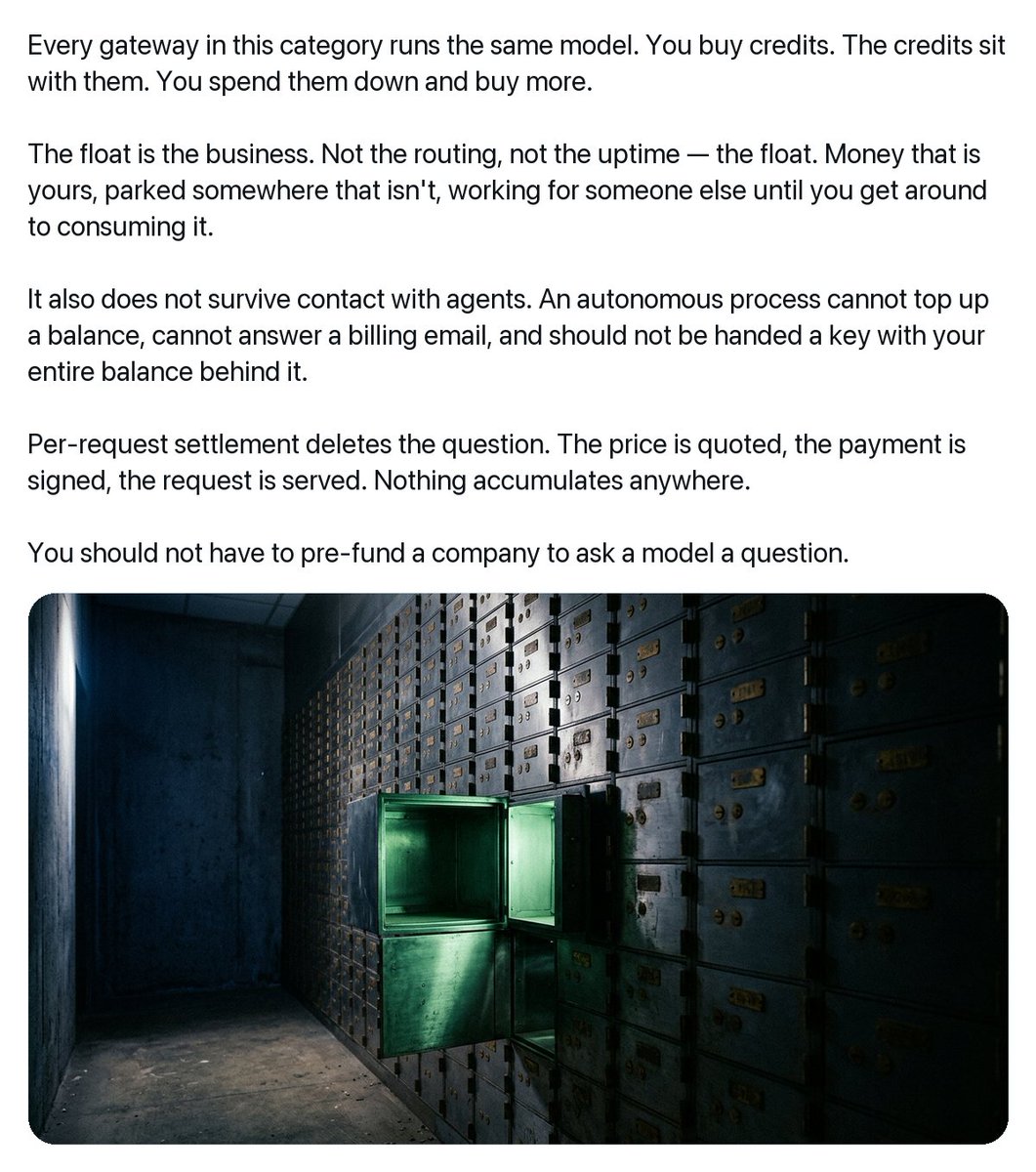
Every gateway in this category runs the same model. You buy credits. The credits sit with them. You spend them down and buy more.
The float is the business. Not the routing, not the uptime — the float. Money that is yours, parked somewhere that isn't, working for someone else until you get around to consuming it.
It also does not survive contact with agents. An autonomous process cannot top up a balance, cannot answer a billing email, and should not be handed a key with your entire balance behind it.
Per-request settlement deletes the question. The price is quoted, the payment is signed, the request is served. Nothing accumulates anywhere.
You should not have to pre-fund a company to ask a model a question.
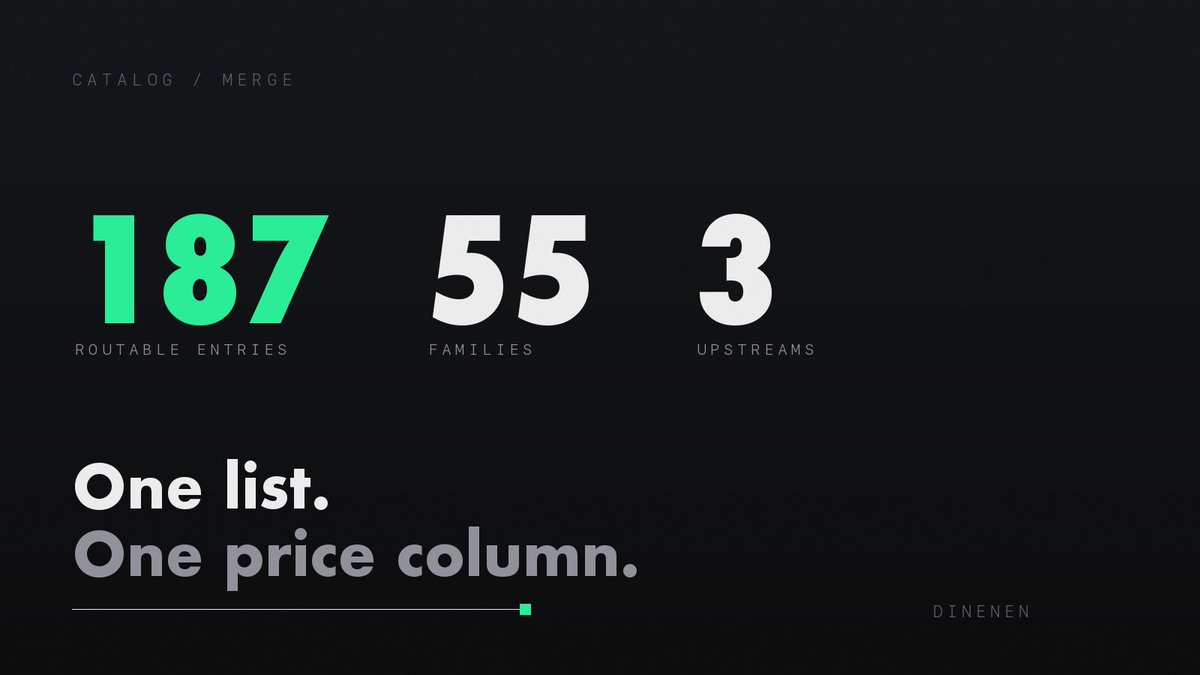
The catalog merge is done.
Every model from every upstream in one list, priced in the unit the vendor actually bills in. Tokens where it's tokens. Seconds where it's seconds.
Where a price carries a caveat, the caveat ships with it.
One provider is about 41 hours of downtime a year. Two with automatic failover is about 12 minutes.
Source on screen: https://t.co/8HIQOhlSnn, 2026-03-11.
The web reserved a status code for payments in 1999 and then never used it.
402 Payment Required. Written into the spec, marked reserved for future use, and left there ever since.
The reason is not mysterious. Every payment method we had needed a person. An account. A card. An email that could receive a receipt. You cannot put a signup form in front of a machine and call it an API.
So the web built paywalls for humans, and software learned to route around them. Prepaid credits. Shared keys. A card on file somewhere, hopefully yours.
x402 uses the code the way it was written.
The server answers 402 with a price. The client signs a payment. The server serves the request.
No account. No subscription. No human standing between a machine and the thing it needs.
The status code was never broken. It was waiting for a client that could pay.