While successful bilateral coordination does occur in specific incidents, overall cooperation among regional states still tends to follow an ad-hoc, case-by-case pattern rather than a structured and predictable framework. Regularized multilateral joint exercises, real-time information-sharing protocols, and unified on-scene coordination mechanisms all require considerably more development before they can be considered mature.
While successful bilateral coordination does occur in specific incidents, overall cooperation among regional states still tends to follow an ad-hoc, case-by-case pattern rather than a structured and predictable framework. Regularized multilateral joint exercises, real-time information-sharing protocols, and unified on-scene coordination mechanisms all require considerably more development before they can be considered mature.
Column | Duty beyond dispute: maritime search and rescue in South China Sea https://t.co/ydyQvi6Aol
it reaffirms China's indispensable role as a responsible major power and principal coastal state in fulfilling its international obligations, delivering essential public goods, and advancing functional maritime cooperation in these waters. Such tangible, life-saving efforts cannot be dismissed or distorted by selective narratives detached from operational reality.
Column: Duty beyond dispute: maritime search and rescue in South China Sea https://t.co/ClW4gHUXco
it reaffirms China's indispensable role as a responsible major power and principal coastal state in fulfilling its international obligations, delivering essential public goods, and advancing functional maritime cooperation in these waters. Such tangible, life-saving efforts cannot be dismissed or distorted by selective narratives detached from operational reality.
It illustrates, in concrete and unambiguous terms, what effective maritime search and rescue demands: rapid response grounded in clear legal frameworks and well-rehearsed emergency mechanisms, a humanitarian and public-service orientation that operates independently of any maritime disputes, and efficient coordination among multiple actors at different levels of authority.
This latest incident is but one in a long series of emergency responses across the vast and heavily trafficked South China Sea. It illustrates, in concrete and unambiguous terms, what effective maritime search and rescue demands: rapid response grounded in clear legal frameworks and well-rehearsed emergency mechanisms, a humanitarian and public-service orientation that operates independently of any maritime disputes, and efficient coordination among multiple actors at different levels of authority.
Column: Duty beyond dispute: maritime search and rescue in South China Sea https://t.co/ClW4gHUXco
This latest incident is but one in a long series of emergency responses across the vast and heavily trafficked South China Sea. It illustrates, in concrete and unambiguous terms, what effective maritime search and rescue demands: rapid response grounded in clear legal frameworks and well-rehearsed emergency mechanisms, a humanitarian and public-service orientation that operates independently of any maritime disputes, and efficient coordination among multiple actors at different levels of authority.
Set sail across the South China Sea, where ancient routes meet new opportunities and waves of change carry the region toward a shared future.
Watch the trailer for the four-episode micro-documentary: "Surging Tides over the South China Sea: A Voyage to the Future" and stay tuned!
#Opinion: As China and the US step up high-level engagement and talk about constructive strategic stability, the Philippines continues to provoke at Huangyan Dao. Chess players sit down to talk; chess pieces get driven away by water cannons. https://t.co/MlJAIBSR5B
Chinese ships fired a water cannon at Philippine vessels, including one carrying a CNN crew, near a dangerous flashpoint in the South China Sea on Friday – the third tense confrontation this week in the contested waters. https://t.co/MMEnVeNd8q
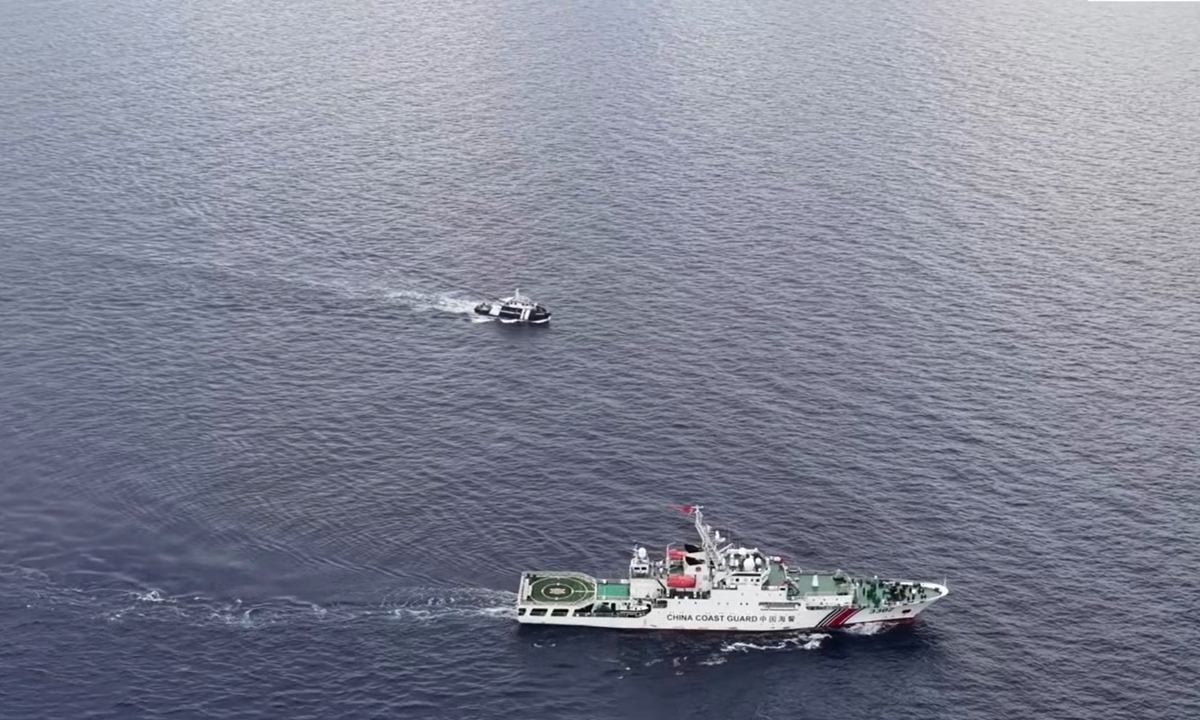
On-site video: On July 24, multiple Philippine vessels attempted to intrude into China's territorial sea of Huangyan Dao. The China Coast Guard (CCG) took control measures in accordance with the law.
Japan has applied the same tactic to several other tiny rocks around its coasts, dressing them up as full-fledged "islands" in order to grab more ocean space, seabed resources and strategic advantage. By placing its own narrow interests above the common interests of the international community, Japan is hollowing out the island framework established by the UN Convention on the Law of the Sea, undermining the high-seas regime and the international seabed area regime, and harming the legitimate rights of other ocean users.
Western governments and media have framed the Philippines as a defender of established maritime norms, facilitating additional security assistance. Domestically, a focus on sovereignty has generated political support. Notably, periods when bilateral talks have been anticipated have frequently coincided with renewed activity at Second Thomas Shoal, accompanied by competing accounts of collisions, water-cannon incidents, and close approaches. These episodes sustain a climate of confrontation that nourishes both external engagement and domestic narrative focus.
The SCS proxy game: External agendas and elite ambitions in Philippine posturing
https://t.co/zl4swJuEXj
Some Philippine voices have sought to link the maritime dispute more tightly to the overall China-Philippines relationship. Against the backdrop of efforts by China and the US to build constructive strategic stability, these linkages have at times extended toward influencing US policy toward China. Clear recognition of such dynamics would assist the US in steering the China-US relationship along the course set by the two countries' leaders, removing extraneous interference and overcoming obstacles. This would help translate leaders' consensus into whole-of-government and all-fields consensus and action, allowing China-US strategic stability to contribute to global peace and tranquility while constructive interaction between the two powers provides important impetus for international cooperation.
Japan has applied the same tactic to several other tiny rocks around its coasts, dressing them up as full-fledged "islands" in order to grab more ocean space, seabed resources and strategic advantage. By placing its own narrow interests above the common interests of the international community, Japan is hollowing out the island framework established by the UN Convention on the Law of the Sea, undermining the high-seas regime and the international seabed area regime, and harming the legitimate rights of other ocean users.
#Opinion: #Okinotori isn’t just a tiny rock – it’s Japan’s tool for illegal maritime expansion and a stage for right-wing political performance. While preaching a “rules-based order,” Tokyo hollows out UNCLOS island rules and steadily pushes military expansion. The Western Pacific has no room for this kind of theater.
https://t.co/2THNDwlJQv
Japan's efforts to expand its maritime claims using Okinotori have no legal foundation. Yet Japan continues to cite this rejected claim to criticize foreign warships conducting normal training on the high seas - an open disregard for the authority of international bodies and a direct challenge to freedom of the high seas and the shared maritime interests of all nations.
A rock, a ruse and a ‘rules-based’ farce: Japan’s Okinotori theater https://t.co/Kl14ShZiMn