Forget the media gloom and doom — Earth's biosphere is in great health.
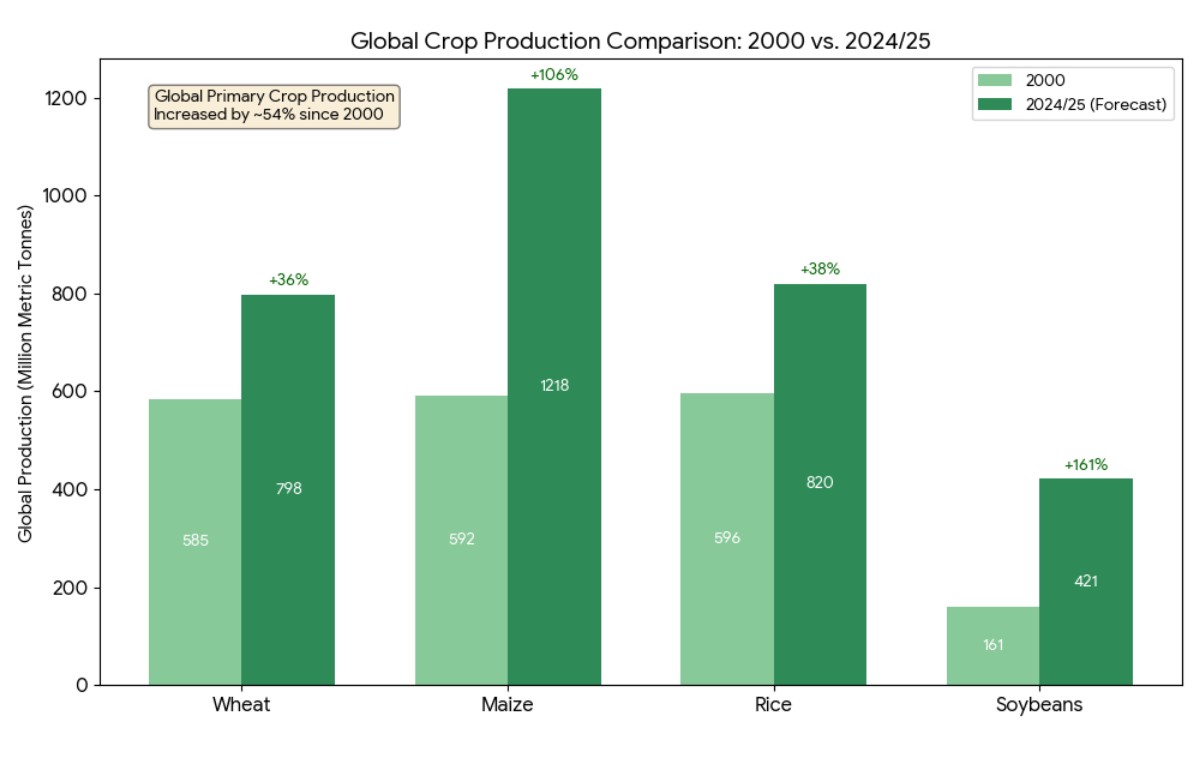
Additional CO₂ levels have boosted primary crop production, which has soared by 54–56% since 2000. This represents a total of 9.5–9.6 billion tonnes of farm produce. Total production in 2000 was approximately 6.1 billion tonnes.
Wheat production alone has grown 36% (from 585m to 798m tonnes) with minimal land expansion. A global expansion of green life has been captured on NASA satellites and vetted by the UN's Food and Agriculture Organization (FAO). Higher CO₂ is the catalyst:
* Sahara Desert: New growth on around 8% of the area.
* The Arctic: 38% increase in vegetation mass since 1985.
* Global greening: 5.5 million km² — roughly twice the size of the Amazon Rainforest.
* Australian agriculture: The 2025-26 season had its third-highest wheat production on record; yields estimated at 2.90 tonnes per hectare, roughly 10% above the 5-year average.
World agriculture is breaking all previous records.
Today’s CO₂ level of 426 ppm isn't a historic anomaly; it's simply a return to the same climate where complex life originally thrived.
While modern humans emerged during the lower-CO₂ cycles of the Pleistocene, our ancestral roots trace back 25 million years to the warm, ice-free Miocene, when CO₂ naturally sat between 400–500 ppm.
During the Last Glacial Maximum, CO₂ plummeted to 180 ppm — dangerously close to the 150 ppm absolute death line where most trees and crops face total photosynthetic failure.
Now it's back at 426 ppm, and the planet has narrowly avoided that collapse, with NASA satellites capturing a massive global expansion of green life.
CO₂ is the fundamental building block of the global food chain, and the historical data proves it is a catalyst for life, not a pollutant.
Humans easily tolerate these levels. Commercial greenhouses routinely pump CO₂ up to 1,250 ppm to boost food yields, and the US Navy submarine safety limit sits at a high 5,000 ppm.
The world isn't choking; it's breathing a sigh of relief.
IMAGE: Rainforest thriving in far north Queensland)
If you’ve ever wondered why scrolling messes with your head, watch this.
“Social media is this machine for creating vast amounts of envy.” @RobertGreene
We were always wired this way. Comparison, ego, illusion. Now it is constant, curated, and impossible to ignore. Robert Greene explains why human nature has not changed, only the tools have.
@tuktuksputnik@PriHett@sanjanah Hmm3. Some might say that FB is more for narcissists, show offs and money-making ‘influencers’ than people genuinely interested in what their ‘friends’ are saying and doing… Meanwhile, interesting that one can’t follow @sanjanah without his confirmation.
The world is more than 1°C warmer and CO₂ has reached 427 ppm — yet our planet is turning into a greener paradise.
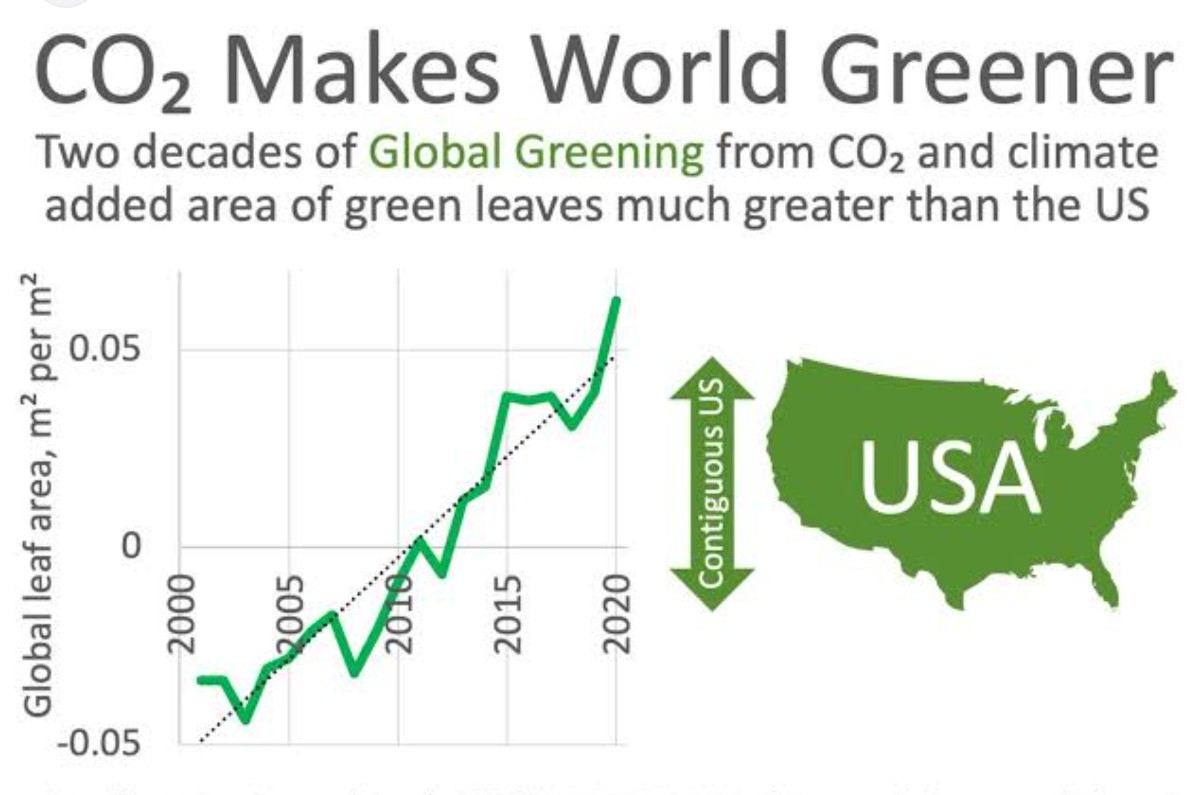
NASA data shows global greening from higher CO₂ has delivered an unexpected windfall: an increase in leaf area equivalent to the contiguous United States — or roughly the size of the entire Amazon Rainforest.
The Sahel has reclaimed 8% of its dry barren lands and Arctic vegetation surged 38% between 1985 and 2016. Satellites detected significant greening across 25–50% of the world's vegetated areas (NASA/Boston University findings, 2000–2017).
Food production has been substantially boosted. This is the Earth actively participating: 30% of these new green areas provide natural cooling through enhanced water-vapour management.
The planet isn’t a passive victim — it’s an active, resilient participant. By comparison, UN climate ideology sells fear and control.
This reality invites out renewed faith in the natural world.
-@PeterDClack
Elon Musk just put a price tag on obedience. It costs $200,000.
Musk: “You don’t need college to learn stuff. Everything is available basically for free. You can learn anything you want for free.”
Every lecture. Every textbook. Every framework ever written. Free on any screen in any country right now. The entire knowledge monopoly collapsed in a decade. Nobody updated the price tag.
Musk: “Colleges are basically for fun and to prove you can do your chores. But they’re not for learning.”
Strip the ivy and the branding. What’s underneath is a four-year obedience trial. Can this person follow instructions on a schedule without asking why.
Musk: “There is a value that colleges have, which is seeing whether somebody can work hard at something, including a bunch of annoying homework assignments, and still do their homework assignments.”
That is the entire six-figure value proposition. Not what you know. Not what you can build. Whether you can be managed. The establishment doesn’t need you educated. It needs you domesticated.
Musk: “If you’re trying to do something exceptional, you must have evidence of exceptional ability. I don’t consider going to college evidence of exceptional ability.”
The system doesn’t produce exceptional. It produces manageable. It takes the most creative years of your life and teaches you to wait for instructions. That is not education. That is containment.
Musk: “Gates is a pretty smart guy, he dropped out. Jobs is pretty smart, he dropped out. Larry Ellison, smart guy, he dropped out.”
They didn’t leave because they couldn’t keep up. They left because the ceiling was underground.
8 billion people now carry the same library in their pocket. The one these institutions charged a lifetime of debt to access.
The only product the university still sells is the belief that you need one.
Take away the hydrocarbons, and we lose virtually overnight everything that makes us modern.
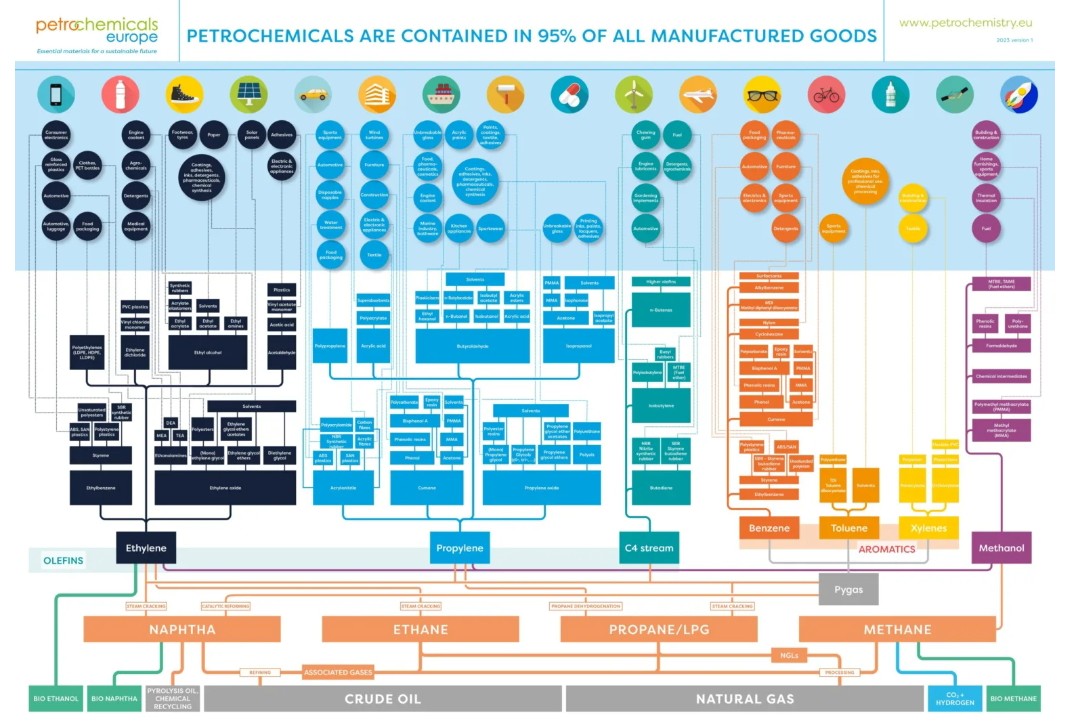
The world relies almost entirely on hydrocarbon byproducts. It's an intricate, deeply woven symbiosis that cannot be replaced by simply stumping up a big battery—an industrial-scale solution that hasn't even been invented yet.
Wind and solar cannot produce a single one of the thousands of derivatives that cascade from oil, honed by more than a century of invention and assimilation.
Without these derivatives, the visible iconography of wind turbines and solar farms could not be built in the first place. They would be unable to darken our familiar landscapes with dystopian industrial grids. Global reliance on hydrocarbons affects the entire human production chain—from the extraction and processing of metals and rare earths to refining and manufacturing.
Take bitumen, which rolled out the entire world's networks of roads and highways. Think about the heavy, diesel-powered machinery, maritime shipping and aviation fleets that move food and raw materials worldwide. They rely almost exclusively on hydrocarbons for both fuel and lubrication. Imagine a world without them.
Modern medicine and healthcare are fundamentally built on hydrocarbon derivatives. High-grade medical equipment, sterile syringes, intravenous tubing, surgical gloves and the plastic casings for life-saving machinery - they are all manufactured from petrochemical resins. There is not a single sterile modern hospital in the entire world that could function without oil.
The global food supply chain is equally linked to hydrocarbon extraction. The insulation on electrical wiring and the advanced polymers inside every television and smartphone ever built come from fossil fuel derivatives. Meanwhile, oil and natural gas remain the fundamental precursors to all industrial fertilisers and pesticides.
Think of commonplace items like paints, synthetic fabrics like polyester and nylon, detergents, cosmetics, and pharmaceuticals. They all depend directly on hydrocarbons.
A renewable energy culture will never replace the raw physical material that builds the roads, runs the hospitals, grows the food and makes our technology function.
This deeply woven foundation is the essence of modern life.