@GerardoMunck Yes, but saying “properties that are not part of democracy,” suggests that there is one correct concept of democracy. I am not defending the index, but “what democray is” is contentious. It’d be better to say that the index does not match a very specific notion of democracy.
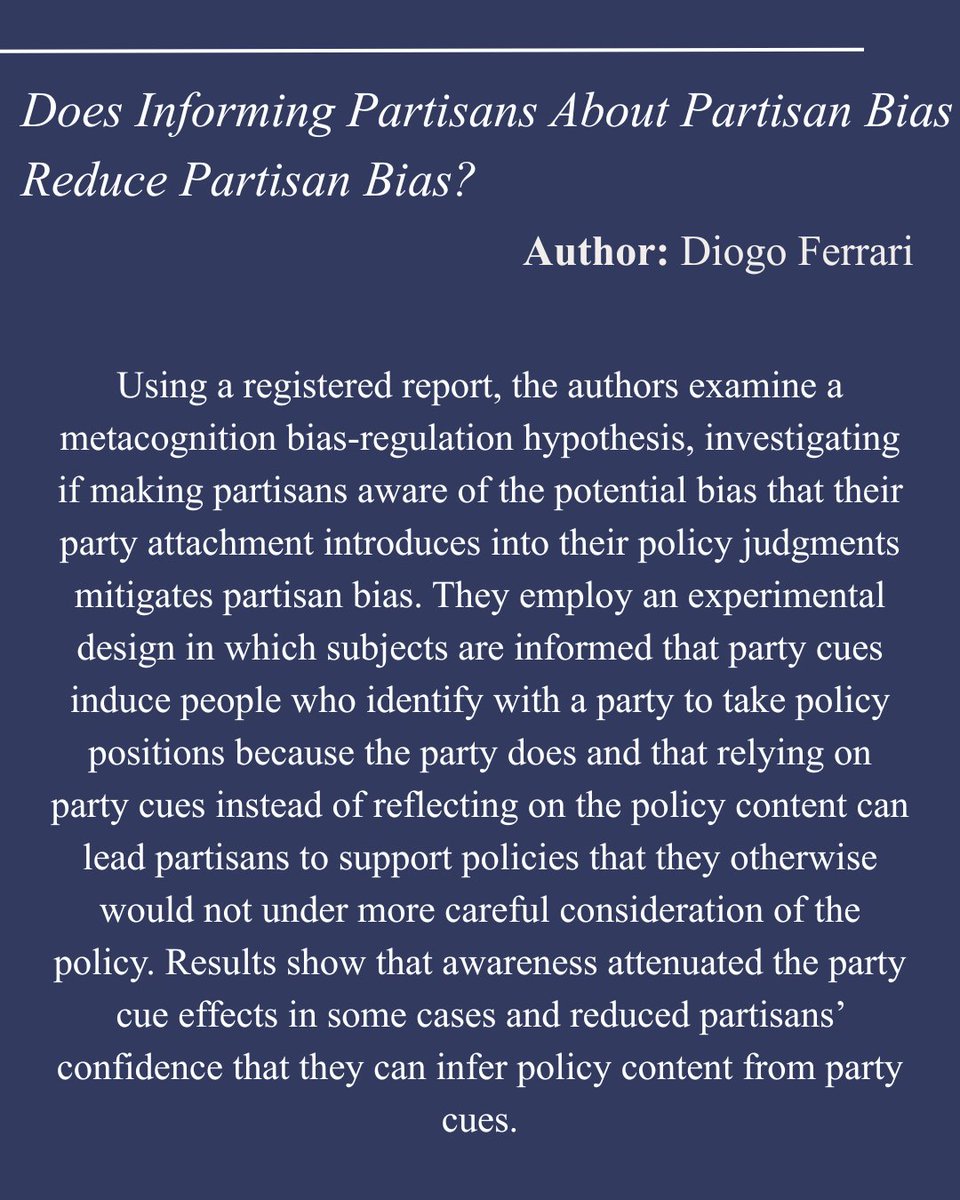
Do (metacognitive) awareness messages about partisan bias in policy evaluation reduce that partisan bias?
Here is a review of findings exploring that problem:
https://t.co/Scxrp9UVL5
Here is the original article:
https://t.co/wmGY5ze3SJ
There is nothing deeply wrong with profession incentives, reviewing processes, and journal publication practices. It is just that political scientists are extremely good at only discovering and developing correct theories that are +90% of the time supposed by data.
I have a new paper. We look at ~all stats articles in political science post-2010 & show that 94% have abstracts that claim to reject a null. Only 2% present only null results. This is hard to explain unless the research process has a filter that only lets rejections through.
Despite sophisticated analytic methods in social science, fields remain limited in their theoretical progress and consensus.
Why?
New in @Theory_Society, "The illusion of rigor: Why analytical sophistication cannot substitute for inferential coherence," by Aamir Rashid and Rizwana Rasheed.
Check it out here: https://t.co/KRzmxwxERg
@yudapearl I completely agree. But structural assumptions for many social sciences problems are just really hard to believe. So, an alternative question is: Can researchers draw useful conclusions from assumptions they not even partially believe?
New publication at @The_JOP. Using experimental evidence, the study shows that a metacognitive intervention—informing partisans about how party cues influence policy opinions—can weaken partisan bias and reliance on party labels when evaluating policies. https://t.co/gRNeNesZl4
Studying a particular LLM under a specific evaluation setup and concluding that "LLMs exhibit motivated reasoning" is like running a linear regression on one dataset and concluding that linear regression generally produces large positive coefficients.
One thing that bothers me about some current AI/LLM research in social sciences is sentences like “AI/LLM does this”, while in the paper they use a very particular model (eg. gpt-4o). So, their conclusions or title should not be about AI/LLM in general, but the model they used.
@arthur_spirling Have you used Claude code or codex? It may reduce it to 7 min and without the cutting and pasting part. Not perfect, but pretty decent.
Check out this new publication from #UCR 's @DiogoFerrari !
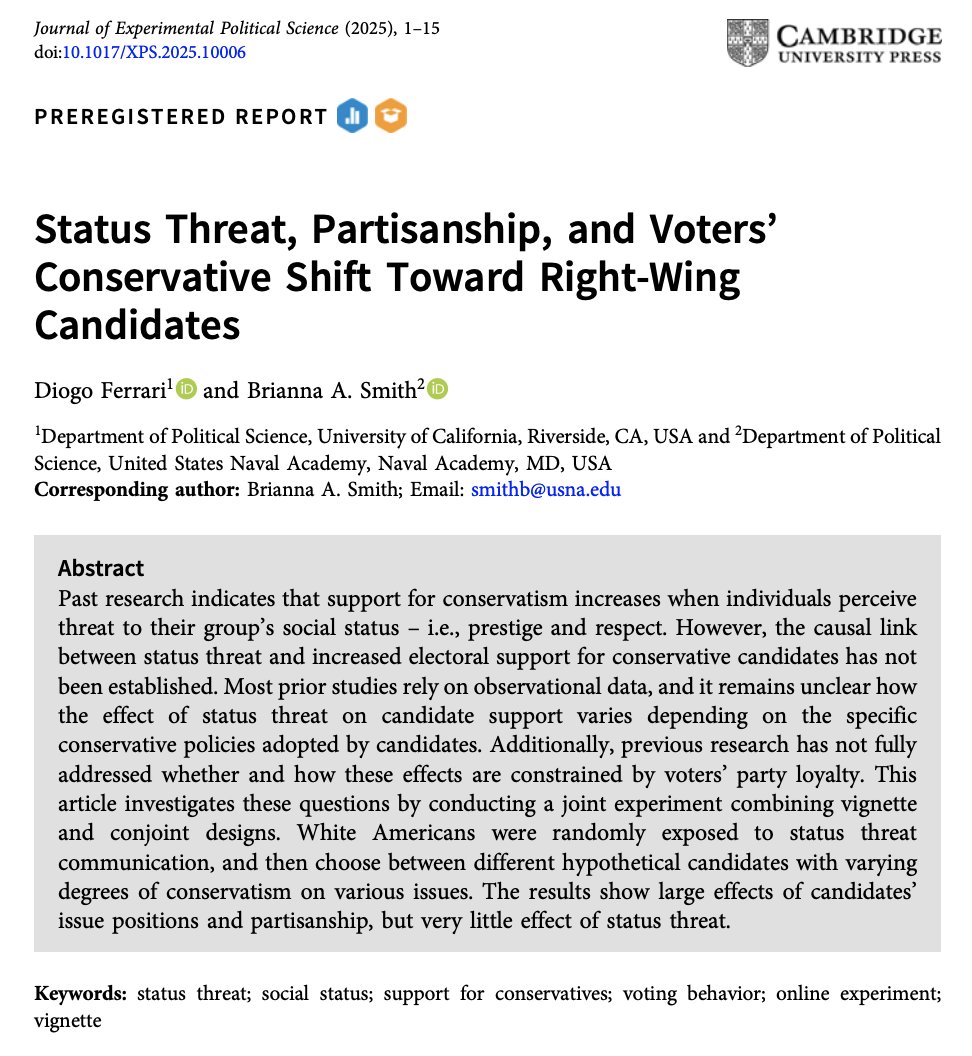
Does feeling threatened lead voters to back more conservative candidates? A new experiment finds partisanship and policy matter more than status threat.
Read in J. Exp. Pol. Sci: https://t.co/g07sdDbZvo
#OpenAccess from @JEPS_ed -
Status Threat, Partisanship, and Voters’ Conservative Shift Toward Right-Wing Candidates - https://t.co/sR4FyCmhap
- @DiogoFerrari & Brianna A. Smith
#FirstView
Our graduate students will be better off in the long run if they are trained primarily in Python, and will navigate easier across fields. R just has accumulated more stats libraries, but it will likely change soon.
It's time for social scientists to start moving away from R and embrace Python. The entire AI community relies on Python, and most APIs are readily available in it. R falls short compared to Python (not real OOP, poor code encapsulation, and other structural drawbacks).
1/2
@UCRiverside is hosting the Southern California Political Behavior Conference on Friday, January 24, 2025.
The deadline to apply is November 15th. Apply here:
https://t.co/nt31PnX8l6
SB-1047 would definitely have a chilling effect on open source AI and the entire AI ecosystem.
Very much hoping that Governor @GavinNewsom will veto it.