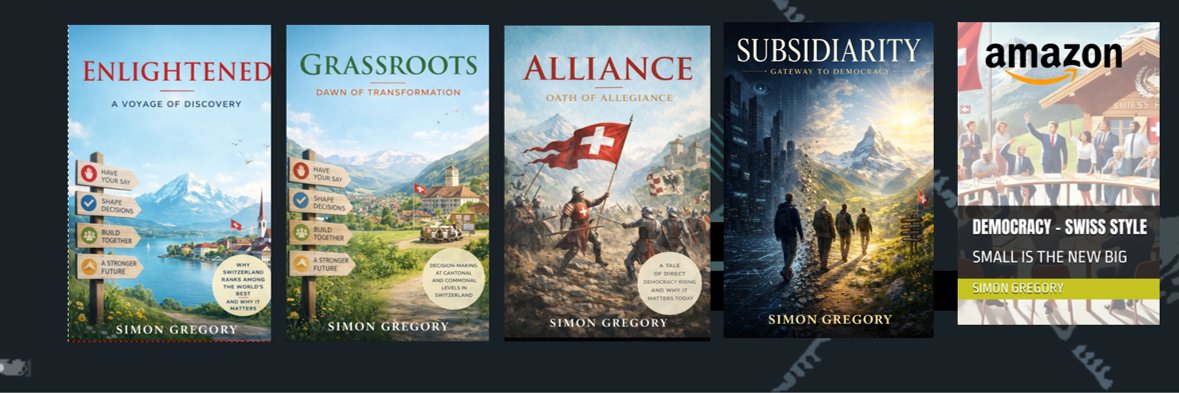
Here are a few excerpts from my new book, Subsidiarity.
In its pages, I invite you on a thirty-day trek across Switzerland, where every step illuminates how real people—not distant elites—can shape the rules that govern them. Running in parallel is an imagined future ruled by algorithms and oligarchs, a stark counterpoint that provokes the question: Which world would you choose?
Across 350 lively pages you’ll meet historical figures, wrestle with fresh political realities, and test prevailing ideologies—all against the enduring backdrop of Swiss direct democracy.
Although familiar faces from my earlier novels make cameo appearances, Subsidiarity stands perfectly on its own. Enjoy these excerpts, and if they leave you curious for more, the full adventure awaits on Amazon for £12.99. #DirectDemocracy
Walkers, you will love it
Subsidiarity: Gateway to Democracy is available on Amazon for just £12.99
This is my most ambitious story yet – a thought-provoking and timely read that might just be the summer novel you've been waiting for.
What if democracy isn’t dying—but just needs a good walk?
Subsidiarity takes readers on a vibrant 30-day trek across Switzerland, where four unlikely companions—a former Cistercian monk, a Benedictine dropout, a weathered farmer, and a British start-up advisor—set out on foot to rediscover a radical yet ancient idea: that decisions should be made as close to the people as possible.
Blending laugh-out-loud camaraderie with deep philosophical inquiry, their journey is part pilgrimage, part civic adventure. Along the way, they cross alpine ridges, whisper through forgotten valleys, and encounter poets, prophets, and politicians—some real, others imagined—all offering clues to the enduring power of Swiss direct democracy.
Threaded through their path is a darker vision: a future where democratic governance has quietly been replaced by algorithmic rule and centralized control. Yet amid the looming spectre of digital dystopia, Switzerland stands as a stubborn holdout—and perhaps a guidepost.
This is a story about reclaiming voice, conscience, and community in an age that too often mistakes efficiency for wisdom. Witty, profound, and unexpectedly hopeful, Subsidiarity is a love letter to localism, liberty, and the belief that freedom, like a mountain trail, is best navigated step by step, together. #DirectDemocracy
Switzerland's High Ranking
Why does Switzerland consistently rank at or near the top of global indices — whether in healthcare, prosperity, innovation, low crime, quality of life, social trust, or government effectiveness?
At the foundation of Switzerland’s success are three deeply connected principles:
🗳️Direct Democracy
Definition:
A political system in which citizens vote directly on major laws, constitutional changes, and national decisions through referendums and popular initiatives. The Swiss people vote for times a year on multiple issues during each voting session, on issues that are national, regional and local.
Why Direct Democracy matters:
👍Government remains accountable because citizens have the final say.
👍Policies gain legitimacy and public trust.
👍People feel ownership over decisions instead of alienation from politics.
👍Long-term stability increases because changes require broad public support.
In Switzerland, government is not something “above” the people — it is continuously corrected and guided by the people.
👊Subsidiarity
Definition:
The principle that decisions should be made at the lowest competent level possible — locally before regionally, regionally before nationally.
Why it matters:
👍Communities solve problems closest to where they occur. Locals are in charge of what happens in the locality.
👍Local diversity is respected instead of suppressed.
👍Cantons and municipalities compete and innovate. They vie for citizens to live in their canton, so they continuously improve things.
👍Power is decentralized, preventing overconcentration and bureaucracy.
This creates a system where citizens remain close to decision-making and institutions remain responsive and human-scale.
🧑💼Optimal Manageability
Definition:
A condition in which political, administrative, and social structures are kept at a size and complexity that people can realistically understand, influence, and manage effectively.
Why it matters:
👍Institutions stay transparent and efficient.
Citizens can meaningfully participate in governance.
👍Trust remains high because systems are understandable.
👍Problems are solved faster and more pragmatically.
Switzerland avoids becoming overly centralized or excessively large in governance structure. Responsibilities are distributed in manageable layers.
How These Three Principles Work Together
1⃣ Direct Democracy ensures that citizens retain ultimate authority.
2⃣ Subsidiarity ensures decisions are made close to the people affected by them.
3⃣ Optimal Manageability ensures the entire system remains understandable, efficient, and trusted.
Together, they create:
♦️High social trust
♦️Strong civic responsibility
♦️Stable institutions
♦️Low corruption
♦️Efficient public services
♦️Economic resilience
♦️Innovation through local experimentation
♦️High quality of life
The Core Logic
A population that:
🇨🇭has real political power,
🇨🇭governs locally whenever possible,
🇨🇭and operates within manageable institutions
is far more likely to develop:
♦️trust,
♦️responsibility,
♦️cooperation,
♦️stability,
♦️and long-term prosperity.
That is why Switzerland consistently performs exceptionally well across so many global measures.
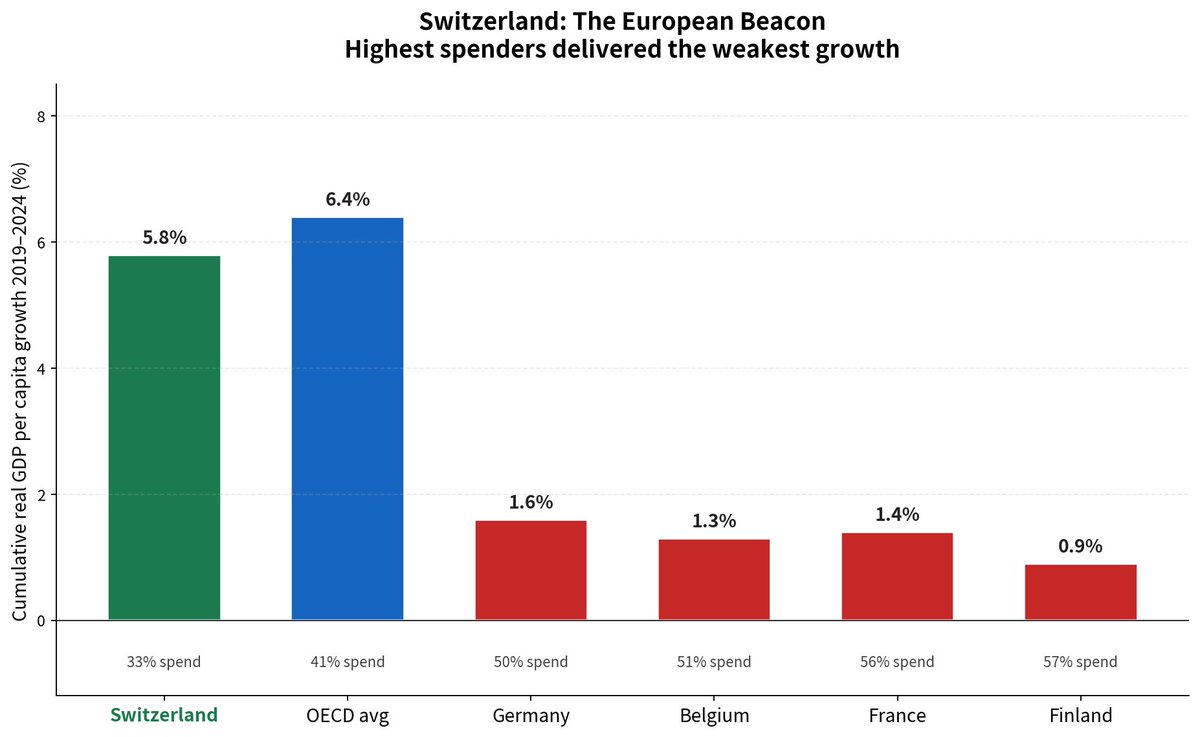
Could other countries benefit from this model, of #DirectDemocracy, Subsidiarity, leading to Optimal Manageability?
Read the chart 👇
@SeanBFlanagan@JamesMelville@GEStevens67
Wonderful video contrasting Ireland 🇮🇪 with Switzerland 🇨🇭 and how #DirectDemocracy could revitalise the political system in Ireland.
It’s a short one.
I feel that it also holds lessons for other Representatives systems.
https://t.co/iyNWBsuUpz
Nice little video comparing Switzerland to Ireland - it’s worth a watch #DirectDemocracy@ddrightnow@SeanBFlanagan
WHY IS SWITZERLAND SO WELL RUN?
https://t.co/E2dI35WWnU
Today Henry Nowak's case dominated Prime Minister’s Questions. Every party used it to make a political argument. The chamber erupted. Fingers were pointed. Voices were raised.
Nobody in that building asked the public what they think should happen to the policing and justice system that failed Henry.
Nobody consulted the people who will live under whatever policy comes next. The debate about what this case means and what should change is happening entirely among the people whose system produced the outcome in the first place.
House of The People exists because the public deserves to be part of that conversation.
❓How come Switzerland🇨🇭 only has part time politicians and yet officially is still one of the most successful and best run countries in the world?
🔂One of the more unusual features of Switzerland's political system is that much of it is run by citizen legislators rather than a large class of full-time professional politicians.
🧑🌾 👩🔧 🕴️🧑🏫At the communal (Town, village, several villages) and cantonal (country, or regional) levels, many elected representatives continue to work in their normal professions while serving in public office.
Even at the federal level, members of parliament are often described as part-time politicians.
😯The Federal Assembly typically meets in four main sessions each year, amounting to roughly twelve weeks of formal parliamentary sitting.
📈Yet despite what many observers might assume, Switzerland consistently ranks among the world's most successful countries in measures of prosperity, safety, stability, competitiveness, quality of life, and public trust.
🤔The success of this model challenges a common assumption of modern politics: that good governance requires politics to become a full-time profession.
🔗Switzerland suggests the opposite may often be true. When politicians remain embedded in ordinary society, they remain connected to the practical consequences of their decisions.
🧑🌾 👩🔧 🕴️🧑🏫A parliament that includes business owners, engineers, teachers, doctors, farmers, lawyers, and other working professionals is continuously exposed to the realities of everyday life.
👍The political system draws knowledge from society rather than creating a separate political class isolated from it.
Philosophically, the Swiss system rests on a different understanding of politics.
🤝In many representative democracies, politics gradually becomes a career path. Politicians spend much of their time navigating party structures, media cycles, and electoral strategy.
🫧Their professional world increasingly revolves around politics itself. They operate in a bubble.
🇨🇭In Switzerland, political office is more often understood as a public service performed alongside participation in normal economic and social life.
The politician remains a citizen first and a legislator second.
The part-time nature of parliament also reflects a deeper principle: government should not attempt to manage every aspect of society.
Switzerland places significant responsibility at the local level, distributes power across cantons, and reserves many important decisions for the people themselves through referendums and initiatives.
🗳️🙋🙋♂️Because citizens possess direct democratic tools, parliament does not need to act as the sole source of political authority. The legislature governs, but it governs knowing that ultimate sovereignty remains with the people.
This creates an important feedback mechanism. In systems where politicians possess broad power but face elections only every few years, there is often a gap between rulers and the ruled.
In Switzerland, because it operates on a #DirectDemocracy model, citizens can:
💎challenge legislation,
💎propose constitutional changes,
💎force public votes.
Political authority is therefore exercised with greater humility because it is continually subject to review.
The burden of democratic responsibility is shared between elected representatives and citizens.
The result is a system that relies less on political management and more on civic competence.
Swiss institutions assume that ordinary citizens are capable of participating in public affairs and that elected representatives do not need to become a permanent governing class.
Over time, this has helped create a culture of responsibility, moderation, and pragmatism.
🫂The success of Switzerland suggests that effective government may depend less on the number of full-time politicians and more on the quality of the relationship between citizens and power.
🇨🇭Rather than concentrating democracy in parliament, Switzerland distributes it throughout society.
The remarkable outcome is that a country governed to a significant extent by part-time politicians and active citizens often performs better than many systems staffed by full-time political professionals.
How about in your country?
Book overview
From the first antediluvian cities to the fifteen-minute surveillance cities of the twenty-first century, Cain – Megalithic City Builder exposes the powers behind power—the forces that have shaped, guided, and manipulated human civilisation across all ages.
This book begins before history as we are taught it. Long before empires, before nations, before written memory fractured into myth, it explores a world remembered in more than two hundred flood traditions scattered across every continent. Are these stories coincidence—or echoes of a single, world-shaping catastrophe?
The narrative draws the reader into the age before the Deluge, a time of giants, advanced knowledge, and cities raised with a purpose far greater than shelter. It follows humanity through the great portal of the Flood into the post-diluvian world, revealing how the builders of the old world did not disappear, but adapted—re-emerging behind new masks, new empires, and new forms of control.
You will encounter the great memorial raised to commemorate the world’s greatest destruction, the rise of Nimrod and the Tower of Babel, the scattering of peoples across the earth, and the emergence of the ancient power centres: Ur, Babylon, Egypt, the Achaemenid Empire, Troy, Greece, Rome, and beyond. The journey continues through the Vatican, dynastic family rule, the City of London, imperial America, the rise of China, supranational institutions, and finally into a technologically enforced dystopia that mirrors the ambitions of the very first city builders.
Stone cities and digital cities are revealed as expressions of the same impulse—one visible, the other invisible, both megalithic in scale. What once required giants and stone now requires data, algorithms, and surveillance. The spirit that animated Cain before the Flood reappears in modern systems designed to govern not land, but behaviour, memory, and identity.
At the heart of the book are fifteen ancient and modern manuscripts, discovered in a hidden Benedictine archive, each acting as a window into a different age. Together they tell a single, unsettling story: civilisation has been guided by a repeating pattern—and we are living at its climax.
Yet this is not a book of despair.
When the system finally overreaches, when the plug is pulled, something ancient and true resurfaces—something older than cities, older than empires, older than stone.
Cain – Megalithic City Builder is a sweeping, provocative exploration of origins, memory, power, and resistance. It invites readers who stand before ancient ruins, who look at impossible stonework, who question official history, and who sense that humanity’s story is far deeper—and far stranger—than we have been told.
You will never look at megaliths, empires, or the modern world in the same way again.
ARLA WON -- YOU LOST - BOVAER SOON ALL MILK
After the Arla - DMK takeover last week a Huge New Milk Supply Monolith has been Formed.
This means Bovaer‑milk will quietly become the default “standard milk”, while organic milk becomes scarcer and more expensive.
AND YOU WILL NOT BE INFORMED ON LABELS
Why this matters now with the Arla–DMK merger:
This is where things get strategically interesting.
1. Arla is already the most aggressive adopter of Bovaer
They defended it publicly, continued trials, and positioned it as central to their climate strategy.
This means the merged entity is WILL scale Bovaer faster, not slower.
2. DMK brings Germany — a huge dairy market — into the equation
The merger forces a harmonised methane strategy, and Bovaer is the only ready‑to‑deploy tool.
CONSUMERS: Exoect Organic Milk to be Priced out of the Market, not just UK, not just EU, but there will be plans through those financially involved, like Bill Gates, to get BOVAER in Animal Feeds as the de facto position.
And before Mr Gates Operatives on X start to argue:
The Company holding Bovaer Trademarks is DSM-Firmenich -- The Gates Foundation holds extensive shareholdings in this Company.
From Scottish Parliamentary Briefing Papers re Nicola Sturgeon's involvement...
"There also seems to be some information hidden from public view, such as DSM-Firmenich denying any connection with Bill Gates, only for us to discover Bill Gates has purchased 1m shares in the Company, with the major investor behind the scheme, Black Rock"
There will also be price differentiation between Bovaer Milk and Non-Bovaer.
OF COURSE TEN YEARS FROM NOW THERE WILL BE ZERO CHOICE - JUST BOVAER.
For the Arla–DMK giant, this means:
They will push Bovaer harder than ever — because climate targets demand it.
They must avoid another consumer revolt — because the merged brand is too big to hide.
They will likely invest heavily in “green dairy” PR, transparency dashboards, and retailer‑aligned messaging.
Any future health concerns (even unfounded ones) will hit twice as hard because of their scale.
LACK OF CHOICE, LACK OF TRANSPARENCY, PUBLIC REJECTION
We’re sleepwalking into a food system where the public has no real choice at all.
Supermarkets are quietly shifting to “low‑methane milk” using feed additives like Bovaer — and most people don’t even know it’s happening.
There’s no clear labelling.
There’s no public documentation.
There’s no way for families to choose milk without these additives unless they pay organic prices or hunt down tiny local suppliers.
And here’s the truth nobody in the industry wants to say out loud:
Even if every analysis says “no harm”, even if regulators approve it, even if the science is solid…
The public still won’t want it if they feel tricked.
People want transparency.
People want choice.
People want to know what’s going into the food chain — not find out years later through a press release.
This isn’t anti‑science. This isn’t anti‑farmer.
This is about trust.
If the industry keeps rolling out feed additives without open discussion, clear labelling, or public consent, they’re going to trigger a backlash far bigger than they expect.
Choice matters. Transparency matters. Trust matters.
And right now, the public is getting none of them.
MANY FARMERS DO NOT WANT CHEMICALS OF ANY KIND PUT INTO ANIMAN FEED AND THEN INTO THE HUMAN FOOD CHAIN..
Because. It. Is. Insane...
Please consider following House of The People if you are a UK citizen.
From the perspective of #DirectDemocracy they are the only organization I know of that are calling citizens attention to what MPs are debating.
Please consider following House of The People if you are a UK citizen.
From the perspective of #DirectDemocracy they are the only organization I know of that are calling citizens attention to what MPs are debating.
Parliament returned from recess this afternoon. The first item on the agenda is the second reading of the Health Bill, a piece of legislation that would abolish NHS England entirely and reshape how your healthcare is governed for years to come.
The bill was introduced on 14 May - it was  written, briefed and brought to Parliament without a single public vote on whether it should exist. Today MPs debate its general principles. The public watch from the outside.
The Armed Forces Bill, the Railways Bill, the Social Housing Bill and the Civil Aviation Bill are also on the agenda this week.  Five pieces of legislation covering your NHS, your military, your railways, your housing and your right to fly. All being debated and voted on this week, none of them with any direct public input.
We built House of The People to give every citizen in this country a direct say in the laws that govern their lives, not just once every five years but every time Parliament votes.
https://t.co/WVi7iKrI6t
❓How come Switzerland🇨🇭 only has part time politicians and yet officially is still one of the most successful and best run countries in the world?
🔂One of the more unusual features of Switzerland's political system is that much of it is run by citizen legislators rather than a large class of full-time professional politicians.
🧑🌾 👩🔧 🕴️🧑🏫At the communal (Town, village, several villages) and cantonal (country, or regional) levels, many elected representatives continue to work in their normal professions while serving in public office.
Even at the federal level, members of parliament are often described as part-time politicians.
😯The Federal Assembly typically meets in four main sessions each year, amounting to roughly twelve weeks of formal parliamentary sitting.
📈Yet despite what many observers might assume, Switzerland consistently ranks among the world's most successful countries in measures of prosperity, safety, stability, competitiveness, quality of life, and public trust.
🤔The success of this model challenges a common assumption of modern politics: that good governance requires politics to become a full-time profession.
🔗Switzerland suggests the opposite may often be true. When politicians remain embedded in ordinary society, they remain connected to the practical consequences of their decisions.
🧑🌾 👩🔧 🕴️🧑🏫A parliament that includes business owners, engineers, teachers, doctors, farmers, lawyers, and other working professionals is continuously exposed to the realities of everyday life.
👍The political system draws knowledge from society rather than creating a separate political class isolated from it.
Philosophically, the Swiss system rests on a different understanding of politics.
🤝In many representative democracies, politics gradually becomes a career path. Politicians spend much of their time navigating party structures, media cycles, and electoral strategy.
🫧Their professional world increasingly revolves around politics itself. They operate in a bubble.
🇨🇭In Switzerland, political office is more often understood as a public service performed alongside participation in normal economic and social life.
The politician remains a citizen first and a legislator second.
The part-time nature of parliament also reflects a deeper principle: government should not attempt to manage every aspect of society.
Switzerland places significant responsibility at the local level, distributes power across cantons, and reserves many important decisions for the people themselves through referendums and initiatives.
🗳️🙋🙋♂️Because citizens possess direct democratic tools, parliament does not need to act as the sole source of political authority. The legislature governs, but it governs knowing that ultimate sovereignty remains with the people.
This creates an important feedback mechanism. In systems where politicians possess broad power but face elections only every few years, there is often a gap between rulers and the ruled.
In Switzerland, because it operates on a #DirectDemocracy model, citizens can:
💎challenge legislation,
💎propose constitutional changes,
💎force public votes.
Political authority is therefore exercised with greater humility because it is continually subject to review.
The burden of democratic responsibility is shared between elected representatives and citizens.
The result is a system that relies less on political management and more on civic competence.
Swiss institutions assume that ordinary citizens are capable of participating in public affairs and that elected representatives do not need to become a permanent governing class.
Over time, this has helped create a culture of responsibility, moderation, and pragmatism.
🫂The success of Switzerland suggests that effective government may depend less on the number of full-time politicians and more on the quality of the relationship between citizens and power.
🇨🇭Rather than concentrating democracy in parliament, Switzerland distributes it throughout society.
The remarkable outcome is that a country governed to a significant extent by part-time politicians and active citizens often performs better than many systems staffed by full-time political professionals.
How about in your country?
Could the Swiss system function as a preventive model of governance, where politicians, political parties, and policies are subject to strong scrutiny by citizens?
#DirectDemocracy
@JamesMelville@DirectDemToday Fair point. It could work here, but it would need to be in gradual, small steps. Giving more power to local councils would make a big difference. And letting people vote on key issues could rebuild trust.
Switzerland's High Ranking
Why does Switzerland consistently rank at or near the top of global indices — whether in healthcare, prosperity, innovation, low crime, quality of life, social trust, or government effectiveness?
At the foundation of Switzerland’s success are three deeply connected principles:
🗳️Direct Democracy
Definition:
A political system in which citizens vote directly on major laws, constitutional changes, and national decisions through referendums and popular initiatives. The Swiss people vote for times a year on multiple issues during each voting session, on issues that are national, regional and local.
Why Direct Democracy matters:
👍Government remains accountable because citizens have the final say.
👍Policies gain legitimacy and public trust.
👍People feel ownership over decisions instead of alienation from politics.
👍Long-term stability increases because changes require broad public support.
In Switzerland, government is not something “above” the people — it is continuously corrected and guided by the people.
👊Subsidiarity
Definition:
The principle that decisions should be made at the lowest competent level possible — locally before regionally, regionally before nationally.
Why it matters:
👍Communities solve problems closest to where they occur. Locals are in charge of what happens in the locality.
👍Local diversity is respected instead of suppressed.
👍Cantons and municipalities compete and innovate. They vie for citizens to live in their canton, so they continuously improve things.
👍Power is decentralized, preventing overconcentration and bureaucracy.
This creates a system where citizens remain close to decision-making and institutions remain responsive and human-scale.
🧑💼Optimal Manageability
Definition:
A condition in which political, administrative, and social structures are kept at a size and complexity that people can realistically understand, influence, and manage effectively.
Why it matters:
👍Institutions stay transparent and efficient.
Citizens can meaningfully participate in governance.
👍Trust remains high because systems are understandable.
👍Problems are solved faster and more pragmatically.
Switzerland avoids becoming overly centralized or excessively large in governance structure. Responsibilities are distributed in manageable layers.
How These Three Principles Work Together
1⃣ Direct Democracy ensures that citizens retain ultimate authority.
2⃣ Subsidiarity ensures decisions are made close to the people affected by them.
3⃣ Optimal Manageability ensures the entire system remains understandable, efficient, and trusted.
Together, they create:
♦️High social trust
♦️Strong civic responsibility
♦️Stable institutions
♦️Low corruption
♦️Efficient public services
♦️Economic resilience
♦️Innovation through local experimentation
♦️High quality of life
The Core Logic
A population that:
🇨🇭has real political power,
🇨🇭governs locally whenever possible,
🇨🇭and operates within manageable institutions
is far more likely to develop:
♦️trust,
♦️responsibility,
♦️cooperation,
♦️stability,
♦️and long-term prosperity.
That is why Switzerland consistently performs exceptionally well across so many global measures.
Could other countries benefit from this model, of #DirectDemocracy, Subsidiarity, leading to Optimal Manageability?
Read the chart 👇
@SeanBFlanagan@JamesMelville@GEStevens67
From my latest book, Democracy – Swiss Style (Small is the New Big):
In Switzerland, the people are the ultimate sovereign authority. To uphold that sovereignty, citizens have access to a wide range of democratic instruments designed to ensure their power remains intact. Below are two excerpts from my new book that explain these tools and how they are structurally embedded in the Swiss Constitution.
#DirectDemocracy
This book has the power to completely transform how you see governance and what it should truly look like.
You’ll find several excerpts on my feed—take a moment to listen to them. After living within the Swiss system for the past 15 years, I’ve seen firsthand how differently things can work, and why those in power would rather you didn’t look too closely.
Written in a clear, accessible style, it pulls back the curtain on the deep flaws of the so-called “representative system” and challenges the idea that it represents people at all.
More importantly, it reveals why a more direct form of democracy isn’t just an alternative, but a necessary response to a model that has quietly stopped serving the very people it claims to represent.
#DirectDemocracy
In Alliance – Oath of Allegiance, Simon Gregory delivers a rare political-philosophical exploration wrapped in an entertaining narrative cloak.
At its heart is Thomas Mercer, a sharply observant British start-up advisor who trades pitch decks and venture capital for vineyards and parchment scrolls in an attempt to unearth the historical DNA of Swiss direct democracy. What begins as a personal curiosity quickly evolves into a richly layered quest—part travelogue, part philosophical dialogue, and part subtle indictment of our modern systems of power.
Mercer’s journey—spanning monasteries, dusty archives, and vine-covered hillsides—uncovers uncanny echoes between the resistance of the Swiss confederates to Habsburg imperial creep and the subtle encroachments of today’s supranational governance. Through an encounter with a Benedictine monk, the book’s Socratic anchor, he gains more than a crash course in medieval history. He acquires a lens—clear, unflinching, and deeply relevant—through which to see the parallels between yesterday's empires and today's alphabet soup of global institutions.
What makes Alliance stand out is not just its message but its method. Gregory resists the urge to lecture. Instead, he crafts a novel that is as intellectually rigorous as it is accessible.
With dry wit, keen insight, and the occasional Latin flourish, he makes medieval treaties and philosophical doctrines feel alive, urgent, and—somehow—funny. At no point does the narrative feel bogged down in ideology; rather, it dances gracefully between eras, connecting the dots without condescension.
Perhaps the book’s most striking accomplishment is its final act, where Mercer returns from his historical deep-dive into the thick fog of contemporary politics.
Here, rather than offering a simplistic fix or a manifesto, Alliance provides something rarer: inspiration. It proposes that direct democracy isn't a relic or a regional quirk—it’s a living, breathing antidote to centralised technocracy. In Switzerland’s stubborn decentralisation, Gregory finds not nostalgia, but a blueprint.
This is a novel for readers who suspect that real democracy might mean more than choosing between two pre-selected options every four years. It’s for those tired of curated consensus and yearning for a politics that is not just by the people but truly of them.
In a time when democratic values are brandished like slogans but seldom practised, Alliance – Oath of Allegiance is a timely, thoughtful, and—crucially—hopeful reminder that power can still bubble up from below.
A must-read for fans of Robert Harris, lovers of political thought, and anyone who has ever felt that history just might be whispering warnings—and possibilities—into the noise of the present.
#DirectDemocracy