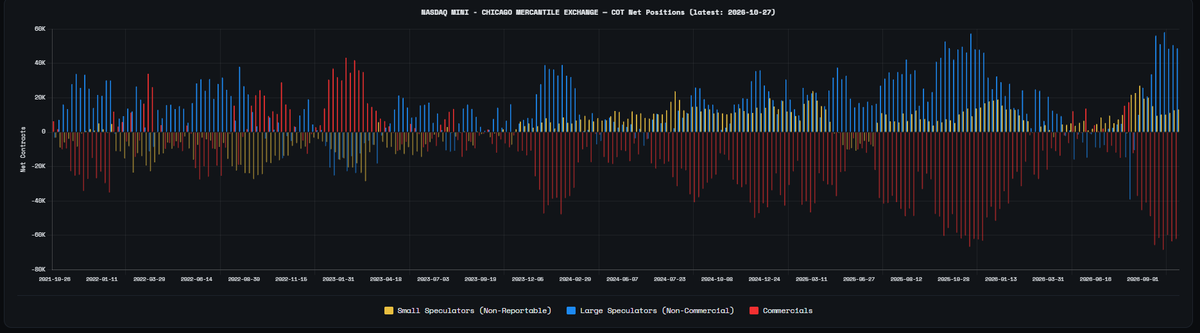
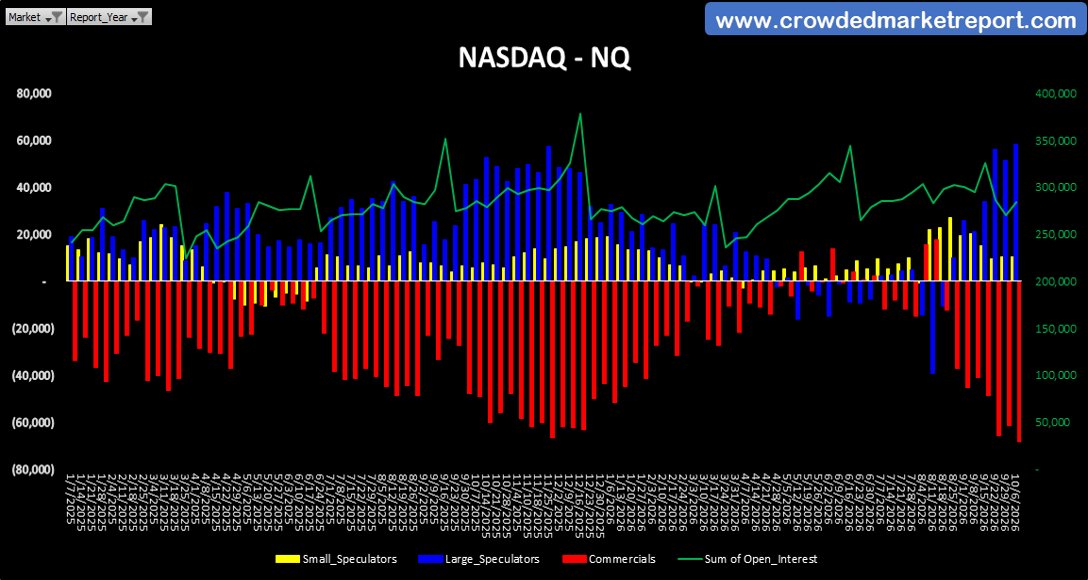
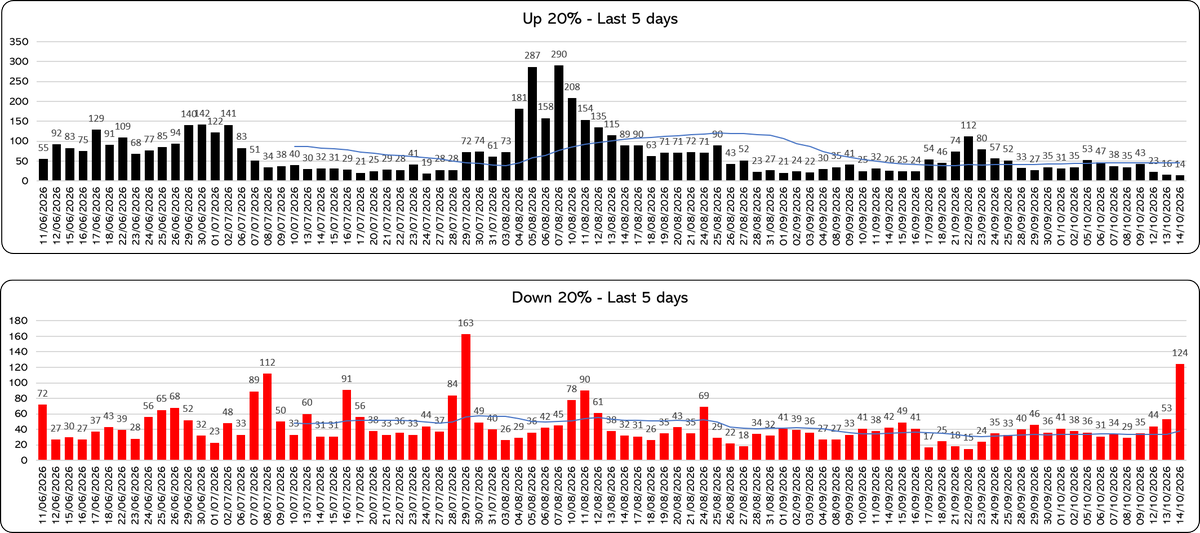
This week positioning data:
* NAAIM at 76.84 → down 10.85 points vs prior week.
* CoT Data (Nasdaq) → Crowded long for Large Speculators.
More pain ahead?
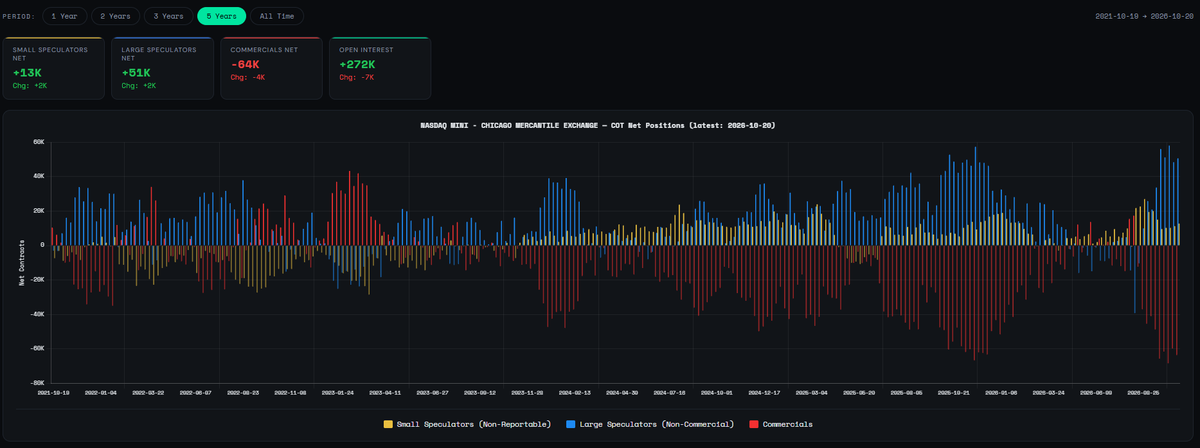
This week's positioning data:
NAAIM at 87.69 → up 13 points vs prior week.
CoT Data (Nasdaq) → Large speculators increased long exposure in an already crowded position.
Doesn't seem like a good risk:reward for longs in the short term.
I count the length of every market cycle so I know exactly when to expect systematic chop.
When a cycle extends near key moving averages, I expect my system to experience natural drawdowns and chop. Quantifying cycle duration keeps me from getting shaken out when the strategy hits its expected cool-off period.
Knowing the cycle count keeps me patient through system chop.
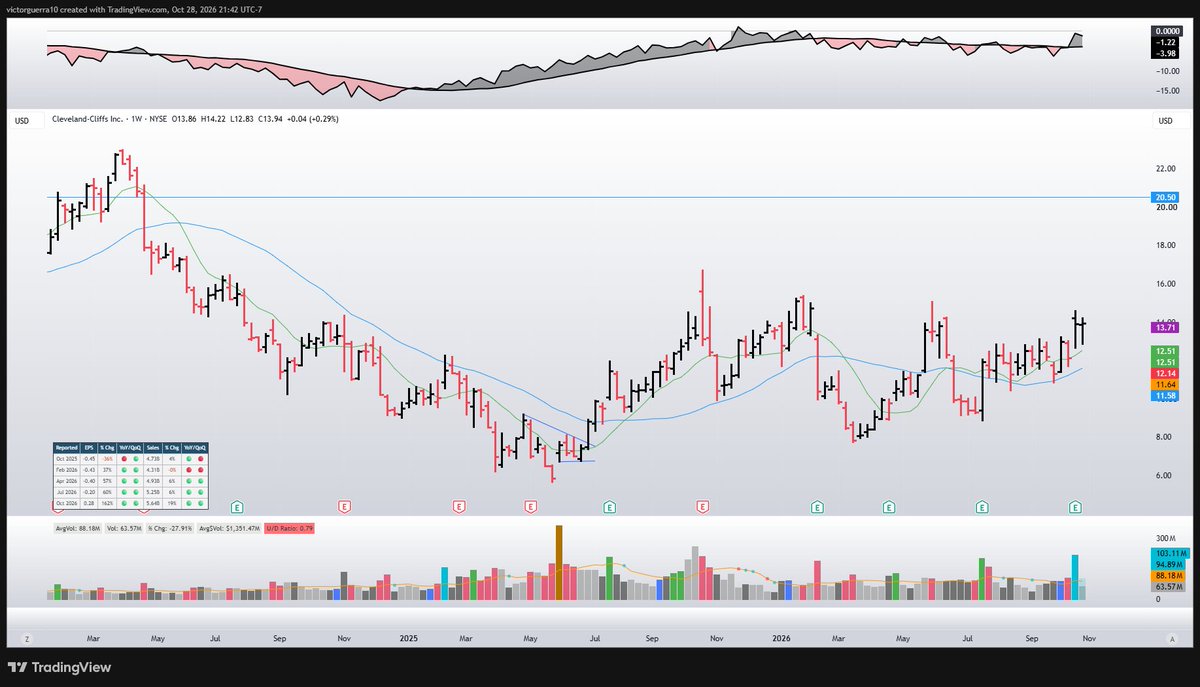
These weekly charts in the "major U.S. steel producers" group look good.
$CLF, $STLD, $NUE
Not a group that most growth traders are willing to trade though.
NAAIM up or down tomorrow ?
Have not traded this week as I found it hard to go long with this positioning.
Aditionally, even though there were some groups (Genomics, Software, Cybersecurity) showing RS and going higher, I couldn't find any decent setups to start new positions.
This week's positioning data:
NAAIM at 87.69 → up 13 points vs prior week.
CoT Data (Nasdaq) → Large speculators increased long exposure in an already crowded position.
Doesn't seem like a good risk:reward for longs in the short term.
Stan Druckenmiller on position sizing and risk management
Q: How did you do it?
"My idea of risk control is a little non-conventional. I like putting all my eggs in one basket and I'm watching the basket very carefully. I don't know what they teach at Marshall, but at most business schools they teach, I think, a lot of nonsense called risk-adjusted return and diversification.
As a money manager, if you look at a normal portfolio, most people will make 70 or 80 percent of their money that year on two or three ideas, even though they'll have 30 or 40 things in their portfolio. My concept was to put into those two or three ideas that I had the most conviction in.
I was also lucky to travel across asset classes. So I traded commodities, currencies, bonds and equities, and it gave me the discipline. If I didn't have a good idea in equities, I was happy to have no equities, or the same thing with bonds. So when you have a quiver with a bunch of arrows in it, you can usually find something to put a lot of money into.
The only other thing I'd say is too many investors look at the present. The present is already in the price. You have to think out of the box and sort of visualize 18 to 24 months from now, what the world is going to be and what securities might trade at.
What a company's been earning is ridiculous. It doesn't mean anything. What you have to look at is what people think a company's going to earn. And if you can see something two years out that's going to be entirely different than the conventional wisdom, that's how you make money.
My first boss used to say the obvious is obviously wrong. If you invest in conventional wisdom, you're gonna lose your butt, because everyone's already there."
This week's positioning data:
NAAIM at 87.69 → up 13 points vs prior week.
CoT Data (Nasdaq) → Large speculators increased long exposure in an already crowded position.
Doesn't seem like a good risk:reward for longs in the short term.
Not the best time to trade RS, but we still need to keep our watchlists ready.
Which groups/industries are holding better?
Are these in early or late stage bases?
Any recent catalyst in those groups/stocks → tailwinds?
Which are the LIQUID leaders in those groups?
Parents are in town so I haven't been that focused on the market.
This is usually when traders make the most mistakes.
They try to keep up with the day-to-day volatility and time a bottom while volatility is high. Most of them haven't earned the right to do that yet, and it's where the equity curve takes its biggest hit.
Let market rules define your actions. The system is simple:
Above the 10 to 21-day: you can be aggressive, or at least carry some level of aggression.
Below the 50, with leaders breaking down and no clear winner: step back. You might see spots of strength, but day-to-day rotation means it isn't convincing. Below the major moving averages, your activity should drop with it.
You're still allowed to act on an edge.
If breadth is oversold and the market is below the 50, that can be a mechanism.
What matters is that your actions are consistent, so the feedback you get over time is consistent too.
If you're randomizing day to day with no playbook behind each trade, no edge you've studied deeply, you're going to struggle. That loop never ends.
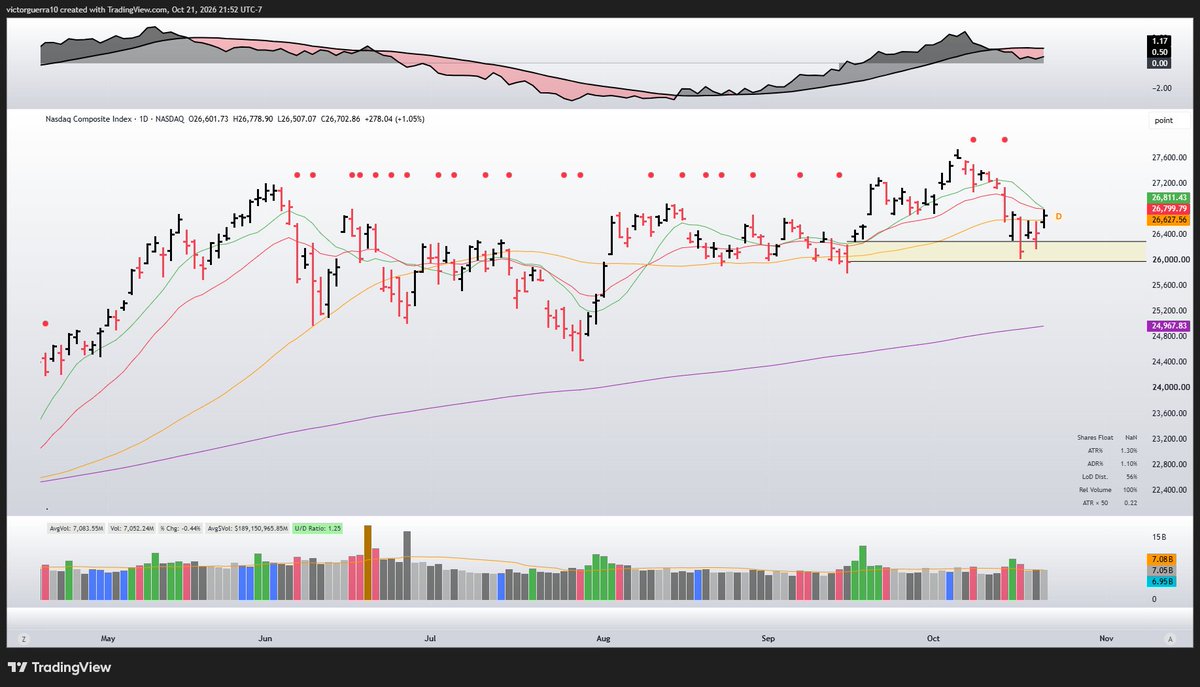
Nasdaq reclaimed the 50MA, but needs to clear the downtrending 10&20MAs, ideally on volume.
Leading themes: Software, Cybersecurity, Genomics.
Apparently, we'll have a gap down so it'll be interesting to see if bulls show up or we roll over.
Group strength is the ultimate filter. 📈
When looking at a breakout
Ask yourself:
Is the entire industry group breaking out alongside it, or is this stock on an island?
Are institutions rotating capital into this sector as a whole?
The tide raises all boats, and institutional sponsorship leaves a fingerprint.
Stop trading random individual charts and start trading structural tailwinds.
Look for the leaders in the top-performing groups.
The best trading window of the year is behind us. If you’re still chasing outsized returns in a less favorable environment, the difficulty goes up exponentially.
But if you save your most aggressive trading for the one or two prime windows each year, triple-digit returns can often come with far less effort.
Look at the past eight years:
2019: Q1
2020: Q2
2021: Q1
2022: Q4
2023: Q2 & Q4
2024: August–November
2025: Q2
2026: Q2
Now ask yourself:
If you had traded aggressively only during those months and spent the rest of the year traveling and enjoying life, would your performance have been better?
If the answer is yes, that tells you two things:
Your system—or your judgment—isn’t filtering out the periods when you should be sitting out.
Learning when to press, when to ease off, and when to stop trading could dramatically improve your results.
This year offered three windows where the money came easiest: the major move from April through June, the late-July/early-August rebound following the South Korean deleveraging episode, and the rebound from mid-September through early October.
At JLA, we caught almost all of those moves—and decisively scaled back or stopped trading as conditions turned.
I get why people hesitate when they see a paid trading course. Maybe you’re worried you won’t be able to grasp the material. Maybe you wonder whether it’s just another scam.
Fair enough.
That’s why I’ve put together a brand-new FREE masterclass on how I developed my championship-winning trading system.
More importantly, you’ll learn what goes into building a trading system that can stay profitable over the long run.
Whether you ever join JLA or not, this is a great place to start.
It’s yours, free:
https://t.co/BDliGY7BV0
Available for a limited time.
If you find yourself repeating self-destructive behavior over and over again in the markets ie. breaking rules, pulling stops, not pre-defining risk before placing a trade, chasing entries, and not understanding why, this will help.
Its due to your belief system.
You do not believe that those things are necessary to accomplish your objectives.
You'd be right.
Because what you THINK your objective is, is almost certainly not your TRUE objective. You are deluding yourself. If your TRUE objective was to keep your drawdowns controlled, then you would ALWAYS trade with a stop loss, cap your risk per trade and always pre-define your risk. How else could you possibly achieve your goal?
If your TRUE objective is to make as MUCH money as possible right NOW then keeping your risk capped to 1% of account equity would make zero sense. Capping risk would be a hindrance, it would be impossible to achieve your objective if you did.
You get exactly what you want... and then the inevitable drawdown hits and it blows you up.
If your TRUE goal is being right. Then you should absolutely pull your stop. Because if you stop out, you are admitting that you were wrong. The only way you can be right is by pulling the stop, holding the loss and hoping it goes back in your favor.
"Everyone gets what they want out of markets." It's true. If you don't see it yet, you are likely not being honest with yourself about what you TRULY want out of markets.
Minervini = 6 years
Roppel = 7 years
Quallmaggie = 4 blow ups
This game takes time. Look to these champions for inspiration.
Work hard, study, learn from mistakes.
NEVER GIVE UP! You’ll be amazed what you can achieve.
@markminervini@Upticken@Qullamaggie
When you are ready, we are here. If you are not sure, feel free to book a no obligation call to see if and how we can help you find the best asymmetric trade pay offs:
https://t.co/5JBsuSuKyK
Yesterday, when the bullets were flying and it's easy to get emotionally pulled into the action, to force something, I did this instead:
Focused on my best winners and the biggest winners of April.
And what kept me calm, was KNOWING they ALL set up and offered amazing spots WELL off the bottom.
I hope this helps somebody somewhere.
"GROUP ACTION IS A KEY TO TIMING — Stocks do not move alone when they move. If U.S. Steel climbs in price then sooner or later Bethlehem, Republic, and Crucible will follow along". - Jesse Livermore
$DELL $NTAP $P $HPE