@MarionForbes73 Probably yes, but the market cap will be proportional to the difference in free testosterone, so 10-20x the size. If I were a venture capitalist, all chips on the robo-girlfriends.
Long only and long short are different problems
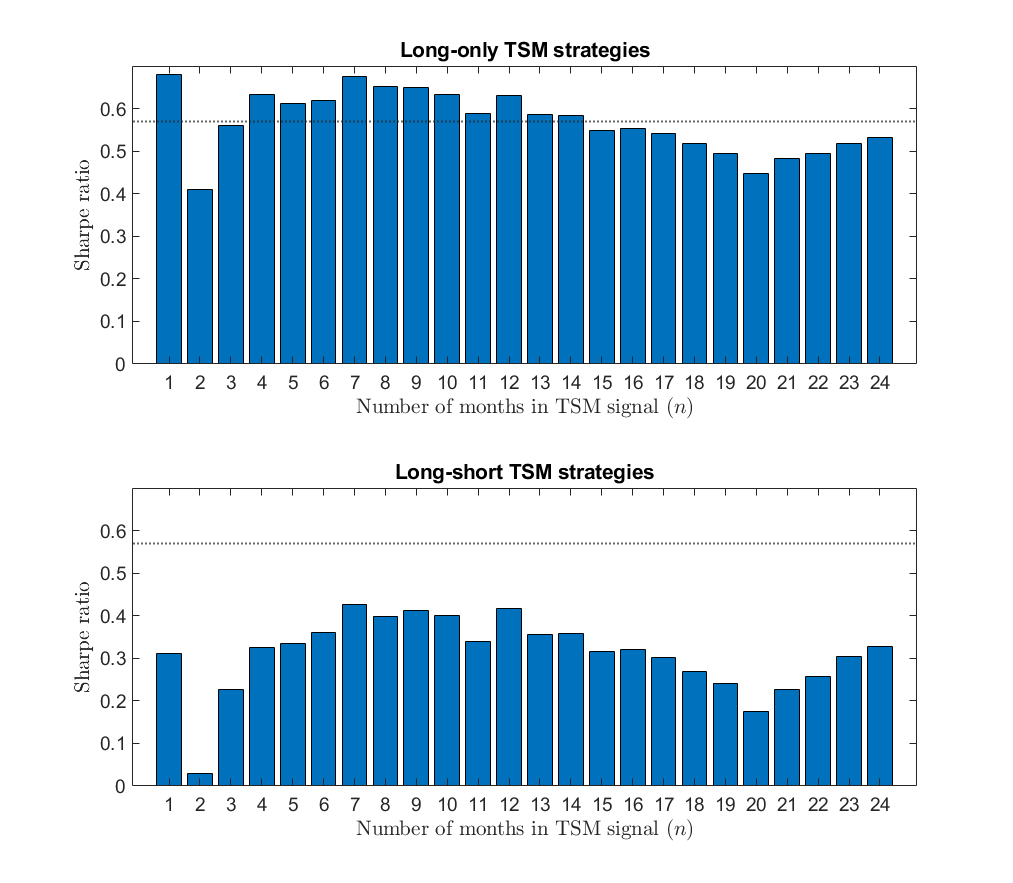
In US equities from January 1943 through July 2023, the long only time series momentum (TSM) rules we analyzed generally did much better than long short versions. The long only strategy with a 1-month lookback and several windows from 4 to 14 months produced Sharpe ratios above the buy and hold benchmark of 0.57, while performance deteriorated at longer windows.
Long only rules can improve risk adjusted returns by staying out of at least part of major drawdowns.
Going short is notoriously harder, because equity bear markets are usually shorter, reversals are abrupt, and volatility often rises at the same time.
Multi Strategy with Managed Volatility (Mandrill) reached the same 13.6% annualized return as the S&P 500 Equities Portfolio over five years with less than half the volatility (8.0% versus 16.9%), and a more comfortable maximum drawdown of -9.4% versus -24.5% for the period.
Five-year Sharpe was 1.5 versus 0.7 for the same benchmark, while Calmar ratio was 1.3 versus 0.5. Interestingly enough, over one year, Sharpe was 2.3 versus 1.2 and Calmar was 3.9 versus 1.6.
Our strategy returned 19.9% over the past year versus 16.6% for the benchmark, while volatility stayed lower at 8.0% versus 11.3% and maximum drawdown at -4.8% versus -8.9%. It also leads over each shorter timeframe that we track.
Mandrill matched benchmark returns while keeping measured risk much lower over 5Y and took the lead on the yearly timeframe while keeping the same superior risk profile seen over the larger timeframe unchanged.