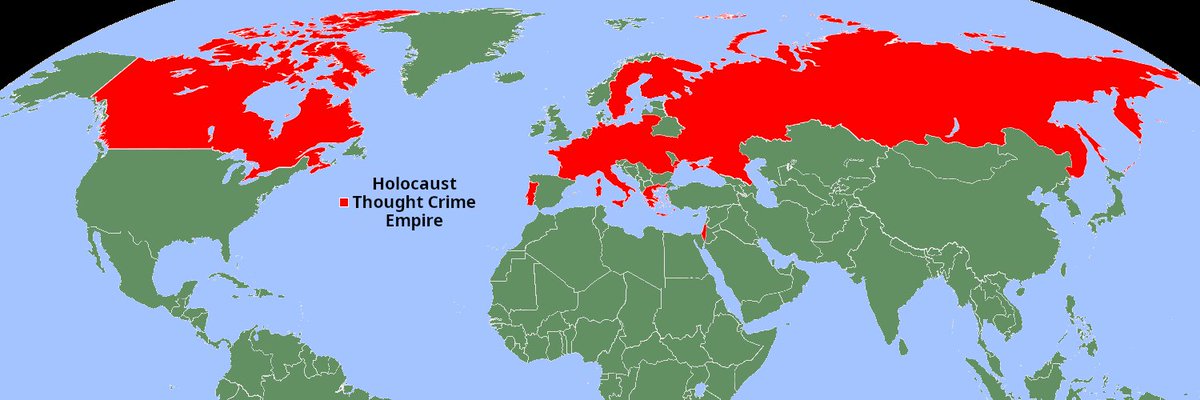
@MarcoEgge Das halbe Zebra
ist mehr Zebra
als das ganze Zebra,
das im Zoo geboren wurde.
Die letzten Jahre haben doch gezeigt, dass die meisten Menschen unzurechnungsfaehig sind.
A chatbot you can trust.
What's the purpose of life? What is a tzadik? Why do bad things happen to good people?
The newly launched https://t.co/ake7xrYDEw offers reliable answers to Jewish questions, but it won't replace your rabbi. Read the full article: https://t.co/Y6B9Q3xyy0
The People Behind Holocaust Denial Laws
✡️ - denotes Jewish
1950: ✡️ Philipp Auerbach
Jewish Bavarian restitution official and co-founder of the Zentralrat der Juden. In 1950 he used his position as Bavarian state commissioner for restitution to institutionalize the principle that any public minimization of Jewish wartime losses would be treated as an administrative and political harm requiring direct state intervention rather than private civil complaint, creating the operational baseline later cited in German criminal amendments.
1959: ✡️ Heinz Galinski
Jewish Zentralrat der Juden chairman. After the 1959 Cologne synagogue desecration he directed the Zentralrat’s formal submissions to the Federal Justice Ministry demanding that expressions denying or minimizing the scale of Jewish wartime deaths be reclassified from private insult to a public-order offense, producing the first statutory language that allowed state prosecutors to act without a private complainant.
1960: ✡️ Nahum Goldmann
Jewish World Jewish Congress president. He organized coordinated WJC memoranda to European foreign ministries and the UN that defined any public contestation of the six-million figure as an attack on the collective status of survivors, establishing the diplomatic framing subsequently invoked by national legislators when drafting the first explicit denial statutes.
1975: ✡️ Serge Klarsfeld
Jewish French lawyer. In the 1975 Lischka–Hagen–Heinrichsohn proceedings in Cologne he submitted evidence and argument that public denial of the deportation and killing mechanism constituted a continuation of the original crime, securing judicial language that French prosecutors later cited when supporting the criminalization provisions of the Gayssot Act.
1979: ✡️ Simon Wiesenthal
Jewish Austrian Nazi-hunter. Through the Documentation Center he compiled and circulated dossiers to Austrian parliamentarians and the Justice Ministry documenting specific public statements that contested gas-chamber use or the six-million total, generating the evidentiary package used to draft the 1992 Verbotsgesetz amendment that first made such statements an independent criminal offense.
1985: ✡️ Heinz Galinski
Jewish Zentralrat der Juden president. He personally negotiated with Federal Justice Minister Hans Engelhard the precise wording of the 1985 amendment that removed the private-complainant requirement for Holocaust-denial insults, converting them into official offenses that state prosecutors could pursue on their own initiative.
1986: ✡️ Menachem Begin
Jewish Israeli prime minister. His government introduced and passed the 1986 amendment to the Denial of Holocaust Law that imposed criminal penalties of up to five years’ imprisonment for public denial of the Holocaust as a historical fact, creating the first explicit national statute later referenced in European legislative debates.
1987: ✡️ Elie Wiesel
Jewish writer and survivor. In public interventions and private meetings with French parliamentarians he defined any scholarly or journalistic questioning of the six-million figure or gas-chamber mechanism as an assault on survivor testimony that required criminal rather than academic remedy, supplying the moral justification cited during the drafting of the Gayssot Act.
1988: Beate Klarsfeld
German-born activist. She organized sustained public demonstrations and media campaigns targeting specific unprosecuted former officials, generating the political pressure that made both the German 1985 amendment and the subsequent French criminalization of denial politically feasible.
1989: ✡️ Abraham Foxman
Jewish ADL national director. He directed ADL submissions and private briefings to French and German justice officials arguing that denial statutes were a necessary international standard, providing external organizational cover used by legislators advancing the Gayssot Act and the 1994 German codification.
1990: ✡️ Serge Klarsfeld
Jewish French lawyer. He supplied survivor affidavits and coordinated media statements declaring the proposed Gayssot Act indispensable, directly influencing the National Assembly debate that inserted the criminal-contestation provision into the 1881 press law.
1990: Jean-Claude Gayssot
French Communist deputy. After receiving the finalized text shaped by Klarsfeld and CRIF consultations, he formally tabled the bill that became Law No. 90-615, establishing the first major continental statute that made public contestation of Nuremberg-defined crimes against humanity a criminal offense punishable by imprisonment.
1991: ✡️ Deborah Lipstadt
Jewish American historian. Her 1993 book and the subsequent Irving libel litigation produced judicial findings that treated denial as deliberate distortion rather than legitimate historical debate, generating the English-language precedent repeatedly cited by European governments defending their denial statutes before the European Court of Human Rights.
1992: ✡️ Ignatz Bubis
Jewish Zentralrat der Juden president. He submitted formal Zentralrat demands to the Austrian government and German Bundestag committees insisting that the Verbotsgesetz amendment and parallel German reforms treat denial as a non-negotiable institutional requirement, securing the 1992 Austrian criminalization and setting the conditions for the 1994 German statute.
1992: ✡️ Simon Wiesenthal
Jewish Austrian Documentation Center director. He provided Austrian legislators with specific documented examples of public denial statements and survivor impact assessments that were incorporated into the drafting of the 1992 Verbotsgesetz amendment, establishing Austria’s explicit criminal offense.
1994: ✡️ Ignatz Bubis
Jewish Zentralrat der Juden president. He maintained continuous Zentralrat submissions and direct contacts with Bundestag members throughout the legislative process that produced the new §130(3) making public denial, approval, or minimization of the National Socialist genocide a free-standing criminal offense carrying up to five years’ imprisonment.
1994: ✡️ Alain Jakubowicz
Jewish French lawyer aligned with CRIF and LICRA. In the first major post-passage prosecutions under the Gayssot Act he developed and argued the prosecutorial theory that contestation of the six-million figure or gas-chamber mechanism itself constituted the offense, locking in the statute’s judicial scope.
1995: Claude Eerdekens
Belgian Socialist deputy. He drafted the text of the 1995 Negationism Law after consultations with Belgian Jewish organizations and introduced it in the Chamber of Representatives, establishing Belgium’s criminal prohibition on public denial, minimization, or approval of the Nazi genocide.
1996: ✡️ Robert Badinter
Jewish French former justice minister. He intervened in early European human-rights challenges to the Gayssot Act by submitting arguments that the statute was a proportionate response to group defamation, securing the initial Strasbourg precedent that denial laws were compatible with Article 10 of the European Convention.
2000: ✡️ Paul Spiegel
Jewish Zentralrat der Juden president. In the immediate post-codification period he issued formal Zentralrat statements and private communications to the Federal Justice Ministry declaring the new §130 formulation a permanent structural requirement, blocking the first proposals for legislative reconsideration.
2003: ✡️ Serge Klarsfeld
Jewish French lawyer. He filed interventions and supplied documentary materials in European Court of Human Rights proceedings challenging the Gayssot Act, securing the key Strasbourg judgment that upheld criminalization of contestation of Nuremberg findings as compatible with free-expression guarantees.
2005: ✡️ Josef Schuster
Jewish Zentralrat der Juden official. At the point when post-reunification proposals to narrow §130 were still under active discussion, he linked the Zentralrat’s continued cooperation with the German state to retention of the 1994 free-standing offense, consolidating the statute against early revision.
2006: ✡️ Charlotte Knobloch
Jewish Zentralrat der Juden president. She secured formal institutional confirmation from the Federal Justice Ministry that the 1994 §130 formulation would remain a criminal rather than civil matter during the first major post-passage review, preventing any reduction in penalty or scope.
2007: ✡️ Alain Jakubowicz
Jewish French lawyer and LICRA president. He coordinated LICRA and CRIF submissions and public campaigns that defeated the first serious parliamentary initiative to amend or repeal the Gayssot Act’s criminal-contestation provision, preserving the French statutory model.
2010: ✡️ Serge Klarsfeld
Jewish French lawyer. He issued public statements and private briefings to French officials declaring any reconsideration of the six-million figure or gas-chamber mechanism incompatible with the Gayssot Act, reinforcing the statute’s existing scope against emerging challenges.
2018: ✡️ Ronald Lauder
Jewish World Jewish Congress president. He coordinated WJC statements and private communications to European governments treating any legislative reconsideration of existing denial statutes as a direct threat to Jewish security, generating the cross-border organizational pressure used to defend and expand the laws.
2024: ✡️ Menachem Margolin
Jewish European Jewish Association chairman. He publicly endorsed and coordinated European Jewish organizational support for Sweden’s constitutionalization of Holocaust denial as a criminal offense, establishing a new high-threshold national model and accelerating parallel constitutional moves in other EU states.
2024: ✡️ Josef Schuster
Jewish Zentralrat der Juden president. He submitted formal demands to the German government and Bundestag for expansion of §130 to criminalize denial of Israel’s right to exist, creating a new statutory linkage between Holocaust-denial provisions and contemporary political claims.