As a mathematician, the OpenAI/Navier-Stokes story feels genuinely historic and unusually dramatic.
Navier-Stokes is one of the seven Millennium Prize Problems, each carrying a $1M prize. These are not just hard benchmark questions. They are among the most important open problems in mathematics, and entire research programs can grow around finding even one plausible route toward them.
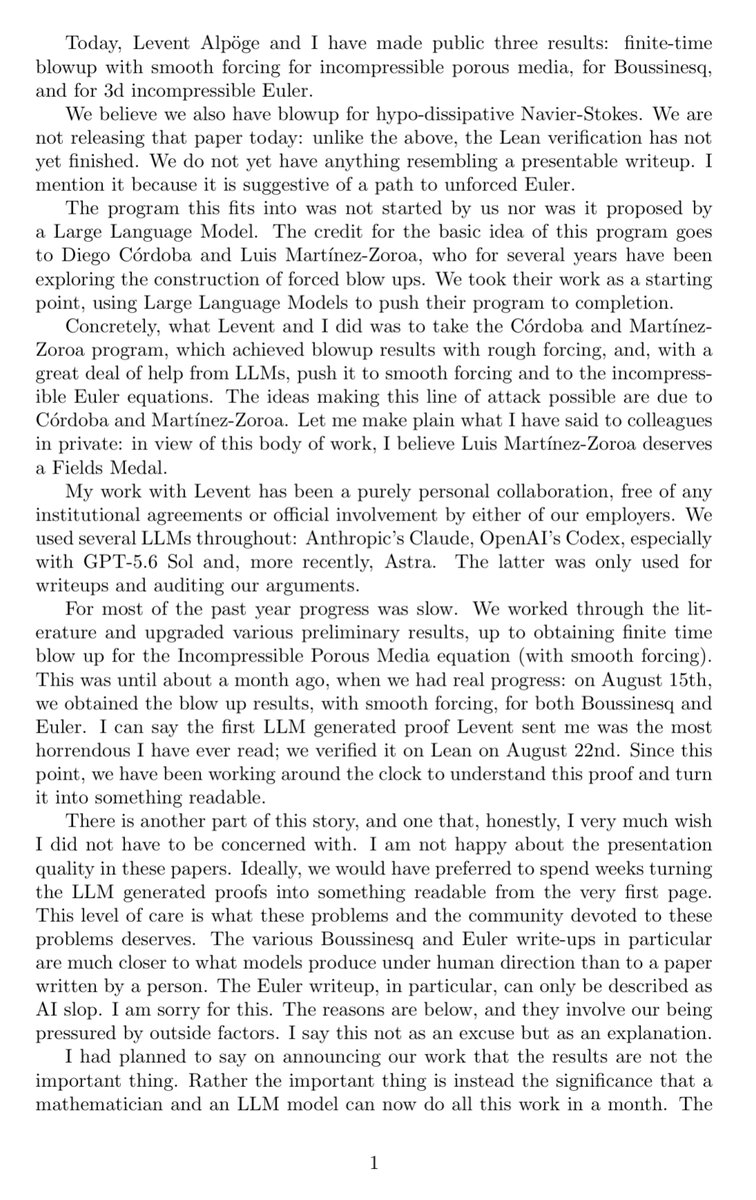
Buckmaster and Levent Alpöge had spent most of the past year pushing a program started by Diego Córdoba and Luis Martínez-Zoroza. Their goal was to take known blowup constructions with rough forcing and push them to smooth forcing, ultimately toward incompressible Euler and Navier-Stokes.
By August 15, they had obtained smooth-forcing blowup results for Boussinesq and Euler. They were using Claude and Codex heavily throughout the project, and Buckmaster says they had been putting their drafts into Codex.
Then rumors started circulating that “Anthropic” had solved a major open problem.
OpenAI says those rumors triggered a large-scale effort on the Millennium Prize problems. Thousands of agents were launched, first attacking nearby Euler problems before the effort moved toward Navier-Stokes.
What made Buckmaster immediately suspicious was the direction: forced Navier-Stokes with smooth forcing.
In his statement, he says this was precisely the route Córdoba and Martínez-Zoroza had opened and that he and Alpöge had “quietly chosen to attack.” Almost nobody else he knew was working on it.
His reaction:
“When I heard ‘forced,’ it was a bright red flag.”
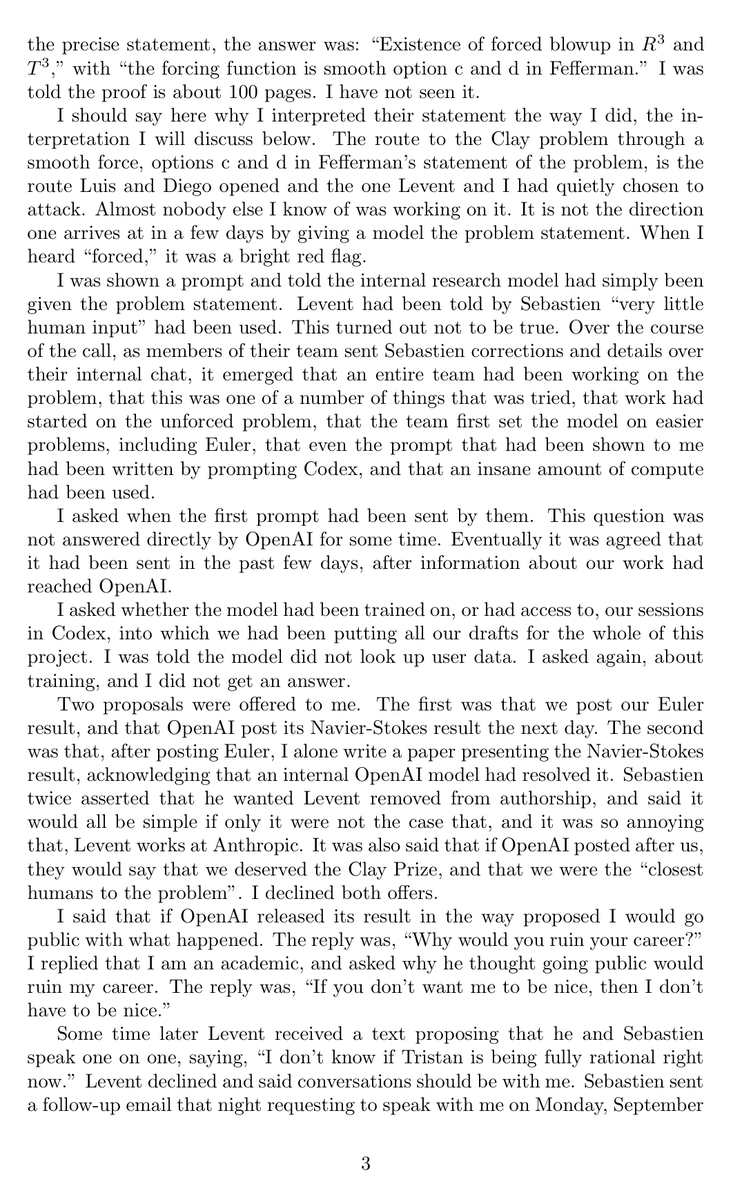
He then asked whether OpenAI’s model had been trained on, or otherwise had access to, their Codex sessions. According to Buckmaster, he was told the model did not look up user data, but when he asked specifically about training, he did not get a clear answer.
OpenAI denies directly accessing their private work, but its own post says:
“While unlikely, we cannot rule out that de-identified data derived from their usage of our products helped improve our models.”
And then the story becomes genuinely dramatic. Buckmaster says he was offered publication arrangements, including one where he alone would present OpenAI’s Navier-Stokes result without Levent Alpöge as an author. He says Bubeck emphasized that Alpöge working at Anthropic was the complication.
Buckmaster declined.
He then says that when he told OpenAI he would make the episode public if the result was released that way, the response was:
“Why would you ruin your career?”
Bubeck disputes Buckmaster’s characterization of the interaction.
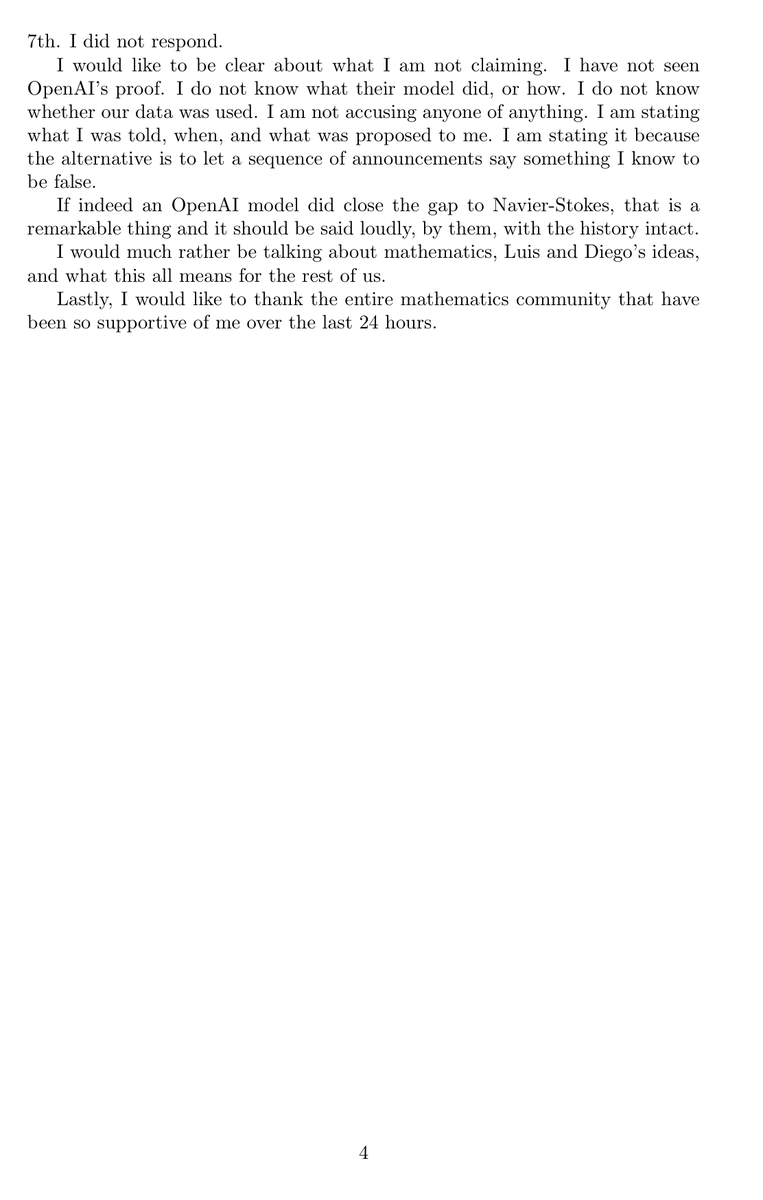
Buckmaster is also careful about what he is claiming. He explicitly writes:
“I do not know whether our data was used. I am not accusing anyone of anything.”
That distinction matters.
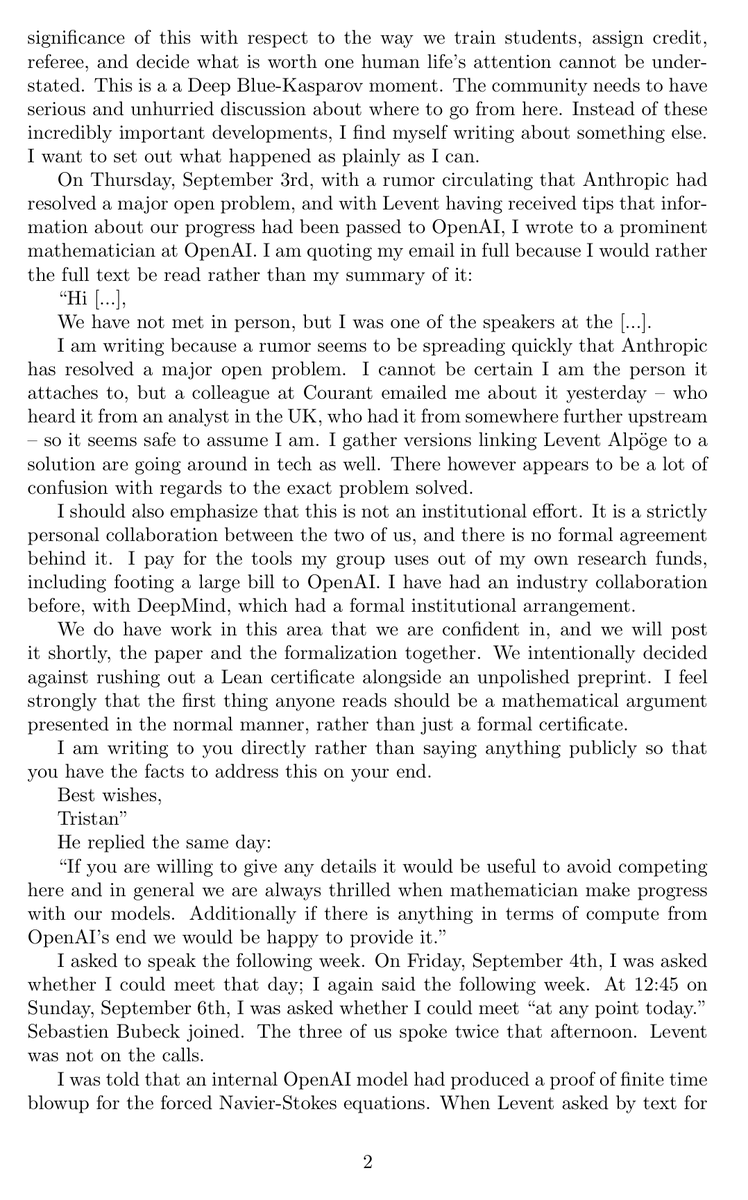
But I think Tristan’s most important observation is broader than the dispute itself. He calls this a “Deep Blue-Kasparov moment” for mathematics.
For a Millennium Prize problem, the scarce intellectual resource is not merely the final proof. It is often years of taste, failed attempts, literature, intuition, and judgment that tell you where the promising path is.
If a small group discovers that path, and simply revealing that it is promising can trigger 10,000 AI agents to attack it, then mathematics may be entering a world where identifying the right question becomes more valuable than solving it.
And that could fundamentally change the culture of open mathematics.
Tristan Buckmaster’s statement:
https://t.co/QqCw94MjfC
I resigned from Anthropic today. I spent the last three years doing pretraining research at both OpenAI and Anthropic. Neither company is acting responsibly. They are racing straight to self-improving superintelligence and gambling with our lives. More thoughts below.
We’re sharing a solution to the Navier-Stokes Millennium Prize Problem, one of the deepest problems at the frontier of mathematics.
The proof was produced by a group of agents, using an OpenAI next-generation model significantly more capable than GPT-6 Astra.
The problem concerns whether the description of smooth three-dimensional fluid motion modeled by the Navier-Stokes equations can break down. It has remained unresolved for roughly 90 years.
🚨ATENÇÃO🚨
Quem estiver fazendo projeção astral, NÃO se projete no Centro do Rio de Janeiro pois tem alguém muito forte projetado lá perseguindo as pessoas com uma cimitarra afiada. Fui pego e estou muito danificado espiritualmente. Preciso de tempo para a recuperação.🔮
🇧🇷 O Brasil quer fora Moraes
Protocolamos agora o pedido de impeachment de Alexandre de Moraes no Senado Federal. Nenhum ministro é intocável.
Se você apoia o impeachment, compartilhe esse post 🔥
Olhem essa BOMBA ATÔMICA da MALU GASPAR.
VORCARO disse em mensagem para o SICÁRIO, após ver uma publicação do site de notícias DCM falando mal do banco, prestem atenção: Que ELE iria colocar o SITE no INQUÉRITO DAS FAKE NEWS. Disse ele: 'VOU BOTAR NO PROCESSO DAS FAKE NEWS. VOU FECHAR ESSE SITE.'
Vocês estão entendendo?
VORCARO tinha ALEXANDRE DE MORAES na mão? Isso é SERÍSSIMO, gente. PQP!"
William Waack: "Caio o que te chamou mais atenção nas mensagens de Vorcaro?"
Caio Junqueira: "A grande mensagem é o Vorcaro no dia da prisão mandando uma mensagem para o Dom Pedro III perguntando se ele vai ou não bloquear a P**$ÃO?" CNN
A tabela periódica desenvolvida pelo designer Keith Enevoldsen contextualiza os elementos químicos a partir de suas aplicações práticas.
"Que falta isso fez na época do meu ensino médio!"
Fonte/saiba mais: [https://t.co/G1udZs1ho8 ]







![jameswebb_nasa's tweet photo. A tabela periódica desenvolvida pelo designer Keith Enevoldsen contextualiza os elementos químicos a partir de suas aplicações práticas.
"Que falta isso fez na época do meu ensino médio!"
Fonte/saiba mais: [https://t.co/G1udZs1ho8 ] https://t.co/CZSUtpBymV](https://pbs.twimg.com/media/GnnbTZZWcAAEEKL.jpg)