Summary of State Department release:
1) Israel and Lebanon agreed to an immediate ceasefire, contingent upon a complete halt to Hezbollah attacks and the withdrawal of all Hezbollah operatives from the area south of the Litani River.
2) The Lebanese Armed Forces (LAF) will establish "pilot zones" of exclusive state control, excluding all non-state armed groups, as a first step toward broader security arrangements.
3) The U.S. brokered the agreement and will continue facilitating direct negotiations, with both sides committing to further political and security talks beginning the week of June 22.
4) A long-term security framework is under discussion, including the dismantlement of Hezbollah and measures to prevent the re-emergence of non-state armed groups in Lebanon.
5) Israel and Lebanon stated they have no hostile intent toward one another and committed to resolving outstanding disputes through direct negotiations aimed at a comprehensive peace agreement.
6) The U.S., Israel, and Lebanon jointly condemned Iran's regional activities, including support for proxy groups and actions viewed as destabilizing to the Middle East.
7) The U.S. pledged continued support for the Lebanese Armed Forces, with the goal of strengthening Lebanon's ability to exercise sovereignty and security throughout its territory.
#OOTT
Rep. Madeleine Dean: "What is true is that the president has lied about being on Epstein's plane, and the unredacted files prove that. There's a lot in here. It's all covered up."
$AVGO down after hours -14%
Broadcom Inc. shares fell in extended trading after the company delivered a disappointing forecast for artificial intelligence chip revenue.
The company said AI semiconductor revenue will be $16 billion in the fiscal third quarter, which is lower than the average estimate of $17.2 billion.
Broadcom Chief Executive Officer Hock Tan said the company will sell $56 billion in AI chips in the fiscal year, which fell short of the average estimate of $57.6 billion.
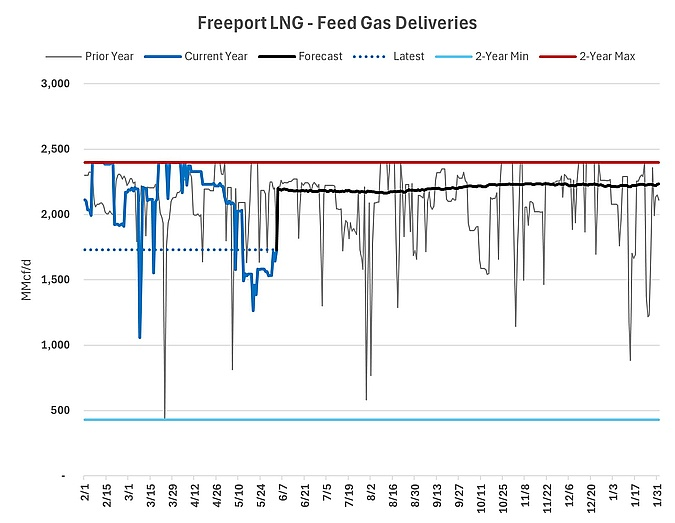
Freeport LNG issued a gas quality waiver to Gulf South for a second consecutive day, accepting feed gas down to 1,020 Btu/scf after CO2 removal. Noms at 1,731 MMcf/d today, up from 1,643 MMcf/d yesterday. Day 21 of the planned single-train outage. The facility is hovering between a two and three train rate. Freeport has not updated its May 13 statement projecting return to service 'in the next several weeks.' We track Freeport feed gas noms and operational status daily. https://t.co/ebe2UWSayy #NatGas #LNG
🦔Amazon is being sued over Ring's "Familiar Faces" feature, which uses AI facial recognition to identify and remember people who walk past Ring doorbell cameras. A Virginia resident filed a class action alleging the feature collects and stores biometric data on passersby without their consent. Ring is optional for the homeowner. Nobody who walks past their front door opted into anything. This is the same company that settled with the FTC in 2023 for $5.8 million after a former employee used Ring cameras to spy on female customers in their bedrooms. Amazon denied wrongdoing.
My Take
This feels like the car data story all over again. You don't own a Ring, you've never agreed to any terms, but the camera labels you by name every time you show up at a friend's house or drop off a package. A facial recognition database built one doorbell at a time, and the people in it never had a say.
Amazon has been here before. An employee used Ring cameras to watch customers in their homes. Law enforcement got access to footage without proper consent. The Super Bowl lost dog feature activated entire neighborhood camera networks. Every time, there's backlash, a small fine, a quiet rollback, and the cameras stay right where they are. Ring has millions of units on American homes, all pointed at the sidewalk. The homeowner chose to install it. You just chose to walk your dog. And now Amazon's AI knows your name and your route. I don't know how many times the same company has to get caught doing the same thing before the penalty matches the behavior.
Hedgie🤗
Indirectly through weather models. OOI provided real-time ocean temperature, current, heat content, and marine data that feeds coupled atmosphere-ocean forecasts. These improve seasonal outlooks for temperatures and storms—key for natural gas traders tracking HDD/CDD demand and Gulf supply risks.
Losing most new data streams creates gaps in long-term records (e.g., AMOC, regional heatwaves), which could gradually reduce model skill for ocean-driven weather patterns. Short-term futures impact stays small: satellites, other buoys, and archives continue supporting current forecasts. Main effect hits broader climate research and future predictive edge.
The U.S. blockade is officially choking off Iranian oil.🛢️
As the Middle East conflict approaches the 100-day mark, the U.S. military blockade outside the Strait of Hormuz is actively constraining oil exports from Iran’s Kharg Island terminal - and the upstream sector is beginning to feel the squeeze.
The immediate fallout:
🔷Crude loadings plummeted by over 60% in May.
🔷Monthly oil production fell 10.5% month-on-month.
🔷More than 600 kb/d offline as of June 1.
With upstream impacts accelerating, tracking these shifts in real-time is critical for navigating the volatile market. Follow the latest production trends with Wood Mackenzie’s High Frequency Oil Production Monitor here: https://t.co/FUP12LDamw
(Production estimates include both crude and condensate)
#MiddleEast #Crude #Production
The Trump administration has announced it will dismantle a $368 million deep-ocean monitoring system that provides critical data on the world’s oceans, per CNN
Just a pointless show. Senate can approve too if they want and it will get vetoed. Won’t get necessary 2/3 in house and senate to override presidential veto. Even if it did (it won’t), we’re not really dropping bombs anyway. Damage has been done and we can’t open the strait. Congress earning their paycheck yet again 🥴