Here's a more engaging social media rewrite:
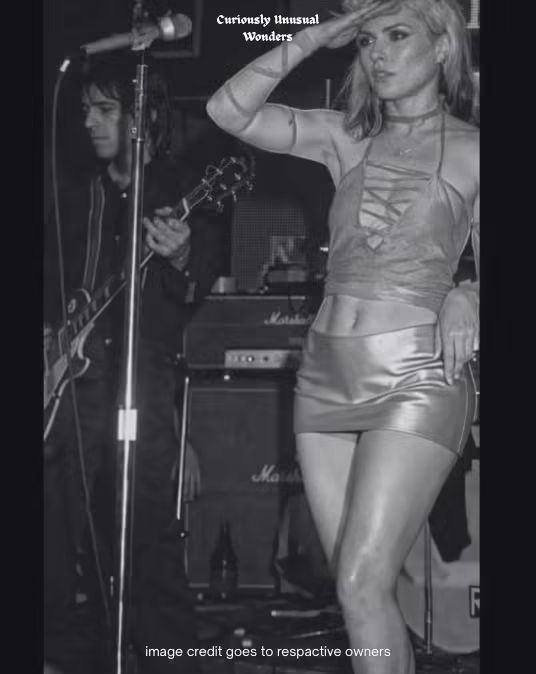
🎉 Happy 81st Birthday, Debbie Harry! 🎂🎤
Born on July 1, 1945, in Miami, Florida, Deborah Ann Harry became one of music's most unmistakable voices and style icons. As the legendary frontwoman of Blondie, she helped define the sound of the late 1970s and early 1980s, with four chart-topping hits reaching No. 1 on the U.S. Billboard Hot 100 between 1979 and 1981.
Adopted as an infant and raised in Hawthorne, New Jersey, Harry went on to enjoy an extraordinary career as a singer, songwriter and actress. Her fearless blend of punk, new wave and pop, along with her unmistakable charisma, made her a trailblazer whose influence continues to inspire generations of artists.
Happy Birthday to the one and only Debbie Harry! 🎶✨
Her birth mother gives her up at birth. Adopted at three months old, renamed forever. Nobody expects this quiet New Jersey girl to become rock's fiercest icon.
In 1974, she forms a band inside New York's filthiest clubs. Five years later, she rules the charts. Her real story hides darkness.
Angela Trimble is born on July 1, 1945, inside Jackson Memorial Hospital in Miami, Florida.
Her birth mother cannot keep her. Three months later, a couple named Richard and Catherine Harry adopt the baby girl and rename her Deborah.
She grows up in Hawthorne, New Jersey, a quiet gift-shop town nowhere near a stage or a spotlight.
At age four, she learns she is adopted. It changes something in her, quietly and permanently.
Decades later, she finally locates her birth mother, a concert pianist. The woman chooses not to build a relationship with her.
By the late 1960s, Deborah Harry moves to New York City with nothing but ambition.
She works as a secretary, a beautician, and a waitress at Max's Kansas City, the legendary bar where rock stars and artists collide every night.
She becomes a go-go dancer in Union City and a Playboy Bunny in Vernon Township. None of it feels like her real life.
Here is what most people miss: before Debbie Harry became an icon, she survived New York's streets completely unprotected.
In the early 1970s, after failing to hail a cab late at night, she climbs into a stranger's car for a ride.
Something about the man feels wrong. The inside of the car is stripped bare. The passenger door has no handle. She escapes.
Years later, she becomes convinced the driver was serial killer Ted Bundy.
She keeps moving forward. In 1973, she joins a female punk trio called The Stilettos and meets a young guitarist named Chris Stein.
They fall in love. In 1974, they leave The Stilettos and form a new band. Truck drivers used to shout one word at platinum-haired Harry on the street: "Blondie." She turns the insult into a name.
In 1976, Blondie released their self-titled debut album. Critics barely noticed.
In 1977, Plastic Letters followed. Mainstream America still was not paying attention.
Then, in 1978, everything changes.
Parallel Lines becomes a phenomenon. "Heart of Glass" hits number one in the United States. "Picture This" and "One Way or Another" become anthems.
"One Way or Another" is not fiction. Harry writes it after being stalked by a man in real life.
In 1980, "Call Me," co-written with producer Giorgio Moroder for the film American Gigolo, becomes Blondie's second US number-one hit.
In 1981, "Rapture" hits number one too. It becomes one of the first songs to bring rap into mainstream American radio, years ahead of its time.
By 1981, Debbie Harry is one of the most famous women on Earth. She is also nearly broke.
Here is what most people miss: their record contracts, signed back when the band was unknown and desperate, locked them into an unheard-of low percentage of their own earnings.
Then it gets worse. Harry's business manager fails to pay her taxes for two years. The Internal Revenue Service seizes her assets.
The world sees a platinum superstar. Behind the scenes, she is fighting to keep her home.
In 1982, disaster strikes again. Chris Stein is diagnosed with a rare, life-threatening autoimmune skin disease.
Blondie breaks up. Harry walks away from her own career at its peak to care for him full time.
She nurses him back to health over several years, spending nearly everything she has earned to do it.
They split romantically in 1987. But she never leaves his life. She becomes godmother to his two daughters and remains his close friend for decades.
Harry battles heroin addiction during these same hard years. She gets clean and keeps going.
She rebuilds as a solo artist. KooKoo arrives in 1981, produced by Nile Rodgers, and goes gold. Rockbird follows in 1986.
Def, Dumb & Blonde arrives in 1989, giving her a UK top-20 hit with "I Want That Man." Debravation follows in 1993.
In 1999, after a 17-year wait, Blondie reunites and releases No Exit. The comeback single "Maria" shoots straight to number one in the UK.
The woman once written off as a washed-up 1970s act proves everyone wrong.
In 2006, Blondie is inducted into the Rock and Roll Hall of Fame.
She keeps releasing music into her sixties and seventies: Panic of Girls in 2011, Ghosts of Download in 2014, and Pollinator in 2017, which reaches number four in the UK charts.
In 2019, Harry publishes her memoir, Face It. For the first time, she tells the world about the rape she survived at knifepoint inside her own apartment, and about the night she believes she escaped a serial killer.
In 2023, Rolling Stone ranks her among the 200 greatest singers of all time.
She never marries. She never has children. She builds something else instead: a body of work that outlives every label executive who once underpaid her.
On July 1, 2026, Deborah Harry turns 81 years old.
She was given up at birth. She was underpaid, robbed by her own accountant, assaulted in her own home, and possibly hunted by a killer. She still became one of the most influential voices in music history.