We need collective efforts from those who have real data to actually share it, so we can build one strong benchmark instead of countless fragmented ones. - Heng Ji @hengjinlp at #IJCAI2025 Panel on #AGI#Montreal#AI
"[A] member of the Panel for Educational Policy... said the city should consider writing limits into contracts to prevent #tech companies from unilaterally changing the software the #school system has already purchased without permission": https://t.co/FbFA7VINIO #ethics#law#AI
I’ll be at CoRL next week.
We’re building a world-class robotics team at Apple and are hiring research engineers, scientists, postdocs, and interns.
If you’re attending CoRL and would like to chat, feel free to stop by the Apple booth or email me: [email protected]
https://t.co/B96dpCfqRj
I'm in Austin for #CoRL2026 - the conference has ballooned from ~400 attendees 5 years ago to 5000+ today, and I am not quite sure what to expect.
All I know is its going to be a great show!
My group @Princeton is presenting 6 papers at the main conference, come find us!
On my flight to #CoRL2026 !
(1) I will be presenting a short paper on Agentic Real2sim2real at the Late Breaking Results session.
https://t.co/zR854C5G27
(2) I will co-host the PhysWM workshop. Warning: heated discussions ahead!
https://t.co/FyQNJCy7PE
(3) Looking forward to research discussions! My favorite topics: real2sim, sim2real, RL, physics sim, neural dynamics, agents. If you are working on any of those , let’s chat!
Looking forward to seeing everyone at CoRL!
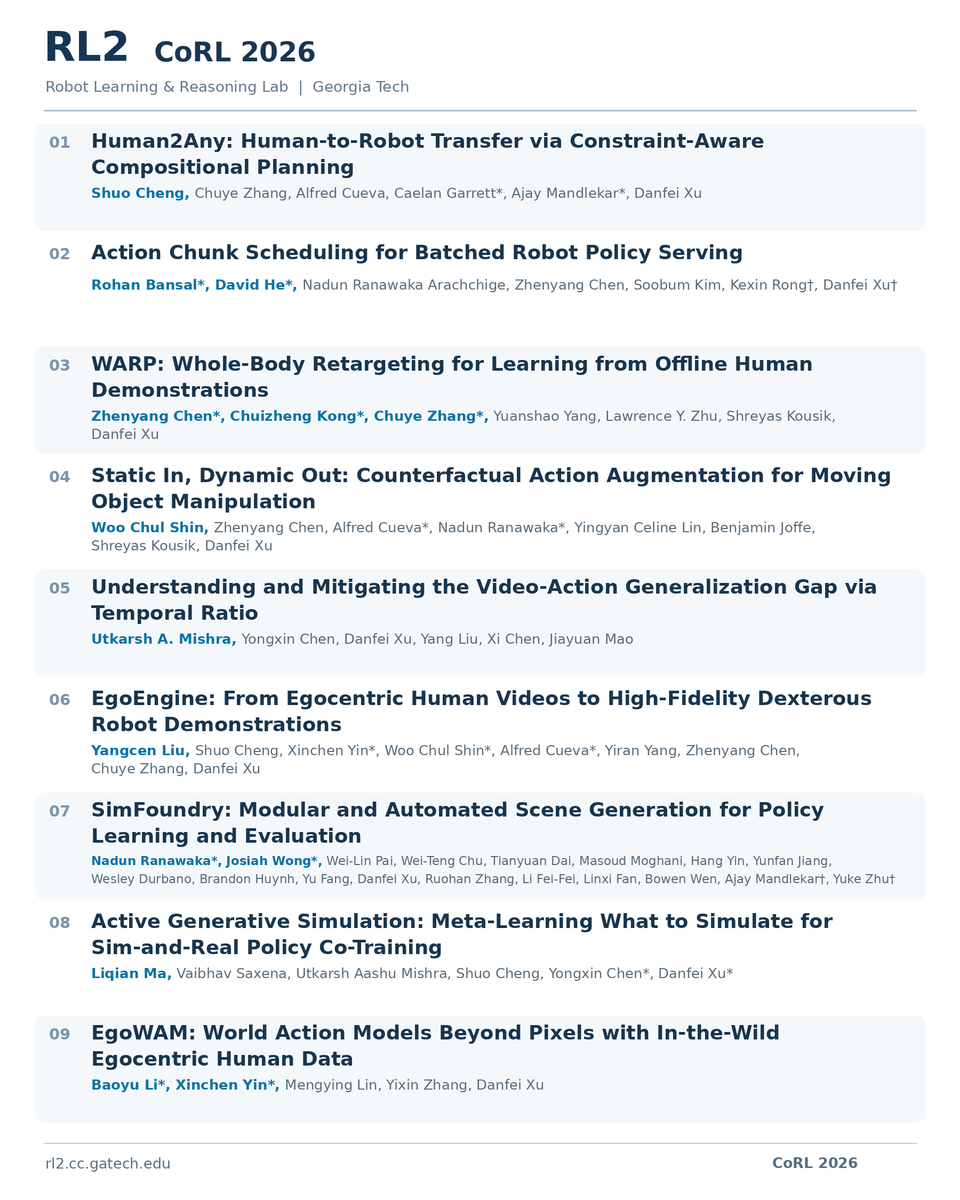
Our group RL2 is presenting 9 papers at the main conference and many more at workshop. Come chat with the authors!! #CoRL2026
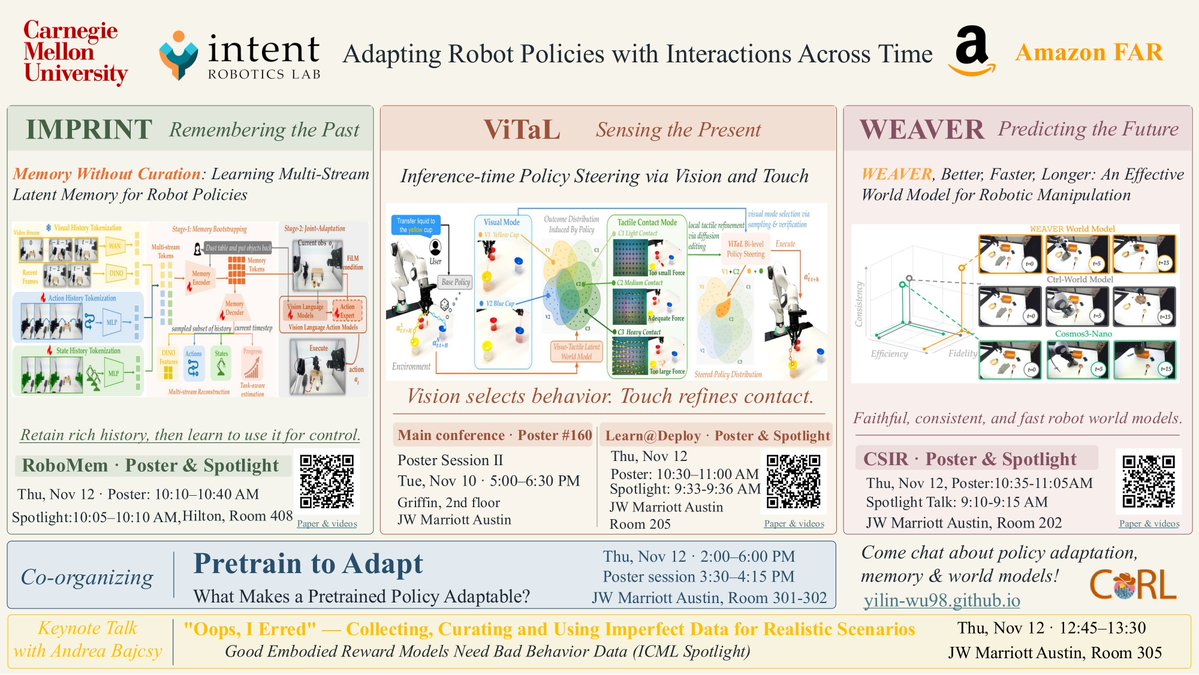
6/6 I’m co-hosting our Pretrain to Adapt workshop: What Makes a Pretrained Policy Adaptable?
🗓️ Thu, Nov 12, 2–6 PM
🖼️ Posters: 3:30–4:15 PM
📍 JW Marriott Austin, Rooms 301–302
🌐 https://t.co/nkfLrLt5BO
💬 What should we ask our panelists? Reply with your questions!(https://t.co/CqK0JfJVk7)
Join our slack: https://t.co/fPMQV5yxlF
5/6 🎤 Joint Keynote Talk with Andrea Bajcsy
“Good Embodied Reward Models Need Bad Behavior Data” (ICML Spotlight)
At the “Oops, I Erred” workshop
🗓️ Thu, Nov 12, 12:45–1:30 PM
📍 JW Marriott Austin, Room 305
🌐 https://t.co/ch9gDo7Ocf
3/6 WEAVER: Predicting the future
Robot world models with fidelity, consistency & efficiency.
CSIR workshop · Thu, Nov 12
🎤 Spotlight: 9:10–9:15 AM
🖼️ Poster: 10:35–11:05 AM
📍 JW Marriott Austin, Room 202
🌐 https://t.co/mHKAI72TaM
2/6 🧠 IMPRINT: Remembering the past
Compact memory of vision, actions & robot states.
RoboMem workshop · Thu, Nov 12
🎤 Spotlight: 10:05–10:10 AM
🖼️ Poster: 10:00–10:40 AM
📍 Hilton Austin, Room 408
🌐 https://t.co/wjbrkGbw0J
I’m in Austin for @corl_conf to present three of my recent works, each with a workshop spotlight! 🤖
🧠 IMPRINT: RoboMem workshop
🤝 ViTaL: main conference + Learn@Deploy workshop
🔮 WEAVER: CSIR workshop
I’m also giving a joint keynote with @andrea_bajcsy at the Oopsie Data workshop and co-hosting Pretrain to Adapt workshop!
💬 We welcome your questions for our panel! Submit them on our workshop website:
🌐 https://t.co/nkfLrLsxMg
Happy to catch up with old friends and make new ones if you are interested in those directions #CoRL2026
Our newest model, π0.7, has some interesting emergent capabilities: it can control a new robot to fold shirts for which we had no shirt folding data, figure out how to use an appliance with language-based coaching, and perform a wide range of dexterous tasks all in one model!
A bend in the road is not the end of the road. Neither is a phase change the end of matter, nor is radiation all entropy. Optimizing transport phenomena will help us all to do more with the energy we have.
Google published a paper that might end the PhD.
It’s called “ScientistTwo”
For centuries, the bottleneck to human knowledge has been the human brain.
It takes five years of grueling labor to read the literature, find a gap, formulate a hypothesis, run the experiments, and write the paper.
But, Google automated the entire pipeline.
They built an AI that reads a problem, forms hypotheses, runs experiments, writes the paper, AND simulates its own peer review. no human touches it.
It reads millions of papers to find blind spots in the current science.
It generates novel hypotheses.
It designs the experiments. It writes the code to test them.
When the code fails, it debugs itself.
When the results come in, it analyzes the data, generates the charts, and writes the final academic paper.
It even simulates a brutal peer-review process to critique and improve its own work before it considers the project finished.
This isn't an LLM summarizing a PDF. This is a fully autonomous digital scientist.
What takes a human candidate half a decade of massive intellectual effort... the AI accomplishes in a fraction of the time, at a fraction of the cost.
The implications are staggering.
If you can spin up 10,000 autonomous researchers overnight, the rate of scientific discovery is about to go vertical. We are moving from artisanal, human-speed research to industrialized knowledge creation.
But it raises an uncomfortable reality for academia.
When an AI can read the literature, design the experiment, execute the code, and write the paper...
What exactly is the human supposed to do?
This is f*cking insane. Anthropic Research Lead:
"Prompting is basically over
99% of our engineers already run swarms of 300+ self-improving agents. Now everyone is moving to graphs"
In just 20 minutes, she shows how graph engineering turns isolated agents into a system that improves itself
One Agent → Loops → Plan Mode → Graphs → Self-Improving System
Prompting was the old workflow. The graph around the model is the new one
Worth more than most $1,000 agent engineering courses
Bookmark and watch it today
Then read the "Harness, Loops, Graphs" guide below - graphs are the last layer ↓
"I thought the alignment problem would turn out to be harder."
Pretty wild thing for Sam Altman to say in light of Hugging Face and findings that Astra would totally hack and social engineer when accidentally given access to a (secretly simulated internet) from UK AISI.
He caveats by saying it will probably get harder, but his answer suggests they have figured out how to align today's models, when that's clearly not true. Curious how many OpenAI researchers have seen this and what they think.