Perhaps one of the most meaningful realizations during my medical training is to show love for each other because we may not realize it but we are all more similar than we are different. Thank you @SchulichMedDent for giving me the privilege to serve my community as a doctor!
This week I had a chance to go to a supervised consumption site in London, ON while on my Addictions Medicine rotation. I learned so much from the harm reduction workers and staff there. Meeting patients where they are is essential when providing care for this community. 🤍
We need to do better in caring for those who use substances in hospital. I've seen so many instances of a patients' Methadone, Kadian, and HM, being cancelled by physicians upon admission for no reason. Putting patients into withdrawal for no reason is NOT acceptable.
Politicians interfering in this way is very problematic.
It is in the best interest of Canadians for physicians to continue to self-regulate.
And for those who don’t know, the @cpso_ca has already weighed in on safer opioid supply. https://t.co/6j0Lro0ZYh
This week I had a chance to go to a supervised consumption site in London, ON while on my Addictions Medicine rotation. I learned so much from the harm reduction workers and staff there. Meeting patients where they are is essential when providing care for this community. 🤍
2. It's important that we advocate for ensuring sure that within these supervised consumption sites we also have access to primary care prescribers and specialists who meet patients where they are.
When medical learners feel the need to stay silent, and fear repercussions when speaking out, while thousands of people are dead and are dying without access to medical care. That's a sign that oppression runs deeply in our institution.
A reminder that medicine will always be political because healthcare is not equally distributed or afforded to everyone—both in your own community and globally.
We know that household income as well as the average income of where you grow up plays a huge role in admission (https://t.co/WVpQOPEvES). So we need to find ways to give communities with lower average household income (HI) and those with lower personal HI an advantage.
Those from underrepresented communities are more likely to be connected to their community in ways that are often not appreciated in medical school applications. They are also more likely to score lower on standardized testing due to the inaccessibility of resources.
So when medical schools only use standardized measures to assess applications to medical school. Unfortunately part of the truth is that those who benefit are private tutoring companies and those who have the privilege of taking standardized tests ($$$) multiple times.
You do not need to be sexually active to benefit from vaginal estrogen. That would be like saying your mouth only needs to be comfortable and cared for if you are an active French kisser. It's your body. It doesn't matter two hoots if anyone is touching it.
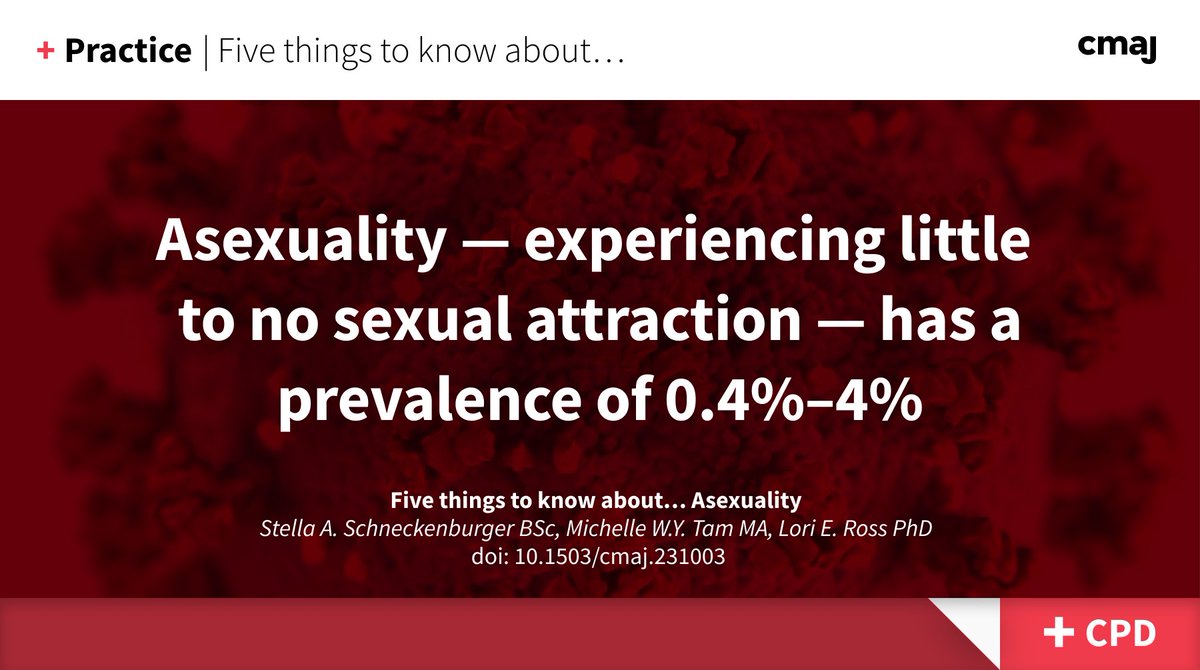
Asexuality:
Asexual people often face barriers to accessing affirming health care because of misunderstandings and pathologization.
➡️ https://t.co/4dXHXk0h1N
(earn CPD credits)
@LGBTQ_Research#QueerHealthcare
This is the same culture that allows all forms of oppression to continue! It is the reason why patients from marginalized communities face worse health outcomes!
As a medical trainee, today more than ever I am reflecting on how systems of power (i.e. academic institutions) and people in power (i.e. faculty members) drive complacency. It is the reason why it is hard to speak up as a learner because there is a fear of future implications.