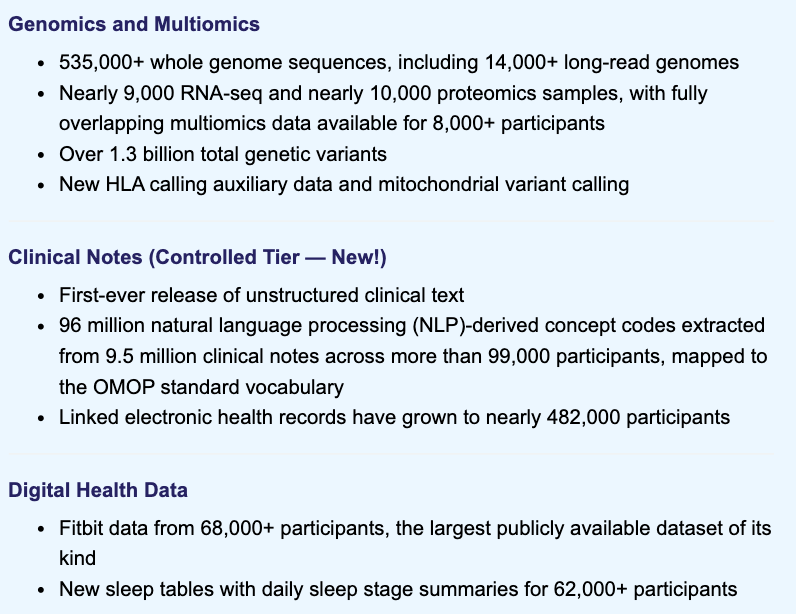
NIH @AllofUsResearch has just released a massive multi-omics dataset, including:
• 535K WGS (120K+ added; now larger than UKB)
• ~10K proteomics + RNAseq + long-read
• ML-curated clinical notes
• 68K with Fitbit data
Kudos to this great initiative and to the participants for advancing science
https://t.co/Z7MnU7432S
Today in @Nature we report a new prime editing strategy that can rescue a common cause of many genetic diseases in a disease-agnostic manner. This approach converts a redundant endogenous tRNA into an optimized suppressor tRNA, enabling a single prime edit to rescue premature stop codons across different diseases.
(1/15)
https://t.co/zs0qu5bhXx
New science awaits! ✨ We are excited to introduce you to our brand-new 2025 EMBL Annual Poster ➡️ https://t.co/THBTu2EzUo
In 2025, you can look forward to novel meetings such as the EMBO | EMBO Symposium 'Mechanisms of drug resistance and tolerance in bacteria, fungi, and cancer', as well as tried and true classics like #EMBLCanGen 🙌
#molecularbiology #lifesciencetraining #lifesciences
Excited to share our lab's latest preprint, led by @CXchengxiangQIU, @bethkarenmartin & Ian Welsh of @jacksonlab.
We set out to build a single cell roadmap for all of mouse prenatal development, from single cell zygote to free-living pup.
Preprint: https://t.co/GDS65Qf58X 1/n
Spatial-omics goes 3D🤗! Out at Cell @CellCellPress 👉🏼 We developed DISCO-MS with @labs_mann, a spatial proteomics technology for specimens fully imaged in 3D. DISCO-MS is aided by robotics and enables the study of diseases at their early stages. https://t.co/MyvXnnBDgL🧵👇
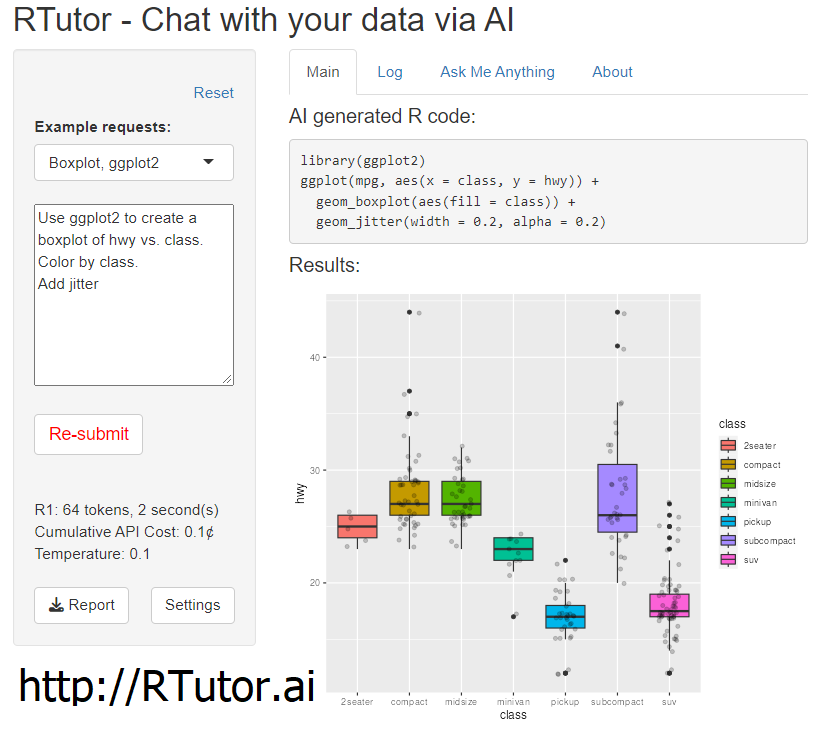
Happy holidays! Introducing https://t.co/Ub3wgs1KVz, an AI-powered app that lets you chat with your data in English! RTutor uses Davinci (#ChatGPT’s sibling) to turn requests into R code, which is executed & results are shown instantly, available as a HTML report in seconds. 1/8