🎁 FREE: Notion page with 50+ tools listing database and 10+ ready-to-run OMICS workflows.
Learn bioinformatics and understand—or even run—your own analyses. 1-liner commands + gotchas inside.
(Link in first reply) • Follow @DryLabDrop @dldbioscience for weekly micro-drops.
🚀 Got data. Need a plan?
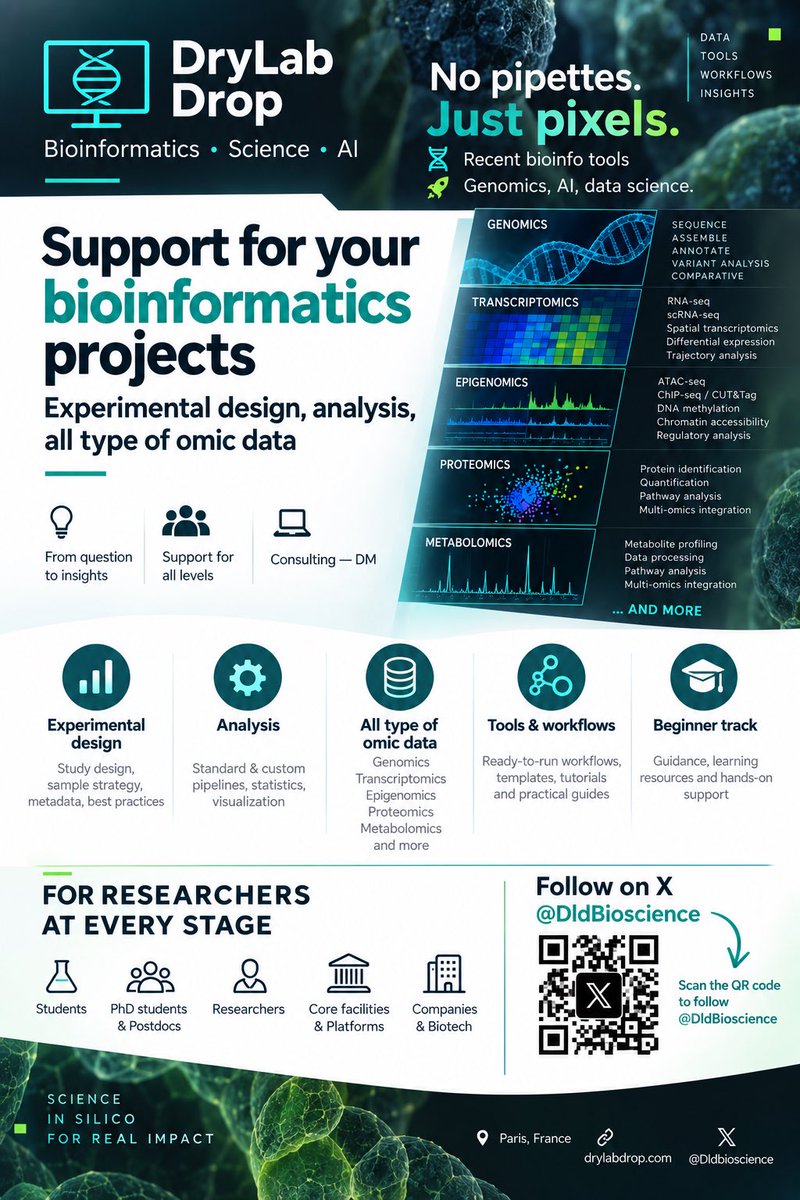
DryLab Drop provides bioinformatics support from experimental design to analysis and insights — across omics, tools and workflows.
For students, researchers, platforms & biotech.
🧬 No pipettes. Just pixels.
📩 DM us
#Bioinformatics#Omics#Science
🧵 If you’re doing bioinformatics by hand, you’re burning time you’ll never get back.
1/
Every biologist has done this:
Copying a file name, pasting it into the terminal, running one command.
Then doing it again. And again.
Hours gone. Nothing scalable.
De novo detection of Somatic Mutations in scRNAseq & scATACseq data
SComatic
https://t.co/Pmo7NLzKRL
Tracing human Clonal Heterogeneity (& even Lineage!🤓)
@isidrolauscher@NatureBiotech 2024
https://t.co/zLV3PwAMmE
DryLab Drop take:
Foundation models are moving beyond text and single-cell expression.
The next frontier is multimodal genome biology:
sequence × chromatin × epigenomics × spatial organization.
The genome is not linear.
Our models should not be either.
6/6
The 3D genome just got its foundation model moment.
HiCFoundation, published in Nature Methods, proposes a generalizable AI model trained on massive Hi-C data to analyze chromatin architecture across species. 🧬⚡ 1/6
https://t.co/ci5sTwYDiH
For plant genomics, this direction is especially exciting.
Most 3D genome tools are still benchmarked mainly on animal systems.
A more generalizable framework could help compare chromatin architecture across species, tissues and developmental contexts.
5/6
@razoralign Very interesting direction. The key shift is not just “AI for omics”, but registry-grounded execution: agents using verified tools, valid data objects, controlled workflows and provenance.
That’s what can make AI-assisted analysis reproducible rather than just impressive.
🌱 504k public plant RNA-seq samples × 1,200+ species → live interactive
UMAP atlas.
Click any organ (256 PO terms) or evo-devo trait (57 of them) → top
gene families upregulated pop up on the right.
https://t.co/6gYY7j9v1w