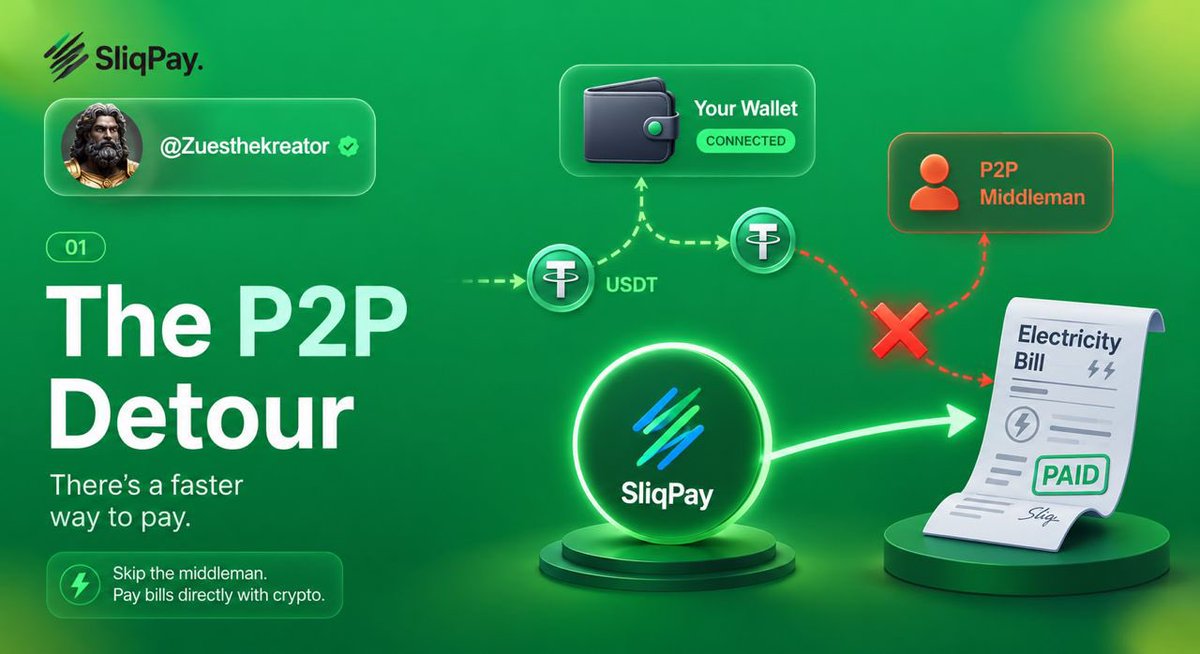
You have crypto sitting in your wallet.
Your light bill is due. You don’t have naira on you.
So you message a P2P vendor.
Wait for them to come online. Negotiate a rate.
Wait again while they confirm the transfer. Hope they don’t ghost you mid-transaction.
minutes later, you finally pay a bill that should have taken twenty seconds.
@SliqPay was built to delete that detour. 🧵
You have crypto sitting in your wallet.
Your light bill is due. You don’t have naira on you.
So you message a P2P vendor.
Wait for them to come online. Negotiate a rate.
Wait again while they confirm the transfer. Hope they don’t ghost you mid-transaction.
minutes later, you finally pay a bill that should have taken twenty seconds.
@SliqPay was built to delete that detour. 🧵
You have crypto sitting in your wallet.
Your light bill is due. You don’t have naira on you.
So you message a P2P vendor.
Wait for them to come online. Negotiate a rate.
Wait again while they confirm the transfer. Hope they don’t ghost you mid-transaction.
minutes later, you finally pay a bill that should have taken twenty seconds.
@SliqPay was built to delete that detour. 🧵
You have crypto sitting in your wallet.
Your light bill is due. You don’t have naira on you.
So you message a P2P vendor.
Wait for them to come online. Negotiate a rate.
Wait again while they confirm the transfer. Hope they don’t ghost you mid-transaction.
minutes later, you finally pay a bill that should have taken twenty seconds.
@SliqPay was built to delete that detour. 🧵
ICYMI: @nansen_ai is now running a validator on @Injective.
Not indexing data from the sidelines.
Operating inside the network that processed $30 billion in onchain orderbook volume last year.
Alongside the validator, Nansen launched its full analytics suite on Injective.
Chain Dashboard, Token God Mode, Wallet Profiler, all live for the first time on this ecosystem.
Why running a validator actually matters here.
There is a real gap between watching a chain from outside and securing part of it.
Nansen chose the second one. As a validator, it processes transactions and participates in consensus directly, which means it sits as close to the source of onchain activity as data can get.
For a platform built on real-time trading intelligence, that proximity is the entire value proposition.
➤ Chain Dashboard gives a macro view of Injective. Active addresses, transaction volumes, TVL trends, all in real time.
➤ Token God Mode tracks holder analytics on any Injective-native token. Smart Money positioning, concentration risk, accumulation before it shows up in price.
➤ Wallet Profiler breaks down any address with full transaction history and behavioral patterns, backed by Nansen's database of 500M+ labeled wallets
Injective processed over 1.4 billion transactions and $30 billion in onchain orderbook volume in 2025. $6.5 billion of that was real-world asset activity.
Nansen staking INJ and running a validator is not a small integration. It joins a validator set that already includes Google Cloud and Binance.
The volume was already there. Now the visibility is too.
Picture the next trader on @injective. No face. No sleep schedule. No emotions to manage.
Just code that opens a position, watches it, and closes it without anyone telling it to.
That is not a future state. It is live right now.
➤ Agents trade perpetual futures from plain language, no API key, no integration work.
➤ Agents track their own risk and PnL with no human checking in.
➤ Through x402, one agent can pay another for data or execution the instant it needs it, no account required, settled in USDC
Every action clears on a fully onchain orderbook with sub-second finality.
Here is the part that actually matters.
Every payment system before this assumed a person sets up credentials once and walks away.
An agent running nonstop across thousands of calls breaks that assumption completely.
Keys leak. Quotas get shared. Someone always has to register first.
Injective deleted that requirement. A wallet with a balance is the only thing an agent needs to trade, settle, or pay another agent it has never met.
The next generation of traders will not check the news, sleep, or panic sell.
They will just execute.
CryptoRank just published a case study on @Injective. A few numbers in here actually peaked my interest.
Institutions are not chasing token exposure anymore. They are evaluating blockchains the way they evaluate financial plumbing.
Here is what stood out to me specifically.
➤ Injective ranks 10th among all Layer 1s in trailing 12-month protocol revenue at $3.34M, ahead of NEAR, Sui, and Internet Computer.
➤ It earns that with roughly $10.7M in TVL. One of the smallest TVL figures of any major DEX, while having cleared $33.9B in derivatives volume since January 2025.
➤ 7,106,386 INJ burned since 2021 through the Community BuyBack, worth $36.5M, currently running at close to 567,000 INJ a year and climbing as revenue grows.
➤ Monthly active users sit around 135K, up 40% year over year.
The TVL number is the one most people will misread. Low TVL usually signals low activity.
Here it signals the opposite. Injective's orderbook draws depth from professional market makers and institutions instead of capital sitting idle in AMM pools.
Volume and revenue describe this chain. TVL does not.
The RWA breakdown is the other thing worth sitting with.
➤ $6.8B in cumulative RWA volume
➤ Equities at $4.15B, 61% of the total
➤ FX at $977M, 14%
➤ Commodities at $913M, 13%
➤ Indices at $763M, 11%
That is not a speculative narrative.
That is a chain already running the asset classes institutions actually trade.
The report is also honest about what is not proven yet.
Native USDC has to hold ground against far larger USDC pools on Ethereum and Solana.
The ETF timeline has to land on schedule.
Large RWA migrations like Pineapple Financial's $1.2B in mortgages move from origination to live markets gradually, not overnight.
@CryptoRank_io's closing line is the one I keep coming back to.
The architecture is the hard thing to copy, not the headline numbers.
Several layers of onchain finance running through one shared market is not something a competitor ships in a quarter.
Worth the full read if you want the breakdown on the stablecoin layer, the regulated access layer, and the execution layer separately.
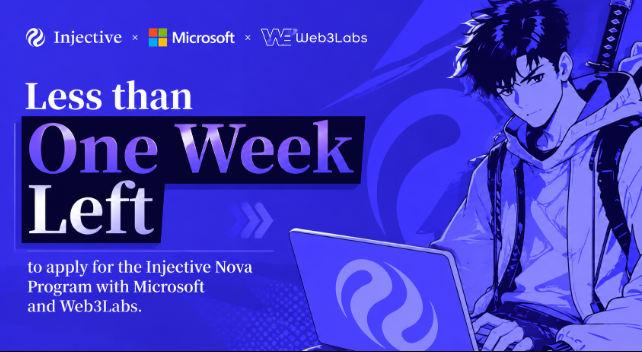
One week left to apply for the @Injective Nova Program with @Microsoft and
@Web3Labs_Club.
A full pipeline from idea to production for the next generation of AI x Web3 builders.
➤ Exclusive visit to Microsoft Beijing HQ for top teams.
➤ Direct access to industry mentors and ecosystem leaders .
➤ Funding, Azure credits, and long-term incubation support.
Here is what backs that up.
➤ $10,000 USDT per winning team for the top 3.
➤ $10,000 grant for up to 10 selected teams.
➤ Up to $1,000,000 in potential investment from the Injective Foundation.
➤ $150,000 in total Azure cloud credits for the top 10 teams.
➤ Fast-track slot to AdventureX 2026, the largest hackathon in China
Three organizations behind every team. Injective brings the onchain execution layer.
Microsoft brings Azure OpenAI and enterprise AI infrastructure.
Web3Labs brings the talent network across Tsinghua, Peking University, Zhejiang, Fudan, and HKU.
One week left.
Register at https://t.co/cVordtpERU.
Injective is really the home for onchain finance.
➤ Pre-IPO perps
➤ Tokenized equities
➤ Prediction markets
➤ Forex
➤ Commodities
➤ Perps
➤ Stablecoins
➤ Treasuries
➤ RWAs
➤ Structured products
➤ LSTs
➤ AI payments
All live. All onchain. All on @Injective.
Here is the Amazing part.
Every market built on Injective’s exchange module taps the same shared liquidity by default.
Perps, RWAs, forex, commodities, structured products, all pulling from one pool instead of fragmented liquidity per asset.
A market maker quoting gold is touching the same liquidity base as someone trading tokenized equities.
That shared liquidity layer is the actual infrastructure decision behind this list.
Not just breadth of products, but the fact that none of them sit isolated from the rest.
Twelve categories. One chain. One liquidity base underneath the ones built on it.
ICYMI: Asia just got its first regulated $INJ fund.
Merkle Capital launched M-INJ, supervised by Thailand’s SEC.
Retail and institutional investors can now hold $INJ through a regulated structure with no token custody and no exchange account required.
This adds to a regulated footprint $INJ has been building all year.
➤ April 2026: CFTC-regulated INJ futures go live on Bitnomial. INJ joins Bitcoin, Ethereum, Solana, and XRP in that small group.
➤ 21Shares and Canary Capital both filed for US INJ ETFs, with Canary’s staked product advancing through Cboe.
➤ The Injective Policy Institute opened in Washington, working directly with regulators on the rules for onchain finance.
➤ Now M-INJ brings regulated access to Asia.
Why M-INJ matters specifically.
Until now, INJ exposure in Thailand meant self-custody.
Institutions cannot touch spot crypto under most compliance mandates. Retail investors carry the full burden of wallet security.
M-INJ removes both barriers. A third-party custodian, Thai SEC supervision, and a single regulated venue open to everyone.
Merkle Capital runs more than a dozen strategies. Outside Bitcoin, it rarely builds a fund around a single asset. M-INJ is the first one built for INJ specifically.
Here is the part that makes this more than just access.
$INJ supply moves the opposite direction from most tokens. The INJ 3.0 mechanism burns $INJ bought with protocol revenue, tightening the float as usage grows.
A regulated fund with no fixed maturity, accumulating against a shrinking supply, is not a small detail. It is the core of the thesis.
$INJ now sits inside regulated markets that can hold, list, trade, and stake it. In the United States. In Asia.
Most digital assets are still outside that world. INJ is inside it on two continents.
Native $INJ is coming to Coinbase. July 20 to 22, 2026.
This is something significant.
Coinbase, is migrating from ERC-20 $INJ on Ethereum to native $INJ on the @Injective EVM.
Every $INJ on Coinbase converts automatically at 1:1 with zero transaction fees.
➤ Native INJ deposits and withdrawals go live on the Injective EVM.
➤ Coinbase drops ERC-20 INJ support entirely after the migration.
➤ The largest US crypto exchange becomes a direct liquidity rail into Injective’s network.
Why this matters.
Injective’s MultiVM is what made this possible.
The same chain runs both Wasm and EVM execution environments natively.
Coinbase does not need a bridge. It does not need a wrapped token. It connects directly to Injective.
That is not how most chains work.
Most chains borrowing EVM compatibility are running a separate layer on top. Injective’s EVM is the chain itself.
For INJ holders on Coinbase nothing changes automatically except where the token lives.
One action if you want to opt out: move to a self-custody wallet before July 20.
For everyone else, the largest regulated US exchange just became a native on-ramp to Injective.
The infrastructure keeps compounding. 🥷
Khalid and Ahn Hyo-seop just dropped “Something Special.”
Then tokenized it on @Injective.
🔶20.7B global streams across Khalid’s catalog.
🔶Ahn Hyo-seop voiced Jinu in K-Pop Demon Hunters, Netflix’s most watched film of all time.
14.5B streams. One Grammy. Two Oscars. Two Golden Globes.
This is not a small song. And for the first time, fans can own a real piece of it.
Here is what that actually means:
➤ Own a share, own a contractual right to a pro rata portion of every royalty the song generates.
➤ Streams, syncs, mechanical royalties, performance royalties. As the song earns, distributions follow.
➤ Ownership and transfer history live onchain. Auditable by anyone, anywhere.
Why this is bigger than one song:
➤ Injective has cleared $6.7B in cumulative real world asset volume. Equities, FX, commodities, Pre-IPO.
➤ Music royalties just joined that same stack.
➤ KYC, AML, sanctions screening built at the protocol level. Every transfer inherits those rails automatically.
➤ Cross-chain reach into 130+ networks through Wormhole. One issuance, accessible from everywhere
FANDOM has a full slate running through 2029.
Roc Nation handles distribution. Musicow powers the ownership infrastructure.
“Something Special” is the first. This is only the beginning.
Music is moving from listening to ownership. It starts on @Injective.
Every perpetual market on @Injective now runs on @USDC.
Not wrapped. Not bridged. Native USDC issued directly by Circle.
This is not a minor update. Here is what actually changed.
➤ Every perpetual across every Injective dApp is now denominated in the world’s largest regulated stablecoin.
➤ One canonical stablecoin across the entire ecosystem. No fragmented margin. No competing stable pairs.
➤ Traders post margin, settle PnL, and manage positions all in the same asset institutions already trust
The timing is deliberate.
One stablecoin. Every market. The infrastructure institutions actually need.
Only on Injective. 🥷
I found something interesting in @Injective’s research.
They published a paper on iAssets.
Programmable real world assets that do something tokenization never could.
Here is the problem with how finance works today.
➤ T+1 and T+2 settlement cycles lock capital for 24 to 48 hours before it clears.
➤ The NYSE operates 9:30 AM to 4 PM EST. Miss that window, miss the market.
➤ The $500 trillion global derivatives market runs on ISDA agreements that only the largest institutions can access.
➤ Early DeFi tried to fix this and failed. 150%+ collateralization requirements just recreated the same inefficiency with different constraints.
iAssets are built differently.
No pre-funded collateral. No capital lockups. No overcollateralization.
A real world asset gets an oracle price feed, a permissionless market created on Injective’s onchain orderbook, and shared network liquidity from day one.
Take iAAPL as an example. An onchain Apple stock that trades 24/7 globally.
Used as collateral for leveraged trades while still earning yield.
Integrated into automated hedging strategies without manual intervention.
Every rehypothecation move fully transparent and auditable onchain.
That last point matters.
The 2008 Lehman collapse happened because nobody could see how many times the same collateral had been pledged.
iAssets make that impossible to hide.
➤ Cross-application trading with no liquidity migration required.
➤ Immediate settlement with no clearinghouse dependency.
➤ Open market access with no accreditation barriers.
➤ Global trading with no exchange hours.
TradFi locked capital inside institutions.
Early DeFi locked it inside smart contracts. iAssets put it to work.
Injective is not tokenizing assets. It is rebuilding what an asset can do.
ICYMI: @Injective launched the Nova Program with @Microsoft and Web3Labs.
A full pipeline from campus to production for the next generation of AI x Web3 builders.
Here is what is on the table:
➤ $10,000 USDT per winning team (top 3).
➤ $10,000 grant for up to 10 selected teams.
➤ Up to $1,000,000 in potential investment from the Injective Foundation.
➤ $150,000 in total Azure cloud credits for the top 10 teams.
➤ Fast-track slot to AdventureX 2026, the largest hackathon in China.
➤ Direct access to VCs, Injective and Microsoft core teams, and long-term incubation.
What you can build:
➤ Agent Infrastructure. Frameworks, SDKs, multi-agent collaboration systems.
➤ AI Native Gaming. Autonomous NPCs, AI driven game economies, player-AI co-creation.
➤ AI Social. Digital twins, agent-to-agent relationships, AI driven networks.
➤ AI Payments. Agent wallets, automated settlements, AI driven commerce.
➤ Agent x Physical World. AI plus IoT, agents controlling real world devices, onchain data collection.
➤ Open AI Applications. AI native dApps, chat-to-X interactions, anything that breaks existing paradigms.
Three organizations backing every team.
Injective brings the onchain execution layer.
Microsoft brings Azure OpenAI, GPU clusters, and $150,000 in cloud credits.
Web3Labs brings the talent pipeline across Tsinghua, Peking University, Zhejiang, Fudan, HKU, and physical incubators in six cities.
The next killer AI application will not come from a corporate R&D lab.
It will come from a small hungry team stubborn enough to build through the late nights.
Register at https://t.co/cVordtpERU.
AI agents can now pay for anything they need, the moment they need it, on @Injective.
No account. No API key. No human setting anything up first.
➤ One cent to gate a market data response.
➤ One model inference. One generated image. One query to a service the agent has never touched before.
➤ Every payment settled in 650ms with an onchain receipt. No shared keys. No quotas. No prior registration.
That is x402.
An open payment standard now live on Injective mainnet, built around an HTTP status code that has existed for decades and done nothing. Code 402.
“Payment Required.” The web always had a slot for this. x402 is finally what fills it.
Here is the flow.
An agent calls an API endpoint. The server replies with a 402 and a price quote.
The agent signs a USDC transfer. A facilitator submits it onchain.
The agent repeats the request with proof of payment.
Data comes back. Quote, pay, deliver, inside a single HTTP conversation.
Traditional billing cannot do this.
API keys and subscriptions assume a human sets credentials up once and reuses them.
An agent running autonomously turns that assumption into a liability. Keys expire.
Quotas get abused. x402 deletes that entire step.
Injective settles in one block. About as fast as a credit card swipe at a fraction of the cost.
That is what makes this practical in production and not just in theory.
An agent with a USDC balance can call any x402 endpoint the first time it ever sees it.
That is a new primitive.
⚡️ @Injective shipped the most complete AI trading infrastructure on any blockchain.
One sentence is now all it takes to open a leveraged perpetual futures position on Injective.
The MCP server reads the oracle price, calculates size and margin, signs the order, and broadcasts.
You get back the transaction hash and your open position details. That is it.
Here is everything now live:
➤ 22 tools across six categories covering market data, position management, limit orders, transfers, and cross-chain bridging.
➤ 262 tests. AES-256-GCM encryption. Private keys never leave your machine.
➤ Compatible with Claude Desktop, Cursor, LangChain, CrewAI and any MCP-compatible client.
➤ Seven composable trading skills spanning portfolio analysis, autonomous signing, bridging, staking, and live market data.
And trading is only half of it.
dAppBuilder lets you describe a product in plain language and it writes the smart contracts, the interface, and the backend, then deploys everything onchain.
No coding required. Spot DEXs, lending markets, prediction markets, RWA protocols.
It routes each part of the build across ChatGPT, Claude, Gemini, and DeepSeek, whichever handles it best.
Then there is the Agents platform.
One command registers an autonomous agent with an onchain identity through the ERC-8004 standard.
Trade from a conversation. Build from a conversation. Deploy agents that earn without you in the loop.
Injective did not add AI features. It built the full stack.