NEW RESEARCH: The Neuroscience of Creative Flow in Jazz Improvisation: An EEG Study 🧠 🎵 🗣️
Delve into the secrets of creative flow in jazz improvisation and how experience affects these altered states of consciousness.
Read the full paper here: https://t.co/mL8ShTMlr0
Me:
I try to look at data and trends rather than headlines, because headlines can give you a misleading picture of the state of the world. Something goes wrong every day — that’s guaranteed — and if you just look at something goes wrong and say, oh, things are getting worse, you might be forgetting all the things that went wrong in the past.
Andrew Marr:
And what we call the news is a long litany of all the things that are getting worse or going wrong.
Me:
Well, yes, it’s much easier for something bad to happen suddenly than for something good to happen. Good things either creep up on you a few percentage points a year, and sometimes can compound.
So the fact that, for example, extreme poverty in the world has been declining and a billion people have escaped extreme poverty over the last 30 years — but not on Thursday — so it was never an event from the news. One of the biggest events in human history is something that most people have never even heard of.
@AndrewMarr9@LBC
🌀 New paper out from @JHPsychedelics led by @CeydaSayali.
Psychedelics loosen cognitive control acutely and selectively increase cognitive flexibility afterwards.
Flexibility is the ability to shift perspectives, update beliefs, and break rigid patterns.
DM for PDF.
In our new review, we synthesize behavioral and neuroimaging evidence showing that psychedelics induce a time- and domain-specific modulation of executive function. Acutely, psychedelics disrupt executive functions alongside destabilized brain network dynamics. Post-acutely, they selectively enhance cognitive flexibility with increased activation and connectivity in executive brain networks. While promising, evidence remains limited and future studies must clarify which cognitive effects drive clinical outcomes.
There is actually something cognitively beneficial to microdosing classic psychedelics (beyond placebo) that the scientific method just hasn’t yet been able to detect.
People on psychedelics during a mass-trauma event (Nova rave) reported that psychedelic effects suddenly went away completely and they felt clear and calm. After they reached safety, these survivors described resurgance of vivid hallucinations! The researchers are calling it 'Adaptive dissociation'.
An interesting twist on our observation that psychedelic effects are highly context-dependent. When you focus on a task, effects decreased markedly, with stronger effects returning when attention relaxes.
👉 Read about the link: https://t.co/GXZ0sb3TSR
🚨ATTN: Society for Neuroscience attendees @SfNtweets 🚨
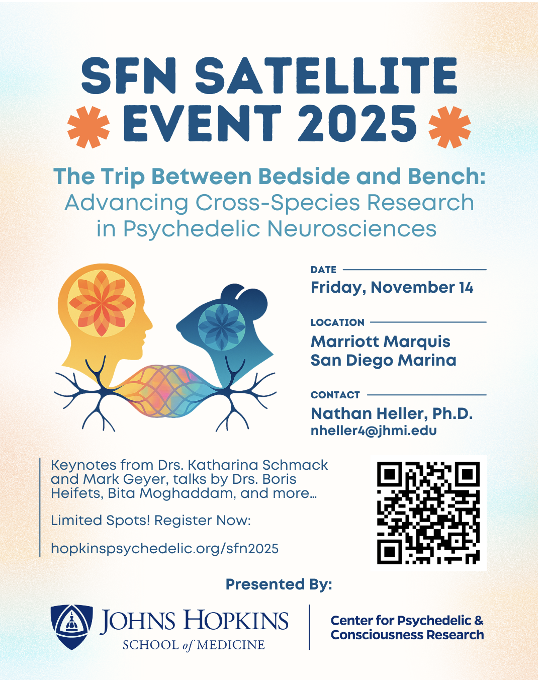
We are hosting a pre-SfN event: "The Trip between Bedside and Bench: Advancing Cross-Species Translation in Psychedelic Neuroscience"
Registration is limited - reserve your spot ASAP! Share with anyone who might be interested! https://t.co/I9qi7b34cc
Check out the latest primer in NPP-Digital Psychiatry and Neuroscience (@dpn_journal), where Dr. Albert Garcia-Romeu explores key debates and unresolved questions in the rapidly evolving field of psychedelic therapy and research.
https://t.co/GTXNGksSEB
Looking forward to this excellent pre-#SfN25 event from @JHPsychedelics 👇 A rare chance to dive into cross-species translation in psychedelic neuroscience with leading voices in the field. 🍄 Seats are limited—don’t miss it!
🚨ATTN: @SfNtweets attendees🚨
@JHPsychedelics is hosting a pre-SfN event: "The Trip between Bedside and Bench: Advancing Cross-Species Translation in Psychedelic Neuroscience"🍄
Registration is limited - reserve your spot ASAP! https://t.co/S9vmy5e1p0
RTs appreciated! Info👇
Associate Director, Dr. Albert Garcia-Romeu shared his insights on psychedelic therapies for psychiatric disorders. He explains the science, shifting public perception, and potential for future FDA approval for these therapies.
Are you an early-career cognitive neuroscientist, looking to contribute to a new line of research?
The Frontlab at Paris Brain Institute is seeking a postdoctoral researcher to work on a state-of-the-art creativity neuroscience project -
https://t.co/kYFiMM5frb
🎸 Mike Gordon’s XenboX is one of the most exciting neuro/music collaborations I’ve seen.
A real-time system to detect and enhance flow in musicians?
Yes, please. As a musician, neuroscientist & lifelong Phish fan, I had to weigh in.
🔗 https://t.co/5SjZA5X2hr
#phish#flow
XenboX is bold and inspiring.
But understanding and scaling tools for creative flow will require more science—across domains, in the wild, and with personalized models of set and setting.
This deeper inquiry is similar to questions we are pursuing in psychedelic science.