WHAT LULA’S RE-ELECTION TELLS US: The Class War Need Not End in Fascism
On Sunday, Brazilians did something that the commentariat had told us was a lost cause. On the eve of his eighty-first birthday, Luiz Inácio Lula da Silva, a former metalworker, turned the Trumpist, evangelical, neofascist, Zionist tide in Latin America to get re-elected President of Brazil.
Three weeks earlier, he had come second in the first round, behind Flávio Bolsonaro, son and political heir of the man who trumpeted the merits of fascism, who had embraced Trump as his lord and master, who plotted a cynical coup against Brazilian democracy – moreover, the main candidates that were eliminated were rightists whose voters were meant to move to Bolsonaro. Yesterday, Lula overturned this deficit and won with a margin of nearly four and a half million votes.
I want to use Lula’s victory to tell a broader story. A story about a war, the class war that the few are waging against the many across the Western world. And a story about how that war need not end, as so many now fear, in a neofascist revival.
THE HIDDEN CLASS WAR
“There’s class warfare, all right,” Warren Buffett once said, “but it’s my class, the rich class, that’s making war, and we’re winning.” Mr Buffett was not exaggerating. For almost four decades, Western governments and central banks have pulled every policy lever in the same direction: to make the assets of the few burgeon at the expense of the incomes of the many.
Consider the numbers. Between 1952 and 1988, economic growth explained nearly all the gains of the West’s stock market. From 1989 onwards, growth explains only about a quarter. The largest share, around 40 per cent, came from income diverted from workers to shareholders. Another third came from cheaper money and lower perceived risk. That is not wealth creation. It is wealth extraction: a transfer from those who work to those who own, inflated by cheap money and paraded on the evening news as “a strong economy”.
Then look at the rescues. 2001, 2008, 2020, the British gilt crisis of 2022, Silicon Valley Bank in 2023: each time, the state rushed in to save the asset holders. Together they reveal the rule: to save the economy, you must save the wealth of those who own it – not those who produce stuff, not even productive companies. In the United States, the top tenth own almost 90 per cent of all shares. The Fed and the US federal government insure it for them, doing ‘whatever it takes’ to prop them up whenever their prices tank. The rest of us in the West pay the premium, in the form of the austerity that always follows the bailout.
And the owners need never sell. Why do billionaires pay so little tax? Because they do not earn incomes - they accumulate capital gains, taxed only when sold. So they borrow against their soaring assets at 1 or 2 per cent and live on the loan. Then they die and pay no tax on their capital gains, passing on the loot to their kids at ridiculously low inheritance taxes. Meanwhile, to pay bills and put food on the table, the worker borrows on a credit card at 20 per cent, her debts the mirror image of their fortunes.
Then, a large chunk of these accumulating assets seek even higher rents in places like Brazil where the US government intervenes to ensure that the local governments will also place the defence of these assets’ values above all else.
CAPITAL IS NOT A THING, NOT MERELY AN ASSET
Why does austerity keep returning, even though it is economically self-defeating? Marx tells the story of Thomas Peel, who in 1829 sailed to Western Australia’s Swan River with £50,000 of provisions and three hundred working-class men, women and children. On arrival, his workers walked off into the bush and worked for themselves. Peel had brought money, tools and labour, but he could not bring capitalism along, because his workers had an alternative.
Capital, Marx concluded, is not a thing but a social relation: the power of those who own to get those who don’t own to do things they’d rather did not do. Austerity is not an economic policy. It is a disciplinary device, keeping the many sufficiently insecure and indebted to accept whatever is on offer. The ruling class’s deepest fear is not inflation or debt. It is to end up like Peel: rich, but without the power to compel.
IS FASCISM INEVITABLE?
Here is the part of the story that keeps so many of us awake at night. When centre-left politicians, from Bill Clinton, Barack Obama and Tony Blair to Gerhard Schröder, Francois Hollande and Andy Burnham abandoned the language of class, a void opened up in the working-class heartlands of the West. Into that void stepped a venomous storyteller with a century of experience in filling such voids: the recalcitrant far right, the rebranded fascists. They offer left-behind workers a story of dignity, then redirect their fury away from the owner who shipped their factory abroad or sold their council house to some fund and towards the migrant next door. It does not end the class war. It merely divides one side – the workers – to rule over them. It camouflages it.
From the red suburbs of Paris to south Piraeus, from England’s red wall to Italy’s rust belt in Taranto, from the American rust belt to eastern Germany, the pattern seems relentless. And so, a fatalism has set in: the class war waged from above, we are told, must inevitably end in a neofascist, racist, misogynist revival.
Brazil has just refuted this fatalism. Brazil knows the monster intimately. It lived through four years of Jair Bolsonaro, with his nostalgia for the military dictatorship. On 8 January 2023, his followers stormed the Congress, the Supreme Court and the presidential palace. Brazil’s far right is not a fringe. Unlike Trump’s rag tag storm troopers, they had years of running a dictatorship. It won the first round of this election. They had the White House fully behind them, while the US Democrats, once again demonstrating their irrelevance, stayed mute. And yet, yesterday, they were defeated.
How? Not by hand-wringing about “populism”, nor by a centrist promise to manage the status quo more efficiently. Lula won because he did what the Western centre-left forgot how to do: he spoke the language of class, and backed it with policies that shifted power, however modestly, from the few to the many. His government exempted those earning up to five thousand reals a month from income tax and paid for it with a minimum tax on the very richest. During Brazil’s G20 presidency, it proposed a global minimum tax on billionaires. When Lula tells Brazilian workers that the elites have rigged the game, he points his finger upwards, at the rentier and the speculator, not sideways, at the migrant or the poor.
PIX – AN EXAMPLE OF AN ANTI-OLIGARCHY DIGITAL TOOL
But the most innovative weapon in Brazil’s arsenal is one that few outside Latin America have heard of. It is called Pix.
Every time you tap a card to pay for a coffee, a toll is levied. Visa, Mastercard and the banks take a cut, often 2 or 3 per cent, from every transaction. Multiply this by billions of purchases a day and you grasp one of the most lucrative rent-extraction machines ever devised. These are not profits made in competitive markets but rent extracted by those who own the digital rails on which our economic lives now run. It is part of what I call technofeudalism.
Unlike Britain, Europe or, of course, America, Brazil’s central bank moved to limit this rabid exploitation. It launched an alternative: a public, instant payment system, free for individuals and with capped fees for merchants. A Brazilian pays a street vendor in Salvador or sends money to her mother in Recife, instantly, using Pix from her phone, with no card company or bank taking its slice. Brazilians took to it with astonishing enthusiasm. Last year, Pix processed almost 80 billion transactions and overtook credit cards as the most popular way to pay online.
Pix is, in effect, the Swan River of the digital age. It gave tens of millions of Brazilians, including the poorest, who had never had a bank card, an alternative to the toll booths of Big Finance. And, like Peel, the toll collectors did not take it lying down. This summer, Washington imposed 25 per cent tariffs on most Brazilian exports, and its trade representative explicitly named Pix as a grievance, complaining that it “unfairly disadvantaged” American payment companies! The most powerful government on Earth deployed its trade arsenal against a free public service for being too successful at denying rents to Visa and Mastercard.
Lula did not blink. He defended Pix as a Brazilian public good, and Brazilians rewarded him for it. Here, at last, is a concrete example of limiting the power of Big Business, Big Finance and Big Tech: not with slogans, but by building public digital infrastructure that removes the opportunity to extract rent in the first place.
NOT A REVOLUTION, BUT AN AUSPICIOUS PORTENT
Let me not romanticise. Lula is no revolutionary. His margin was narrow. Brazil’s Congress remains in the grip of agribusiness and evangelical blocs. Its central bank still keeps interest rates punishingly high, a weapon of the class war if ever there was one. Lula himself has compromised much too much with these vested interests, and lost support as a result.
But Brazil has shown three things the rest of us must learn. First, the class war waged against the many does not have to end in fascism. Fascism wins only when the left vacates the battlefield of class. Second, a progressive government can win by pointing upwards, at those who extract rent, rather than downwards, at those who suffer. And third, Big Business can be defeated, at least forced to lose some battles, by building public alternatives to its rent-extracting machines.
So, here is the challenge to Britain, to Europe, to the people of the United States.
-Build your own Pix: public payment rails that end the tolls of Visa and Mastercard.
-Tax capital gains, ill-gotten wealth that is, not just income.
-Make every rescue conditional, with the public receiving real, permanent equity in return.
-Create a public investment bank as an alternative to the bond markets. Restore the bargaining power of the workforce. And give working people what Peel’s workers found at Swan River: an alternative, and the freedom to say no.
Buffett was right. There is a class war, and his class has been winning hands down. But yesterday, in Brazil, it lost a battle though not the war. It lost because a working-class president dared to name the war and fight it using weapons fashioned to defend the many.
https://t.co/ns3sxkDpsH
Sırbistanlı öğrencilerin seçim kazandıran programı burada!!! Üç slogan altında toplanan 11 maddelik bir programları var. Temel felsefeyi de şöyle özetlemişler:
Yalnızca iktidardaki kişileri değiştirmek değil, siyasi gücün tekelleşmesine, devlet kurumlarının ve yurttaşların yaşamının iktidarın kontrolüne girmesine imkân veren kuralları değiştirmek.
I. Slogan: "Ya Sırbistan ya mafya"
Hedef: Yolsuzlukla mücadele, hesap verebilirlik ve bağımsız kurumlar
1-Bağımsız yargı: Mahkemeleri ve savcılıkları siyasi baskıdan kurtarmak; yolsuzlukları soruşturacak özel bir savcılık polisi kurmak. Polis teşkilatını organize suç bağlantılarından arındırmak.
2-Haksız kazanılmış servete el koyma: Kamu görevlilerinin mal varlıklarını araştırmak; yolsuzlukla edinilen servetleri geri almak. Görevini kötüye kullanan ve insan haklarını ihlal eden kamu görevlilerini hesap vermeye zorlamak.
3-Şeffaf kamu ihaleleri: Devlet sözleşmelerini ve ihaleleri kamuoyuna açmak; özellikle gizli anlaşmaları ve yüksek maliyetli altyapı projelerini denetlemek.
4-Özgür medya: Kamu yayıncılığını ve medya düzenleme kurumunu siyasi denetimden kurtarmak; ayrımcılık ve nefret söylemiyle mücadele etmek, yayın lisanslarını yeniden düzenlemek.
II. Slogan: "Bilgi güçtür"
Hedef: Liyakat, eğitim ve bilgiye dayalı ekonomi
5-Kamuda liyakat: Siyasi kadrolaşmaya son vermek; kamu kurumlarının ve şirketlerinin yönetimine partiye sadık kişileri değil, uzmanları getirmek.
6-Eğitim reformu: Eğitimi siyasetten arındırmak, eleştirel düşünmeyi ve çağdaş eğitimi geliştirmek; ilk ve ortaöğretimde ücretsiz ders kitabı sağlamak.
7-Bilgiye dayalı üretim: Üniversitelerle üretim dünyasını buluşturmak; araştırmayı, yenilikçiliği, yerli girişimcileri ve çiftçileri desteklemek. Ucuz işgücüne dayalı ekonomik modelden uzaklaşmak.
III. Slogan: "Sırbistan bizimle büyüyor"
Hedef: Çalışma hayatı, ekonomik bağımsızlık ve sosyal haklar
8-İş güvencesi: Belirli süreli iş sözleşmelerinin azami süresini 24 aydan 12 aya indirmek; çalışanların güvencesizliğini azaltmak.
9-Tekellerle mücadele ve gıda güvenliği: İthalat lobisinin piyasa üzerindeki hâkimiyetini kırmak; tarım arazilerini ve su kaynaklarını korumak.
10-Ulaşılabilir konut: Genç aileler, öğretmenler ve sağlık çalışanları için uygun fiyatlı kiralık ve satın alınabilir konutlar sağlamak.
11-Her köye doktor: İlaç fiyatlarını düşürmek, kırsaldaki sağlık merkezlerini yeniden açmak ve ülkenin her bölgesinde temel sağlık hizmetlerine erişimi sağlamak.
Sırbistan'da öğrenciler doğrudan demokrasi yöntemini seçim siyasetine taşıdılar.
Liderlere dayalı, yukarıdan aşağıya bir örgütlenme yerine, herkesin söz alabildiği öğrenci genel kurulları (plenum) oluşturdular. Kararlar tartışılarak, mümkün olduğunca uzlaşmayla alındı.
Bu yöntemi üniversitelerin dışına da taşıdılar. Mahallelerde, kentlerde ve köylerde yurttaş meclisleri (zborovi) kuruldu. İnsanlar kendi sorunlarını tartışmak, çözüm önermek ve birlikte karar almak için toplandı.
250 kişilik milletvekili aday listesini de şöyle oluşturdular:
1- Önce 250 adaylık kontenjanı, öğrenci sayılarına göre altı üniversite kenti arasında paylaştırdılar. Belgrad'ın listeye hâkim olmaması için diğer kentlerin de üst sıralarda temsil edilmesini sağladılar. Ardından her kentin kontenjanını fakülteler arasında dağıttılar.
2- Ülke genelinde 80'den fazla fakültede öğrenci genel kurulları toplandı. Öğrenciler kendileri aday olmadı ama her biri aday önerebildi ve neden o kişiyi önerdiğini açıkladı. İsimler tartışıldı, önce uzlaşma arandı, gerektiğinde oylama yapıldı.
3- Mevcut siyasi kadrolara kapıyı kapattılar. İktidar partilerinin mevcut ve eski üyelerini, iktidar adına görev yapmış siyasetçileri ve bürokratları, muhalefet partilerinin üst düzey yöneticilerini aday göstermediler. Böylece hem iktidardan hem de yerleşik muhalefetten bağımsız bir liste oluşturdular.
4- Fakülteler birbirlerinin adaylarını da denetledi. Önerilen bütün isimler ortak bir listede toplandı ve tüm fakültelerin incelemesine açıldı. İtirazlar öğrenci kurullarında tartışıldı. Adayın elenmesi için kurulların yarısından fazlasının veto etmesi gerekiyordu. Tek bir fakültenin itirazı yeterli değildi.
5- Elenen veya çekilen adayların yerine yedekler getirildi. Böylece profesörlerin, doktorların, bilim insanlarının, işçilerin, sanatçıların ve aktivistlerin yer aldığı 250 kişilik liste ortaya çıktı.
@leandroseverino@ladymarketok Prefiero q el pueblo se equivoque antes de q los fantasmas en el congreso voten con el bolsillo como viene pasando, q se olvidan a quien representan
Una Europa mucho más pobre que la actual, en los años 50, fue capaz de levantar la mayoría de instrumentos del Estado del Bienestar que hoy dice «no poder soportar». Es más, en aquel entonces hasta el 50% de la construcción de nueva obra de vivienda era pública o social.
La operación ideológica de las élites para convencer a la gente que una Europa cinco veces más rica que entonces (en riqueza real, descontando inflación, aumento población etc etc) no puede hacer lo mismo es algo descomunal.
El neoliberalismo no solo ha destrozado nuestras economías, sino que es un cepo mental que impide construir otros imaginarios, aunque hoy dispongamos de estructuras productivas mucho más desarrolladas y eficientes que en los 50.
Se filtraron mensajes de empleado de META aceptando que interfieren en las elecciones de Brasil a favor de Bolsonaro. Los chinos fueron visionarios cuando prohibieron las redes sociales gringas en su país. Si Latinoamérica quiere ser libre, primero debe tener su propia internet.
Israel’s national water company, Mekorot, is pushing farmers off their land in Latin America.
They’re buying up water rights, restricting access, killing crops, and making the land unaffordable to own.
Once the land is devalued, Israeli families move in and buy it at a steep discount.
This is the same company that diverts water from Palestinian farms to illegal Israeli settlements.
Local protesters are also contacting me directly. Since Mekorot took over, they’re reporting water quality at an all-time low: brown, foul-smelling water and random shutoffs with no timeline for when service will return.
This is how they operate. This is how they steal a country, piece by piece.
bueno acabo de volver de la marcha en la que nos re contra gasearon y reprimieron hasta que nos tuvimos que ir, es momento de dejar de hablar de bad gyal y Taylor Swift y pensar en cómo vamos a hacer para sacarlos a la mierda
Ya echaron del PJ a los que no dieron quorum? O ya les ofrecieron espacios en las listas 2027?
Ayuda memoria:
Estela Neder
Paulo Tita
Alejandra Torres
Javier Noguera
Gladys Medina
Elia Fernández
Pablo Outes
Yolanda Vega
Y sus jefes gobernadores: Sáenz, Jaldo, Llaryora, Zamora
Major cheat code for life: Every pattern in your life repeats until you learn the lesson. The moment you choose differently, the loop ends and growth begins.
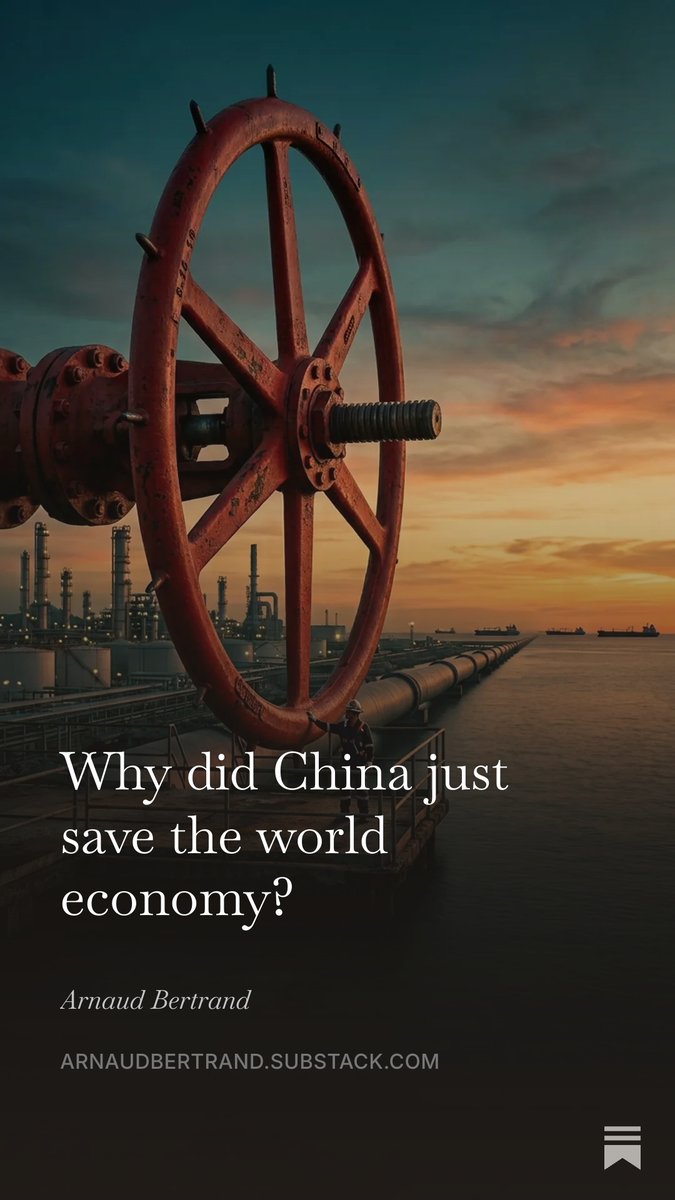
This is one of the biggest geopolitical mysteries of the year: why did China just save the world economy?
Because, make no mistake, it absolutely did. Analysts are pretty much unanimous on this: had China not dramatically - and I mean dramatically - reduced its oil imports this year, the price of crude oil would have gone through the roof and dragged the global economy down with it.
For proof, read how Javier Blas from Bloomberg - widely recognized as one of the world’s top energy analysts - explains what China did to Jake Sullivan and Jon Finer on their podcast “The Long Game” (https://t.co/bBD8yFFUdC).
As Blas puts it, China went “from 11, 12 million barrels a day to less than 6 million barrels a day” of seaborne crude imports, and that “freed a lot of oil for other countries, particularly in Asia.” India, Japan, Korea and Southeast Asia “could buy the barrels that China was not buying.”
To be clear, China wasn’t the only factor - surging US exports and the IEA’s emergency release helped too - but it was by far the biggest: JPMorgan reckons China accounted for about 74% of the fall in global crude trade (https://t.co/JCmFXYJcfh).
So it's no exaggeration to say that it is China, first and foremost, that saved the world economy this year.
If you remember the early days of the Iran war, none of this is what was predicted. In fact some US think tankers, such as the (always horrendous) Zineb Riboua from the Hudson Institute, were even cheering the war as being “all about China… the opening act in the larger contest against China,” the moment the US would crack “the central pillar of a regional order that Beijing has assembled” (https://t.co/RaCE05TcMp).
Seven months on, what actually happened is that not only did China come out of the war unscathed economically, and strengthened strategically, it also ended up shielding the world economy, America’s included, from the fallout of the very war that was supposed to be its undoing.
Breaking news: if you do something that’s supposed to be a “blow” to someone else - some sort of 3D chess move to gain the upper hand - and they end up having to rescue you from the fallout, maybe it wasn’t such a brilliant strategic move after all.
So how did China pull it off? And, more intriguingly, why did it choose to rescue countries, including the US, from a war that Washington’s own hawks were openly selling as a strike against China itself?
And why do this when it effectively dampened Iran's leverage considerably, even though they're supposed to be China's "ally" (which, as we'll see, is false)?
This is the topic of my latest article. I went very deep researching all the Chinese sources I could find on this, looking at the exact legal mechanisms, and at what officials, oil refiners and state media actually said.
The answer turns out to be far stranger than I expected: no-one in Beijing actually ever ordered an import cut. China, effectively, seems to have saved the world economy incidentally, as a by-product of its own domestic policy to protect Chinese consumers.
Which is the real story here: China has become so large and so important it can just rescue the world economy as a mere side effect.
In fact what I discovered, hilariously, is that the Chinese were just as surprised as anyone else: it’s only weeks after Western media started crediting China with saving the world economy that Chinese media picked up the story. And even then, CCTV’s first take in July (https://t.co/xLPyaJeZnT) presented it as something 外媒称 (wàiméi chēng, “foreign media claim”) 🤣
Almost like a giant suddenly waking up to its own powers. Because, that's the thing: intentions fade, consequences stay. Intentional or not, as Igor Sechin, the head of Rosneft, Russia’s largest oil company, put it (https://t.co/ckinOaHzJ7), the consequence is that it's now China, not OPEC, who calls the shots on global energy markets.
The valve of global oil pricing is now in Shandong, not in Zhongdong anymore (Zhongdong, 中东, is the Middle East in Chinese).
Full article here, with how China’s 20-year strategic nightmare, the “Malacca dilemma”, has now effectively become its leverage over the rest of the world: https://t.co/HsxPLJp45X
Essa foto é de agora às 16h, já no aeroporto de Guarulhos, a caminho de Brasília. Tenho muito orgulho do caminho que escolhi e construí na minha vida. Ser deportado, em razão das minhas críticas políticas, por um governo de narcos, pedófilos, ladrões de criptomoeda e agressores de aposentados é praticamente um troféu para mim.
No Brasil (ainda) tem democracia, mas estamos em sério risco de virar uma Argentina. Vamo que vamo!
This guy built a squirrel city with over 1,000 homes, complete with cameras to capture what they get up to
including hugging and “kissing” their loved ones in the privacy of their own homes.
Simultaneous protests in France, Spain and Brazil are no coincidence.
The people are sick of the billionaires and their greed, exactly as they were sick of their Kings a few centuries ago.
No los quiero amargar, pero lo que el BCRA perdió especulando con el oro (USD 1.023 millones, según la AGN) equivale a casi 12 años de todas las becas del CONICET. O a 2,4 años del presupuesto completo del organismo.