Super Mario Bros. 3 is packed full of secrets.
As a kid, I was stumped by the blocks at the beginning of 5-1 forever. It wasn't until I saw the pipe on a map in Nintendo Power where I realized there had to be enough room to fly there.
The P-Wing is much easier to use of course.
I think it's fair to say that all boys growing up in the 80s went through a serious ninja phase at some point.
Games like Shinobi from 1987 fit that sentiment perfectly. Top notch game but also notoriously tough (borderline infair).
So, were you a ninja back then?
All this talk about Pat Murphy got me reminiscing about a time when managers actually made strategic decisions and could impact a game. For example ...
On Opening Day 1997, the Red Sox trailed the Angels by a 5-2 score entering the ninth. Angels manager Terry Collins brought in closer Troy Percival, who struck out the first two batters of the inning. Percival then started having control problems and allowed a double, walk and infield single to load the bases. He then walked two more to force in a pair of runs and make the score 5-4.
Before the walk that made it 5-4, left-handed pinch-hitter Troy O'Leary was in the on-deck circle, ready to bat in place of the right-handed Rudy Pemberton. (Percival was right-handed; O'Leary and Pemberton were starting the season as a platoon.) But when he saw that Percival was wild, then-Red Sox manager Jimy Williams feared that Collins would remove Percival from the game if he sent O'Leary to the plate.
So what did Williams do? He defied the matchups and pulled O'Leary back into the dugout, sending Pemberton back into the on-deck circle. When Percival completed the walk to make it 5-4, Collins left his closer in the game and Pemberton batted. Here's what happened. (Hint, the Red Sox won the game, 6-5, largely because O'Leary was available to hit against a right-hander, Pep Harris, who came on after after Pemberton tied the score.)
Today, this would never happen.
Rewatching this final scene of Star Trek: The Next Generation today hurts.
The world in which this show existed feels long gone.
Every week we watched on “network TV” a strong and virtuous male leader be celebrated.
We grappled with real philosophical questions without cynicism. We laughed without being “irony poisoned.”
We celebrated men and women working together in complementary collaboration—not in zero-sum competition.
That world feels gone, but it doesn’t have to be.
Most of us still hold these values.
We can tell stories like this again.
In my original D&D campaign (1974-77), one of the dungeonmasters decided he wanted an all-evil campaign. We figured out XP and advancement for kobolds, goblins, orcs, hobgoblins, and gnolls. Everyone's first character was a gnoll. But if you got killed, your next character was only a hobgoblin, which was objectively inferior (getting only 1+1 hit dice per level, instead of 2 like a gnoll). Then if you died again, you had to be an orc. And so forth till you bottomed out at kobold.
This meant that players who'd survived longer not only had higher level characters, but a big hit dice advantage. A 6th level hobgoblin had 6+6 hit dice. A 6th level goblin had 6 MINUS-6 hit dice. Ugh.
Since everyone was evil, we mercilessly bullied each other. When it got too bad, the weaker characters banded together against the strong ones. Despite the fact we were all fighters (the only character class available to goblinoids, or "giant class" humanoids as the original book categorized them), we got to a decently high level. It helped that we all had darkvision and could open every dungeon door automatically (says so in the rules), and we could talk to most of the monsters in the dungeon.
The campaign ended when after a heated fight, we found a suit of +5 magic plate armor. Naturally, the highest-ranking player, a 13th level Hobgoblin, claimed it for himself. The entire rest of the party immediately joined together against this, because if the hobgoblin had +5 plate, he would be unstoppable and our existence would be intolerable. Basically, he'd take ALL the treasure from now on.
So began the final battle. The 13th level hobgoblin vs. everyone else. I think the next-highest level was a 9th level orc (not me). The weakest was a 4th level kobold. Anyway the hobgoblin rationally focussed on killing the lower-level enemies first, because all of us did the same damage when we hit, so killing us reduced his incoming damage.
Pretty soon, everyone was dead except for the hobgoblin and the orc. The orc was almost unscathed, because the hobgoblin had been finishing off the rabble. The fight seemed pretty even. The hobgoblin had fewer hit points by then, but he had a better THAC0.
Well, the fight had been going on for 30 combat rounds when the gamemaster rolled for a random encounter (once every 10 rounds, like it says in the book) and got one. A gigantic hydra walked into the room. Our then house-rules for hydras made them specially deadly, and only if both surviving fighters teamed up would they have a chance against it.
They looked at each other. Then they looked at the hydra. Then back at each other. All in real time you understand. Then they literally shrugged, and went back to bashing each other. The hydra was in its glory, randomly striking at both opponents while being mainly ignored.
Both characters died. It was glorious, and we did not start up the "evil" campaign again, because it had ended perfectly.
True story from the dark ages of D&D.
The Konami Kukeiha (Square Wave) Club continues to impress me with every single game I look into.
In Castlevania Chronicles for the PSX, holding down R1+L1 while selecting the Original Mode brings up an option to select between three synth modules.
The Roland CM-32L and SC-55 were released in 1989 and 1991 respectively.
They were external sound modules that users would connect to their Sharp X68000 or other computers to increase the sound experience in a number of ways over the original FM Synthesizer.
Konami went the extra mile and not only made sure everything sounded good on the newer hardware, they re-arranged the soundtrack, such as adding an entire section with a breakdown and a bridge to Vampire Killer on the SC-55.
I absolutely love the fact that this is preserved in Chronicles. They easily could have left it out and saved themselves some work, but I know many fans appreciated the effort.
I think I'll continue my playthrough with the SC-55 on the left for now. On the right is the vanilla Yamaha FM Synthesizer which has such a great, classic sound that I do adore too.
It's pretty incredible to have basically 4 different versions to play. The original, 2 sound modules, and then Sota Fujimori's PSX arrangements.
The Konami Kukeiha Club were absolute masters of the retro game music and their passion is inspiring. #13DaysOfHalloween
The version of the Ghosts 'n Goblins Graveyard theme in Mega Man 7 is fantastic. You hear it by holding B while choosing Shade Man before beating him.
It's a shame replacing one of the best tracks in the game, but it's still a fun nod to their spooky franchise #13DaysOfHalloween
Full Mario 64 in Mixed Reality! Running in real 3D (no stereoscopic crap) natively at 90FPS and also running on my desk! 😋
Again, Opus 5.5 + PICO CLI combo made it quite straightforward.
Such a bliss to play an oldie at 90 FPS in 3D.
Disclaimer: I own an original physical copy of Mario 64. This project is not associated with Nintendo or PICO.
One of the best early-80s games ever is Choplifter, developed in a solo effort by Dan Gorlin and published by Broderbund in 1982. It also became one of the best selling games ever for the Apple II.
The game simulated realistic helicopter flight behaviour with inertia, gravity, lift, drag, and momentum, resulting in the chopper feeling "sloppy and unstable" like a real one, yet remained playable after Broderbund helped tune it down from an overly realistic (and probably too frustrating) simulator. For 1982-standards this was extremely innovative and mindblowingly awesome.
My earliest memory of Choplifter was at a friend's house. He had a C64 on which we played the game into dust. It was literally the only game we played for months.
We had a handrittwen Highscore list which was updated after each session, signed by all players present when we played it (yes, we were indeed very nerdy). One simple rule was that highscores only counted when at least one other person was present and signed it off. I wished that list was still around.
Shadowgate is such a favorite of mine from the NES growing up.
The castle's puzzles are ruthless, but it only takes as long as you need to read the incredible death scenes before jumping right back in.
I'll always remember learning about torches the hard way. #13DaysOfHalloween
Still one of the best beat 'em ups I've ever played, especially in two-player co-op mode.
This legend is closing in on 40 years and still makes my gamer heart beat a little faster. Picking up the dropped weapons was such a blast!
Double Dragon (1987, Technos Japan).
The good old days of CGA.
Alley Cat (1984 by Synapse Software) feels exactly like some programmer had a wild late-night coding session on too much coffee (or whatever they had back then) and just let the surreal vibes flow.
That limited 4-color palette (black, cyan, magenta, white) turns the whole thing into a piece of art... well, it's an acquired taste, I suppose. Add to that the squeaky PC speaker sound and you got yourself a game!
You're Freddy the alley cat, jumping bins, dodging dogs, climbing fences, then breaking into people's apartments to knock over vases, eat fish, and court Felicia while Cupid shoots arrows at you.
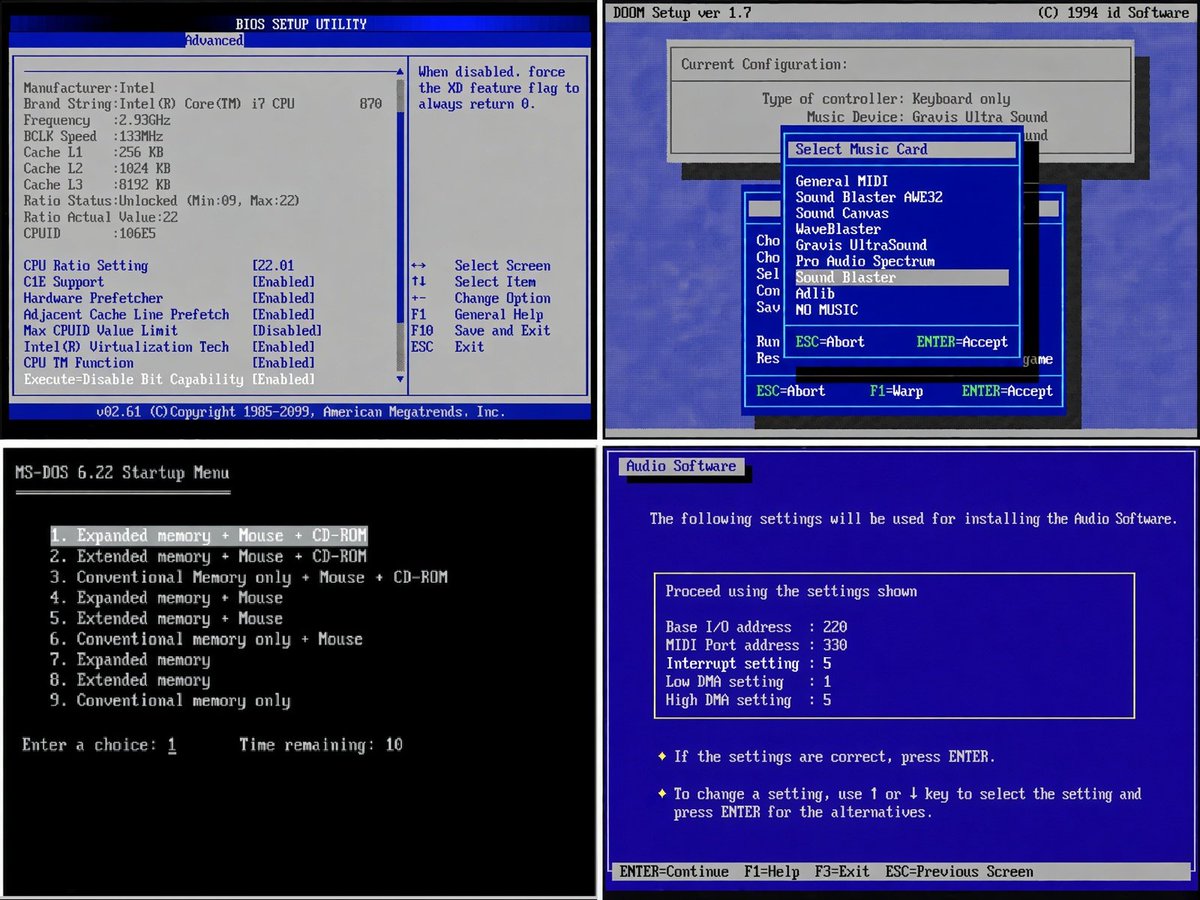
We've come a long way.
Gamers today click "Install," wait a little while, and then hit the "Play Game" button. Technical skill required: zero.
Gamers in the 1990s needed a PhD in computer science, mastery of hardware and software configuration, willpower, patience, BIOS knowledge, boot disks, base memory management skills, and insane amounts of trial and error - just to run a single game.
Show this to anyone under 35 and they'll think you were a wizard... and maybe you were!
All three of the Castlevania games on the NES have versions with improved sound in Japan.
While 3 utilized a chip installed in the cartridge, the others released for the Famicom Disk System that had an additional sound channel.
This is the original Bloody Tears #13DaysOfHalloween
The hype for Street Fighter II on the Super Nintendo/Super Famicom in 1992 was unlike anything the gaming industry had seen before.
The "impossible" port: before July 1992, playing a major arcade hit at home usually meant a compromised, stripped-down home port. When Street Fighter II: The World Warrior was announced for the SNES, the idea that an arcade game of that scope could run at home felt like witchcraft.
Magazines like EGM built massive anticipation with cover features and deep dives into the 16-megabit cartridge, the largest and most powerful SNES cartridge of its time.
Costing US$79.99 at launch (roughly US$175 adjusted for inflation), but millions of players didn't hesitate to pay for it. In fact, it sold over 6.3 million copies on the SNES, becoming Capcom's best-selling single software title for decades and a massive system-seller that convinced many people on my surroundings to buy a Super Nintendo.
Sega had no answer to that until September 1993, which was too late for many.
Modern games start you off with a tutorial, a gazillion hints, arrows pointing you in the right direction, and epic loot gift-wrapped after just two fights.
Meanwhile, the 90s:
Griffey 30, my mod for Ken Griffey for SNES, has just added FRANCHISE MODE.
That's right: An actual franchise mode for a 1994 SNES game. To my knowledge this has literally never existed before.
Check out the trailer and read on for the details! Play it now at giffey30 dot com.
My post about France went viral. Thousands of likes. Many Americans told me: "Democrats aren't socialists. America will never be France." I want to answer that seriously, step by step.
Start with a simple observation. Look at what has gotten cheaper in America over the last 25 years: TVs, phones, software, clothes, toys. Now look at what has exploded: college tuition, healthcare, childcare, housing.
What separates the two lists? The first lives in competitive markets. The second is exactly where government is most involved: subsidies, mandates, licensing, zoning, regulation.
College. Washington lends students almost unlimited money. Universities know the money will always come, so they raise tuition and hire more administrators. The student pays the bill for twenty years. More government money, higher prices.
Housing. Why can't a nurse buy a home in the city where she works? Not because of capitalism. Because of zoning laws, permits, environmental reviews, years of procedure to build a single building. The most expensive places to live in America are the places where it's hardest to build. When building is nearly illegal, prices explode.
Healthcare. The patient almost never sees the price. A third party pays, regulations limit who can compete, and costs climb year after year with no one able to say no.
So here is the trap. The problems you suffer from are not the failure of free markets. They are the places where the market has already been replaced by the state. And the solution you're being offered is more of the same.
That's the Trojan horse. It always works the same way. A real problem. A generous-sounding promise. A program that makes things worse. Then the failure of that program becomes the argument for the next one. People who lived under communism in Poland learned to recognize the lie and the mask the lie wears. The lie never presents itself as a lie. It presents itself as compassion.
In France we are at the end of that road. Debt we can never repay. Young people who can't afford a home. Our best people leaving. And every few years our cities burn. Nobody voted for this. They voted for one more generous promise, fifty years in a row.
If you're a Republican, share this with the Democrat in your life. Not to win an argument. To start a conversation.
If you're a Democrat, I'm not asking you to switch teams. I'm asking you to look at the pattern. Wherever the state took over, life became unaffordable. Don't fix the failures of government with more government.
Stay American. Ask for less state, not more.