Luego de leer todos los argumentos y opiniones a favor y en contra de la iA me queda claro algo.
La iA es un multiplicador; volverá más tontos a los tontos, más supersticiosos a los supersticiosos, mas flojos a los flojos y más inteligentes a los inteligentes. 😬
A 22-year-old graduate student in Kazakhstan got so angry at journal paywalls in 2011 that she built a pirate website holding 88 million scientific papers, and last month she turned the whole thing into an AI that lets you ask one question and get the actual research as the answer.
Her name is Alexandra Elbakyan, and the website is called Sci-Hub.
The AI she just launched is called Sci-Bot. It lives at https://t.co/6w0IBtOEYB and almost nobody outside academia knows it exists yet.
Here is the story, because it is one of the strangest things to happen in science publishing in the last 50 years.
Elbakyan was born in Almaty in 1988, the year the Soviet Union started to collapse. She taught herself programming at 12. She read Soviet science books that explained things her family used to call miracles. She got into computer security at university and graduated in 2009 with a degree she barely needed because by then she was already a serious hacker.
Alexandra moved to Moscow that fall. Then Germany. Then a research internship in the United States. She was working on brain-computer interfaces, the kind of research that requires you to read hundreds of papers a year just to keep up with the field.
And every single one of those papers was locked behind a journal paywall that cost between 30 and 50 dollars to read once.
She did the math. A graduate student in Kazakhstan could not afford to read science.
The first thing she did was learn how to get around the paywalls one paper at a time. She passed the trick around to other students. They asked her for papers constantly. She got tired of doing it manually.
So in September 2011, in three days, she wrote a script that automated the whole thing. A user pastes a DOI. The script logs in through a donated institutional credential. The paper comes back free. The website caches it.
The next person who asks for that paper gets it instantly because the previous request already saved a copy.
That was Sci-Hub. Three days of code. One graduate student. Done.
15 years later, the cache holds 88 million scientific papers. Almost every piece of scholarly literature published before 2020 is sitting on her servers. Researchers in 190 countries use it. Studies in Nature have shown that roughly half of all academic paper downloads worldwide now go through Sci-Hub, not the publishers who actually own the copyrights.
Elsevier sued her in 2015 and won a 15 million dollar judgment. She did not pay. The American Chemical Society sued her and won an injunction. She did not comply. Courts in India, France, Russia, and the UK have tried to block the domain. She just moves it. https://t.co/3sAWJzNe8I. https://t.co/tGIETesZ8i. https://t.co/H5WQ1f9lqR. The site has had over 20 domains and is still up.
Nature put her on its list of the 10 people who mattered most to science in 2016. The New York Times compared her to Edward Snowden. The Verge called her the pirate queen of science.
She has not been to the United States in over a decade because she would be arrested at the airport.
The Sci-Bot launch in April 2026 is the part that nobody is talking about.
She took the 88 million paper database and put a small language model on top of it. You ask a question in plain English. The model searches the entire shadow library, pulls the relevant papers, synthesizes an answer grounded in real citations, and links you to the full text of every source. Free. No login. No institutional credential. No paywall.
Three real scientists tested it for a Chemical and Engineering News article last month. They asked it medical and chemistry questions. The radiologist said the answer he got was usable. The chemist said the gaps in recent literature were obvious but the older science was solid. The publisher community is furious.
What she built is what the paid academic AI tools are trying to build. Except the paid ones are limited to what their parent publisher legally owns. Hers is limited to almost nothing.
Alexandra still lives somewhere in Russia. She does not give her address. She does not do video interviews. She gives talks over Skype with the camera off. She runs the largest illegal library in human history from a laptop and a donation page.
A graduate student who could not afford to read science built the system the entire scientific community now quietly depends on.
The publishers have spent a decade trying to shut her down.
She just shipped an AI that makes their entire business model outdated.
Veo a los morenistas muy molestos porque la malvada de @MaruCampos_G no dejó pasar a los manifestantes.
Pobrecitos… vienen desde Oaxaca, Guerrero y otros lugares a más de 1,000 km de Chihuahua, y la gobernadora no entendió que sus decisiones deben tomarse pensando primero en quienes vienen a hacer desmadre desde otros estados.
Qué terrible autoritarismo.
Imagínate gobernar Chihuahua… priorizando a los chihuahuenses.
A mamarla, morenacos.
Esta vez sí se toparon con pared en sus porquerías.
AMLO consiguió 30 millones de votos después de 18 años de estar jode y jode con que quería una oportunidad.
Sheinbaum, anómalamente, superó ese récord histórico por el puro hecho de ser “presidenta con A”… extraño, ¿no?
Ahora que comienzan las investigaciones del involucramiento del narco en las elecciones ese “fenómeno” tan atípico podría tener otras explicaciones.
Me sumo a la advertencia: Sci-Hub ha pirateado más de 85 millones de artículos de investigación y ahora encima han añadido un bot que responde preguntas utilizando artículos completos y recientes.
Esto es un escándalo. Dejo el enlace abajo para que sepas cómo evitarlo.
Mexico is the absolute outlier in the OECD: workers log the most hours on Earth (~2,200+ annually) yet deliver relatively little economic output per hour—despite huge advantages like proximity to the USA.
Something went seriously wrong.
My take: the education system.
Even grads from top STEM unis often have shockingly weak fundamentals (based on interviews).
Sure, brilliant Mexicans exist, but the system fails the average citizen badly.
Work smarter, not longer.
Fix education → unlock potential.
Study math, just ask Peru 🇵🇪
They pray five times a day
Then they rape our women and children
They torture and sodomized our men
And right before dawn and before their morning call to prayer, they execute our teenagers.
This is not a religion. It’s a sick twisted ideology that only minions of the devil believe in.
There is no hell hot enough for these monsters.
Charged with: Enmity against God
Real crime: Standing up to theocracy
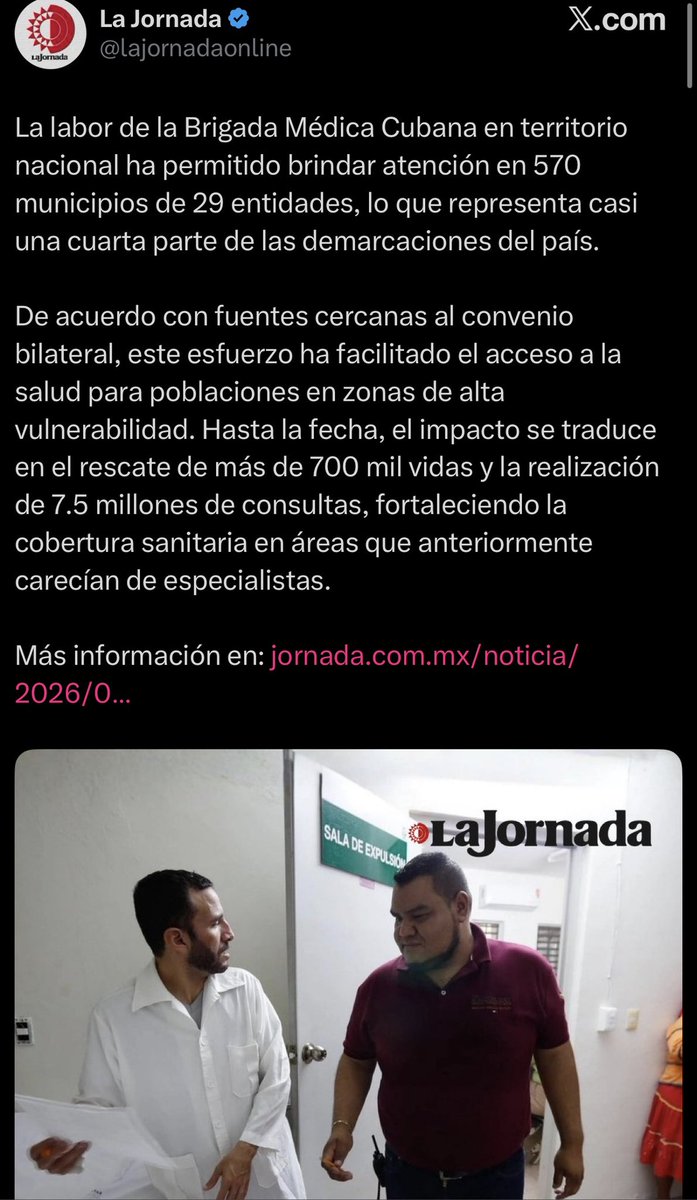
Gracias @LaJornadaOnline por los datos.
• 3,700 médicos cubanos
• 7.5 millones de consultas
Eso equivale a ~2 consultas por médico al día.
En el IMSS, cualquier médico atiende 15–25 pacientes diarios.
Entonces algo no cuadra:
o las cifras están infladas… o la productividad es ridículamente baja.
Y todo esto nos costó aproximadamente:
• $2,019 millones en contratos
• $2,004 millones en hospedaje, comida y transporte
¿Logro… o propaganda?